Inspiration
The trucking industry is the backbone of the economy, yet small and mid-sized fleets still operate with outdated tools. Dispatchers manage complex logistics using phone calls, spreadsheets, and intuition.
When we analyzed the problem, one insight stood out:
Small fleets are making million-dollar decisions with zero intelligence support.
At the same time, Trucker Path already serves more than 1 million drivers, providing navigation, fuel, and routing data. However, it lacks a true decision-making layer.
This inspired us to build FleetIQ, an AI-powered intelligence layer that transforms how fleets operate without requiring new infrastructure or behavior change.
What it does
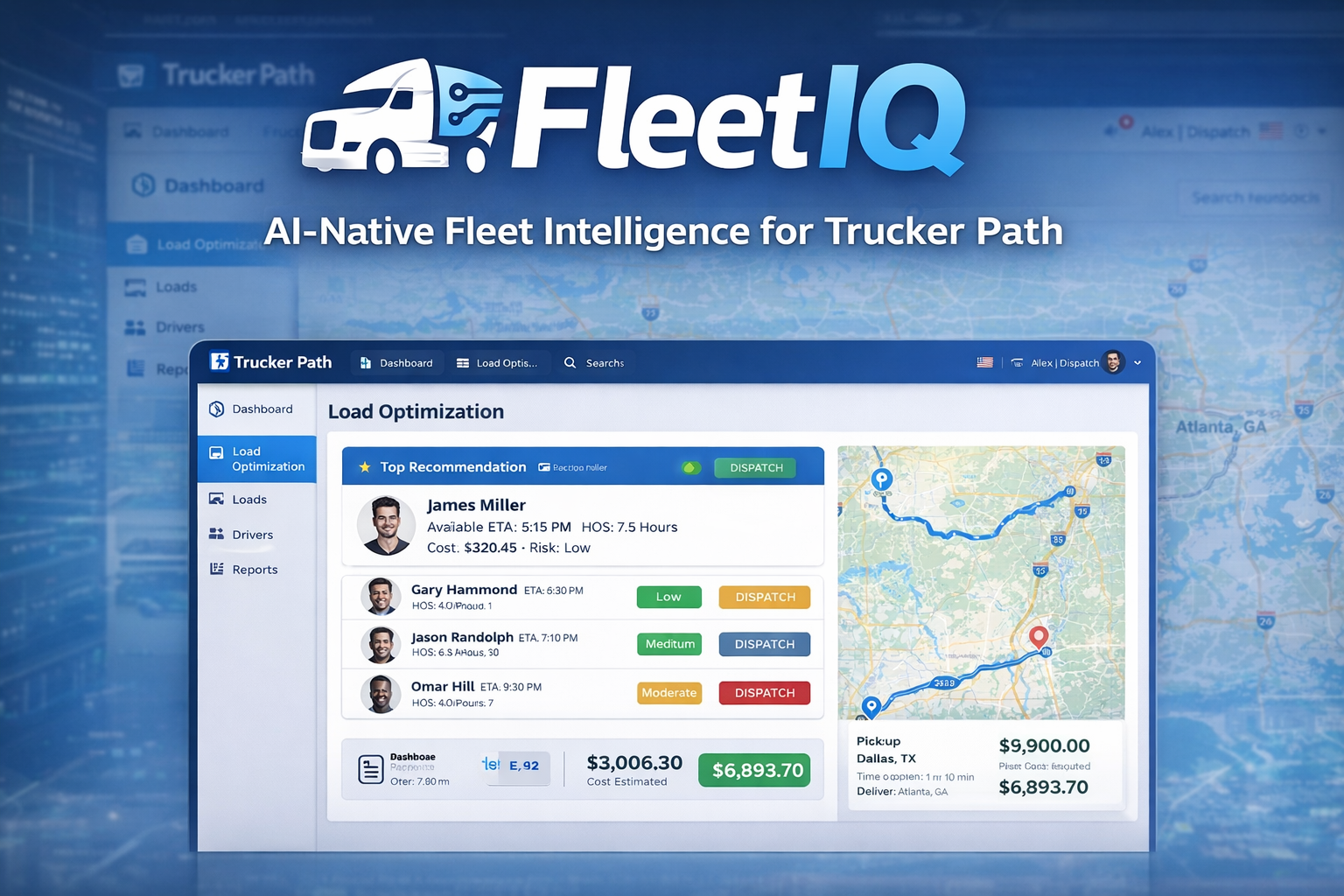
FleetIQ is an AI-assisted dispatch system that helps fleet operators make faster, smarter, and more profitable decisions.
Instead of manually checking:
driver location Hours of Service (HOS) fuel costs route efficiency
FleetIQ performs these evaluations instantly.
How it works:
A load is entered into the system FleetIQ evaluates all available drivers Each driver is scored based on: proximity (deadhead miles) HOS feasibility estimated cost delivery risk The system recommends the best driver The dispatcher approves the recommendation The driver receives and accepts the load
What previously took 15 to 30 minutes can now be completed in secon
How we built it
We developed FleetIQ as a working prototype using Trucker Path APIs, building it as a separate web application to demonstrate the core intelligence layer and end-to-end workflow.
Our long-term vision is to integrate FleetIQ directly into Trucker Path’s existing web dashboard (Command) and mobile app, allowing it to function as a native feature within the current ecosystem.
Core components:
Decision Engine that ranks drivers using weighted scoring based on distance, HOS, cost, and risk Risk Prediction Layer that estimates delivery delays and compliance risks Cost Modeling that calculates cost per mile and deadhead impact User Interface simulation demonstrating the dispatcher to driver workflow
Data sources (simulated and API-driven):
GPS location data HOS data from ELD systems fuel pricing data load and route data
Building the prototype as a standalone system allowed us to focus on developing and validating the intelligence layer. The intended production version would be embedded directly into Trucker Path, requiring no new app, no data migration, and no change in user behavior.
Challenges we ran into
Balancing automation with real-world operations Fully autonomous dispatch is not practical. Dispatchers require control, and drivers require flexibility. We addressed this by designing a human-in-the-loop system.
Defining the role of AI Many dispatch problems can be solved with rules and scoring. We incorporated prediction, decision support, and explainability to make the system truly intelligent.
Ensuring practical usability We focused on zero training, no additional applications, and seamless integration into existing workflows.
Designing for go-to-market viability We aligned the solution with existing Trucker Path users, in-app distribution, and a scalable SaaS model.
Accomplishments that we're proud of
We built a solution that addresses most of the problems truckers face, a working prototype, and a go-to-market strategy.
What we learned
We learned that the main challenge in trucking is not lack of data, but the absence of systems that turn data into actionable decisions. Small and mid-sized fleets do not need more tools, they need simpler and smarter workflows that reduce manual effort. We also found that effective AI in this space relies more on optimization, prediction, and clear explanations than complex models. Keeping humans in the loop is essential, as dispatchers need control and flexibility in real-world operations. Finally, integrating directly into an existing platform like Trucker Path is critical for fast adoption and real-world impact.
What's next for FleetIQ
Our next step is to integrate FleetIQ directly into Trucker Path’s existing web and mobile platforms, moving from a standalone prototype to a native feature. We plan to launch a private beta with real fleets to validate performance using live GPS and ELD data. From there, we will refine our prediction and optimization models based on real-world usage and expand features such as cost intelligence and compliance monitoring. Our goal is to deploy a production-ready system within 6 to 8 months and scale across Trucker Path’s existing user base.
Built With
- css
- geminiapi
- javascript
- node.js
- python
- vscode

Log in or sign up for Devpost to join the conversation.