-
-
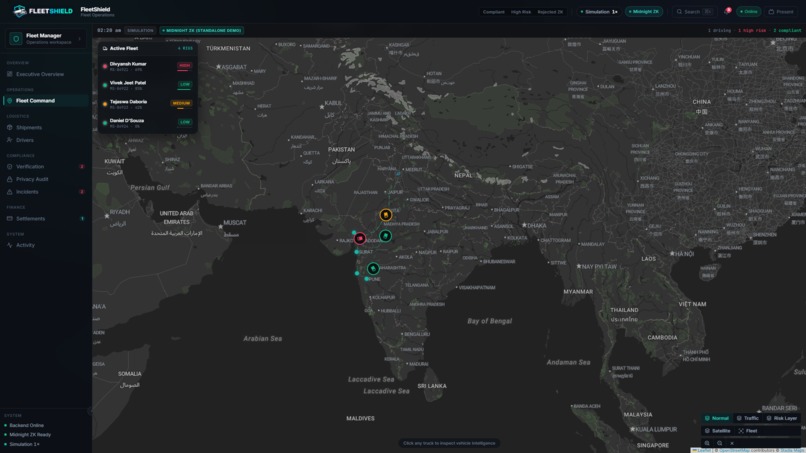
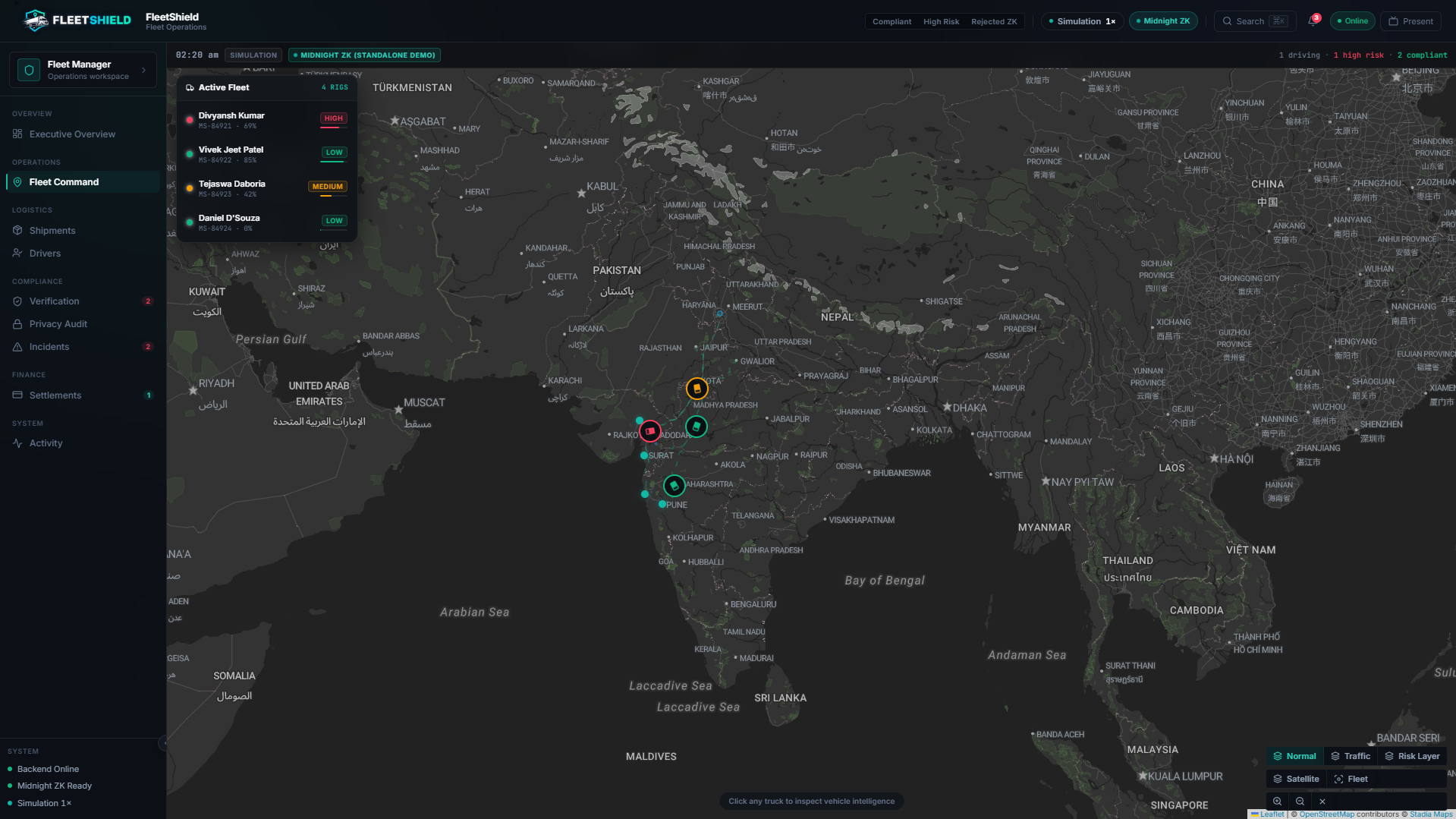
Fleet Command Map — A focused operational view for monitoring the fleet, routes, and vehicle positions.
-
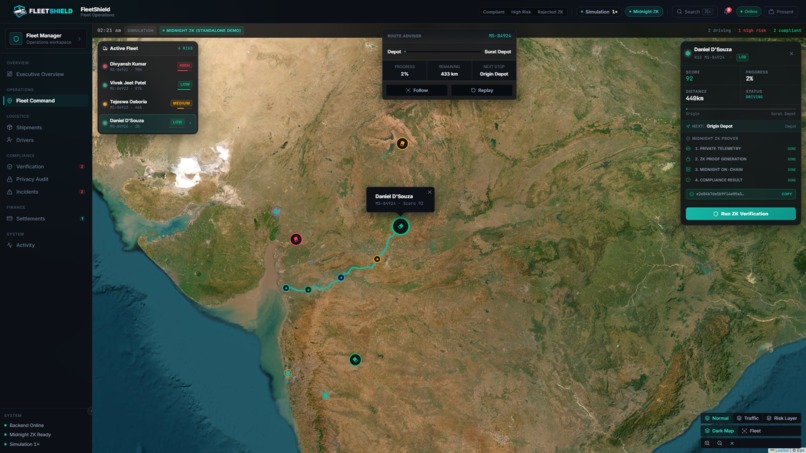
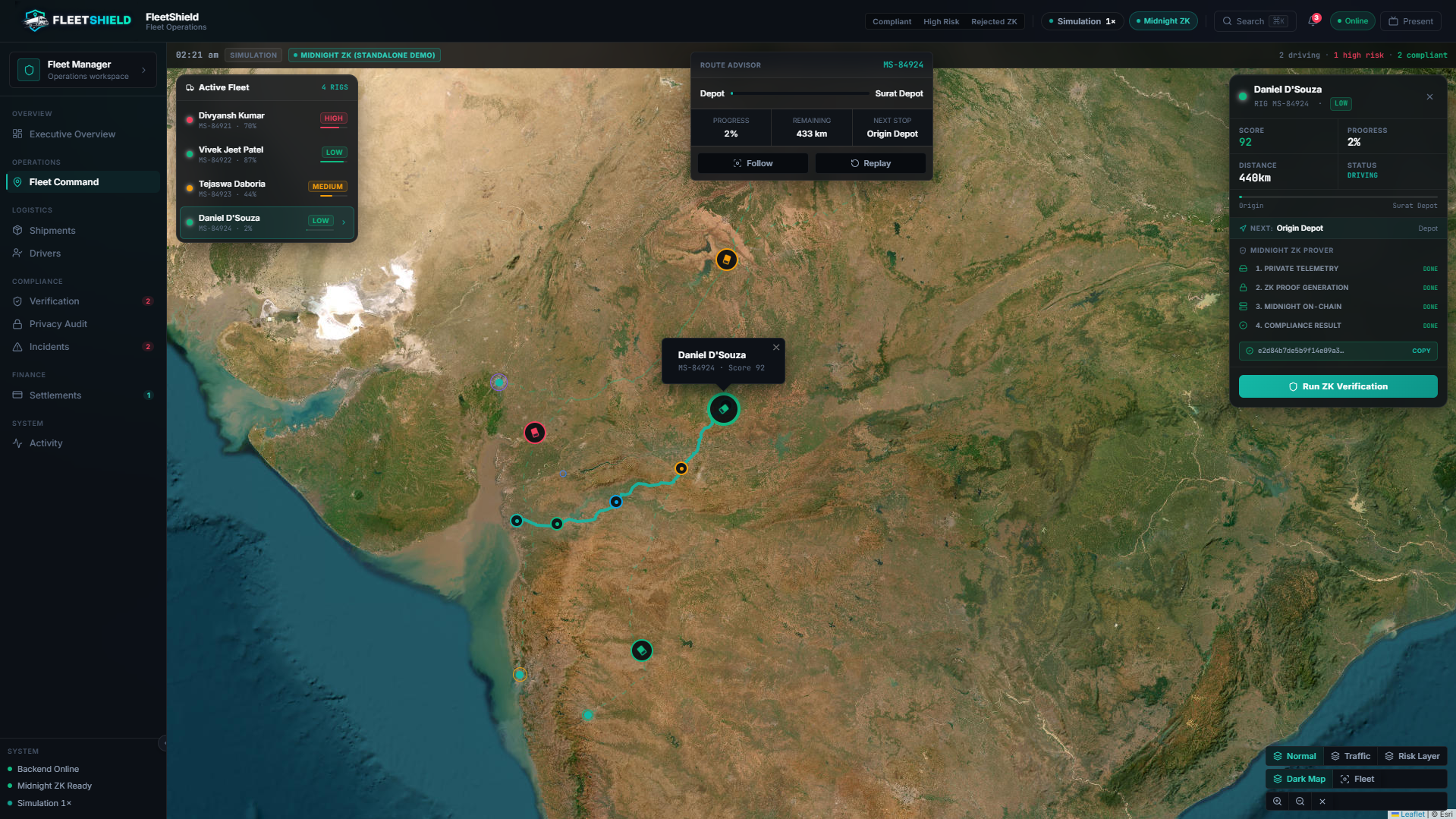
Route & Fleet Intelligence — Explore routes, vehicles, stops, and operational events using an alternate map layer.
-
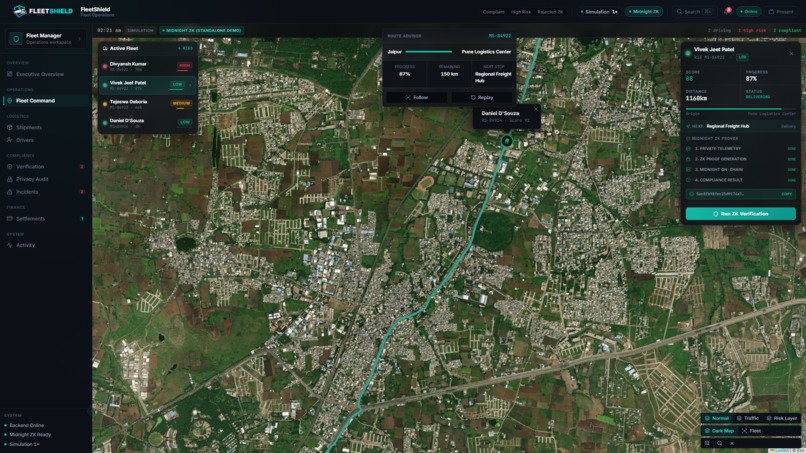
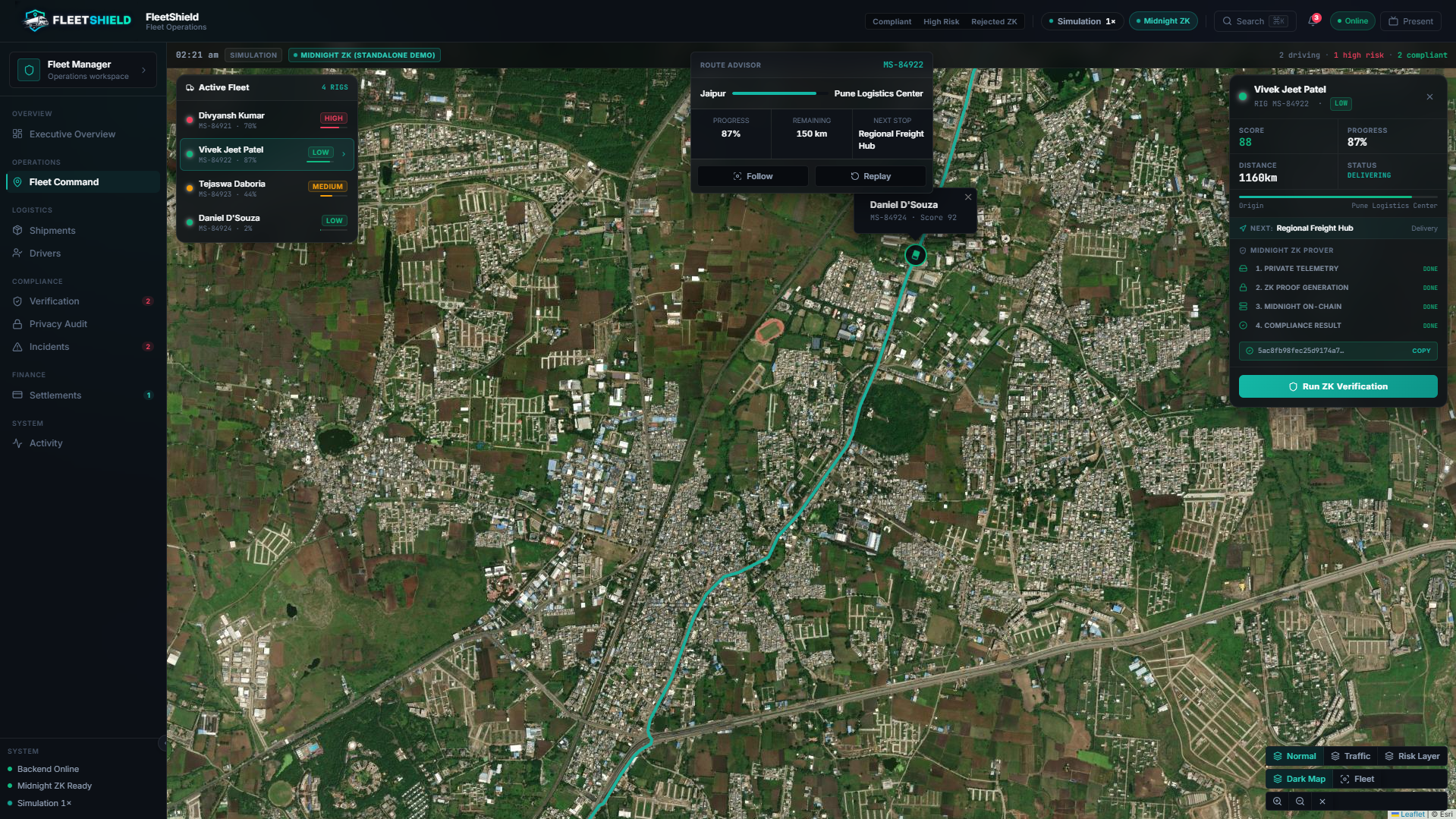
Live Fleet Command — Follow simulated fleet movement across road-based routes with vehicle and stop intelligence.
-
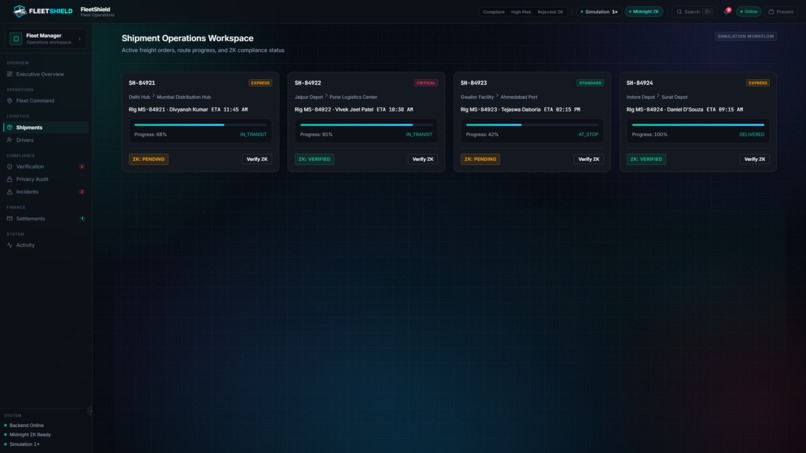
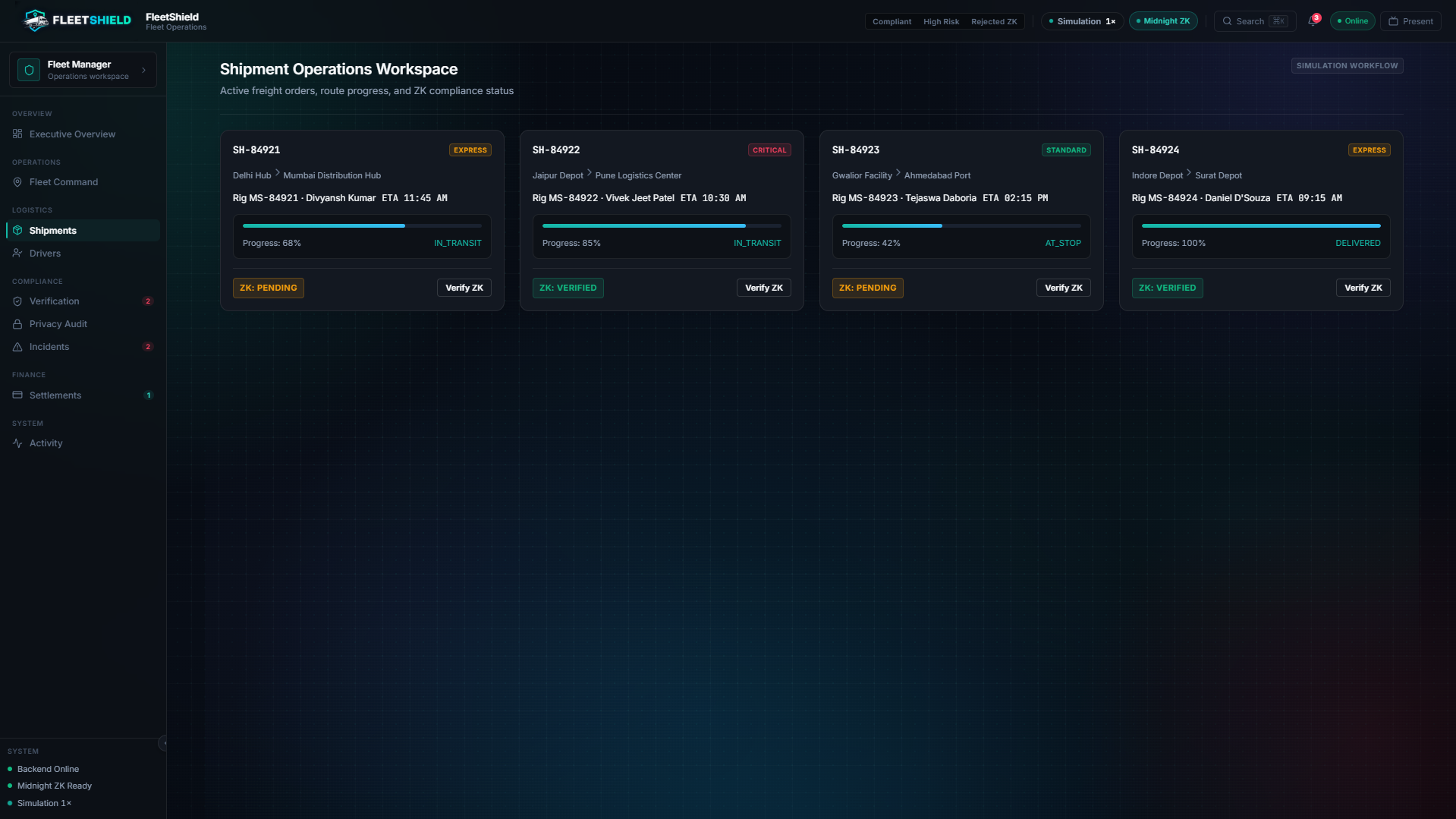
Shipment Operations — Track active freight, assigned vehicles, delivery progress, priorities, and compliance status.
-
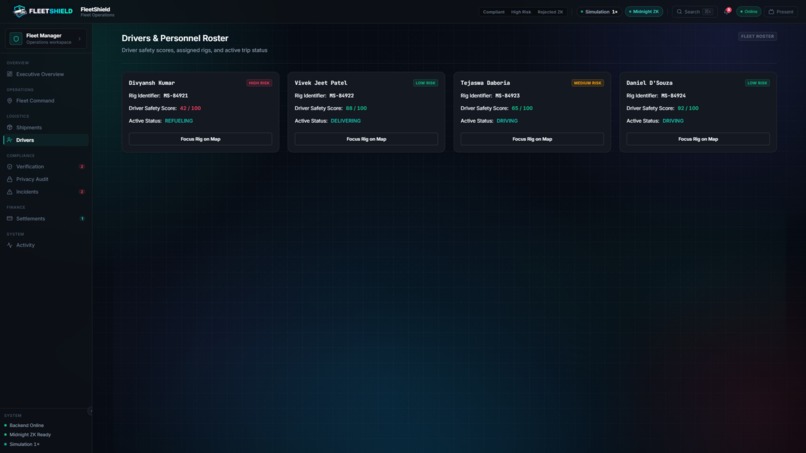
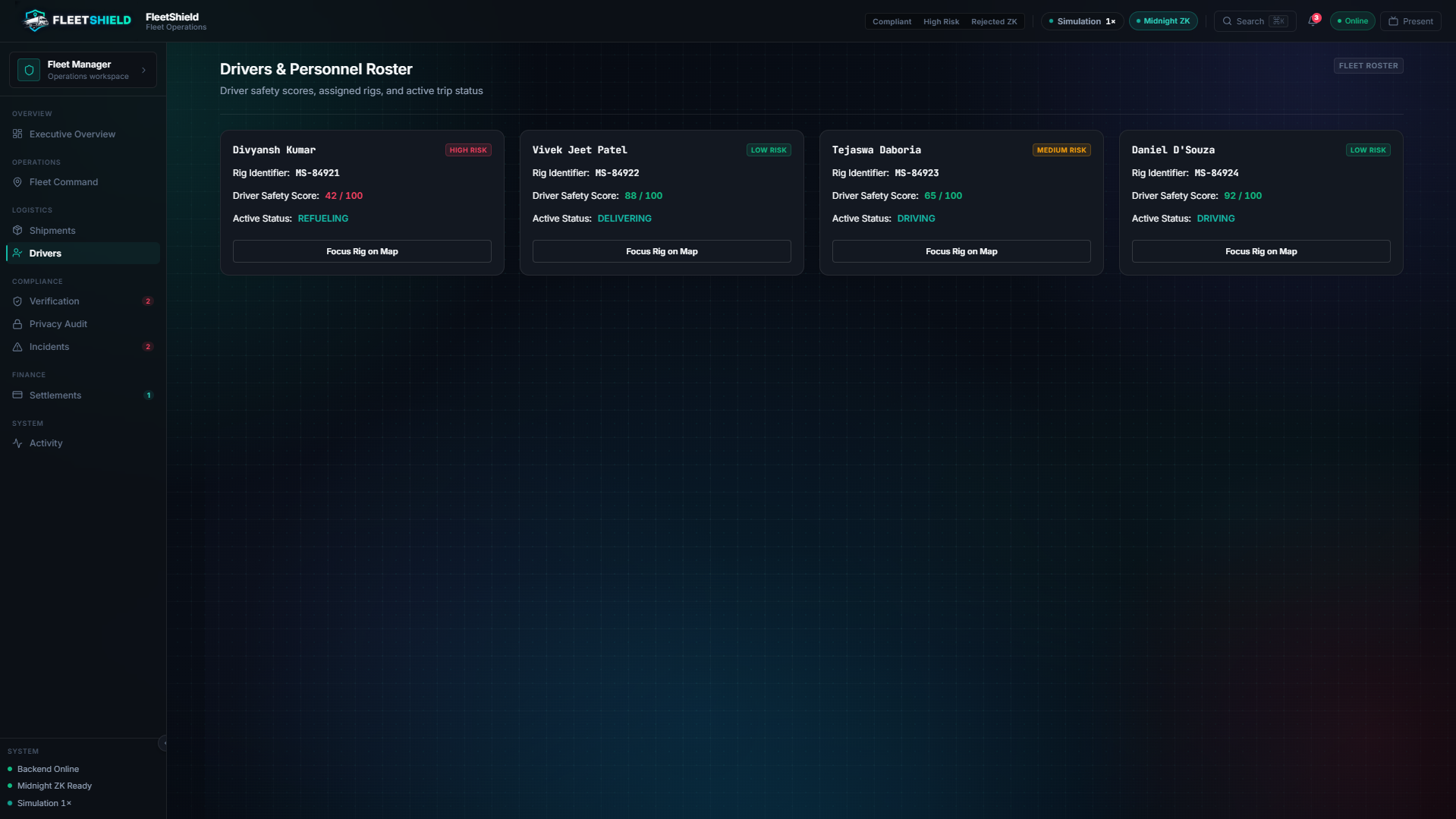
Driver Operations — Manage driver status, risk levels, assigned vehicles, and compliance history.
-
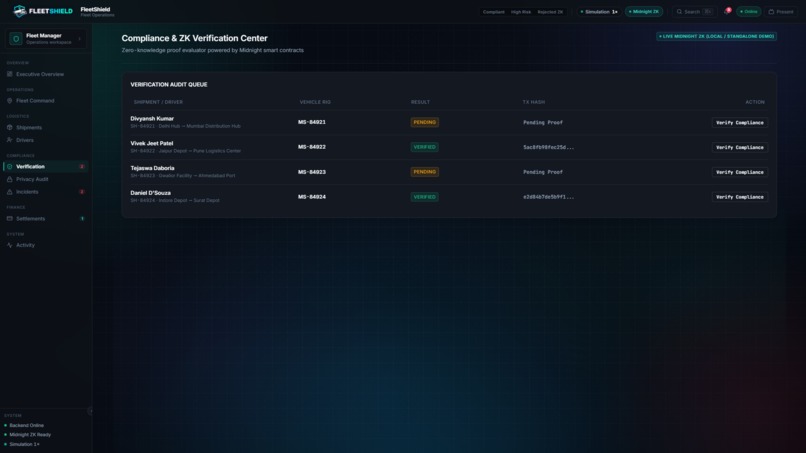
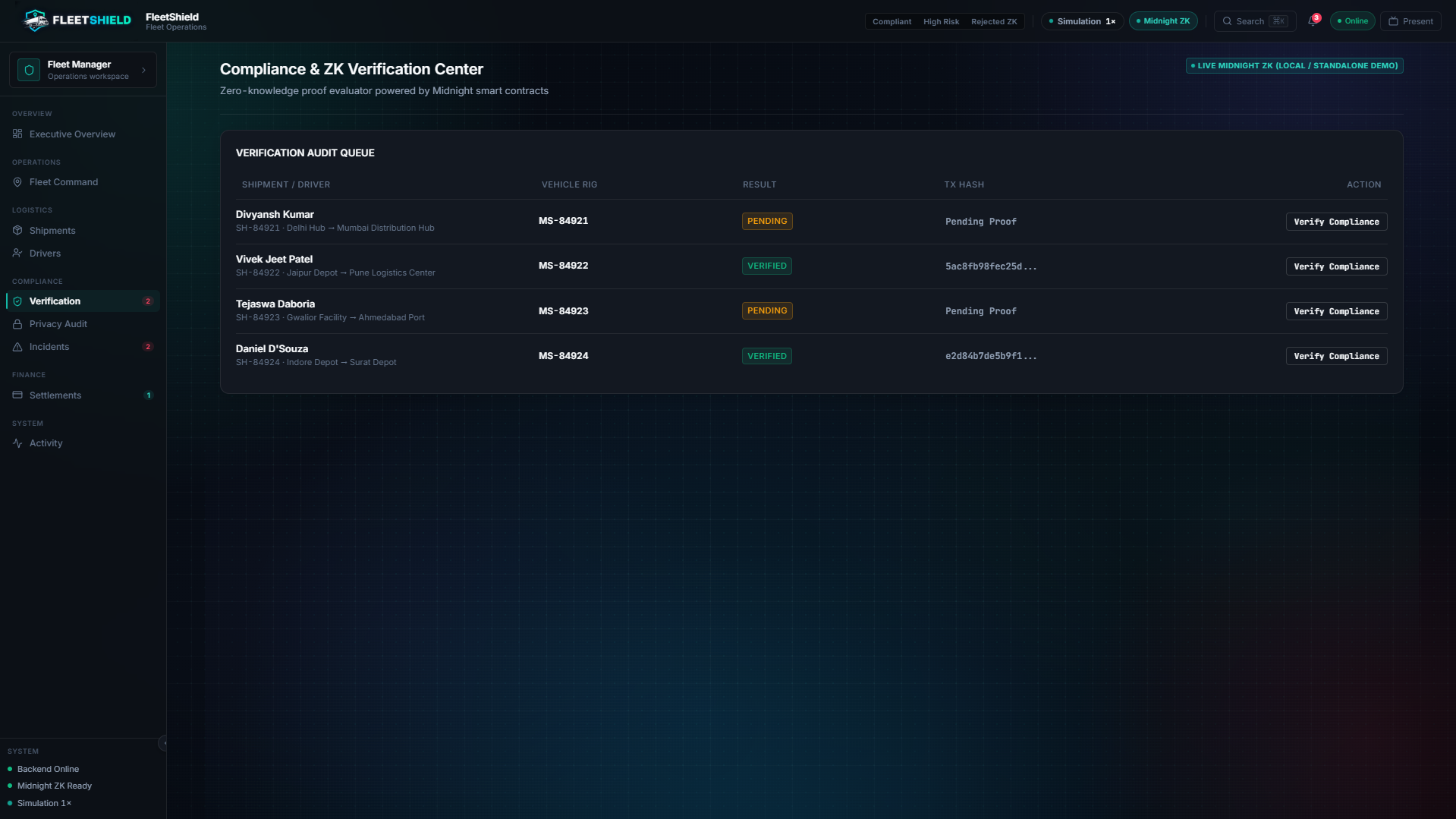
Compliance Verification — Monitor verification status across trips and trigger privacy-preserving compliance checks.
-
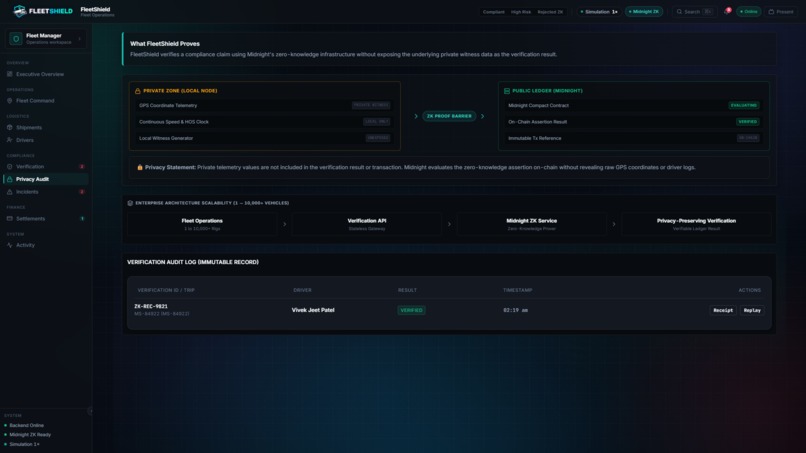
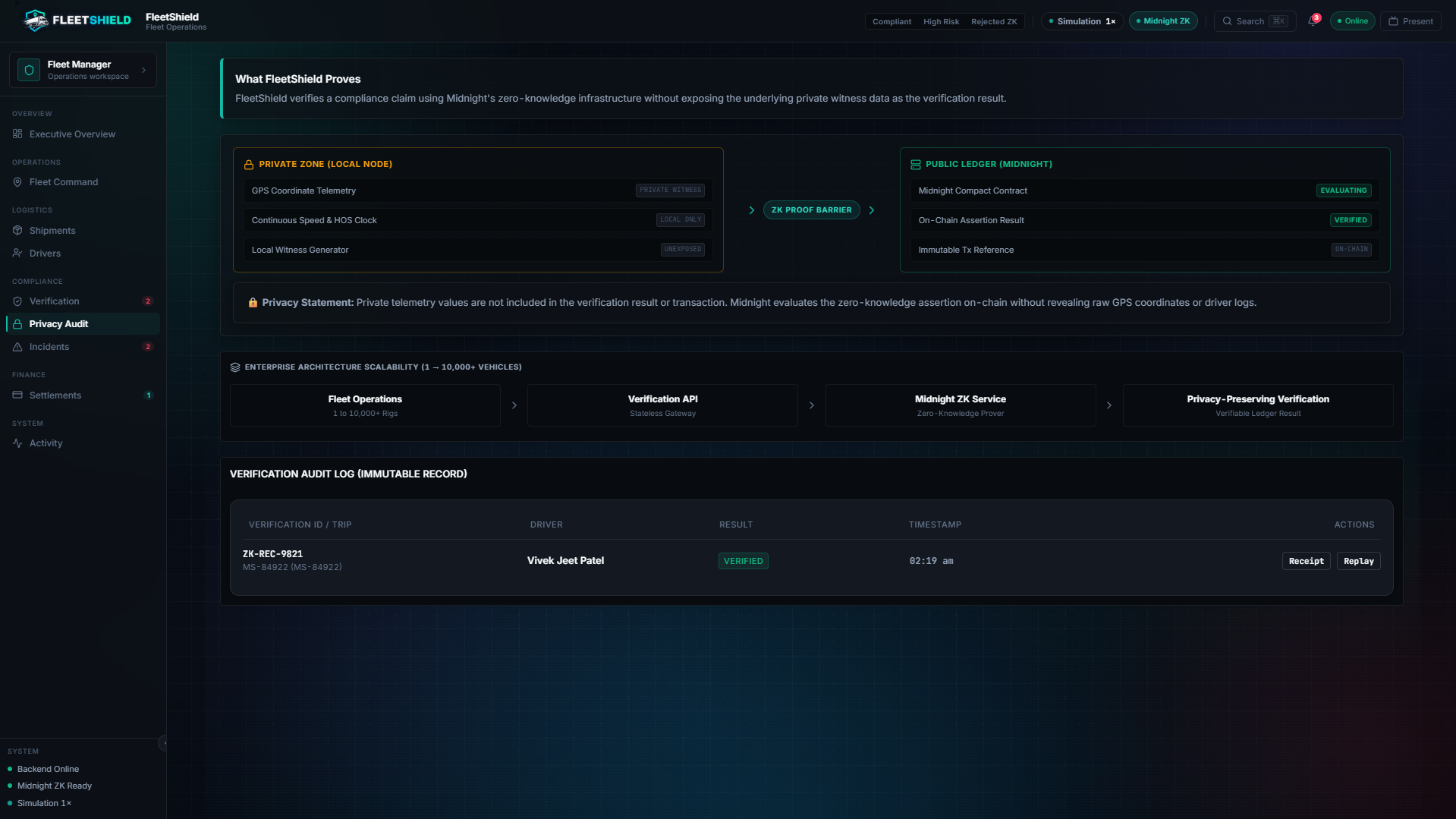
Privacy Audit Center — Visualize the boundary between private witness data and the verifiable Midnight result.
-
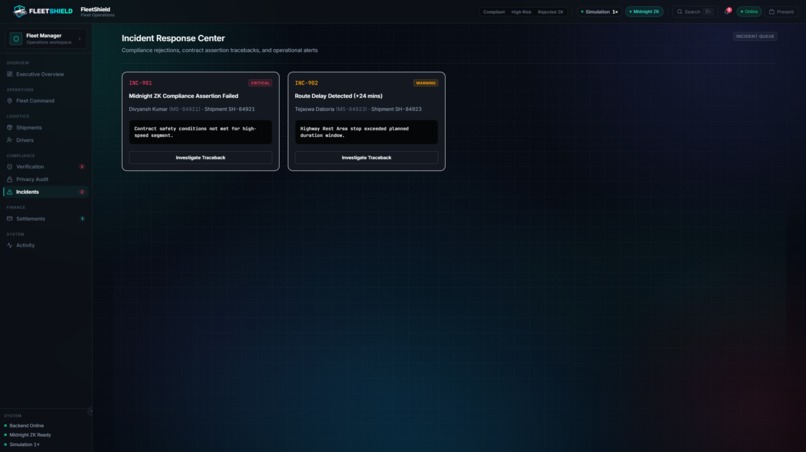
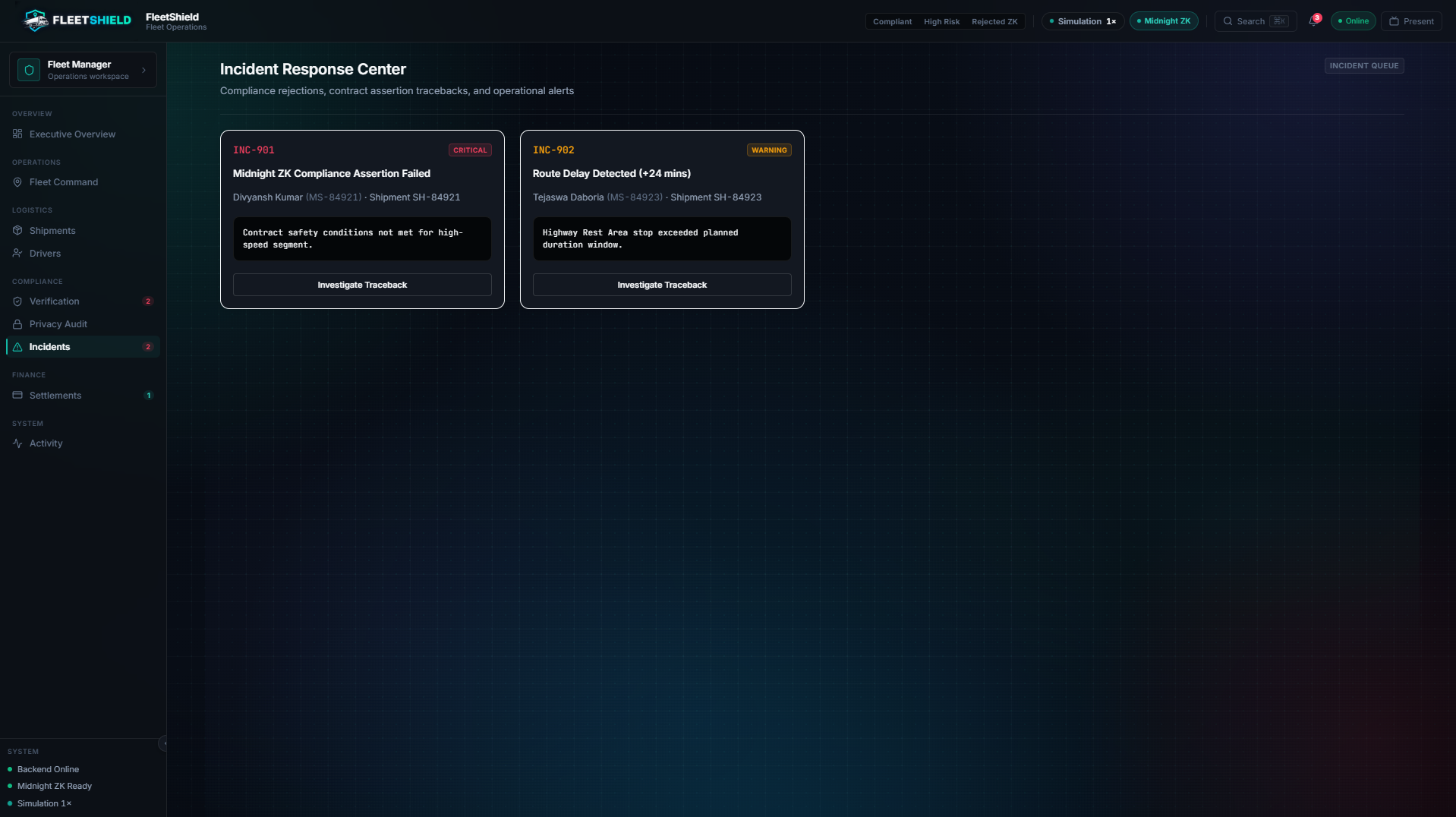
Incident Investigation — Review high-risk events and compliance issues with actionable operational context.
-
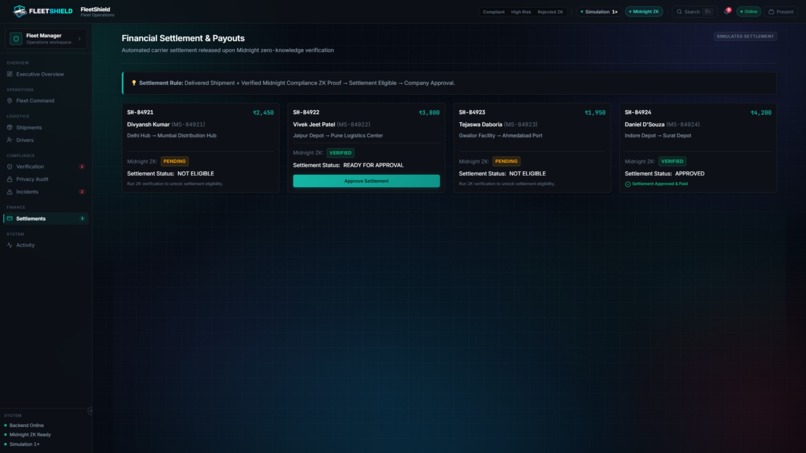
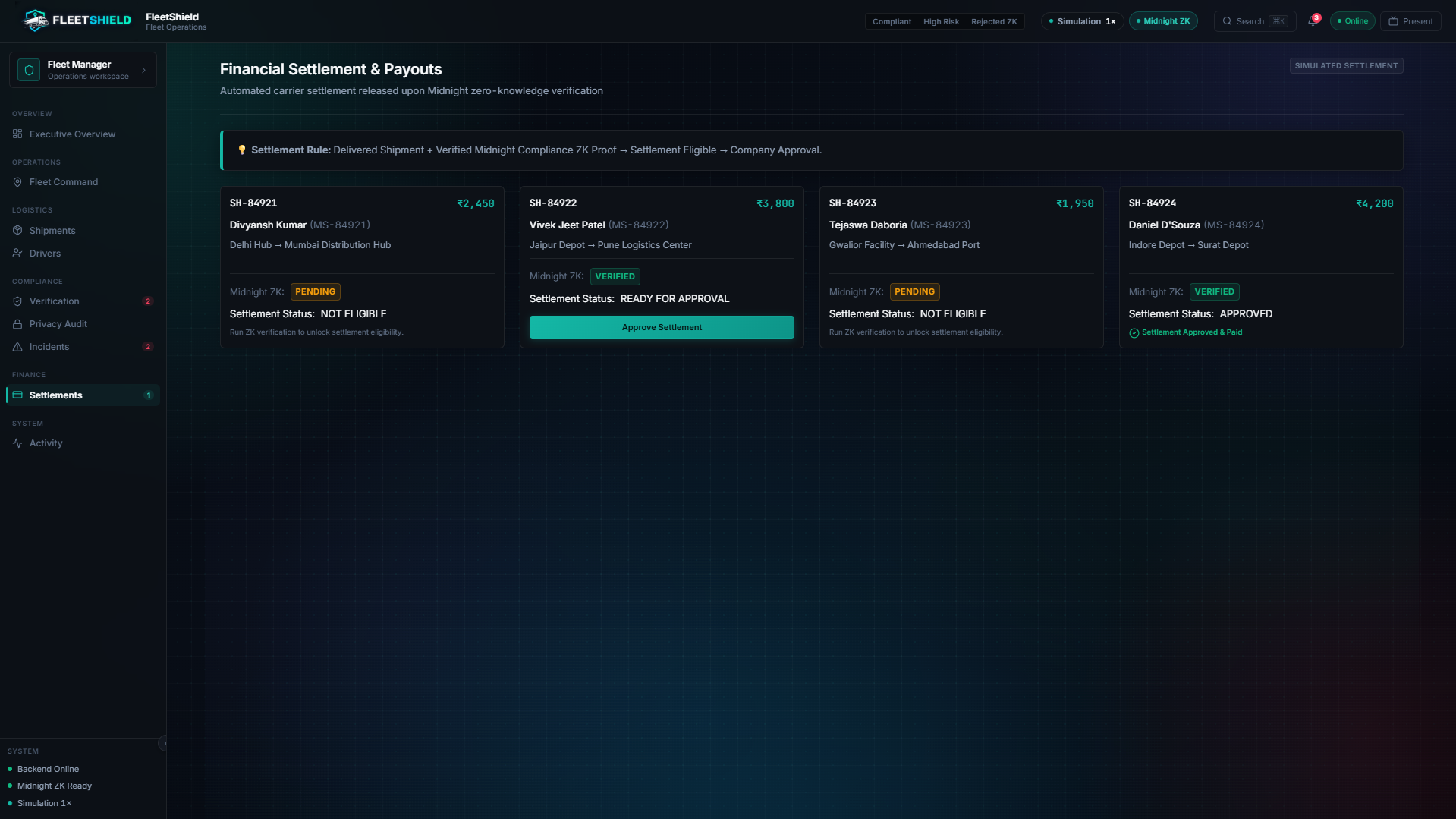
Settlements & Payouts — Review shipment payouts and move verified deliveries through the settlement workflow.
-
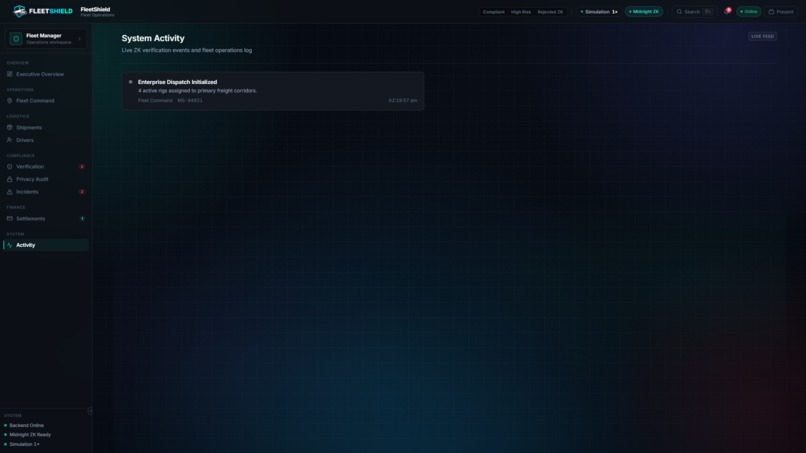
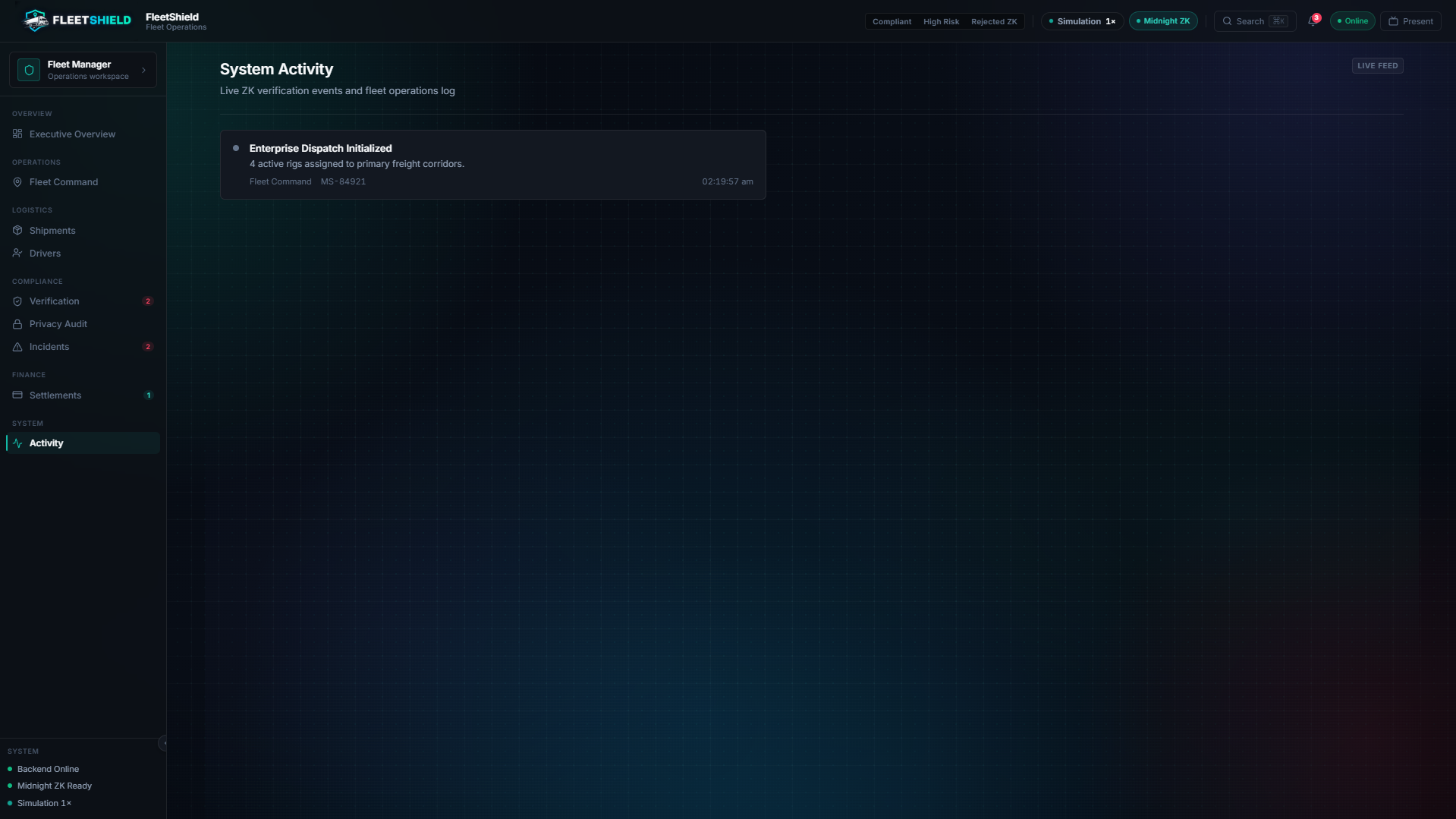
System Activity — A unified operational timeline for fleet events, compliance actions, and system activity.
-
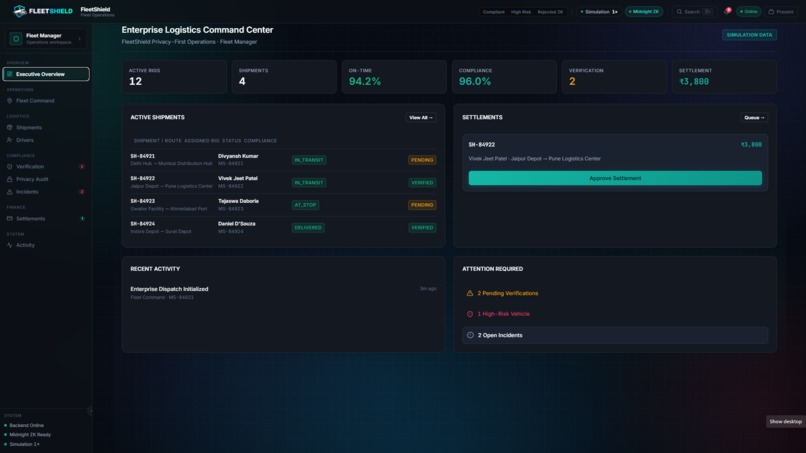
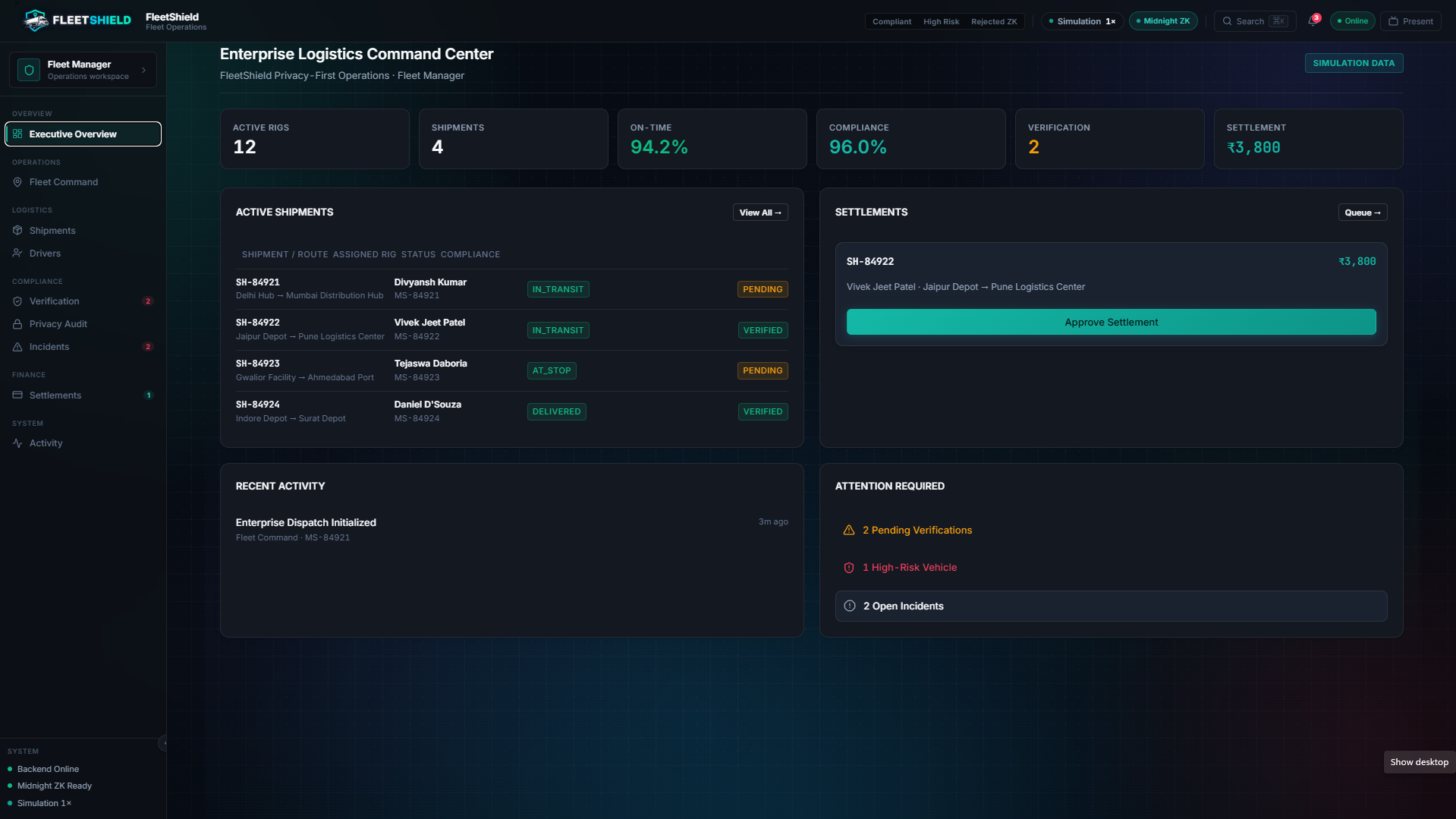
Executive Overview — Fleet, shipment, compliance, and settlement summary.
-
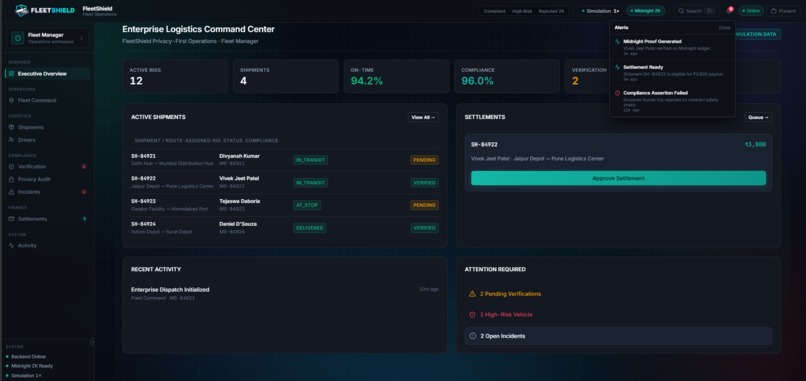
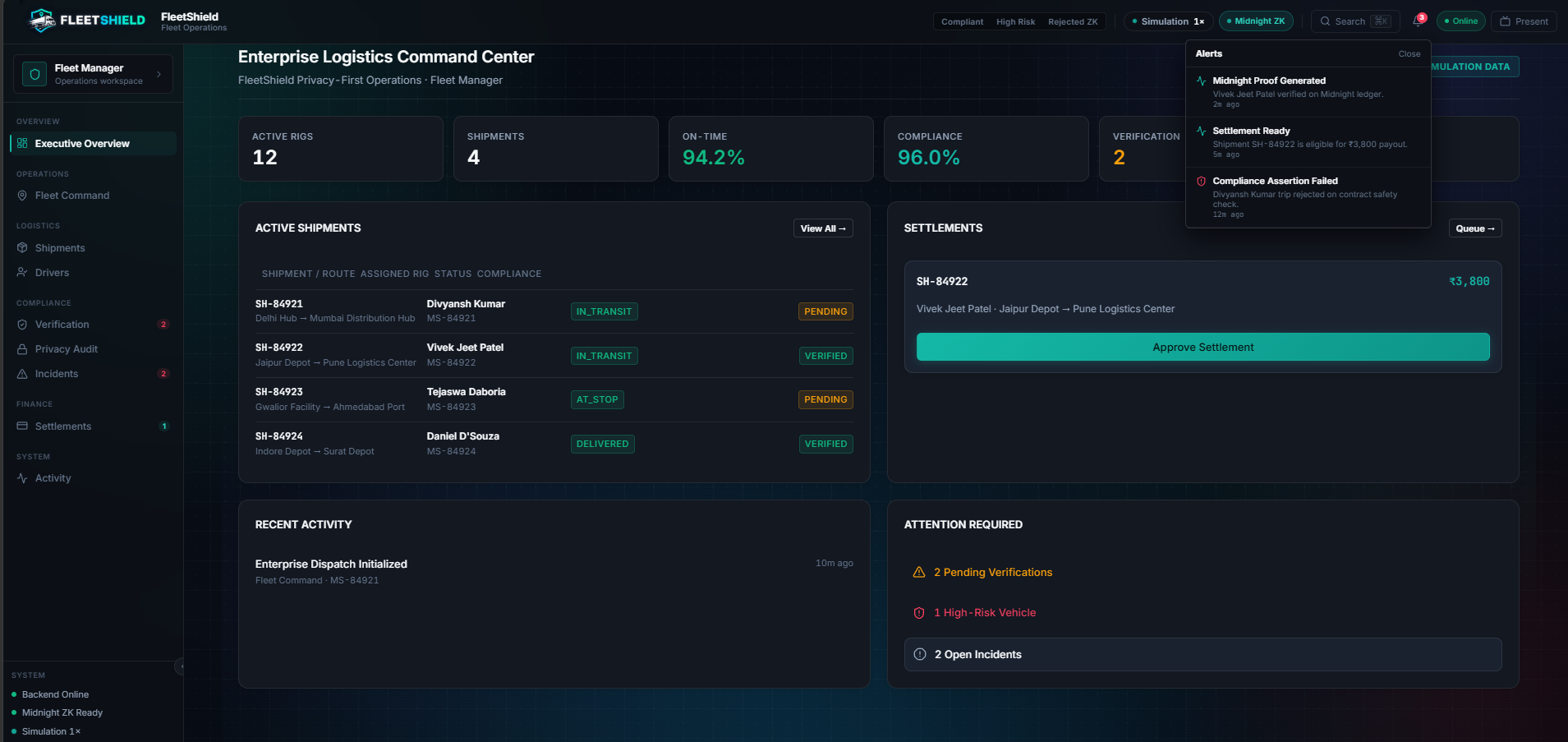
Executive Overview & Alerts — Fleet KPIs, shipments, settlements, and alerts.
💡 Inspiration
Fleet operators need a lot of information to keep deliveries moving: where vehicles are, which drivers are on the road, whether shipments are on time, and whether trips meet safety and compliance requirements.
The problem is that proving compliance can require sharing the same data that companies and drivers would rather keep private. GPS history, route information and other trip telemetry can reveal sensitive operational and personal information.
While exploring Midnight, we became interested in its privacy-first approach to blockchain and zero-knowledge proofs. That led to a simple question:
Can we prove that a compliance condition was satisfied without exposing the private information behind that proof?
That idea became FleetShield.
🚛 What it does
FleetShield is a privacy-first logistics operations platform that combines fleet management with Midnight zero-knowledge verification.
Instead of building only a blockchain demo, we wanted to show how privacy-preserving verification could fit into a real logistics workflow.
Fleet managers can use FleetShield to:
- Monitor vehicles and routes on a live fleet map
- Follow trucks along road-based routes
- View driver status, risk levels and upcoming stops
- Manage shipments and assigned drivers
- Investigate incidents and high-risk trips
- Run privacy-preserving compliance verification
- View verification receipts and audit information
- Review settlement workflows connected to verified trips
“FleetShield is fully functional end-to-end in its current demonstration environment, with the complete logistics workflow connected to a working Midnight zero-knowledge verification layer.
At the center of the application is the compliance workflow. An operator submits a compliance claim through the FleetShield backend, which connects to our Midnight service and Compact smart contract.
A valid claim is accepted and produces a transaction result. An invalid claim is rejected by the contract assertion.
The result is designed to provide something that can be verified without requiring the underlying private witness information to be exposed in the verification result.
🛠️ How we built it
FleetShield is built as a full-stack application with three main layers.
Frontend
The dashboard is built with React, Vite and TypeScript.
We used Leaflet for the interactive fleet map and OSRM for road-based route geometry. The interface includes fleet operations, shipments, drivers, compliance, privacy audit, incidents, settlements and activity views.
Backend
The backend is a Node.js and Express API that connects the dashboard to the Midnight verification service.
It exposes endpoints for health checks and trip compliance verification and handles the interaction with the Midnight environment.
🌙 Midnight
The core privacy layer is a Compact smart contract located at:
contract/src/tripverify.compact
The backend uses the Midnight SDK and proof infrastructure to execute the contract's compliance verification flow.
The application is designed so that the operational experience stays simple for a fleet operator while the underlying verification is handled by the Midnight stack.
⚠️ Challenges we ran into
The biggest challenge was combining a complex blockchain privacy workflow with something that feels like a normal enterprise logistics application.
We had to deal with asynchronous proof generation, contract state, wallet setup, backend integration and UI state transitions while still keeping the experience understandable to someone who isn't familiar with zero-knowledge systems.
We also spent a lot of time working with the Midnight PreProd environment.
“We successfully integrated the Midnight stack and validated the application’s verification workflow end-to-end. During the hackathon, the public PreProd faucet did not make test funds available to our deployment wallet, so our production-network deployment could not be completed within the submission window. The working application and cryptographic verification flow were therefore demonstrated using the Midnight standalone environment.
Instead of hiding that limitation or simulating a deployment, we kept the actual Compact contract and ZK verification flow working against the Midnight standalone environment so the demonstration still uses genuine Midnight execution.
🏆 Accomplishments that we're proud of
We are proud that FleetShield became more than a smart contract proof-of-concept.
We built a complete workflow around the privacy problem:
Fleet → Shipment → Route → Driver → Compliance → ZK Verification → Result → Business Action
The application can simulate an entire fleet operation while connecting that workflow to a real Midnight verification process.
We are especially happy with the way the ZK process is presented. A normally complicated concept such as private witness data, proof generation and contract verification is presented through a simple visual workflow that a fleet operator can understand.
We also built both successful and rejected verification paths, so the demo shows that the contract is actually enforcing its assertion rather than simply displaying a success message.
🧠 What we learned
This project taught us that building with zero-knowledge technology is not just about writing a smart contract.
The contract, proof generation, backend, wallet, state management and frontend all have to work together correctly.
We also learned a lot about the practical side of blockchain development, especially the differences between a local development environment and a public testnet, including wallet funding and network synchronization issues.
Most importantly, we learned that privacy can be part of the actual business workflow instead of being something added afterwards as a separate security feature.
🚀 What's next for FleetShield
The next step is moving the already-working verification stack to Midnight PreProd once the public testnet funding and synchronization issues are resolved
After that, we want to move beyond simulated fleet data and connect FleetShield to real sources such as ELDs, vehicle telemetry and IoT devices.
That would allow compliance claims to be generated from real operational data while keeping sensitive information private.
Long term, we see FleetShield as a privacy layer for logistics companies, carriers, insurers and other organizations that need to trust a compliance result without necessarily receiving the complete underlying dataset.
The idea is simple: prove what needs to be known, while protecting what doesn't.
Built With
- blockchain
- compact
- express.js
- leaflet.js
- midnight
- node.js
- react
- smart-contracts
- typescript
- vite
- zero-knowledge

Log in or sign up for Devpost to join the conversation.