Inspiration
A firmware push that froze mid-rollout on real fleet hardware while every dashboard stayed green. Large printer fleets scatter one incident across device telemetry, print servers, queues, jobs, accounts, and change tools — and the tools that watch each layer independently can all report "fine" while the fleet is broken. FleetPilot is the operator console that would have caught it.
What it does
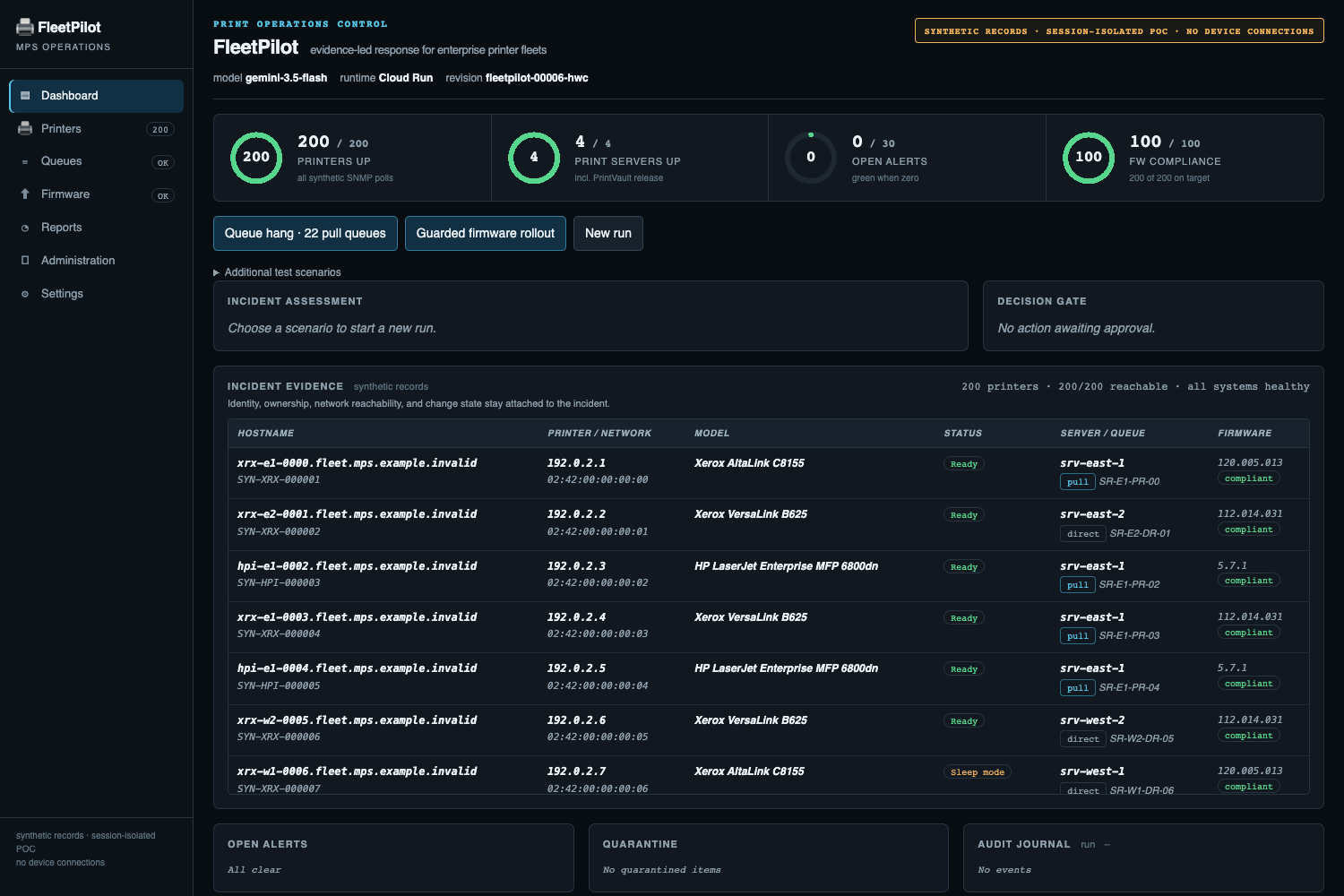
FleetPilot turns printer, print-server, queue, job, account, firmware, and reachability evidence into a governed response:
- Observe synthetic fleet alerts and retain the operational evidence.
- Correlate shared server and queue topology before asking Gemini to refine the diagnosis and propose an action.
- Validate model output (allowlisted action kinds, known device IDs, bounded confidence) and ground the exact incident scope before policy runs.
- Gate — deterministic policy auto-runs a bounded low-risk action, requires a human for higher blast radius, or blocks the action.
- Verify by re-observing simulator post-state rather than trusting an execution receipt.
- Audit — every observation, diagnosis, gate decision, approval, action, verification, and watchdog event lands in an append-only journal.
Two proof workflows on the live dashboard:
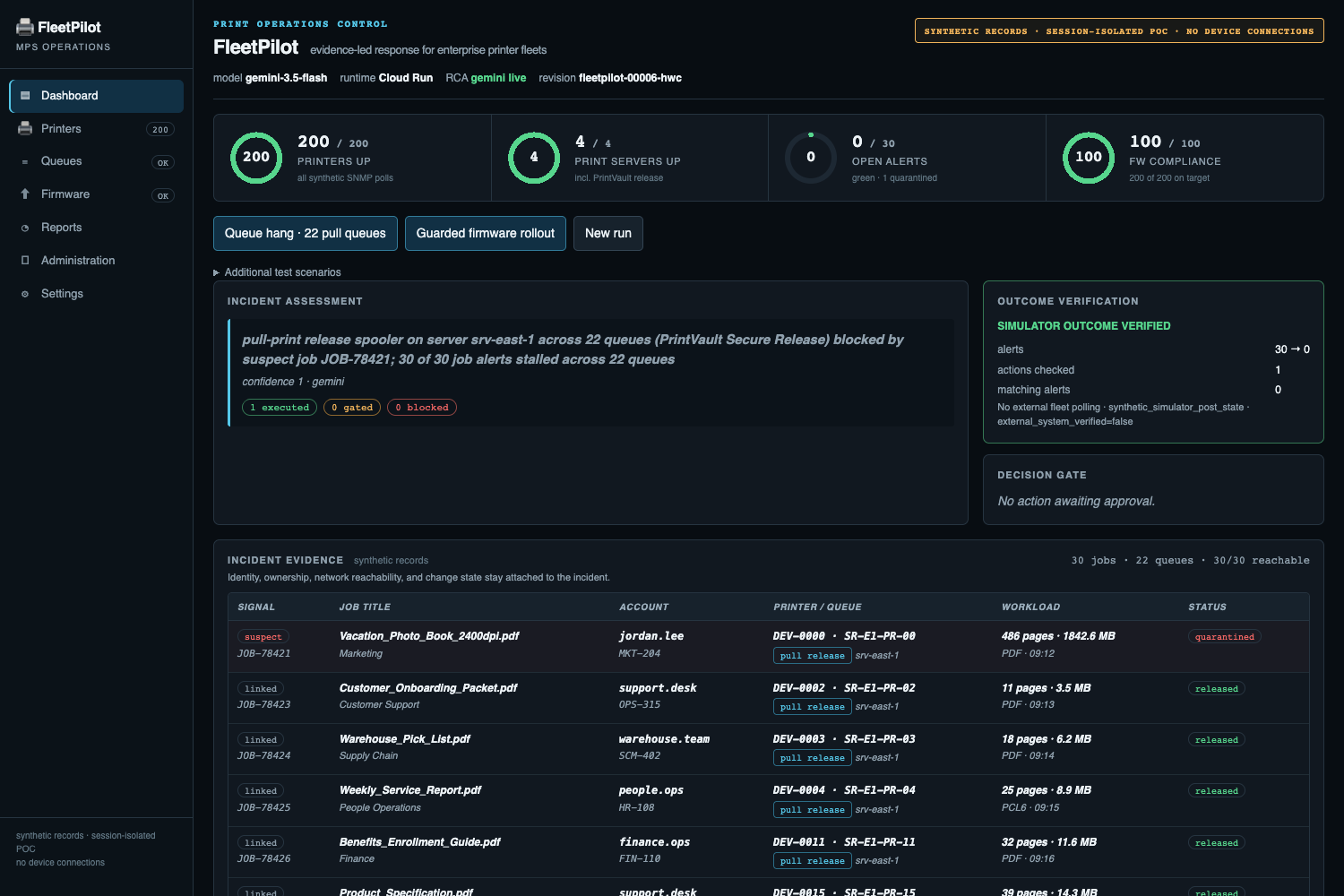
- Queue hang — 30 jobs stalled across 22 pull-release queues on the secure release server collapse to one root cause: a single 1.8 GB non-business job blocking the release spooler. FleetPilot quarantines that one job, releases the other 29, and re-observes zero matching alerts with no collateral clearing — printers stay 200/200 online throughout, because it's a queue-layer incident, not a device one.
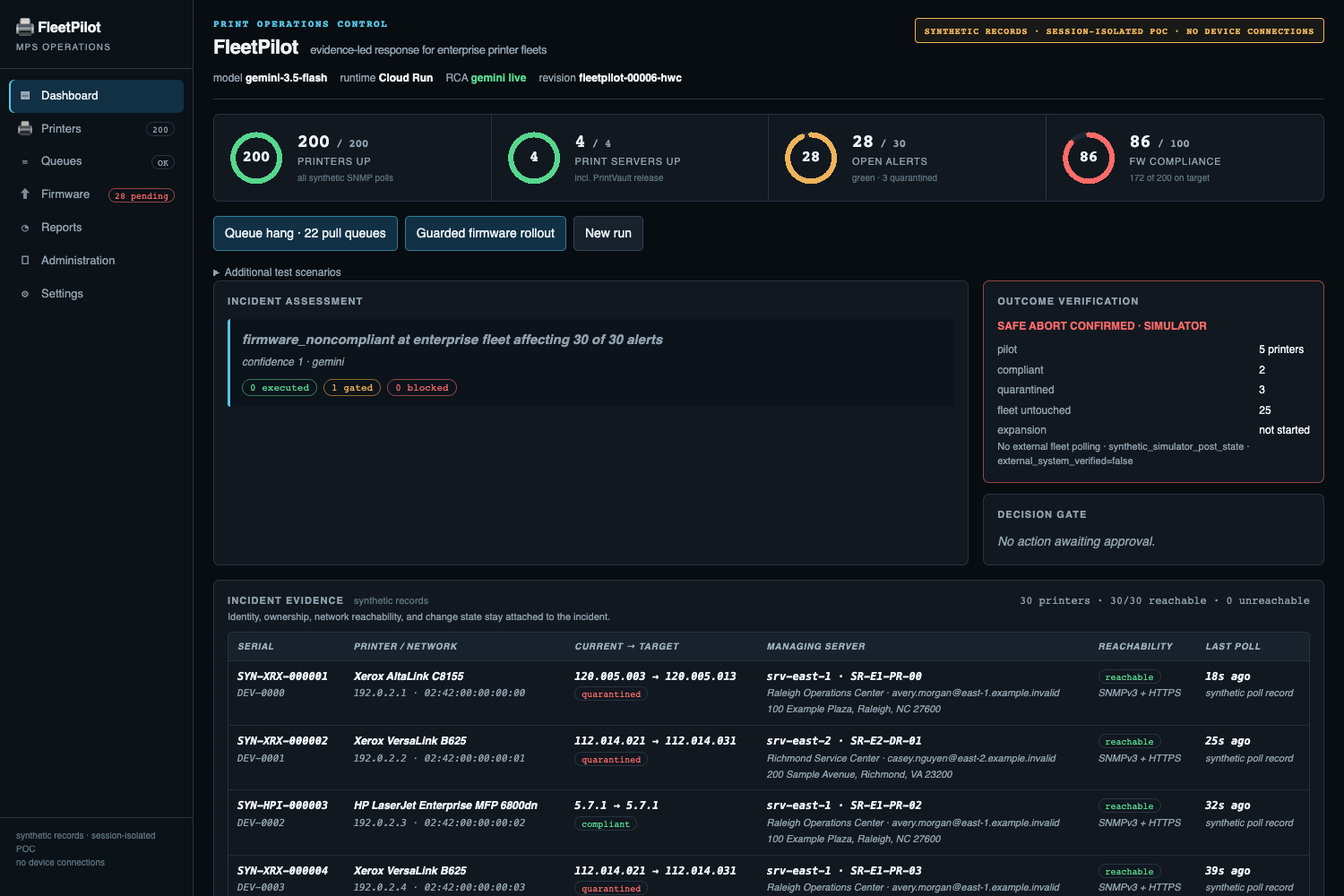
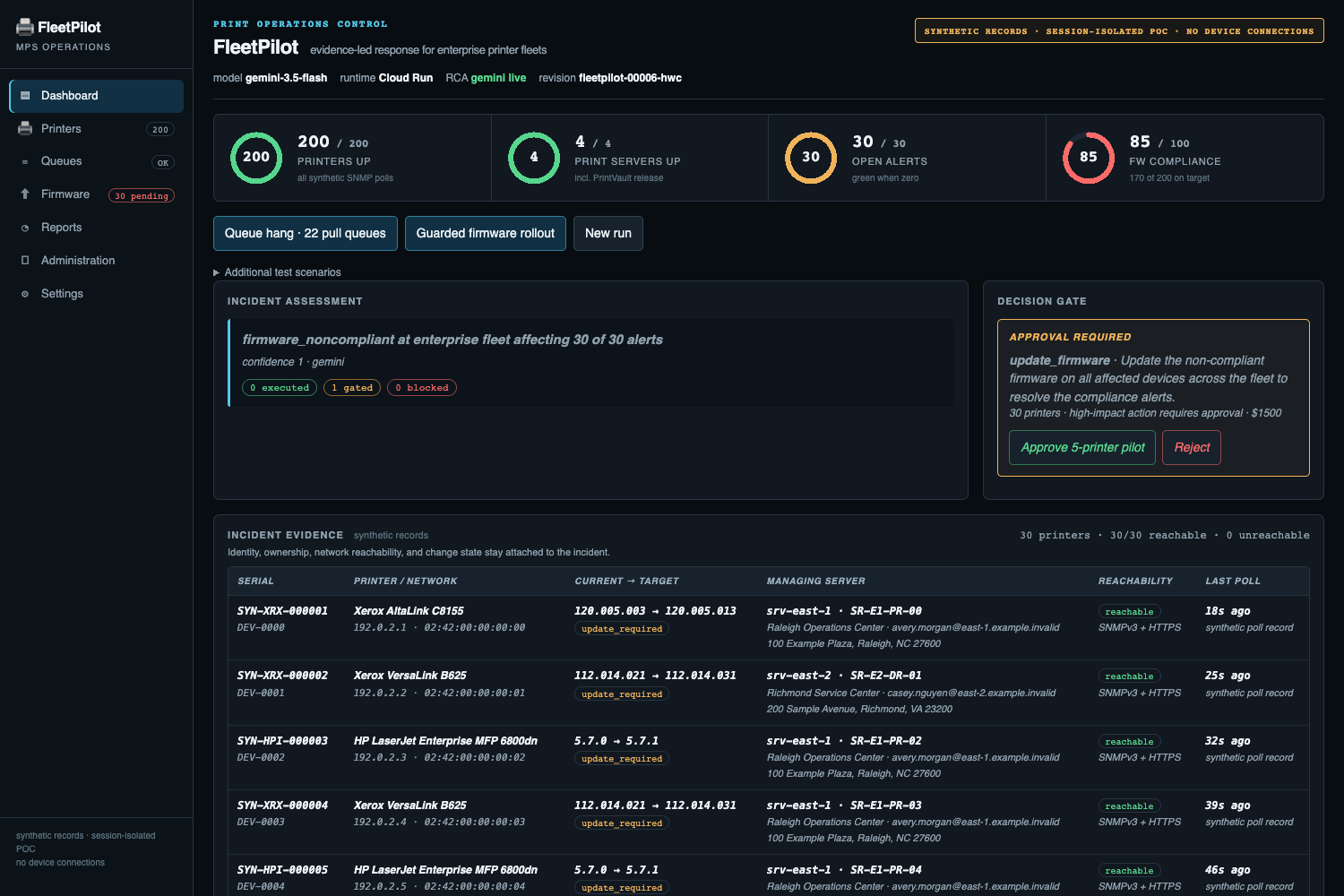
- Guarded firmware rollout — 30 devices report a firmware baseline mismatch. Gemini proposes the change, policy requires human approval, and approval starts only a 5-printer pilot. Two updates complete, three freeze; the watchdog quarantines the frozen devices, proves 25 printers were untouched, and stops before fleet-wide expansion.
How I built it
- Gemini 3.5 Flash on Vertex AI via the Google GenAI SDK, with service-account authentication — no API key shipped in the service
- Google Cloud Run for the deployed service
- FastAPI dashboard and API
- Deterministic Python policy engine, fleet simulator, rollout watchdog, and eval harness (11 scenarios / 19 assertions, fully offline)
- SQLite append-only POC journal
The core pattern: the agent proposes, policy disposes. Gemini contributes diagnosis and action selection inside a larger action loop — observe → correlate → Gemini → validate → scope → policy → act/gate → verify → audit — and cannot bypass validation, policy, approval, pilot limits, or the watchdog. A labeled deterministic fallback keeps the workflow safe and testable when the model is unavailable.
Challenges I ran into
- Gemini JSON responses truncated at 1024 tokens, silently breaking diagnosis parsing — fixed by raising the output budget to 8192 and validating output before it reaches policy.
- Cold-start latency on Cloud Run made first diagnoses take ~30s; I added a health/warmup path so rehearsed runs land in the 4–7s range.
- Model hints and executor interpretations could describe narrower or wider incident scopes than the true one — policy had to evaluate the effective incident scope, not either claim.
- Making browser sessions isolated within a single unauthenticated POC instance without pretending that was real authentication.
Accomplishments that I'm proud of
- A pilot that fails safely is a success: when devices froze mid-push, FleetPilot proved 25 printers were never touched and refused automatic expansion.
- Post-action verification re-observes state instead of trusting executor receipts — it catches both unresolved work and collateral effects outside the policy-reviewed scope.
- 55 passing tests, 11/11 offline eval scenarios, and three consecutive hosted rehearsal runs with live Gemini, no fallback, correct end states.
- The demo video is one continuous unedited take on the live Cloud Run deployment.
What I learned
- High alert count does not equal high root-cause count; topology must be correlated before action.
- Policy must evaluate the effective incident scope — not a narrower model hint or a wider executor interpretation.
- An executor receipt is not proof. The system must re-observe post-state.
- A failed pilot can be a successful safety outcome when the system proves the remainder was untouched.
What's next for FleetPilot
Production adapters: authenticated operator sessions, a durable audit store (SQLite on Cloud Run is POC evidence, not production storage), and real vendor/SNMP/HTTPS integrations in place of the synthetic simulator — while keeping the same trust boundary where the model proposes and deterministic policy decides.
Links
- Live demo: https://fleetpilot-118750462659.us-central1.run.app
- Source: https://github.com/lantzmurray/Fleetpilot
- Demo video: https://youtu.be/tjeV5Zkmsnc


Log in or sign up for Devpost to join the conversation.