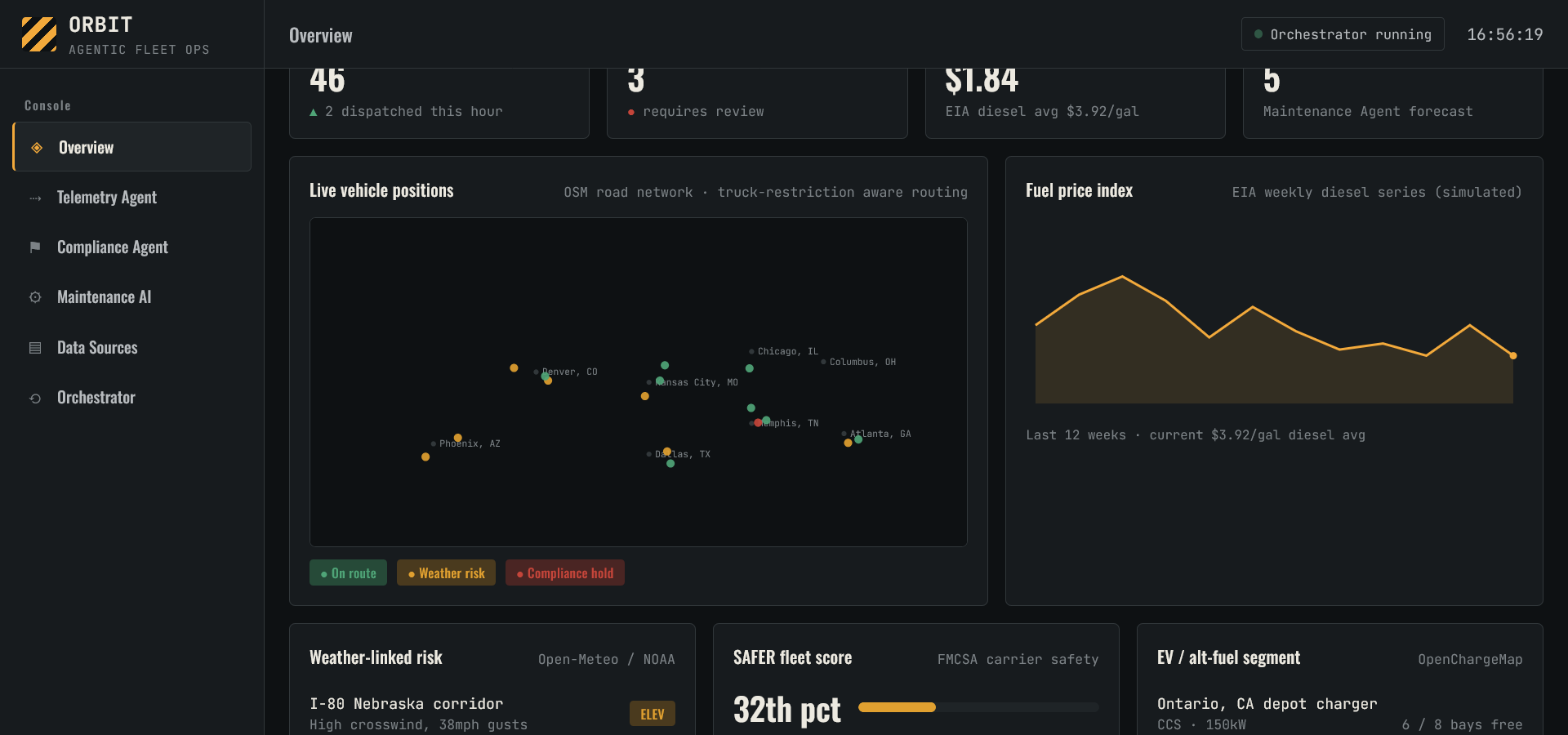
Based directly on the attached ORBIT — Agentic Fleet Operations Console prototype, here is a polished version suitable for a hackathon/project submission, presentation, or product documentation. The prototype presents a fleet-operations dashboard combining telemetry, compliance, maintenance prediction, routing, weather risk, fuel economics, and agent orchestration.
Inspiration
The inspiration for ORBIT — Agentic Fleet Operations Console came from the need to move fleet management beyond passive monitoring toward intelligent, proactive, and agent-driven fleet operations.
Traditional fleet-management systems often require operators to manually monitor vehicle locations, driver Hours-of-Service (HOS), maintenance conditions, fuel costs, weather, compliance requirements, and routing constraints. ORBIT was conceived as a unified operational intelligence layer where specialized AI agents continuously interpret these different streams of information and help fleet operators identify problems before they become costly failures.
The idea was particularly driven by the opportunity to combine open transportation, regulatory, weather, road-network, energy, and charging data with vehicle telemetry and a fine-tuned language model. The prototype therefore brings together sources such as FMCSA SAFER, OpenStreetMap, NOAA/Open-Meteo, EIA fuel-price data, and OpenChargeMap.
The central question behind the project was:
What if a fleet-management system could continuously observe the fleet, reason about emerging risks, recommend actions, and coordinate specialized AI agents instead of simply displaying dashboards?
That led to the concept of an agentic fleet-management platform capable of turning raw operational data into actionable decisions.
What it does
ORBIT provides a centralized fleet operations intelligence console with several interconnected capabilities.
- Fleet overview
The overview dashboard provides a high-level operational picture covering:
Active vehicles Open compliance flags Cost per mile Upcoming service windows Vehicle positions Fuel-price trends Weather-linked risks Fleet safety indicators EV/alternative-fuel infrastructure
The interface explicitly combines telemetry, compliance, weather-linked risk, routing, and cost-per-mile information into a single operational view.
- Telemetry Ingestion Agent
The Telemetry Ingestion Agent continuously processes simulated ELD/OBD-II events.
It handles events including:
Engine RPM Coolant temperature Fuel level GPS speed Diagnostic trouble codes Brake air pressure Tire pressure
The agent validates and transforms incoming events into a canonical vehicle-event schema, making heterogeneous telemetry easier for downstream AI agents to consume.
- Compliance Agent
The Compliance Agent combines driver HOS information with carrier safety information to identify potential violations before they become citations.
It monitors areas such as:
Hours-of-Service Vehicle inspections Tire conditions Driving limits FMCSA BASIC categories Violation-risk alerts
The system can generate recommended actions—for example, prompting a driver to complete a missing log segment or holding a vehicle for inspection.
- Maintenance-Prediction Agent
The maintenance component uses a simulated QLoRA fine-tuned Qwen2.5-7B-Instruct model trained around maintenance logs, diagnostic trouble codes, and FMCSA-related narratives.
The operator can provide:
Vehicle DTC/fault code Odometer reading
The model then produces a plain-language maintenance recommendation and proposed service window.
- Intelligent routing and environmental awareness
ORBIT incorporates road-network and environmental information into fleet decision-making.
The routing layer is designed to consider truck restrictions such as:
Height Weight Hazmat restrictions
Weather information is also used to identify elevated-risk corridors and influence routing and maintenance decisions.
- Fuel and alternative-fuel intelligence
The system tracks fuel-price information for cost-per-mile analysis and incorporates charging-station information for electric/alternative-fuel fleet segments.
- Agent Orchestrator
The Orchestrator coordinates the specialized agents.
The prototype defines:
Telemetry Ingestion Agent — periodic polling Compliance Agent — triggered by new telemetry batches Maintenance-Prediction Agent — triggered by DTC events
The orchestration layer records execution results and feeds them back into the fleet dashboard.
How we built it
We designed ORBIT as a modular agentic architecture rather than one monolithic AI application.
Data layer
The system is designed around multiple heterogeneous data sources:
FMCSA SAFER Used for carrier registration, vehicle information, BASIC safety indicators, and compliance intelligence.
OpenStreetMap Used as the road-network foundation, including truck-related restrictions.
NOAA / Open-Meteo Used for weather and environmental risk.
EIA Used for diesel-price information and cost-per-mile calculations.
OpenChargeMap Used for EV charging infrastructure and alternative-fuel routing.
These sources are represented in the prototype as the primary external-data layer.
AI layer
The core predictive-language component uses a Qwen2.5-7B-Instruct model with QLoRA fine-tuning for maintenance reasoning.
Rather than asking the LLM to perform every task, the architecture separates responsibilities among specialized agents:
Vehicle / External Data ↓ Telemetry Ingestion Agent ↓ Canonical Event Schema ↓ ┌───────────────┬─────────────────┐ ↓ ↓ ↓ Compliance Maintenance Routing / Agent Agent Risk Logic ↓ ↓ ↓ └───────────────┴─────────────────┘ ↓ Agent Orchestrator ↓ Fleet Operations Console Simulation layer
Because the prototype is intended to demonstrate the architecture without requiring production credentials or live integrations, the browser generates synthetic telemetry, compliance events, weather conditions, fuel-price movements, and orchestration activity.
The application explicitly identifies the displayed figures as simulated and states that it does not establish live connections to the listed external systems.
User-interface layer
The frontend was implemented as a responsive single-page operations console with dedicated views for:
Overview Telemetry Agent Compliance Agent Maintenance AI Data Sources Orchestrator
This makes the system resemble an actual fleet operations center, rather than simply a machine-learning demonstration.
Challenges we ran into
One of the biggest challenges was designing an AI architecture capable of handling heterogeneous fleet data.
Vehicle telemetry, regulatory records, road-network information, weather observations, fuel prices, and charging infrastructure all have different structures, update frequencies, semantics, and reliability characteristics. A common representation was therefore necessary, which motivated the canonical vehicle-event schema used by the Telemetry Agent.
Another challenge was determining when an AI agent should act.
Not every telemetry event requires an LLM call. The architecture therefore uses different triggers: periodic telemetry polling, telemetry-driven compliance processing, and DTC-triggered maintenance inference.
We also had to balance AI capability with computational efficiency. Running a large model for every fleet event would be expensive and unnecessary. Fine-tuning with QLoRA provides a more practical approach for specialized maintenance reasoning.
A further challenge was representing real-world fleet uncertainty. Vehicle conditions, weather, road restrictions, driver behavior, and fuel prices continuously change. The prototype therefore treats the system as a continuously updating operational environment rather than a static prediction model.
Finally, because the prototype is browser-based, we needed to demonstrate realistic data flows without pretending that synthetic values were live operational data. The explicit simulation notice was therefore incorporated into the interface.
Accomplishments that we're proud of
We are particularly proud of transforming the concept of an agentic fleet-management system into an interactive operational prototype.
Unified fleet intelligence
Instead of building isolated dashboards, ORBIT demonstrates how telemetry, compliance, maintenance, routing, weather, fuel, and EV infrastructure can be connected within one operational environment.
Specialized AI agents
The system demonstrates that fleet intelligence can be divided into specialized agents with distinct responsibilities:
Telemetry Agent → observes and normalizes vehicle data. Compliance Agent → identifies regulatory risk. Maintenance Agent → interprets vehicle faults and recommends maintenance. Orchestrator → coordinates the agents. Event-driven architecture
The architecture demonstrates event-based agent activation instead of continuously invoking an LLM. For example, a diagnostic trouble code can trigger the Maintenance-Prediction Agent, while a new telemetry batch can trigger compliance processing.
Explainable recommendations
The maintenance component does not simply return a numerical prediction. It produces a human-readable explanation and recommended action, which is much more useful to a fleet manager or maintenance coordinator.
Operational rather than purely experimental design
The prototype is structured around real fleet-management workflows—monitoring, detecting, reasoning, recommending, and coordinating—rather than focusing exclusively on model accuracy.
What we learned
The most important lesson was that fleet AI is fundamentally a systems-engineering problem, not simply an LLM problem.
A high-performing model alone does not create an effective fleet-management platform. The system also needs:
Reliable data ingestion Data normalization Event detection Domain-specific models Rules and constraints Agent coordination Human oversight Auditability Explainability Appropriate escalation mechanisms
We also learned that agent specialization is valuable. A maintenance agent should not necessarily be responsible for regulatory compliance, while a compliance agent should not need to reason about every maintenance fault.
Another important lesson is that LLMs should operate alongside deterministic algorithms. Regulatory rules, safety constraints, routing restrictions, and threshold-based alerts can often be handled more reliably using deterministic logic, while the LLM can focus on interpretation, explanation, prioritization, and recommendation.
The prototype also reinforced the importance of a canonical data model. Once heterogeneous vehicle events are normalized, multiple downstream agents can consume the same information without each requiring a separate integration layer.
What's next for the Fleet Management System
The next stage is to transform ORBIT from a browser-based simulation into a production-ready AI fleet-management platform.
- Replace synthetic data with live integrations
The simulated feeds should eventually be replaced with authenticated production integrations for:
ELD/telematics OBD-II/CAN bus GPS FMCSA/SAFER Weather APIs Fuel-price feeds Mapping/road networks EV charging infrastructure
The current prototype already establishes the intended data-source architecture.
- Build a production data platform
A scalable backend could introduce:
IoT / ELD / OBD-II ↓ Streaming Ingestion ↓ Event Bus ↓ Canonical Fleet Data Model ↓ Time-Series + Geospatial Database ↓ AI / ML / Agent Layer ↓ API Gateway ↓ Web + Mobile Applications
- Develop predictive maintenance models
The maintenance agent can evolve from primarily language-model reasoning into a hybrid predictive-maintenance architecture combining:
Gradient-boosting models Time-series forecasting Anomaly detection Remaining Useful Life estimation Fault-code classification Fine-tuned LLM reasoning
The LLM would explain and contextualize predictions rather than being the sole predictive mechanism.
- Add intelligent dispatch optimization
A future Dispatch Agent could optimize:
Vehicle assignment Driver assignment Delivery sequencing Fuel stops Charging stops Driver HOS constraints Vehicle capacity Road restrictions Weather risk Delivery deadlines
This could incorporate optimization algorithms such as constraint programming, mixed-integer optimization, or vehicle-routing algorithms.
- Add real-time risk prediction
ORBIT could evolve toward a continuously calculated Fleet Risk Score combining:
Vehicle Risk + Driver Risk + Compliance Risk + Weather Risk + Road Risk + Maintenance Risk + Operational Risk
This would allow fleet managers to prioritize the vehicles and routes requiring immediate attention.
- Add autonomous-but-controlled agent workflows
The eventual system could allow agents to move from:
Observe → Analyze → Recommend
toward:
Observe → Analyze → Recommend → Request Approval → Execute → Verify
For example, a Maintenance Agent could identify an imminent service requirement, check available maintenance facilities, estimate downtime and cost, recommend the optimal service window, and request human approval before scheduling.
- Build web and mobile applications
The final platform could provide:
Fleet Manager Web Console
Fleet overview Analytics Compliance Maintenance Dispatch Financial intelligence AI assistant
Driver Mobile Application
Route instructions HOS awareness Vehicle inspections Maintenance alerts Safety notifications Delivery workflow
- Add a fleet AI copilot
A natural-language interface could allow operators to ask questions such as:
“Which vehicles are most likely to require maintenance within the next seven days?”
“Which active routes have the highest combined weather and compliance risk?”
“Which vehicles should be dispatched for tomorrow's deliveries?”
The agentic system would retrieve the appropriate data, perform the necessary analysis, explain its reasoning, and return an auditable recommendation.
- Introduce continuous learning and evaluation
Finally, the platform should continuously evaluate:
Prediction accuracy False-positive rates Maintenance savings Fuel savings Compliance incidents prevented Downtime reduction Route efficiency Agent execution reliability Human override rates
That would turn ORBIT from a compelling prototype into a measurable AI-powered fleet optimization platform.
Overall vision: ORBIT's long-term goal is to become a fleet operating intelligence layer—connecting vehicles, drivers, infrastructure, external data, predictive models, optimization algorithms, and specialized AI agents into one system that helps logistics companies move from reactive fleet management to predictive and increasingly autonomous operations.

Log in or sign up for Devpost to join the conversation.