-
-
Thumbnail
-
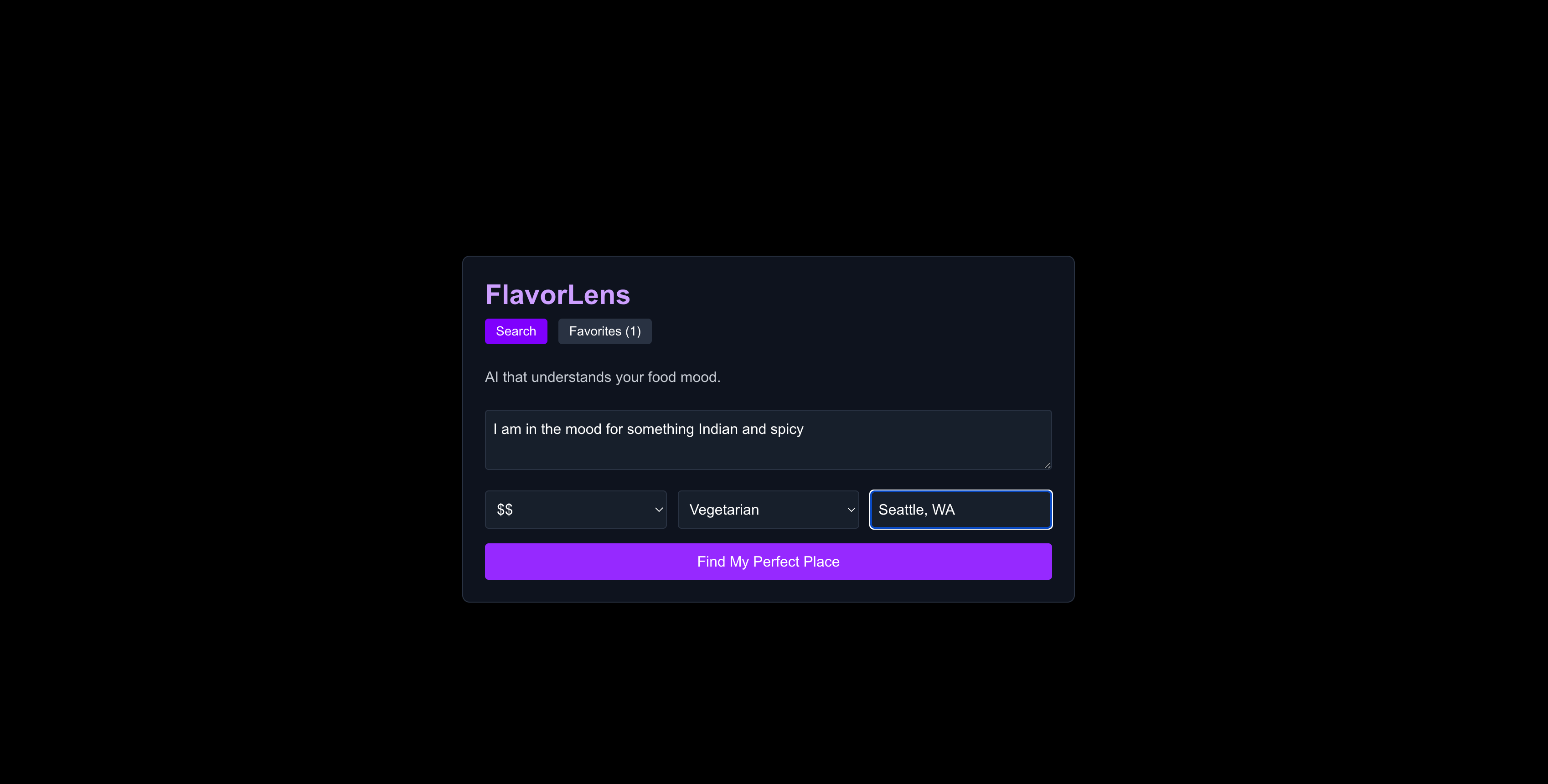
Homescreen
-
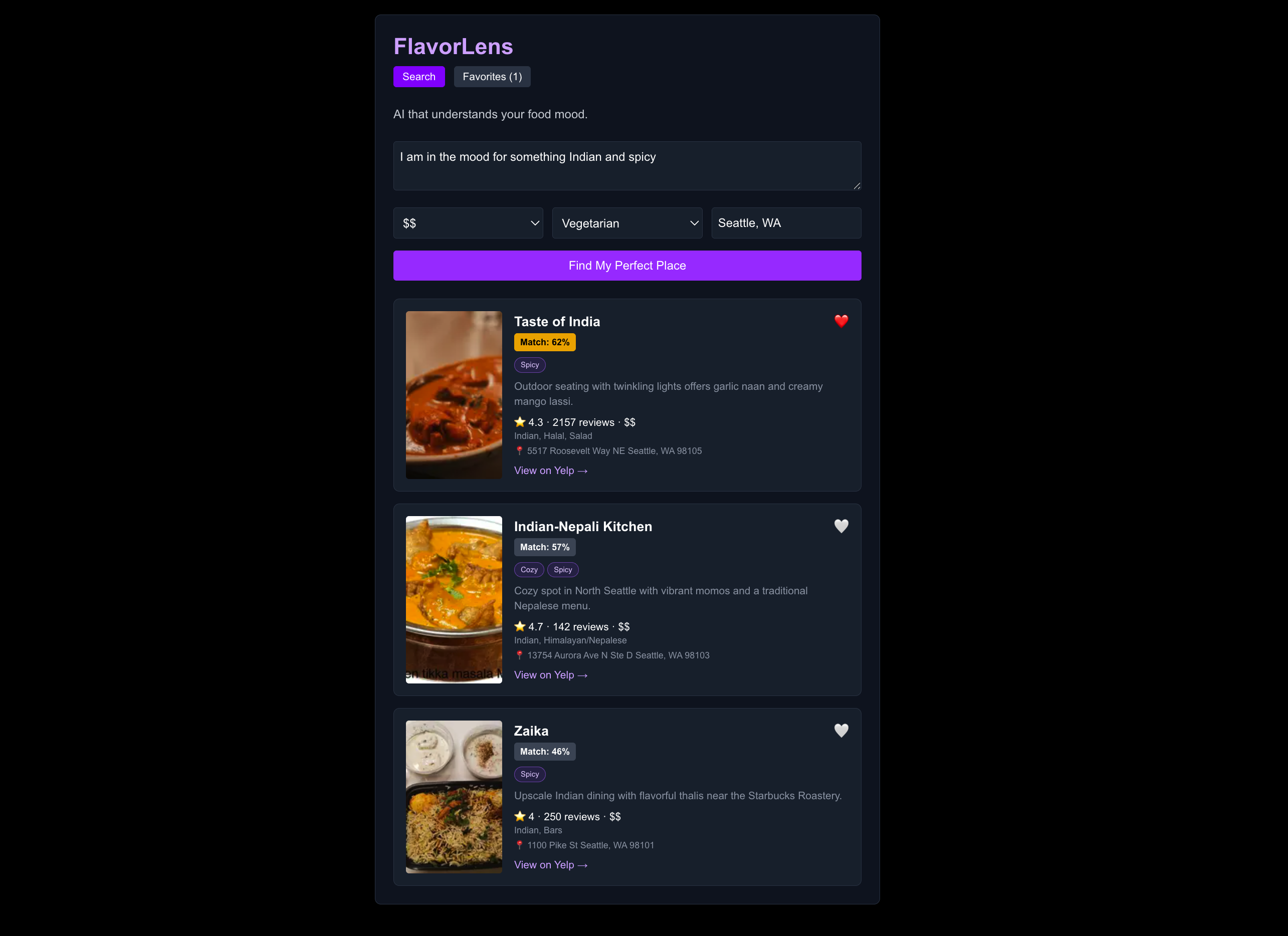
Search Tab
-
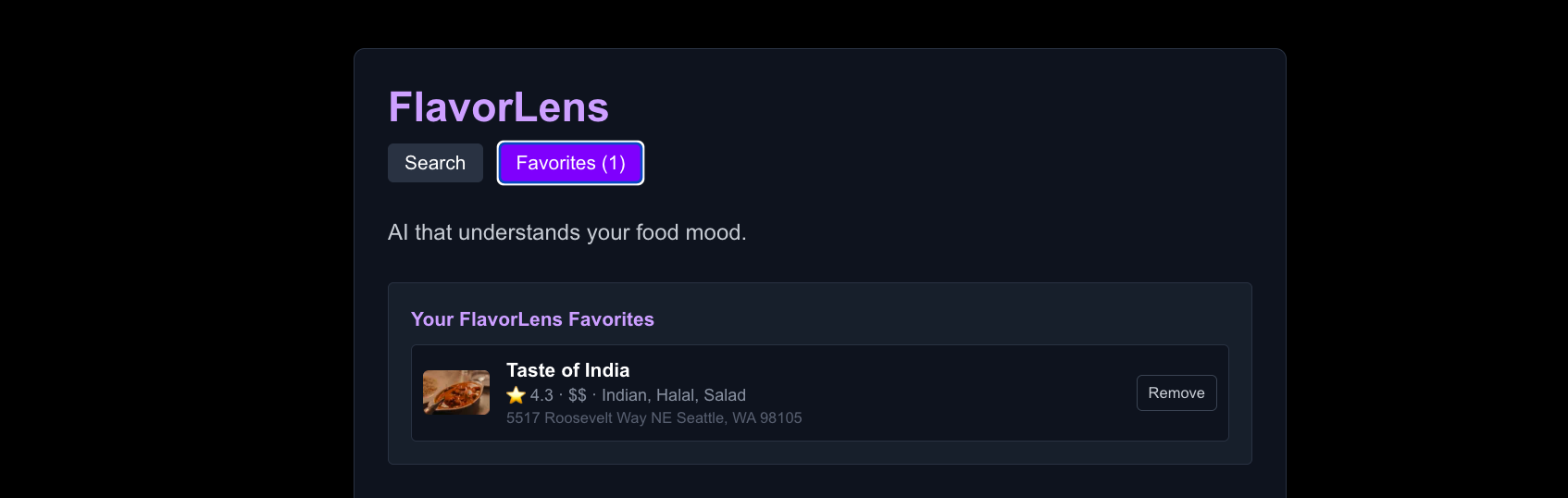
Favorites Tab
Inspiration
Food decisions are rarely logical — they’re emotional. Most discovery platforms force users to think in terms of filters, categories, and ratings, even though people usually decide where to eat based on how they feel in the moment. We were inspired to build FlavorLens after realizing there was no intuitive way to express cravings like “spicy comfort food with friends” or “something light but still exciting” and have that translated into meaningful restaurant recommendations. The Yelp AI API opened the door to bridge that gap by allowing us to combine conversational intent with rich, real-world local business data.
What it does
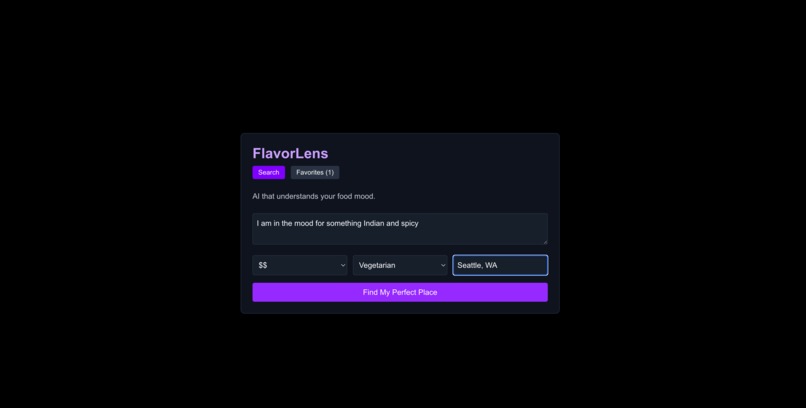
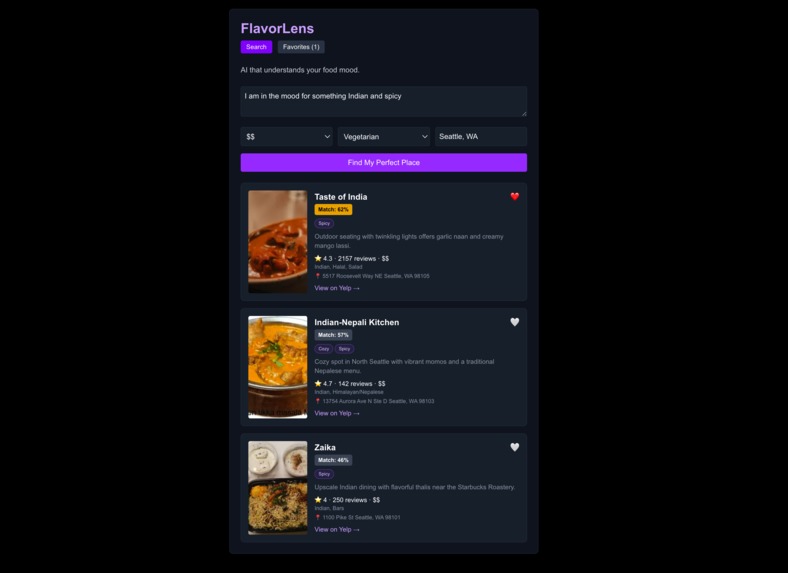
FlavorLens is an AI-powered local food discovery app that understands your food mood and turns it into personalized restaurant recommendations. Users describe what they’re in the mood for using natural language, select preferences like budget and dietary needs, and choose a city. FlavorLens then analyzes this input and surfaces a ranked list of restaurants using Yelp’s AI API as the primary data source. Each recommendation comes with a match score, vibe tags, and a clear explanation of why it was selected, helping users make confident decisions quickly without endless scrolling.
How we built it
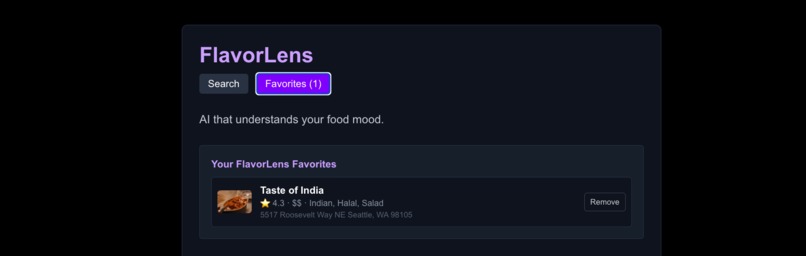
FlavorLens was built as a modern web application using Next.js and TypeScript, with Yelp’s AI API powering all restaurant data and insights. We implemented a custom match-scoring engine that evaluates businesses based on multiple factors such as mood relevance, ratings, review volume, price alignment, and dietary compatibility. To ensure fast and reliable location input, we built a local city search index using a U.S. cities dataset, eliminating dependence on third-party autocomplete services. The UI was designed to be clean and interactive, featuring dynamic result cards, detailed modals, and favorites for easy exploration and comparison.
Challenges we ran into
One of the biggest challenges was translating subjective, emotional user input into structured signals that could meaningfully rank restaurants. Balancing AI-driven insights with transparency was critical — users needed to understand why a place was recommended, not just see a result. We also faced technical challenges around location accuracy, API rate limits, and hydration issues in a server-rendered environment, which led us to rethink and optimize our city search strategy. Through iteration and testing, we refined both the scoring logic and UX to deliver a fast, intuitive, and reliable experience.
Accomplishments that we're proud of
FlavorLens was built as a fully functional, end-to-end application that rethinks how people discover restaurants by starting with intent and mood, rather than rigid filters. We successfully integrated the Yelp AI API as the primary data source and designed a natural-language experience where users describe what they’re in the mood for, such as craving something spicy, social, or comforting. One of our proudest accomplishments is the transparent match scoring system, which clearly explains why each restaurant is recommended. This improves trust and makes the AI feel understandable rather than opaque. We also implemented dynamic vibe tags, favorites functionality, and a reliable local city indexing system to ensure fast, consistent location input. Together, these elements resulted in a polished, responsive application that balances intelligent recommendations with strong usability and design.
What we learned
Throughout the build process, we learned that explainability is just as important as intelligence when designing AI-driven products. Users are far more engaged when they can see the reasoning behind recommendations instead of being presented with unexplained results. We also gained insight into the challenges of translating natural language into structured signals, especially when working with real-world business data that can vary in completeness and quality. Handling API variability, designing graceful fallbacks, and maintaining a smooth user experience under imperfect data conditions were key learning moments. Additionally, we discovered that local-first optimizations, such as indexed city search, can significantly improve performance and reliability compared to relying entirely on external geocoding services.
What's next for FlavorLens
Looking ahead, FlavorLens has the potential to expand well beyond restaurant discovery. Future iterations could include nightlife, cafés, and local experiences, leveraging Yelp’s broader business categories. We also plan to introduce more conversational interactions using Yelp’s agentic action capabilities, enabling follow-up questions, reservations, and deeper personalization. Group-based recommendations, learning from user favorites, and mobile-first or voice-enabled experiences are natural next steps. Our long-term vision is to evolve FlavorLens into a platform that makes local discovery feel intuitive, personal, and genuinely aligned with how people decide where to go in real life.
Built With
- next.js
- node.js
- react
- restapis
- tailwindcss
- typescript
- vercel
- yelpaiapi


Log in or sign up for Devpost to join the conversation.