Inspiration
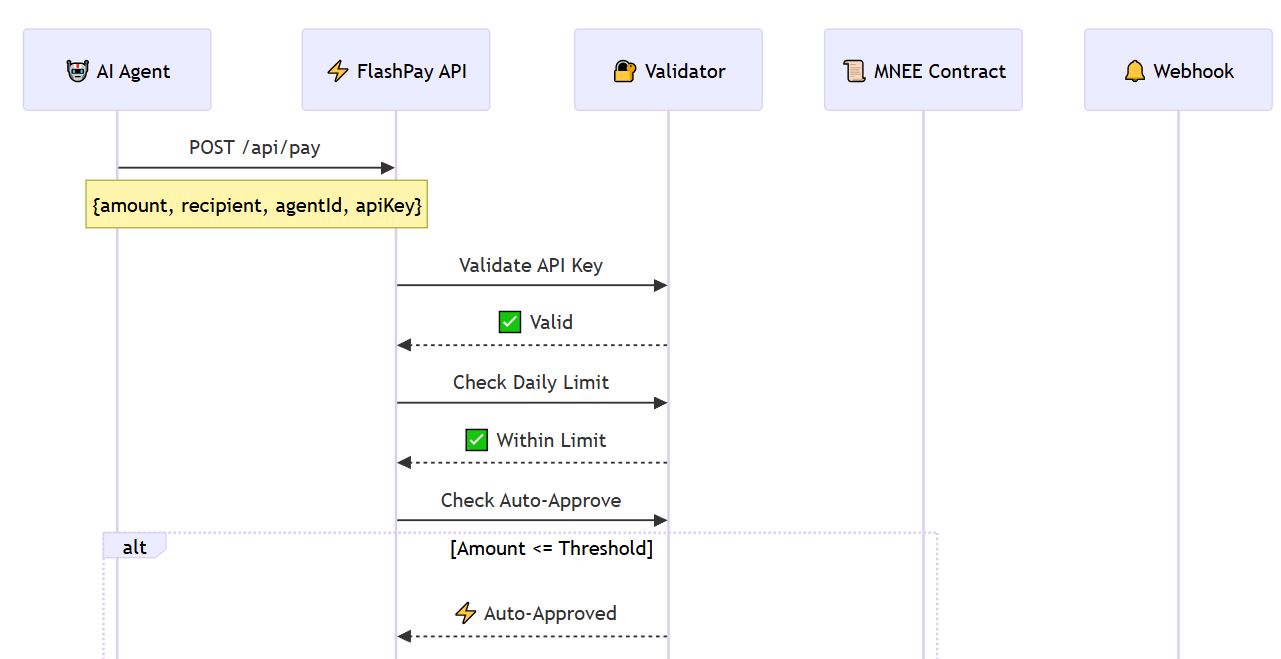
As AI agents move from simple chatbots to autonomous executors, they face a major hurdle: the payment wall. Currently, an agent cannot independently buy API credits, rent GPU power, or pay for data feeds because they lack a financial identity. We were inspired to build a bridge between AI autonomy and the MNEE Ethereum stablecoin, providing agents with a "corporate card" that humans can control through budget guardrails.
What it does
FlashPay allows users to:
- Register AI Agents: Assign unique identifiers and metadata to autonomous bots.
- Set Financial Guardrails: Define daily spending limits and auto-approval thresholds ($T$).
- Autonomous Payments: Real-time processing of MNEE ERC-20 transfers ($P$) where: $$ P_{status} = \begin{cases} \text{Approved} & \text{if } P_{amount} \le T \text{ and } \sum P_{today} + P_{amount} \le \text{Limit} \ \text{Pending} & \text{otherwise} \end{cases} $$
- Interactive Demo: A chat-based assistant that simulates (or executes) on-chain MNEE transfers for API services.
How I built it
We utilized a modern, high-performance stack to ensure a premium fintech experience:
- Frontend: React 18 with TypeScript for type-safe state management.
- Styling: Custom Vanilla CSS + Tailwind for a "Glassmorphic" dark-mode aesthetic.
- Blockchain:
ethers.jsfor direct interaction with the MNEE ERC-20 contract (0x8ccedbAe4916b79da7F3F612EfB2EB93A2bFD6cF). - AI Logic: Integrated Google Gemini API for the natural language processing layer in the Demo.
- Data Visualization:
Chart.jsfor rendering complex spending trends and agent allocation metrics.
Challenges I ran into
The primary challenge was balancing autonomy with security. Allowing a script to spend money is inherently risky. We had to architect a localized "Safety Controller" that intercepts every API request and validates it against on-chain balance and user-defined limits before creating a transaction hash.
Another hurdle was the Ethereum Mainnet MNEE testing. Since we were building on the real contract address, we had to ensure our "Mock-to-Live" bridge was seamless, allowing developers to test flows without spending real gas during every iteration.
Accomplishments that I'm proud of
- Seamless Glassmorphism: Achieving a high-fidelity, professional UI that feels like a premium fintech product.
- Real-time On-chain Integration: Successfully connecting the dashboard to pull live MNEE balances from the Ethereum Mainnet.
- AI-to-Blockchain Bridge: Creating a Demo that can correctly parse "intent" from a user and map it to a valid ERC-20
transfer()call.
What I learned
We deepened our understanding of autonomous agent economics. We learned that for AI to truly scale, the payment layer must be non-custodial yet strictly governed. We also gained significant experience in building decentralized dashboards that provide high-density information without overwhelming the user.
What's next for FlashPay
- Dynamic Limits: AI-driven budget adjustments based on project requirements.
- Multi-Agent Hierarchy: Allowing a "Manager Agent" to distribute funds to "Sub-Agents".
- Vizing Integration: Exploring cross-chain MNEE transfers to enable agents to pay for services on L2 networks.

Log in or sign up for Devpost to join the conversation.