Inspiration
It was the day of our networking exam. Honestly, we didn't study enough -- we procrastinated. Jon usually writes a series of basic flashcard style questions to test himself before the exam -- it usually works out well. When driving to school, Jon wanted to study. But how could he study safely when he needs to read the questions? There he discovered that he could copy and paste his study questions into an Apple note on his iPhone and tell Siri to read it to him! It worked .. kinda. Siri didn't give him enough time to respond to the questions before blurting out the answer. Enter Flash Talk.
What it does
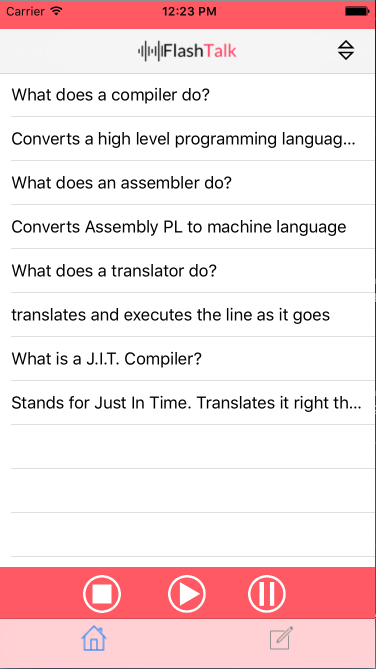
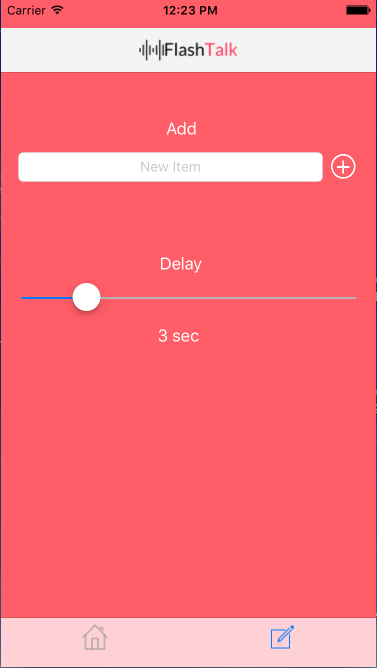
Flash Talk is a simple application with a simple purpose. To read what you tell it out loud. With an intuitive interface perfect for students studying for the big exam (like us), one could finally utilize their driving time/shower time/any-other-time-where-you-can't-sit-and-study. Since it was inspired by flashcards, a variable delay time is provided to give the user time to answer the question before hearing the correct answer.
How we built it
There are two elements of the app -- a web app and an iOS mobile app.
Franklin created this web app by using node.js and koajs in the backend, mongodb for database, and angularjs for frontend. It's an interactive and two-way data binding web app.
Jon used Xcode and Swift 2 to make Flash Talk on iOS. Since iOS allows for local storage, he did not need any APIs. He used a native speech library and basic data structures to implement the program.
Challenges we ran into
Development
Web: (in the words of Frankie) Due to the network issue, it's hard to reach the API documentation. It slowed down my progress a bit. The most challenge of this hackathon for me was to build a functional web-app from backend to frontend in one day and half. However, it's lots of fun.
iOS: (in the words of Jon)
I can admit that I was a noob in iOS. Most of my time was spent Googling and watching videos to get it done. Storage in iOS took me awhile to understand. Also, I unknowingly added a breakpoint to my code and thought my app was crashing. I really wanted to test the app on my iPhone but the Apple Developer site happened to be experiencing issues (just my luck huh?).
The Real Challenge
We originally had a team of 4 set from UNLV (Las Vegas) to attend the HackingEDU. Super psyched about our first hackathon, we went to our computer science department chair to ask for assistance in funding to get to San Mateo. Major flop. Long story short, we got no money. Two of the four backed out. Frankie and Jon -- two noobs, half a team, no money, in the middle of midterms -- felt we had to do this. And here we are. No Ragrets.
Accomplishments that we're proud of
We initially planned on just attending all the workshops and and walking out with a bunch of swag. Nope. Seeing the Bay Area developer culture, we were inspired and motivated to do something awesome. Despite it's simplicity, we are very proud to have completed a useful product in less than 48 hours. We never knew we had it in us.
What we learned
We've got some side projects to start: They don't teach this stuff at school. APIs, cloud services, frameworks -- so much more to learn!
Confidence: This team of two that our own computer science department wouldn't support had completed a project at our first ever hackathon. We are patting ourselves on the back.
Outlook: We learned that our dreams are set really high and there's a lot of competition -- but more importantly, we learned that they are within our reach.
California: It's the land where great developers congregate. Since we landed in San Francisco, we've heard tech lingo all around us. It's such an awesome culture that promotes innovation.
What's next for Flash Talk
Open-source it and put the iOS app on the App Store! We've got some fine-tuning and integration to do beforehand, though. This thing is going on our resume and will go down as the proudest achievement of our undergrad career!


Log in or sign up for Devpost to join the conversation.