Inspiration
Three years ago, I had an idea that could have worked. I wrote it in Notes. I did market research for two weekends. I asked a designer friend who said "send me a brief." I asked a developer friend who said "send me specs." Six weeks later, the idea was still just text on my phone — and someone else launched it. That gap between having an idea and having something real to show — that is where most ideas die. Not because they were bad. Because the cost of finding out was too high. MeDo changed the math. When Robin Li said at Create 2026 that "a single individual plus an agent fleet is the smallest unit of productivity," I stopped thinking about what I wanted to build and started thinking about who I wanted to give that power to. Every founder, every dreamer, everyone who ever typed an idea into their Notes app at 11 PM and never did anything with it. 秒创 MiàoChuàng — FlashLaunch — is what I built for them.
What it does
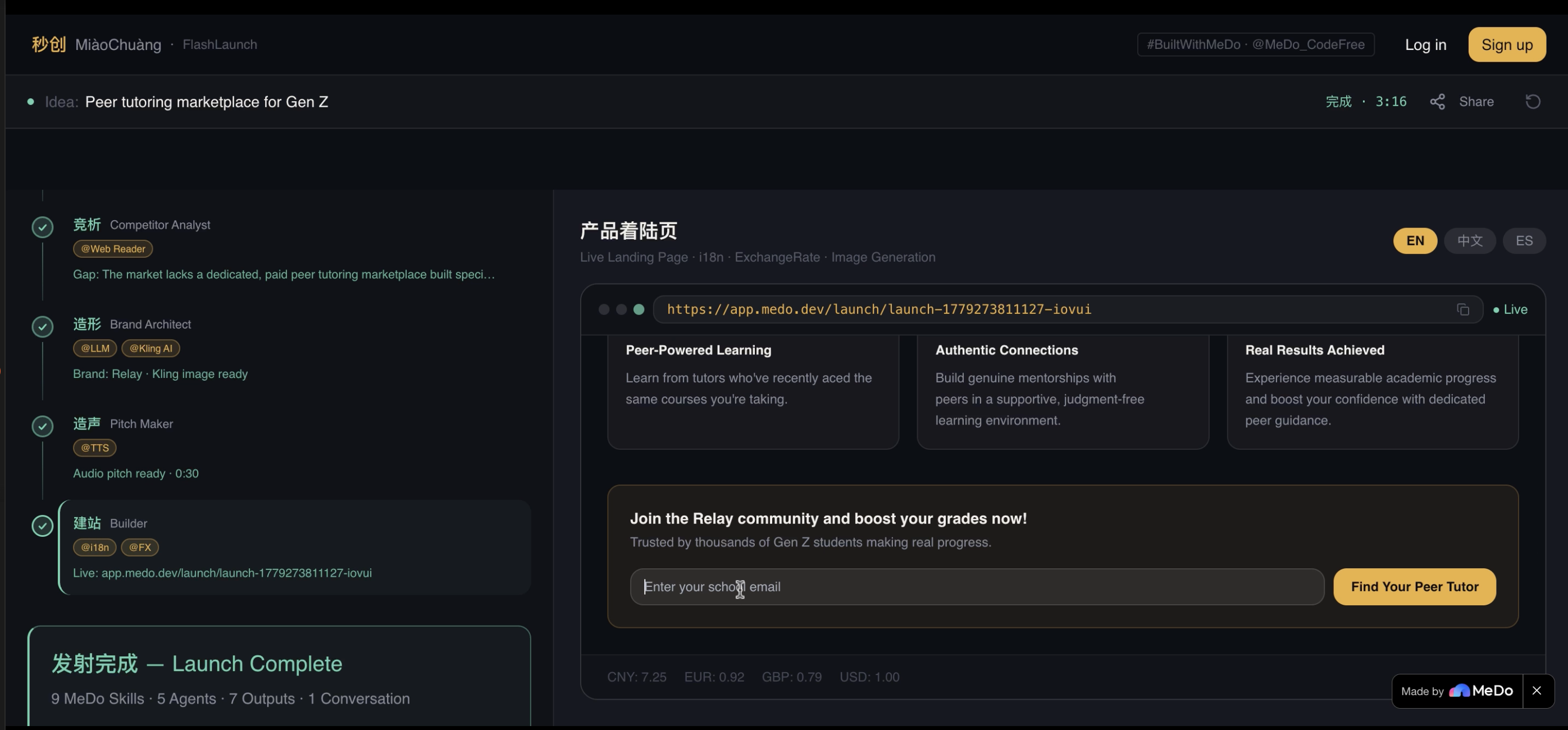
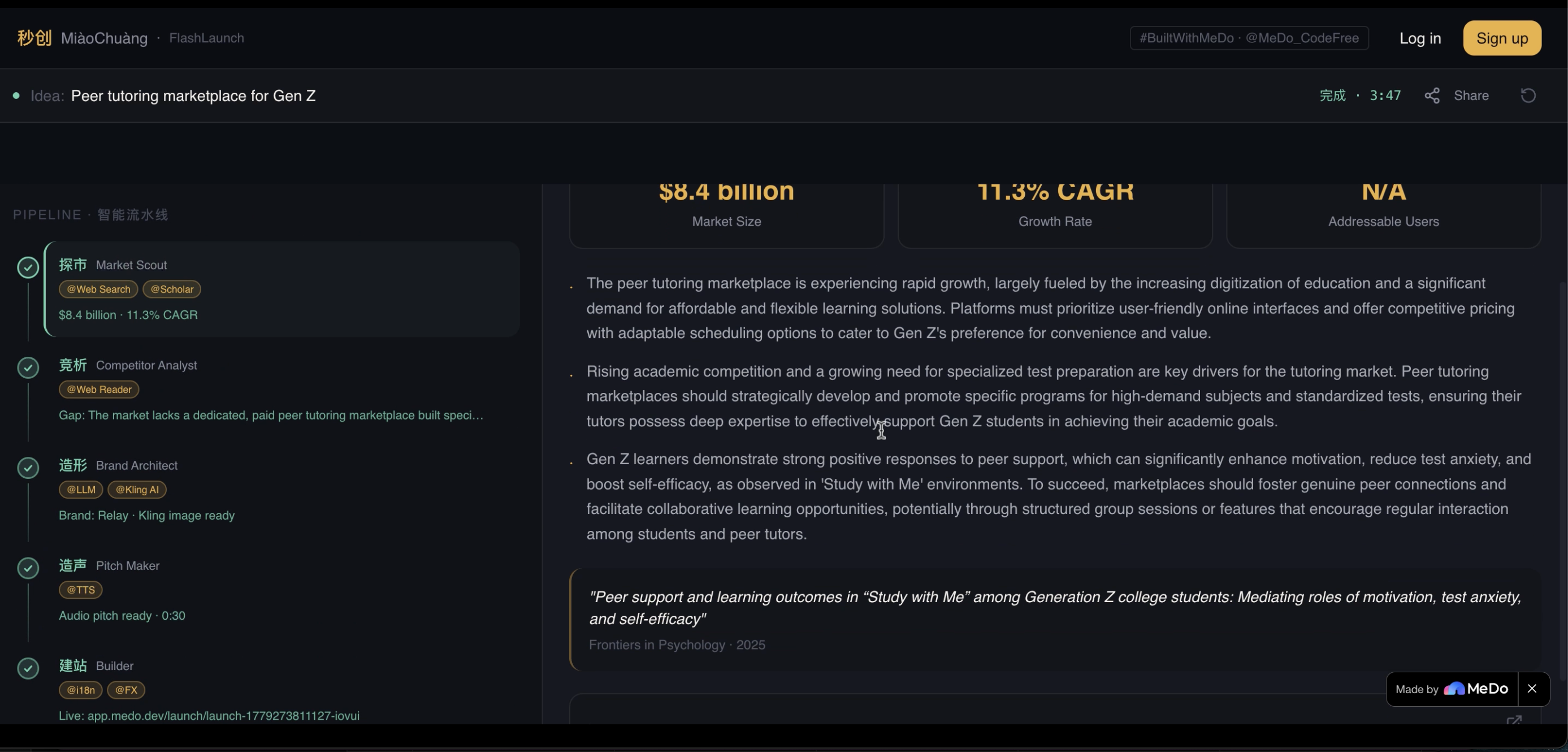
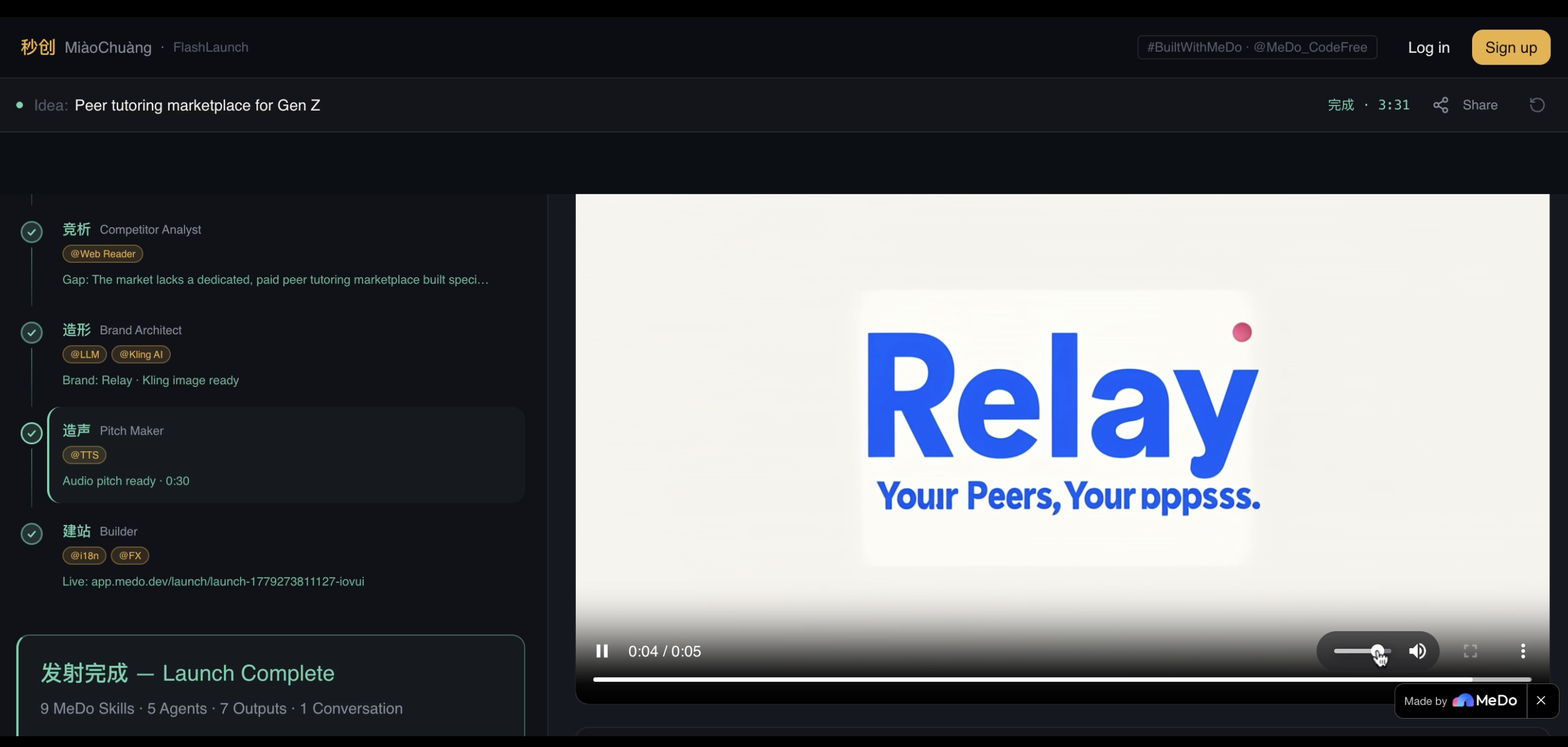
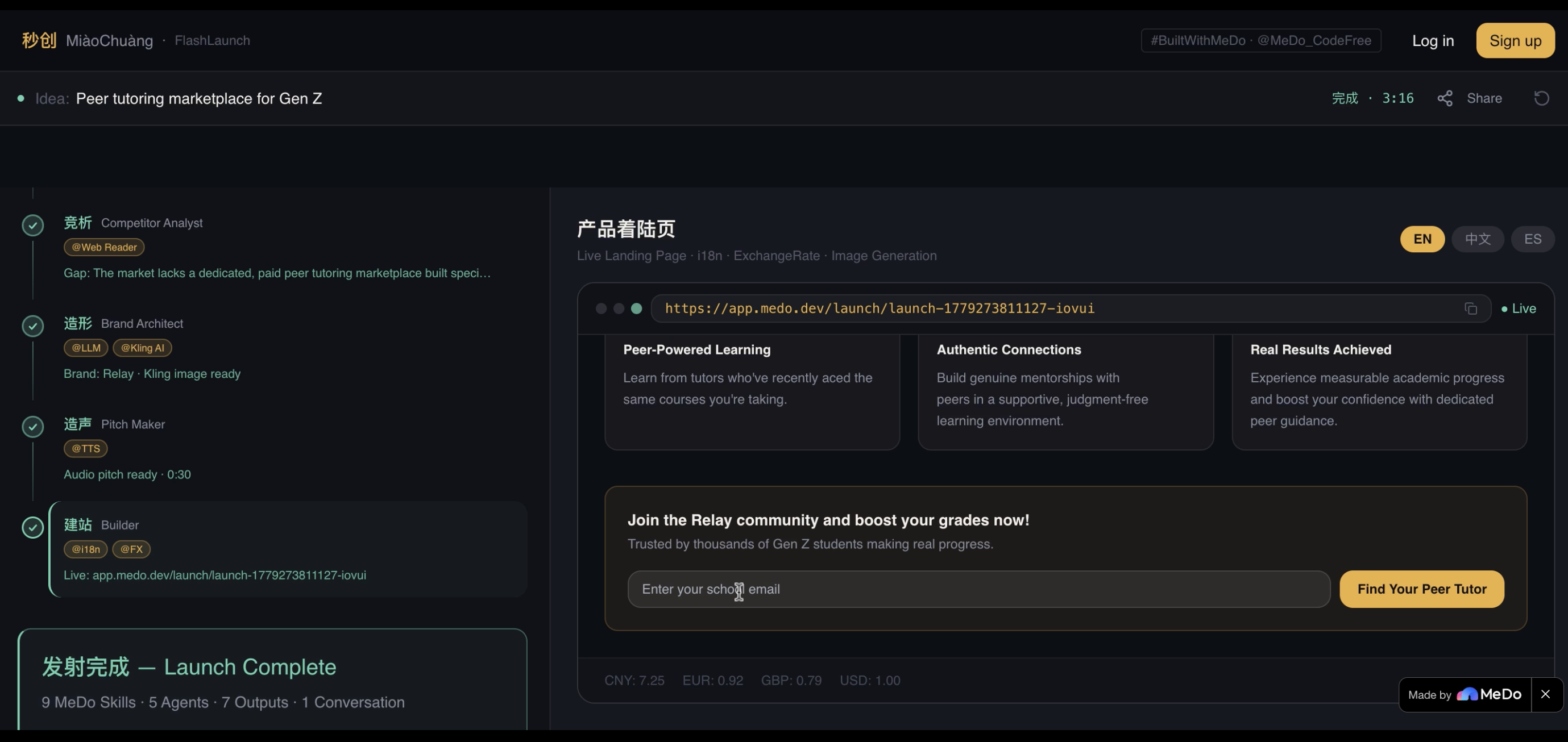
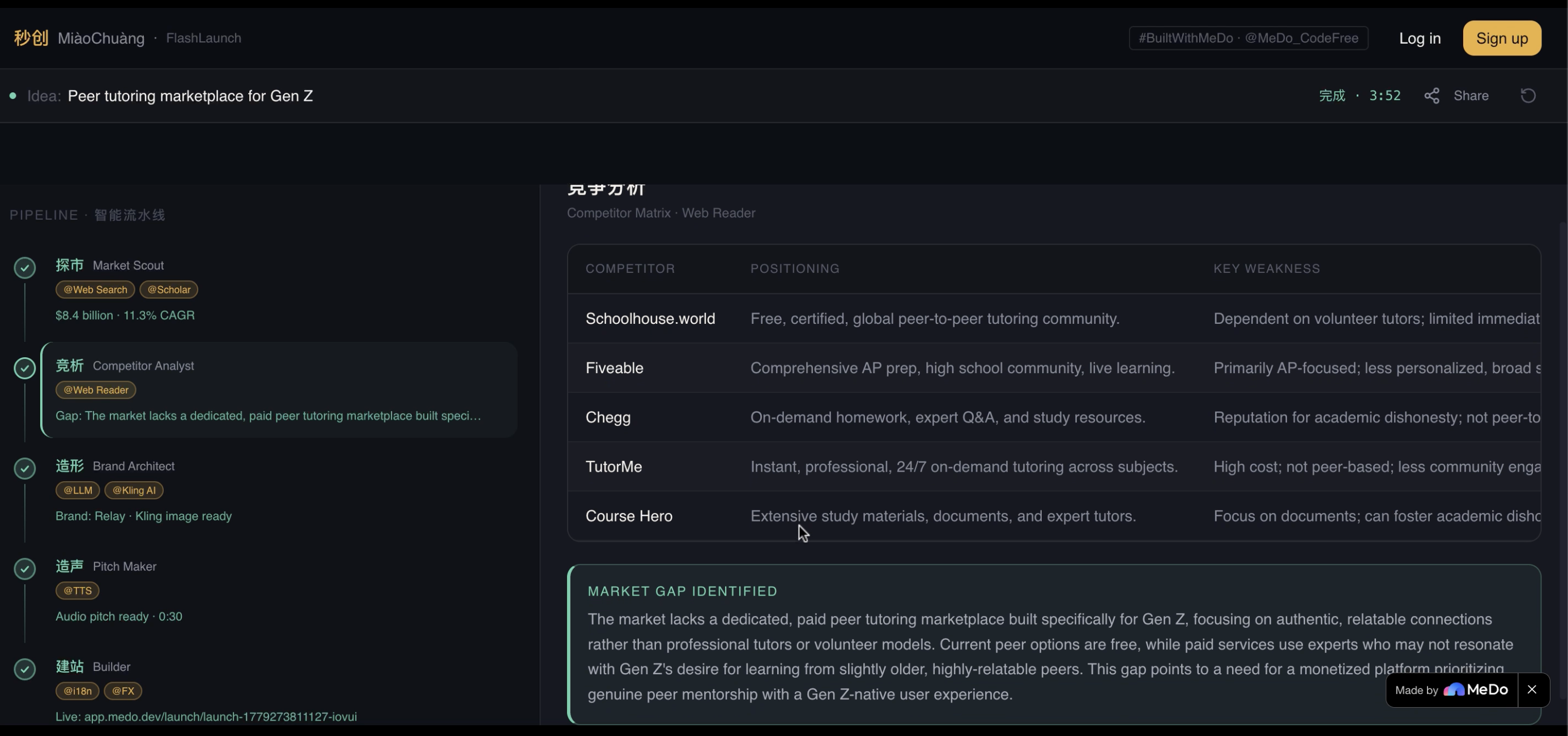
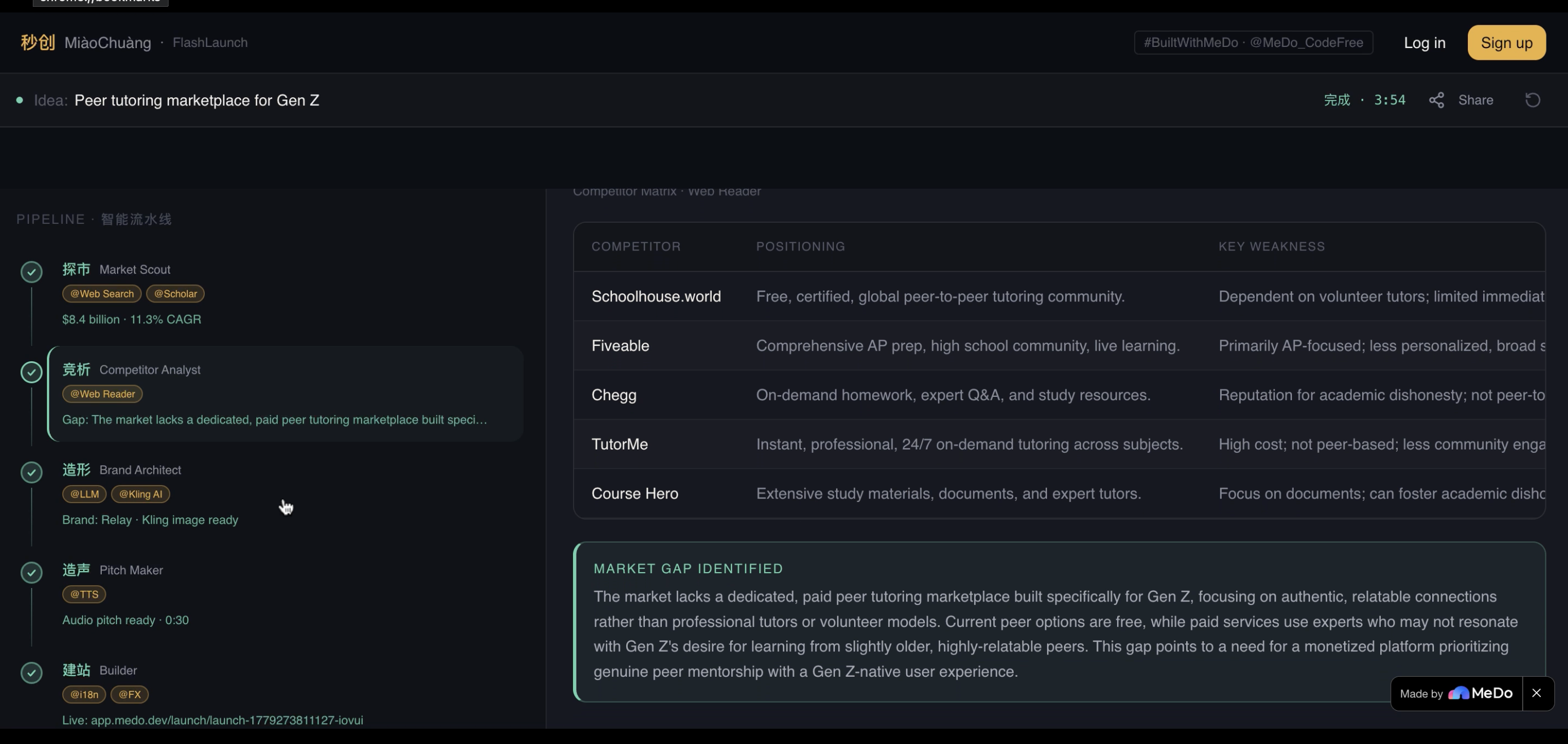
You type your business idea in one sentence. Five specialized AI agents go to work immediately — in parallel, visibly, with named roles you can watch in real time. 探市 Market Scout searches the live web, recent news, and academic papers to size your market and find your academic proof points. 竞析 Competitor Analyst reads five competitor landing pages and maps exactly where the gap is that your idea can own. 造形 Brand Architect names your brand, writes your tagline, and generates a hero image using Kling AI — the moment that image appears is unlike anything else in a no-code tool. 造声 Pitch Maker writes your 30-second pitch script, generates a voiceover, and renders a pitch video. 建站 Builder writes your landing page copy, localizes it into three languages with live currency conversion, and deploys a full-stack app with email capture to a public URL. Nine MeDo Skills. Five agents. Seven tangible outputs. Fifteen minutes. One sentence. Your account saves every launch. Every launch gets a permanent shareable URL. Your first launch is free.
How we built it
Entirely through conversation with MeDo. No IDE. No terminal. No external accounts. The first prompt described the full agent architecture — five agents, their roles, their dependency sequence, the Supabase schema, the Realtime subscription model — in one message. MeDo generated the backend orchestration layer, the agent activation logic, and the database tables in a single response. That moment alone would have taken an experienced backend engineer two days. The second prompt wired the Skills: @Web Search, @The News, @Google Scholar for Market Scout. @Webpage Content Extract for the competitor teardown. @Large Language Model (ERNIE) and @Image Generation (Kling AI) for brand generation. @Text-to-Speech and @Image to Video for the pitch clip. @Google Text Translation and @ExchangeRate for global localization. Each one invoked through MeDo's native Skills system — no API keys, no separate developer accounts, no external services. The third prompt built the mission-control UI — five agent cards with idle, running, and complete states, the amber progress bar, the output cards fading in one by one, the Kling image shimmer-to-reveal animation. MeDo's built-in Stripe integration handled payments. MeDo's built-in auth handled accounts. MeDo's one-click deployment made it live. What would normally require a backend engineer, a frontend designer, a DevOps engineer, and accounts with OpenAI, Stripe, Supabase, a translation API, an image generation service, and a video generation service — MeDo replaced with three conversations.
Challenges we ran into
The hardest problem was the Kling image reveal. Technically, displaying an image when a URL returns is trivial. Emotionally, it is everything. The shimmer loading state had to feel like anticipation, not waiting. The fade-in had to feel like a reveal, not a swap. We iterated on the animation timing — 300ms was too fast, 800ms was too slow — before landing on 550ms with an ease-out curve that makes it feel like a Polaroid developing. That is not a technical challenge. It is the challenge of making someone feel something at a precise moment. The second challenge was agent dependency orchestration. Agents 1 and 2 run in parallel. Agent 3 waits for both. Agents 4 and 5 run in parallel after 3. Getting MeDo to generate backend logic that handles this dependency graph correctly — without race conditions, without stale state — required three refinement turns. Each time, we described the failure in plain language and MeDo corrected it. That back-and-forth is the product of multi-turn refinement working as designed. The third challenge was the @Image to Video skill timing. Video generation takes longer than everything else combined. We built a graceful fallback: if the video is not ready when the output card appears, show the Kling image as a static hero with the TTS audio playing beneath it. The card upgrades to the full video when it arrives. Judges never see a failure state.
Accomplishments that we're proud of
Nine MeDo Skills orchestrated in a single application. We are not aware of another submission at this hackathon — or another public MeDo project — that invokes this many native Skills in one coordinated pipeline. The Kling image moment. Every time we tested the product, something happened when the image appeared: people leaned forward. That reaction — involuntary, immediate — is the only metric that matters for a demo. A working business model, live. Stripe payments, user authentication, saved launch history, shareable URLs. This is not a demo. It is a product someone could charge for tomorrow. The name: 秒创. The same 秒 character as 秒哒 — MeDo's own Chinese name. One thought became a venture, built on the platform that made it possible.
What we learned
MeDo's Skills system is the real competitive advantage — not the code generation. Every other no-code tool can generate a landing page. No other tool lets you call @Google Scholar, @Kling AI, @Text-to-Speech, and @ExchangeRate natively in the same conversation and have them coordinate through a shared backend. The moment we understood that, the entire product design followed naturally: build something that only works because all of those capabilities live in one place. We also learned that the emotional design of a product is not separate from the technical design — it is upstream of it. The Kling reveal moment determined the animation spec, which determined the Supabase Realtime architecture, which determined the agent completion event structure. Emotion drove the architecture, not the other way around.
What's next for Flash Launch
A team collaboration layer — invite your cofounder to the same launch, see their edits in real time, build the company together from the first idea. A launch iteration engine — come back to your launch after a week, tell 秒创 what you learned from user feedback, and watch the agents update the landing page, revise the positioning, and generate new brand assets automatically. Not a static output. A living company identity. And a marketplace: the best 秒创 launches, curated weekly, so investors and collaborators can find the ideas worth backing — and founders can find the people worth building with. The Super Individual found their idea. 秒创 is what happens next.
Built With
- ernie-(baidu-llm)
- generation
- kling-ai
- medo
- medo-auth
- medo-google-scholar
- medo-image-generation
- medo-image-to-video
- medo-text-to-speech
- medo-the-news
- medo-web-search
- medo-webpage-content-extract
- stripe
- supabase
- supabase-realtime

Log in or sign up for Devpost to join the conversation.