-
-
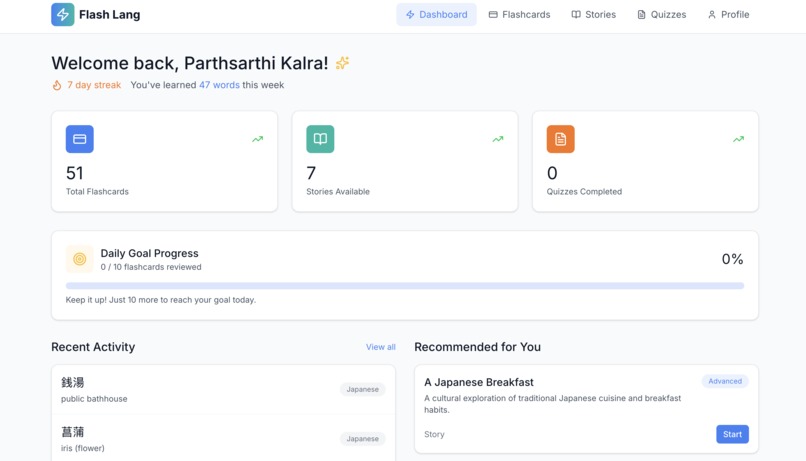
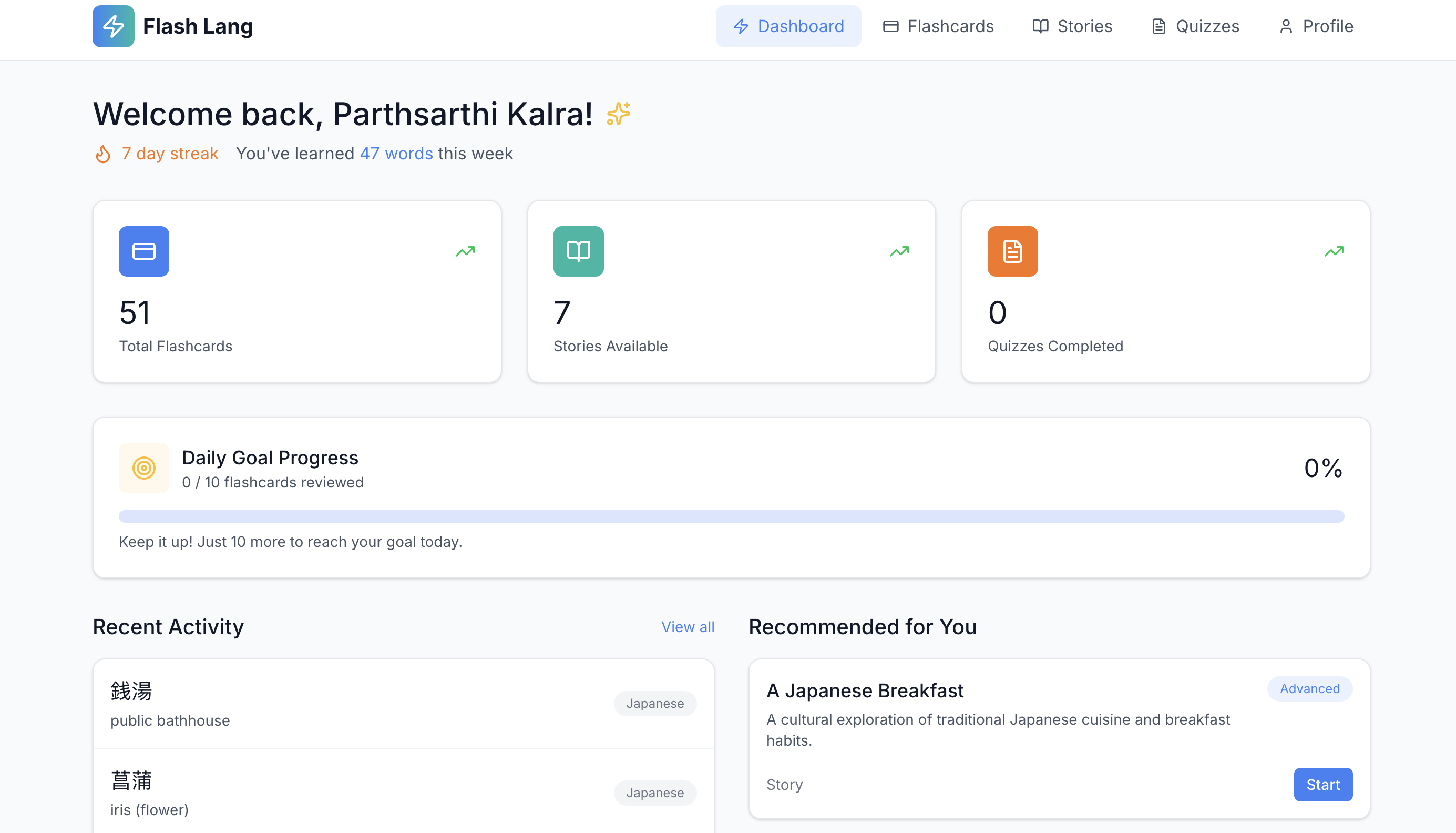
Dashboard shows you your progress and recommended tasks.
-
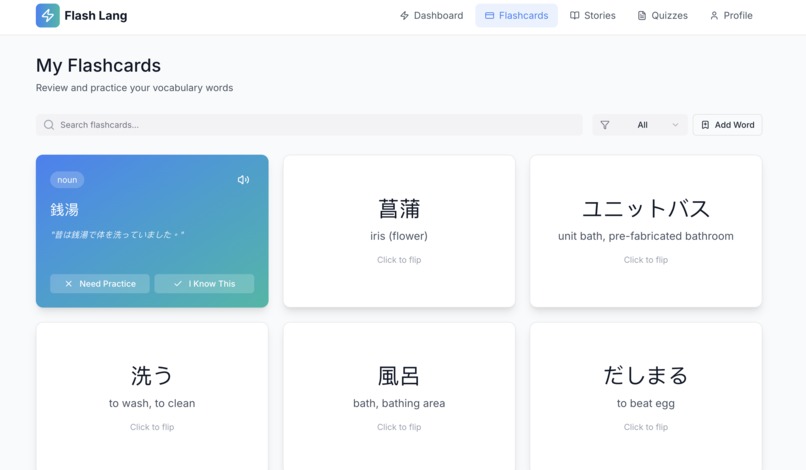
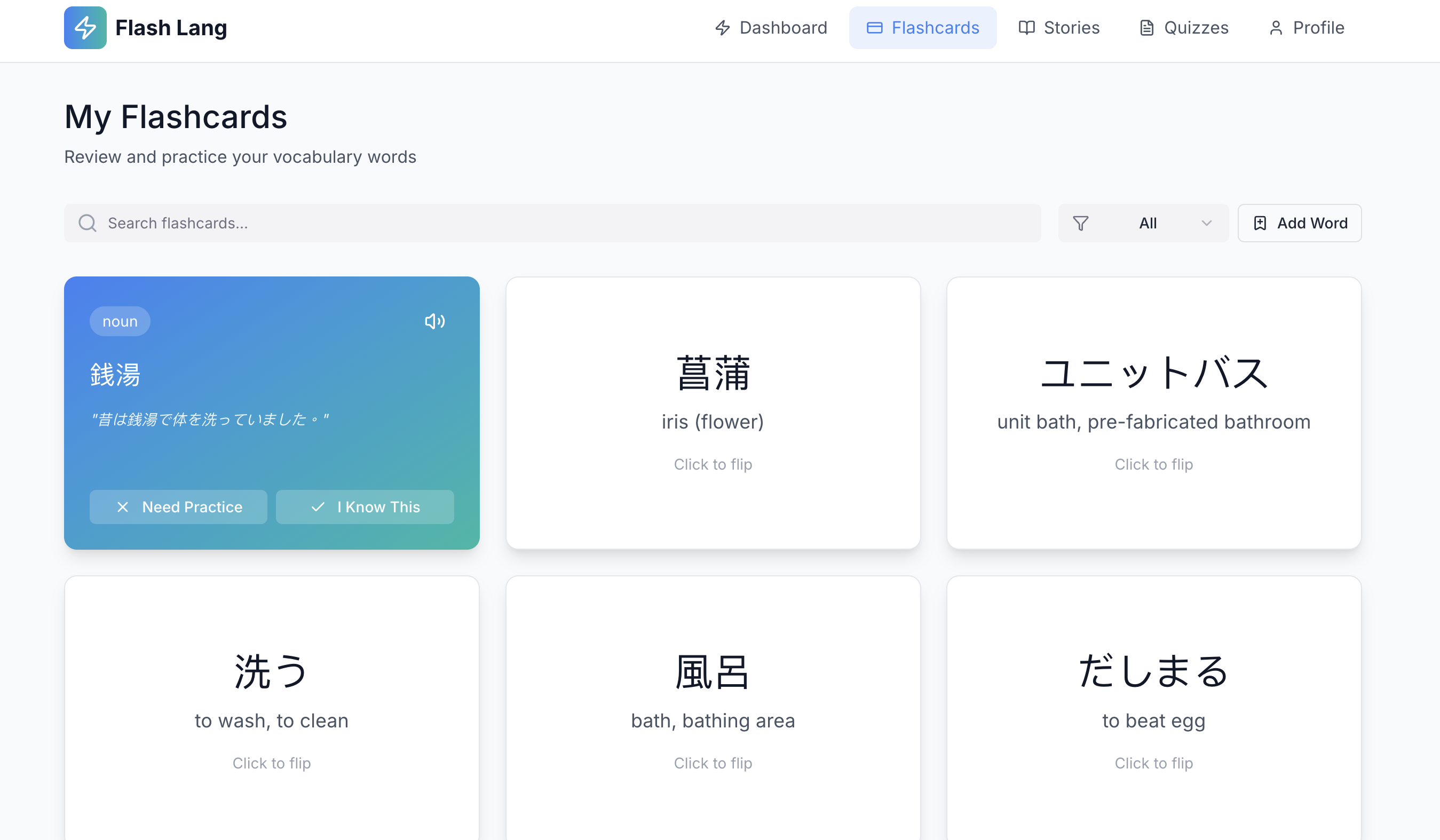
Review flashcards that are automatically generated for you through your browsing.
-
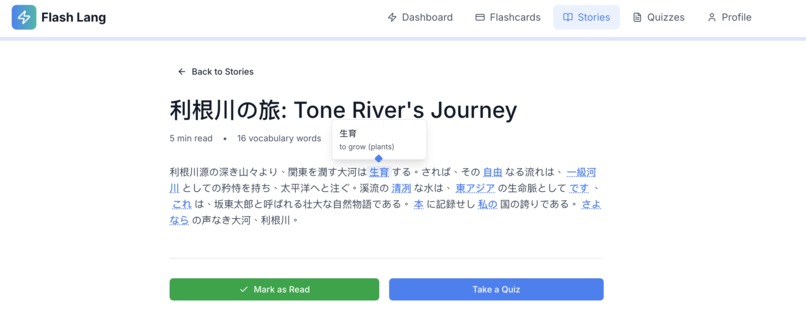
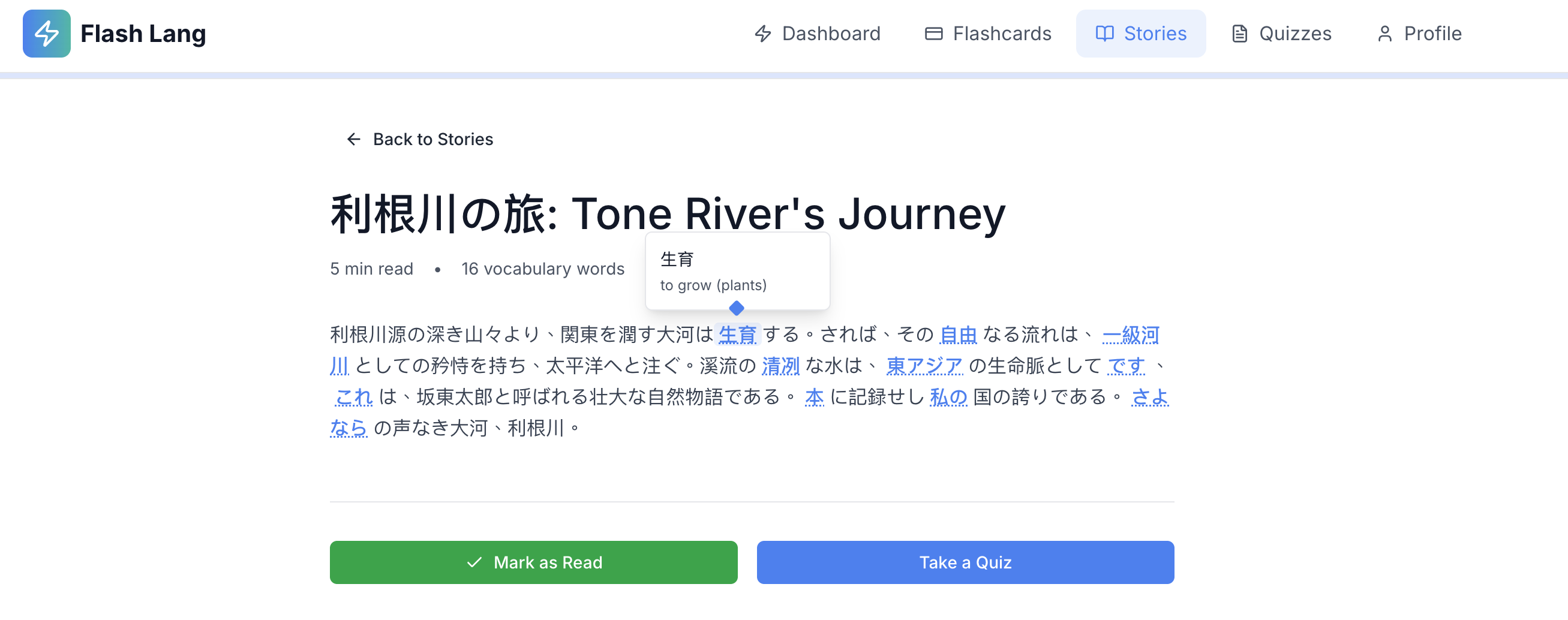
Flash Lang automatically creates tailored stories using context from your recent activities.
-
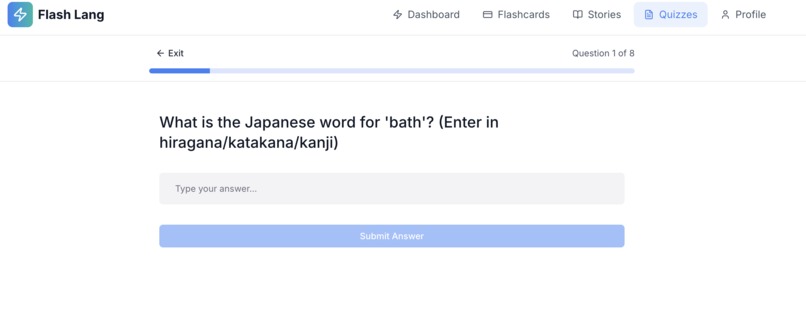
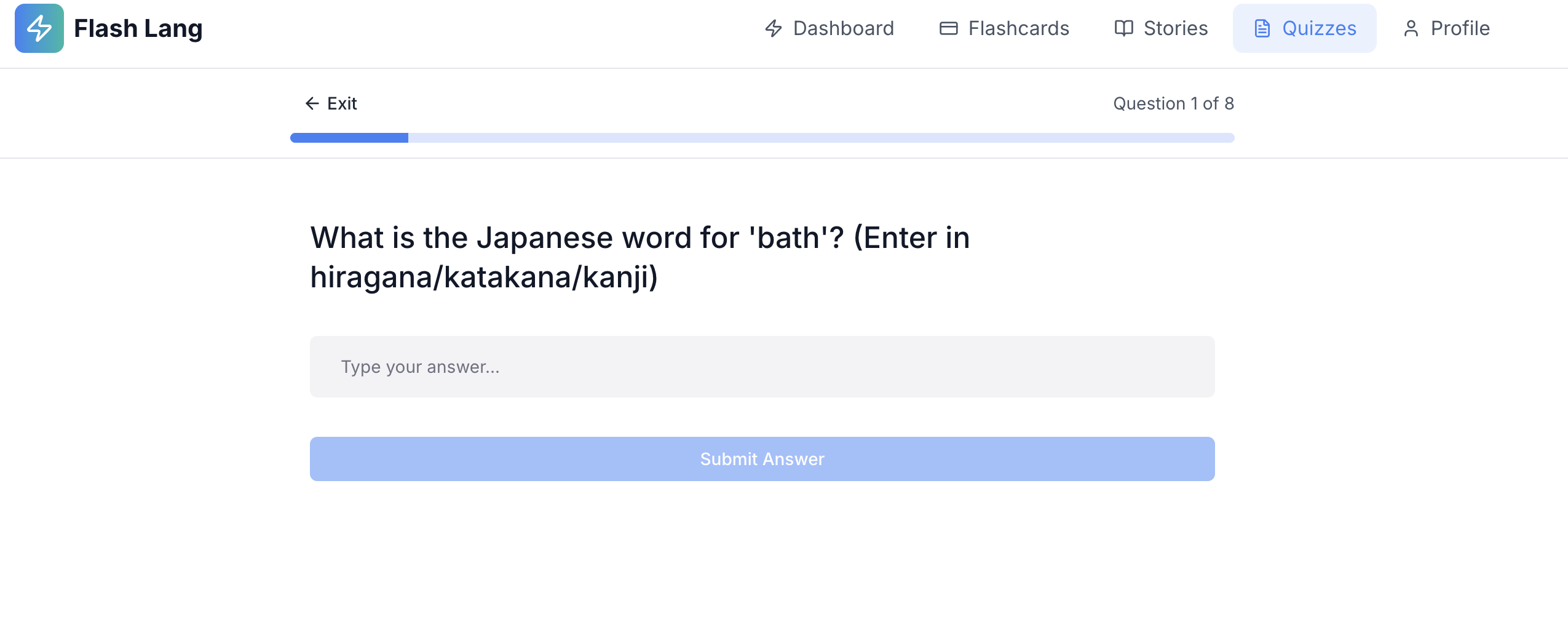
Quizes are necessary to test your knowledge!
Inspiration
Our teammate Parth has been learning Japanese for over two years. Along the way, he noticed how much time gets consumed by routine tasks like creating flashcards, logging new vocabulary, finding reading material at the right level. Time that could otherwise go toward actual, meaningful study.
That frustration sparked the idea for Flash Lang: an AI-powered language-learning ecosystem that automates the tedious groundwork, so learners can focus on what actually matters — immersion and comprehension. By using the content you've recently been reading and watching on the web as live context, Flash Lang doesn't just generate learning material, it generates the right learning material, tailored precisely to where you are in your journey.
What It Does
Flash Lang is far more than an automatic flashcard and quiz generator. At its core, it's a closed learning loop:
- The browser extension detects target-language content as you browse, translates it in context, and silently logs vocabulary and concepts you encounter
- Those encounters automatically populate your flashcard deck using spaced repetition
- An AI story generator weaves your recent vocabulary into readable, level-appropriate narratives to reinforce retention
- A progress dashboard tracks your streak, weak areas, and growth over time
The result: every tab you open becomes part of your lesson.
How We Built It
We divided responsibilities across the team — one member owned the browser extension, another handled frontend development, and others focused on backend integration, deployment, and UI. Our stack included a React frontend, a Python/Node backend for AI generation and data handling, and a Chrome extension for in-browser context capture.
The AI story and quiz generation pipeline was built on top of a large language model API, with prompts conditioned on the user's known vocabulary list and recent browsing context to ensure output was always level-appropriate.
Challenges We Ran Into
Deployment proved to be our biggest technical hurdle. We initially planned to use Vercel for the frontend, but persistent build errors forced us to pivot to Netlify — a last-minute switch that tested our adaptability under pressure.
On the team side, mismatches in comfort levels with certain technologies led us to migrate from Next.js to vanilla React, ensuring everyone could contribute effectively without bottlenecks. These weren't setbacks so much as recalibrations, the kind that every real-world software project demands.
Accomplishments We're Proud Of
We shipped a fully working prototype that demonstrates the complete immersion loop end-to-end: browse a webpage in your target language → extension captures context → flashcards are generated → AI story reinforces vocabulary → quiz tests retention. Seeing that pipeline work cohesively as a team was genuinely rewarding.
What We Learned
This project was a masterclass in shipping software as a team. Beyond the technical skills — deploying full-stack apps, integrating LLM APIs, building browser extensions — we learned how much communication and documentation matter. On a multi-person project, undocumented decisions and unclear ownership create friction fast. Those lessons are now deeply internalized.
What's Next for Flash Lang
Flash Lang isn't just limited to language learning, the core idea spans to learning and education across all areas. The way we envision the immersion process for Flash Lang is applicable to any area where human beings need consistent focus and immersion to master a field.
Built With
- fastapi
- minimax
- neon
- netlify
- python
- railway
- react
- typescript
- vite

Log in or sign up for Devpost to join the conversation.