Inspiration
One in three university students who enroll never graduate. The signals that predict this outcome already exist—scattered across LMS platforms like Canvas and Brightspace in the form of grades, submission timestamps, and engagement patterns. The problem is not data scarcity, but the absence of real-time monitoring and actionable intelligence. We built Flare to close that gap: a system that detects risk as it emerges, not after it is too late.
What it does
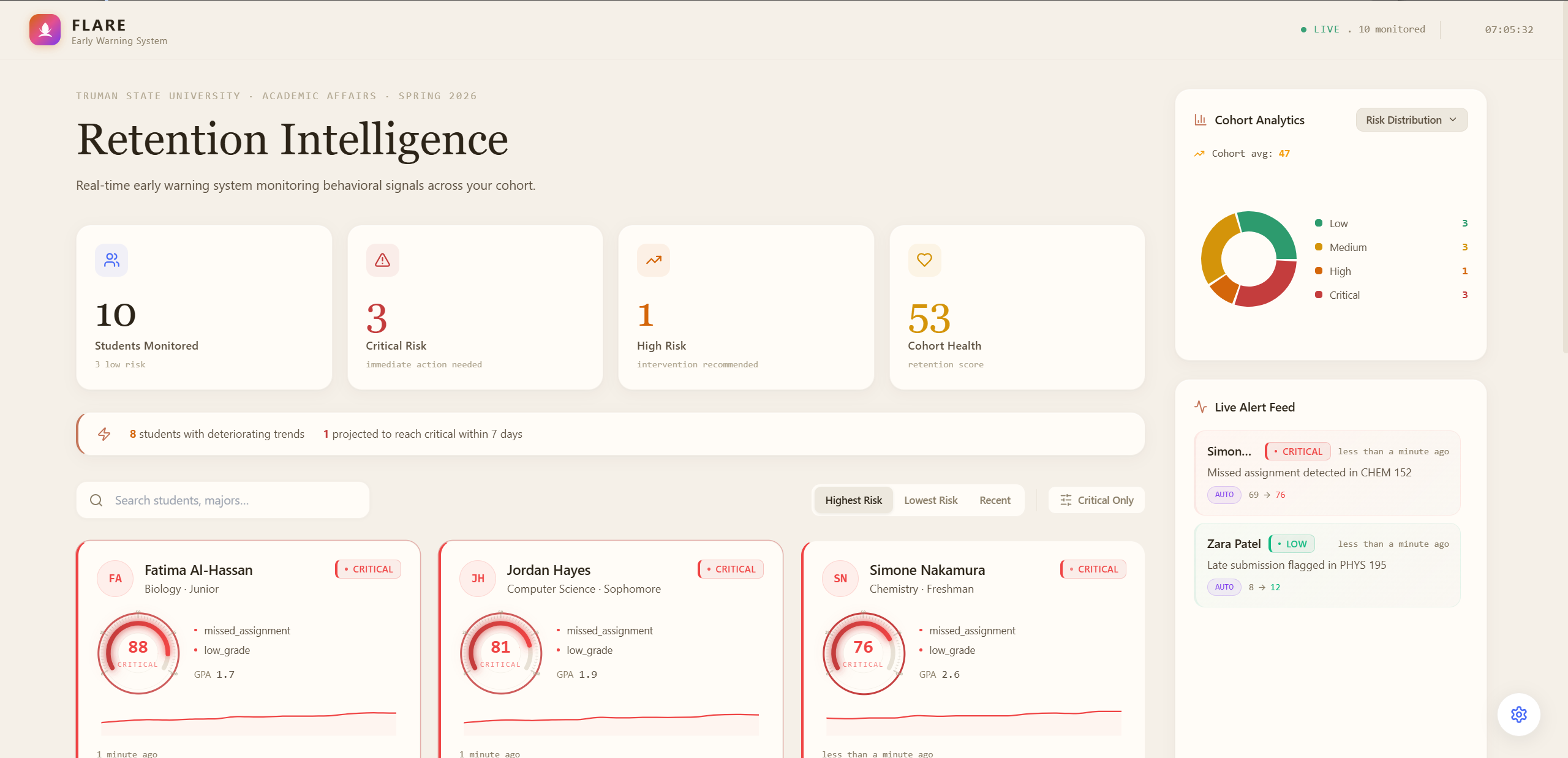
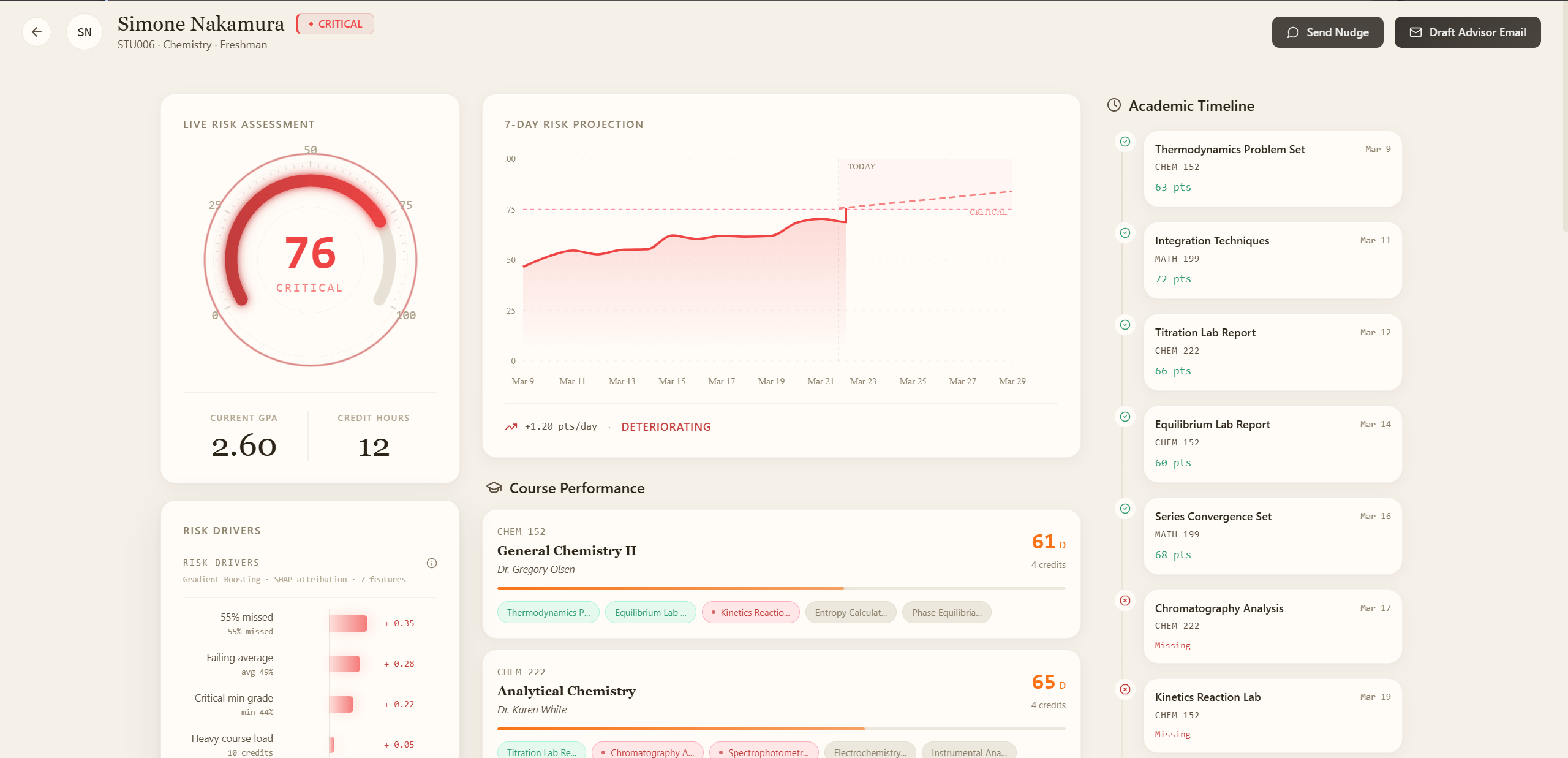
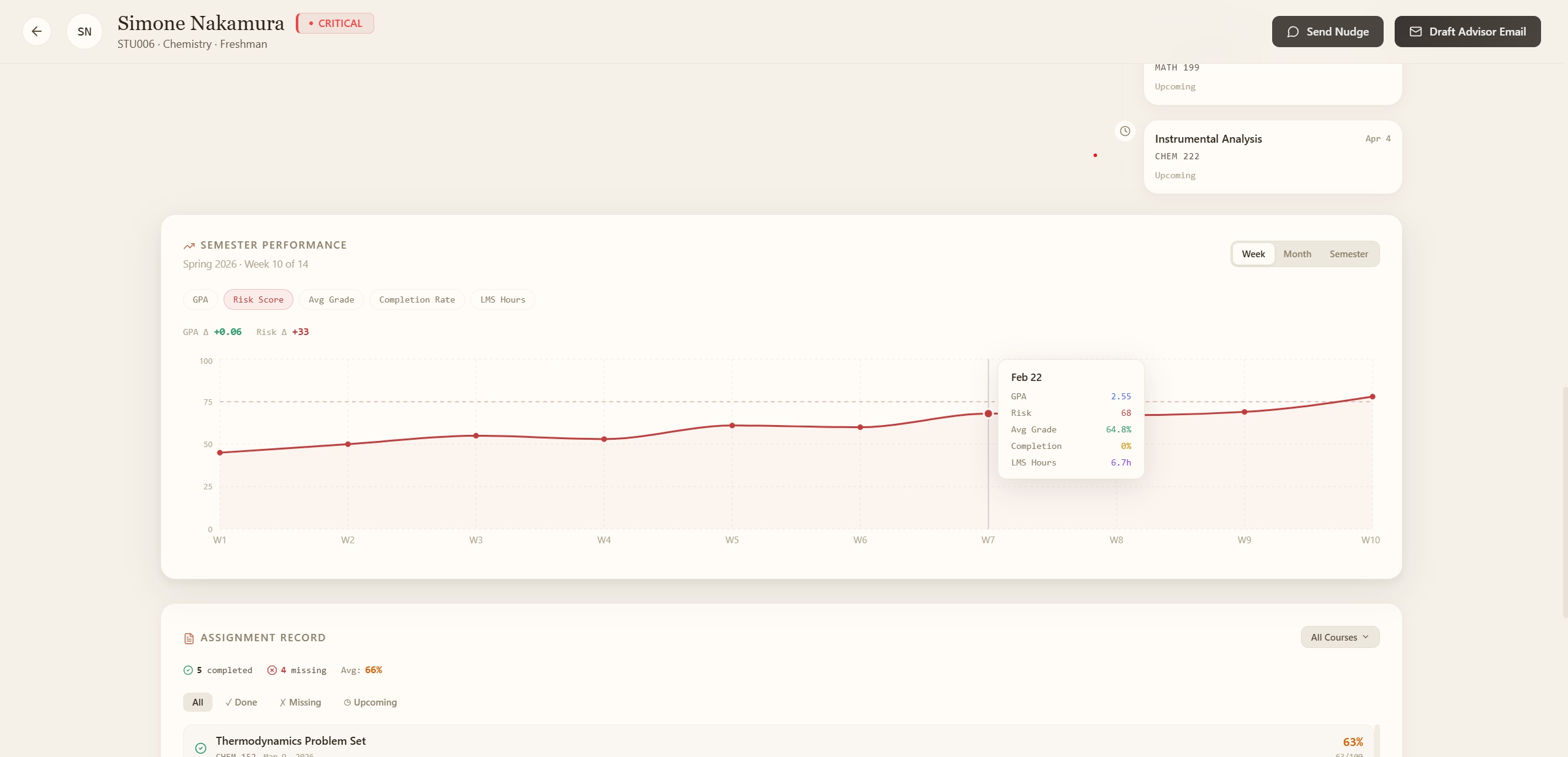
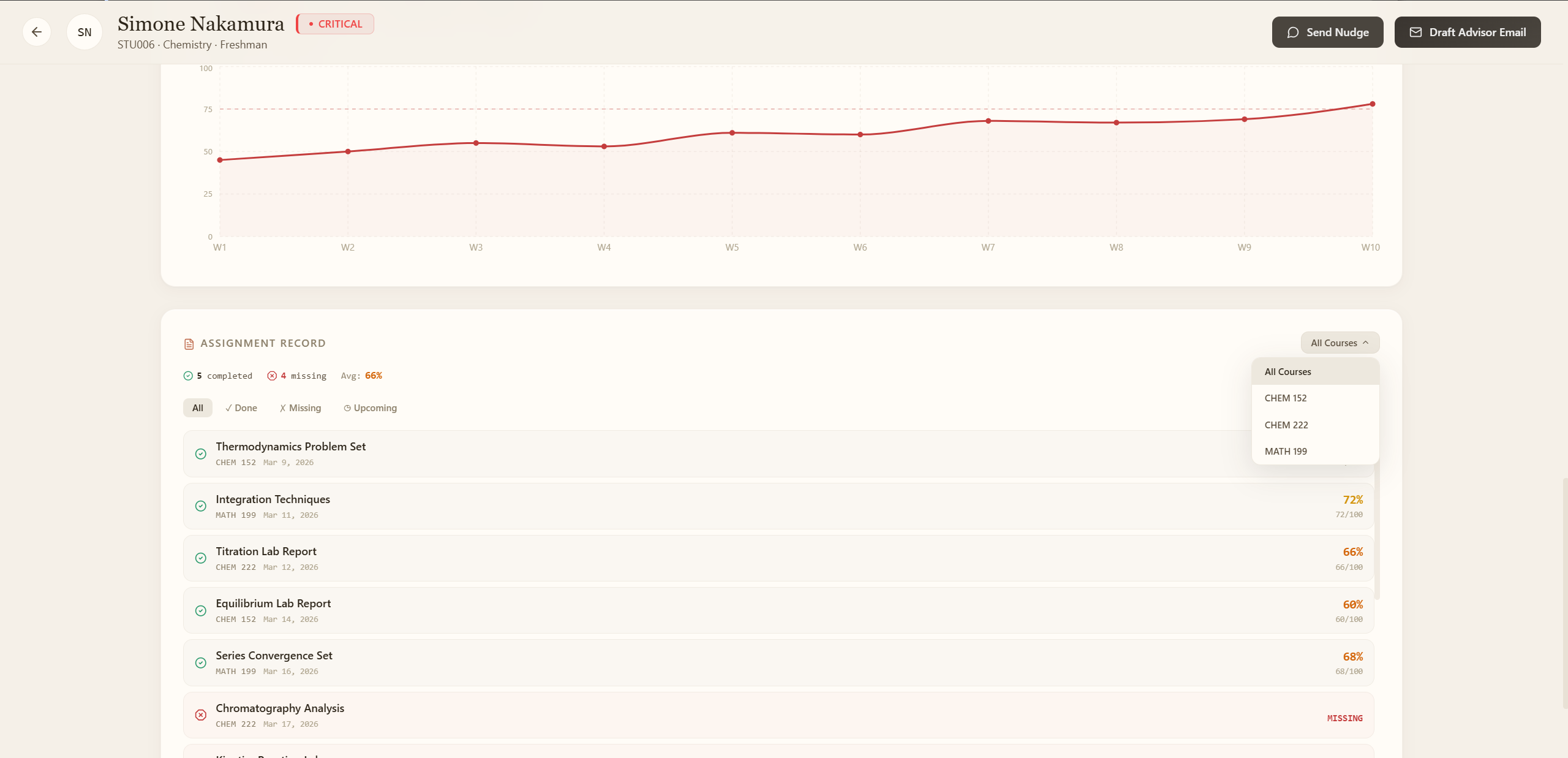
Flare continuously ingests live LMS data and transforms it into a real-time risk score for every student. A gradient-boosted ensemble model evaluates behavioral signals and outputs a probability of academic risk.
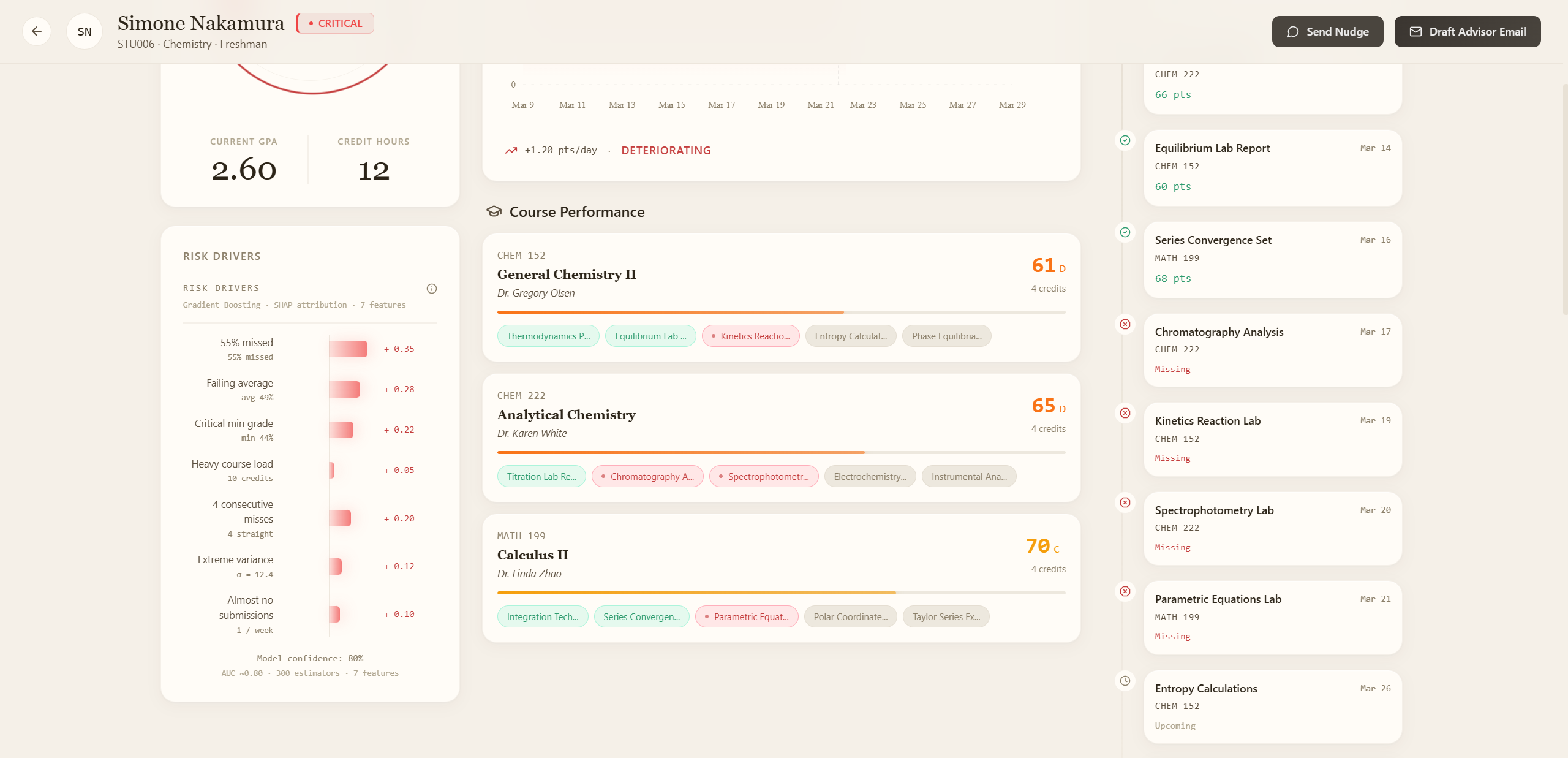
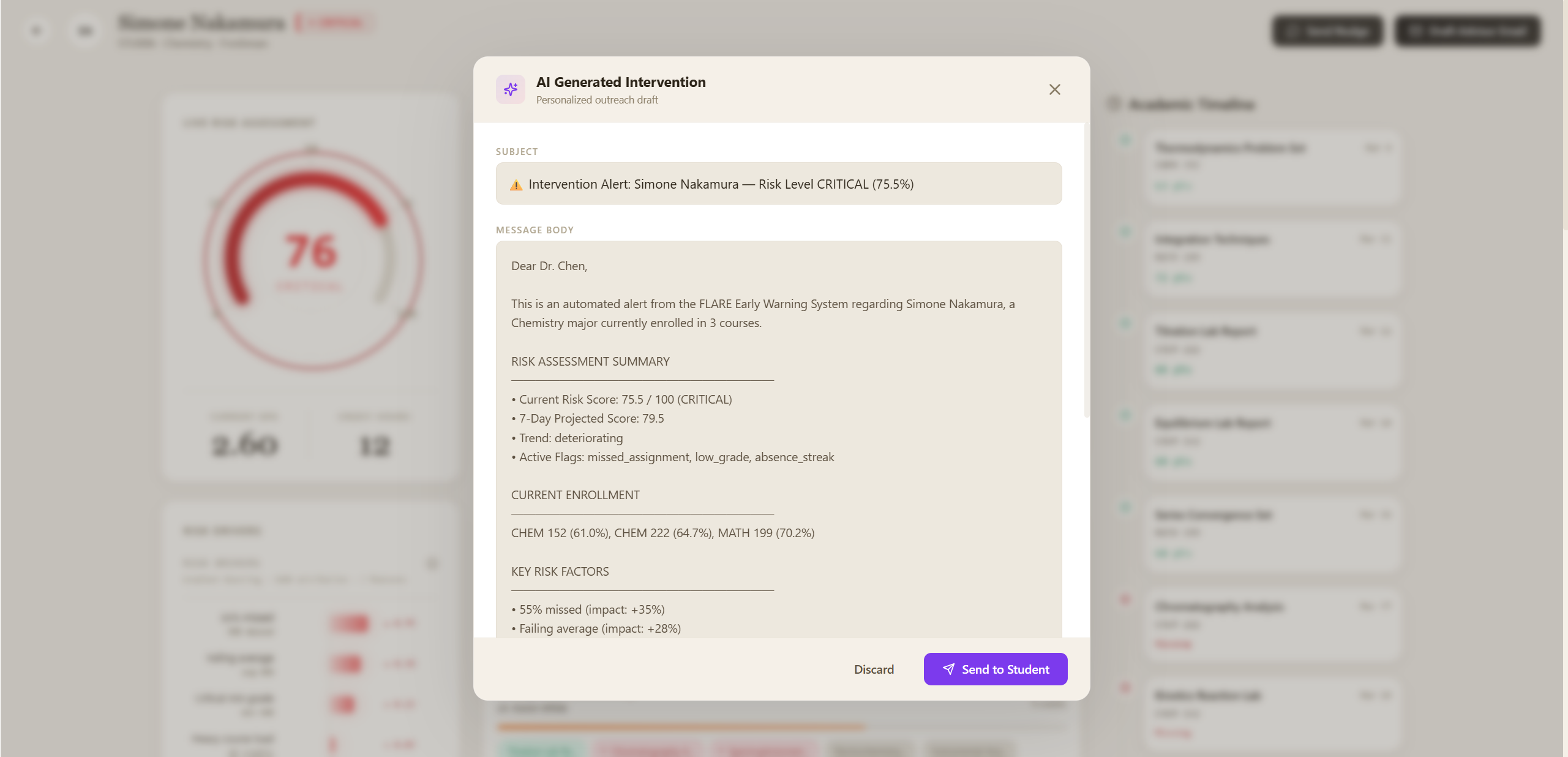
Each prediction is fully explainable using SHAP, breaking down exactly which factors contributed to the score. When risk crosses a threshold, Flare generates structured, context-aware intervention recommendations using an LLM.
All updates propagate instantly through a WebSocket pipeline, ensuring advisors see changes the moment they occur.
How we built it
The system is built as an event-driven pipeline:
LMS APIs (Canvas, Brightspace) are polled for state changes
A feature engine computes 7 behavioral metrics per student
A Gradient Boosting Classifier (300 estimators) produces a risk score
SHAP TreeExplainer generates feature-level attributions
A linear regression model projects short-term risk trajectory
Results are stored in a SQLite audit database
A WebSocket server broadcasts updates to all connected clients
For intervention generation, structured student context is injected into an LLM (Claude/GPT), which produces advisor-ready communication grounded in the model’s outputs.
Challenges we ran into
Real-time consistency : Keeping ingestion, inference, and UI state synchronized under continuous updates.
Compliance : Maintaining FERPA-defensible design with auditability and controlled data exposure.
System boundaries : Ensuring the LLM remains a rendering layer, not a decision-maker.
Data realism : Generating synthetic data that reflects real student behavior.
Accomplishments that we're proud of
Achieved an AUC of ~0.80 on held-out data, competitive with academic retention models
Built a fully real-time, event-driven pipeline with sub-second updates
Delivered per-prediction explainability using SHAP, not approximations
Created a complete audit trail of every prediction and intervention
Clean separation of responsibilities: model (decision), SHAP (explanation), LLM (communication)
What we learned
Training a model is NOT fun
What's next for Flare
Test at Truman State


Log in or sign up for Devpost to join the conversation.