-
-
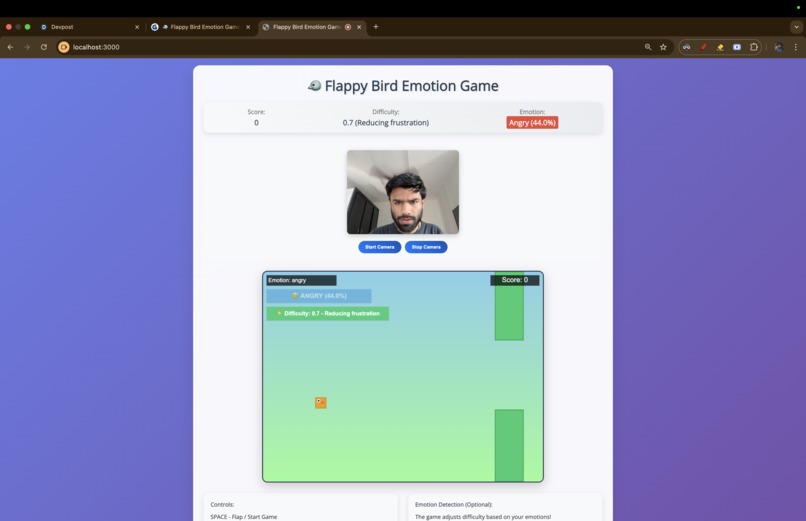
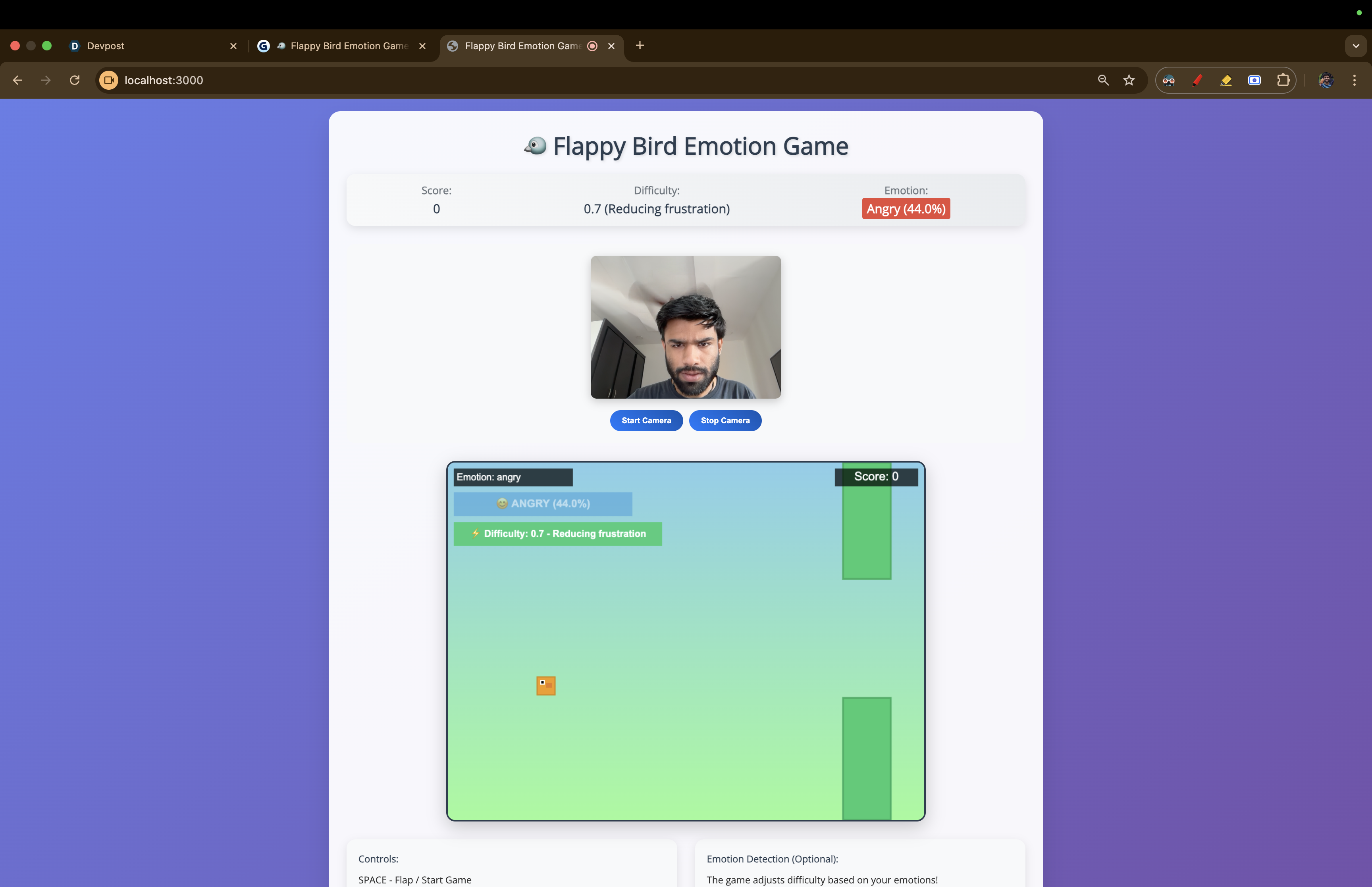
Angry Emotion Predicted: The Game becomes easier !
-
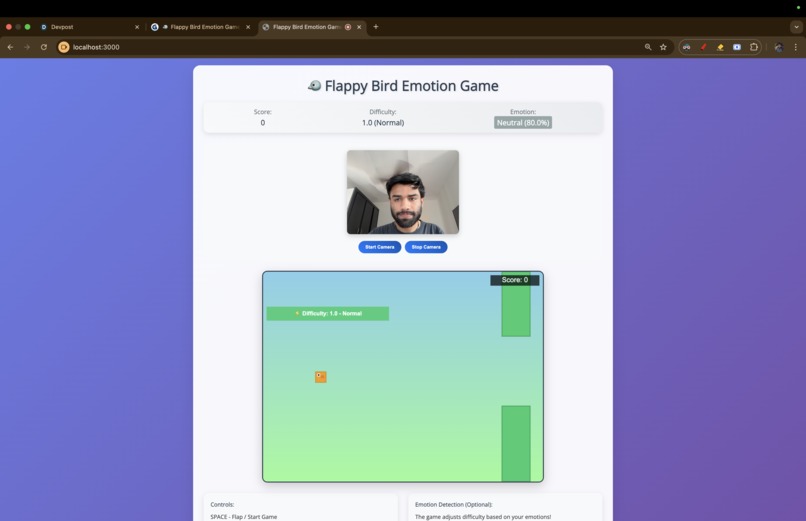
Neutral Emotion Predicted: The Game continues with normal difficulty !
-
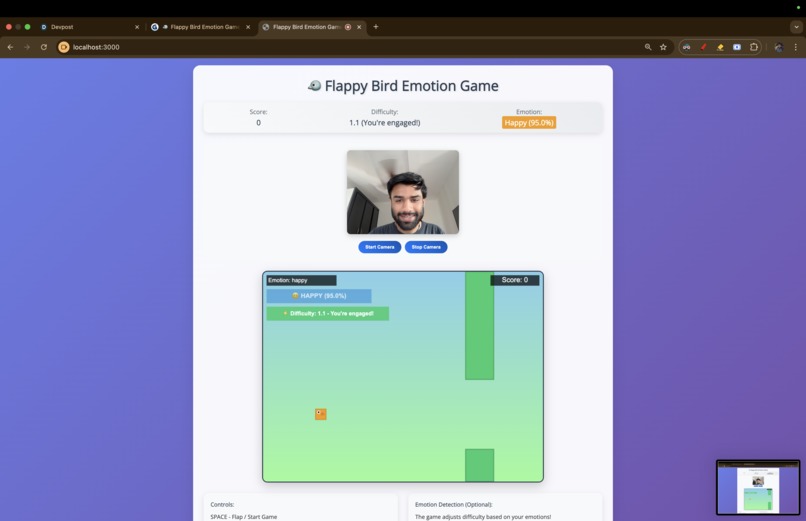
Happy Emotion Predicted: The Game becomes lot harder !
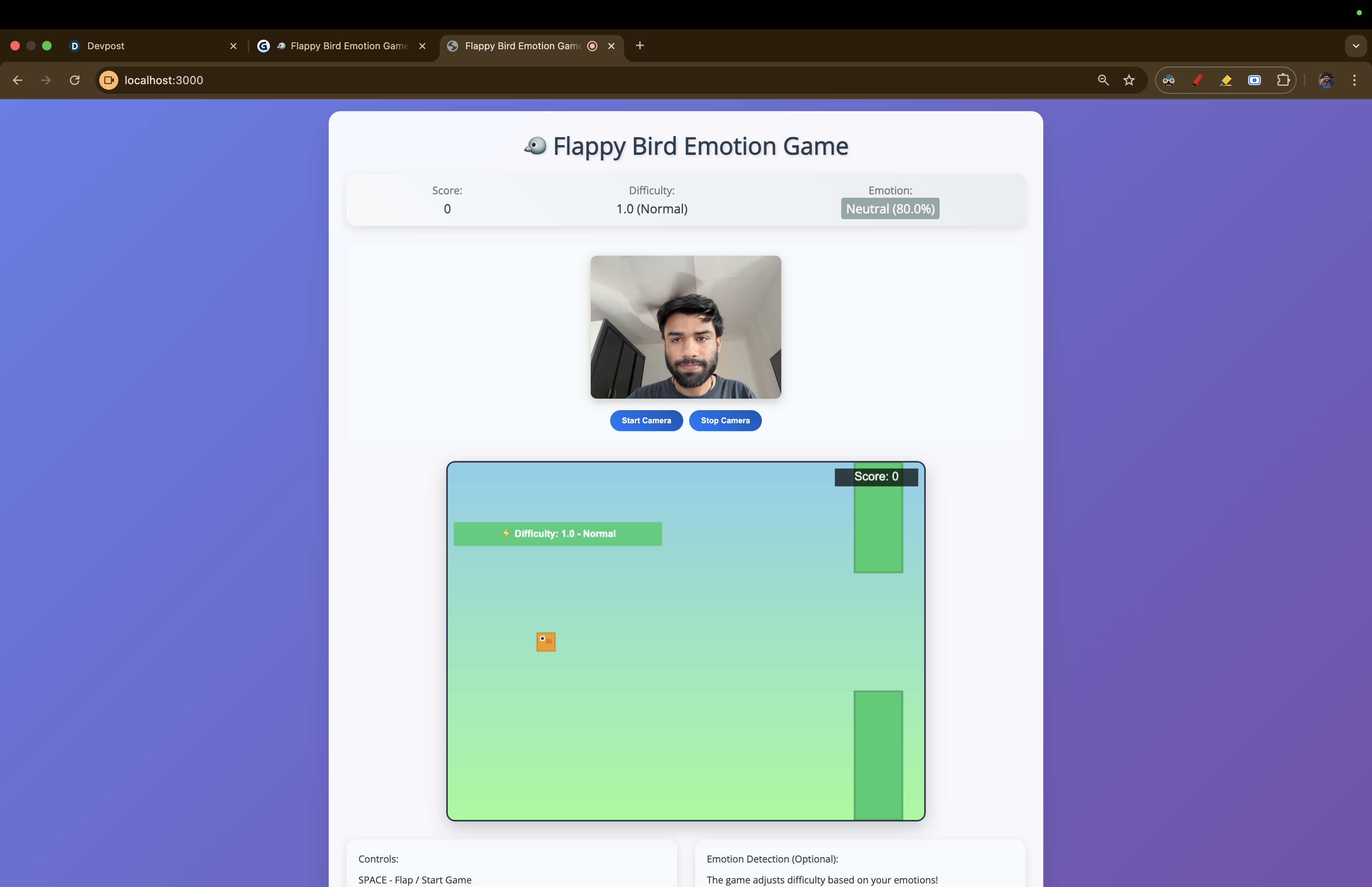
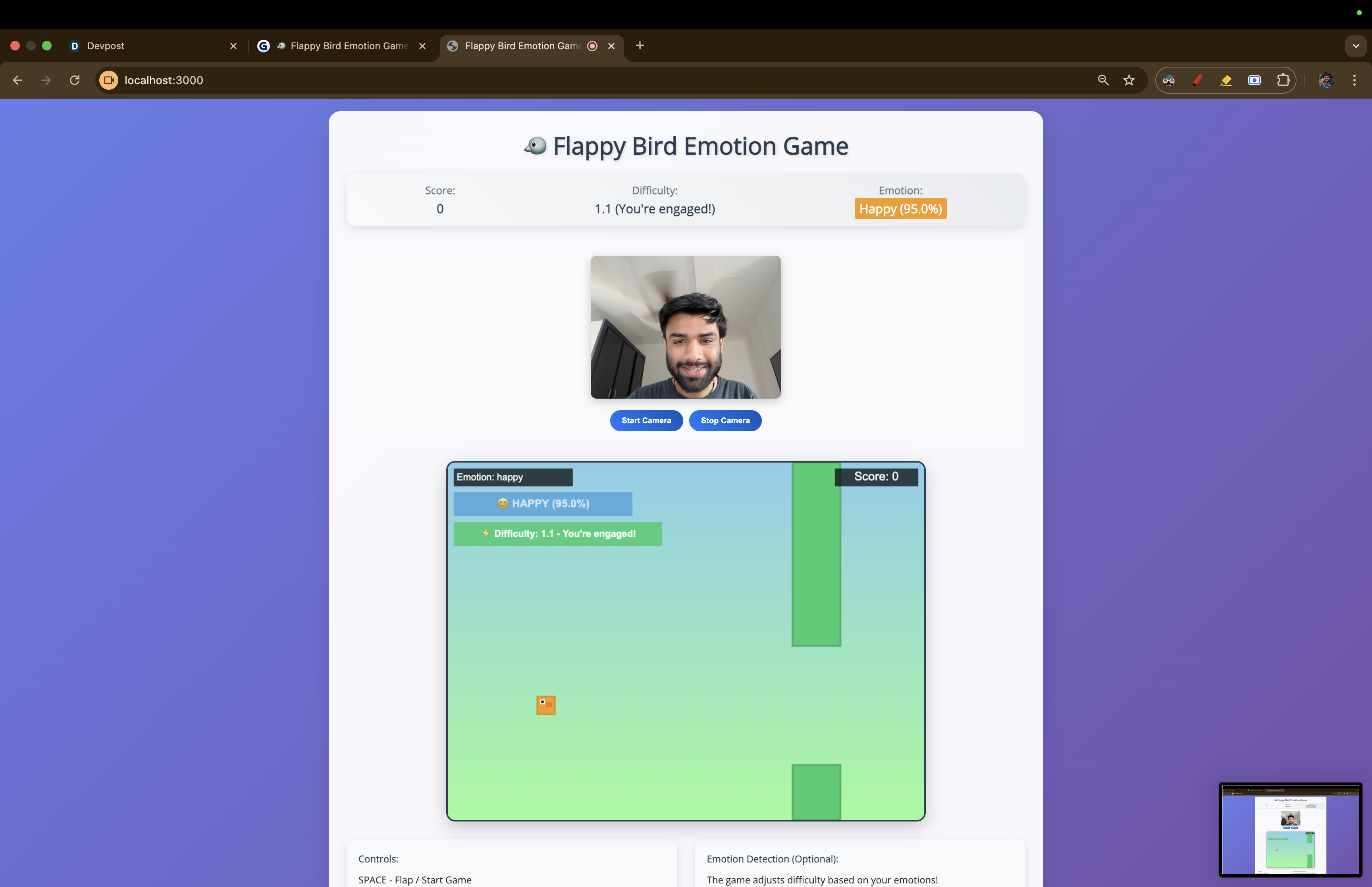
What Inspired Me
I always wanted to make games that can understand how players feel. When I was playing games, I noticed that sometimes I would get frustrated and the game would become too hard, or I would be bored and it would be too easy. I thought, "What if the game could see my face and adjust itself?"
That's how I got the idea for the Flappy Bird Emotion Game. I wanted to create a game that uses artificial intelligence to read emotions from your face and change the difficulty accordingly.
What I Learned
Building this project taught me so many things:
Deep Learning: I used a Convolutional Neural Network (CNN) architecture. The model takes 48x48 pixel grayscale images as input and outputs probabilities for each emotion. I learned about layers, activation functions, and how to prevent overfitting.
Docker: I learned to containerize the application so it can run anywhere. This was important for deployment.
Real-time Processing: I figured out how to capture video from the webcam, process frames in real-time, and send them to the ML model without making the game lag.
How I Built It
The project has three main components:
1. Custom ML Model I trained a CNN model using TensorFlow/Keras. The model architecture:
- Input: 48x48x1 grayscale images
- Convolutional layers with ReLU activation
- MaxPooling layers
- Dropout for regularization
- Dense layers with softmax output
- 7 output classes (emotions)
The model was trained on the FER2013 dataset and achieved around 85% accuracy on the test set.
2. Game Engine I built a Flappy Bird clone using HTML5 Canvas and JavaScript. The game includes:
- Bird physics with gravity and flapping
- Pipe generation and movement
- Collision detection
- Score tracking
- Adaptive difficulty system
3. Emotion Integration The game captures frames from the webcam every few seconds, sends them to the ML service, and adjusts difficulty based on the detected emotion:
- Happy: Slightly harder (player is engaged)
- Sad: Easier (supportive gameplay)
- Angry: Much easier (reduce frustration)
- Fear: Easier (reduce stress)
- Neutral: Normal difficulty
Challenges I Faced
Model Training: The biggest challenge was getting the custom model to work properly. At first, the model was overfitting and giving poor predictions. I had to experiment with different architectures, add dropout layers, and use data augmentation.
Real-time Performance: Making the emotion detection work in real-time without affecting game performance was tricky. I had to optimize the image processing and reduce the frequency of emotion checks.
Browser Compatibility: Getting the webcam to work across different browsers was challenging. Some browsers have different APIs for accessing the camera.
Deployment: Deploying a multi-service application with ML models was complex. I had to learn Docker and figure out how to package everything together.
Technical Details
The emotion detection works like this:
- Webcam captures video frames
- Frames are converted to grayscale and resized to 48x48
- Images are normalized (0-1 range)
- Custom CNN model predicts emotion probabilities
- Game adjusts difficulty based on the highest probability emotion
The difficulty adjustment affects:
- Gravity strength
- Flap power
- Pipe gap size
- Pipe movement speed
- Pipe spacing


Log in or sign up for Devpost to join the conversation.