-
-
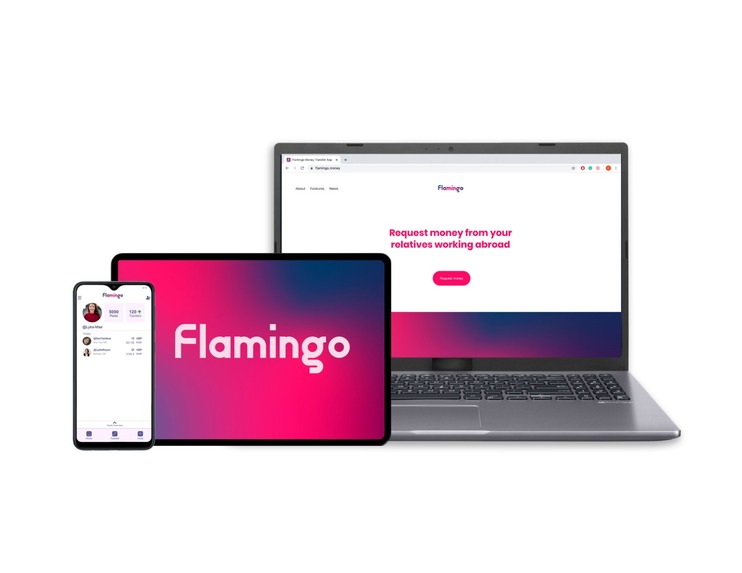
Flamingo Money Transfer on laptop, tablet, and phone
-
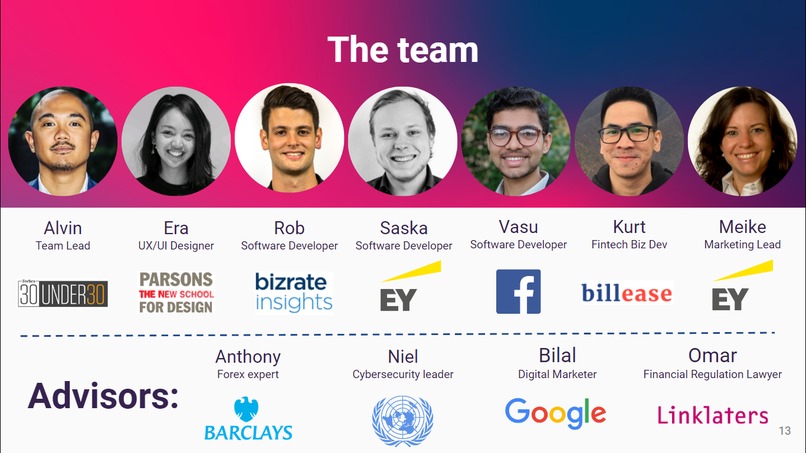
The Flamingo hackathon team
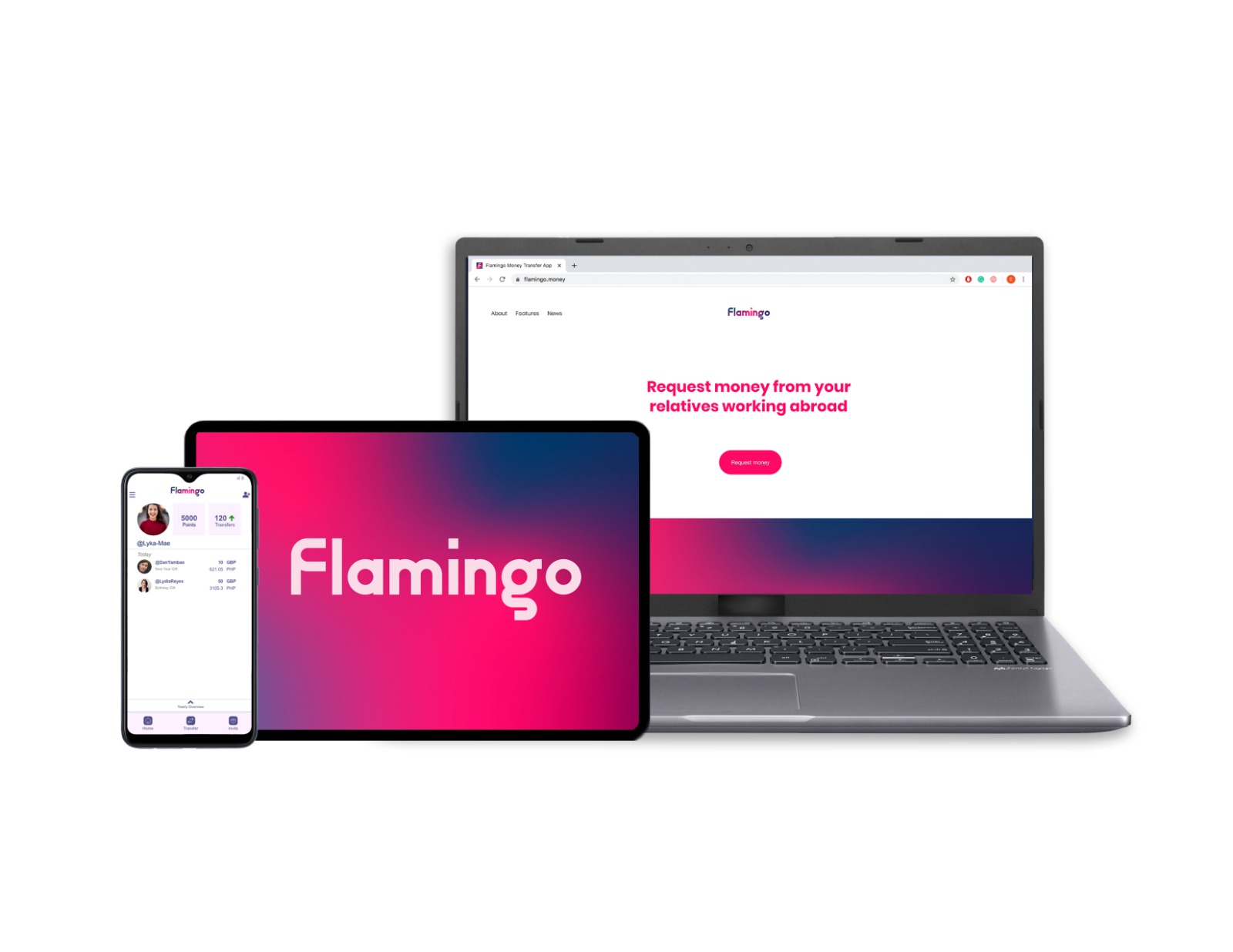
Flamingo Money Transfer
Helping migrant health workers send money to their relatives abroad during the coronavirus lockdown
The problems our project solves
This once in a century pandemic crisis has upended the world as we know it. The global economy is experiencing a huge downturn, and unemployment has increased dramatically.
The coronavirus crisis has created new obstacles for the 164 million migrant workers who provide for their families abroad:
- The lockdown means people in the developing world: (i) cannot pick up cash from remittance shops; (ii) have become unemployed due to the downturn, and are therefore more reliant on relatives working abroad; and, (iii) their existence and survival is threatened.
- Migrant essential workers (such as nurses, doctors, and care-workers) are still employed, fighting covid-19 on the frontline, but are deeply stressed and time poor. They are also less able to go to brick-and-mortar financial institutions to send money due to banks overloaded with customer support.
The solution we bring to the table
Our solution: Flamingo Money Transfer is a fintech web app that helps migrant essential workers, such as nurses and care-workers, send money to their relatives abroad.
Here are the app's key features:
- We provide families in need the tools to request money easily.
- We provide migrant essential workers the tools to send money seamlessly.
- Migrant workers who send money abroad can also set up regular automated payments to save precious time.
Senders also receive reward points every time they send. These reward points give them access to exclusive discounts and vouchers from brands they love through the Flamingo loyalty programme. Brands who we partner with can reach migrant workers and their families to sell products and services they need, and increase their social responsibility footprint by partnering with us.
During the crisis, we will provide our software service free of charge.
In terms of other use cases for our software, our technology can be repurposed to distribute public funds and enable citizens to donate directly to families in need.
During the crisis, Flamingo aims to speed-up the distribution of financial support between overseas workers and their families.
What we have done during the weekend
Here are our major achievements this weekend:
Tech/Product We built a new working web app. The web app enables users to request and send money, which is the key feature we sought to build this weekend.
In addition, we: (i) built a points and rewards system for a loyalty programme, and (ii) set up the registration and sign-up form.
Crucially, the backend is ready to connect with an API to be provided by a compliant payments institution.
Marketing We developed user personas and customer journeys, which outline the behaviours of the people we aim to serve. This will help ensure we develop our solution according to their needs. The personas and journeys are founded on literature reviews, interviews with 150 users, and in-depth prototype testing with 10 beta testers.
In addition, we created a social media strategy after deciding that social media would be the most relevant channels to reach our best first customers who we have identified as millennial Filipino nurses and their families in the Philippines.
It is important to note that whilst we are targeting this customer segment early on, there are 800m people of all ethnicities around the world who are supported by remittances. Our longer term plan is to serve migrant workers from all nations.
Loyalty programme We produced a strategy for our loyalty programme which rewards senders and connects brands with migrant workers. The brands we partner with can access a specific target customer group (migrant families in need). This will help them gain traction in social responsibility, by providing Flamingo app users with discounts. Exclusive offers can be provided to users based on their location, behaviours, and preferences, using GDPR compliant data.
Business For your reference, we have uploaded a slidedeck which outlines our business plan. It includes information about the problem we are solving, our solution, how the app works, addressable market size, business model, competition, competitive advantage, marketing strategy, go-to-market strategy, compliance and regulation, and 5 year plan. The appendix includes links to our showcase website, web app prototype, design prototype, screens that showcase the user-journeys, tech stack, infrastructure and system context, user personas, loyalty programme journey, and social media plan.
Regulation We have a compliance plan, and were mentored by a lawyer who has previously advised the world's biggest remittance provider. The insights finessed our compliance plan, and helped us make strategic business decisions which helps ensure we can go to market.
The solution's impact to the crisis
Flamingo Money Transfer’s mission is to help migrant families support each other financially. If successful, the scale of impact is global and directly beneficial to families, countries, and regions.
Our solution will have the following immediate impact:
- Help migrant essential workers save precious time, as they work on the frontline against covid-19; and,
- Help families in need receive financial support to pay for daily necessities.
For wider society, this means health workers have one less thing to worry about so they can focus on saving lives, and families in our communities are more financially resilient.
Flamingo is primarily an impact-driven team and project: All of us got involved in this hackathon to address the new problems caused by the pandemic, and support vulnerable groups, in this case migrant families in need. Due to the pandemic, the lockdown means people cannot pick up cash, many have become unemployed, and are therefore more reliant on their relatives working abroad who have become sole financial providers. We want to address these new problems.
More broadly, according to the UN, one billion senders and receivers and a projected US$6.5 trillion in international remittances will be sent to developing countries between 2015 and 2030. Getting remittances right can lead to real change for a significant group of people worldwide.
Here are some key statistics which show how important remittances and migrant workers are:
- 22.3 million people (4.4 %) of the 512.4 million people living in the EU on 1 January 2018 were non-EU citizens.
- Almost half (46.9%) of all migrant workers were located in North America and Northern, Southern and Western Europe (Source: Migration Data Portal).
- There are 800m people who are supported by remittances
- $689bn remittances are sent annually
- There are 164m migrant workers worldwide who, on average, send ~$250 per month (15% of their salaries) to their relatives abroad.
- 75 per cent of remittance flows go towards immediate needs, but the other 25 per cent – over US$100 billion per year – is available for other purposes.
- Remittances are crucial to economic growth and economies: For example, 10% of the Philippines’ GDP is derived from remittances.
The Flamingo Money Transfer team aims to help global collective efforts to achieve the Sustainable Development Goals (SDGs) by 2030. Specifically, our fintech app solution will impact the following SDGs: Households - goals 1, 2, 3, 4, and 5; Local: goals 6, 7, 12, and 13; National - goals 8, and 10; International - goal 17.
As the UN notes, “With these apparently small funds, most remittance families commit to reaching “their own SDGs” – reduced poverty, better health and nutrition, education opportunities, improved housing and sanitation, entrepreneurship, financial inclusion and reduced inequality, and the ability to deal with the uncertainty in their lives by increasing their savings and building assets to ensure a more stable future.”
Our long term goal is to provide good value and effective products and services that serve migrant families, and the 800m people supported by remittances.
We cannot overstate the need to get remittances right. That is why Flamingo will help migrant families request and send money faster, easily, and seamlessly.
The necessities in order to continue the project
There is a clear and urgent need to distribute funds to those who need it during the pandemic crisis. After the hackathon, we are committed to bringing this to market to address the pain points described above.
To do so, we will do the following:
- Test the MVP further with a small group of beta testers in the next 2 weeks.
- We have longlisted payment institution APIs to support our vendor selection process, and will decide which API to integrate with our web app next week.
- We will reach out to hospitals to help distribute the solution to the migrant health workers who send money abroad, which will help us scale our services to those who most need it.
- We are also approaching brands to secure our first loyalty programme partner, to help provide discounts and vouchers to migrant essential workers such as nurses, doctors, and careworkers.
To build the resources we need to undertake this, and to achieve our impact, business, marketing, and technology goals, we are seeking 18 months of financing to serve 10,000 customers and handle $25m volume of transactions.
Note: We are focused on bringing this solution to people in need as soon as possible. Concurrently, we have noted two other potential use-cases for our technology which we will explore further: 1. Helping governments distribute public funds to those in need (people who request money and are identified as in need could be sent money from the state); and, 2. Private requests could optionally be made public, allowing altruistic citizens to donate funds directly to families in need. Key considerations here are protecting against fraud, and having strong identity verification tools. We have already analysed potential KYC/AML solutions for these purposes.
The value of our solution after the crisis
There are 800m people worldwide who are supported by remittances. According to the UN, one billion senders and receivers and a projected US$6.5 trillion in international remittances will be sent to developing countries between 2015 and 2030.
Put simply, the need to provide financial tools and services for international migrant families is sharper now, and will continue after the lockdown.
The URLs to our prototype
- Showcase website: https://flamingo.money/
- Web app prototype: http://35.195.251.141/ (To use the web app prototype, make sure to use these log-in details - Email: [email protected] | Password: extrasecure)
- User journey video: https://www.youtube.com/watch?v=cXE2rNVIMIo
- Design prototype: https://era696488.invisionapp.com/public/share/GU13DAMDPC#screens/477005424
Responses to the judging criteria
Impact
Please note that have provided an extensive outline of the impact our solution will have above, in the section titled "The solution's impact to the crisis".
Technical complexity and novelty
We have built web app software that enables a smoother remittance process. In the attached slide-deck, we provide further information on the technology, infrastructure, and system context. For now, here is the tech stack:
Infrastructure
- Everything is in kubernetes (Google Kubernetes Engine), enabling scalability, rapid development of new services and CI/CD.
- Secure and production ready
Frontend
- We built the frontend using React, including the modern features such as React Hooks, for quick rendering load times, and to avoid unwanted side effects in our components.
- The target system is a 360x640 smartphone, the most common platform in the Philippines
- This is a single page application using react-router-dom to handle the frontend routing.
- Eventually a mobile application will be written, and much of the react code can be ported over to react native to utilize one code base for a mobile app that will function on ios and android platforms.
Backend
- Node.js API Layer - JavaScript backend that handles the data retrieval / data persistence
- MongoDB (Atlas) NOSQL - Data Storage
- Will be hooked up to a KYC solution in the coming days to ensure all of the users on our platform are verified and real via email verification.
- The application has the ability to hook into a payment API using our secure node.js backend
- Low bandwidth to account for slow connections
A note on digital inclusion: We optimised the web app for our target market with capacity for it to be used by 2G users, and in the future, SMS, especially in low-connectivity regions.
PROTOTYPE COMPLETION
As shown above, our web app prototype is ready to be connected to a payments institution API. For your reference, here are the links to showcase what we’ve built:
- Prototype video showing user journey: https://era696488.invisionapp.com/public/share/GU13DAMDPC#/screens/477005424
- Link to brand new prototype web app built during hackathon (to access, make sure to use the following log-in details: [email protected], password - extrasecure): http://35.195.251.141/
BUSINESS PLAN
We have attached a slide deck which outlines our business plan. Here are specific additional points for the judges:
Feasibility
We have built a web app in the last 48 hours. We can go to market once we choose our preferred payments institution API.
There are also proven remittance models, as this is a buyer’s market. Our innovation in this space is our focus on migrant families, and providing the tools to request money easily and send money seamlessly.
We adapt our solution to the needs of migrant families specifically, which differentiates us from other companies who aim to provide money transfer services for everyone (including businesses, and employers). Practically, this means we provide features our customers care about, such as regular payments, and rewards from brands they love.
Think of it this way: First there were horses (in remittances, we can compare these to sending money in envelopes and via banks), then there were Ford cars made for every American (compare these to companies that provide universal services), then there were car brands like Mercedes-Benz, Honda, and Tesla for different segment markets (compare this to Flamingo Money Transfer, where we are moving away from trying to cater for all, and to focus on the 164m migrant workers worldwide).
Economic value
$689bn is sent in remittances annually. Remittance companies currently charge a range between 1% to 12% in fees, on average 7%. This equates to $50bn in fees charged to people who send money internationally.
We believe that we can deliver a sustainable business model which also provides better value and savings to customers.
Our revenue model is clear: We charge 0% on transfers, and 0% on forex spread. We only charge a tiny 1% fee when users withdraw money from their e-wallet. We also earn 15% on referral fees to partner brands.
This means we earn revenue for the startup to grow and provide the best services, whilst also provide huge financial savings for migrant families by helping them avoid charges which could be 12x higher. It also means huge time savings, as we enable one-tap instant and automated transfers, as opposed to spending 7-minutes waiting for a remittance shop assistant to send it (note that this does not count the 1-hour travel time to and from the shop, nor the length of the queue).
Social value
The impact we seek to achieve is stated in detail in the impact section above. In summary, remittances provide huge social value to 800m people worldwide, and if done well, can help achieve a total of 12 different SDGs. We aim to help migrant workers and their families support each other financially during the pandemic crisis.
Market knowledge
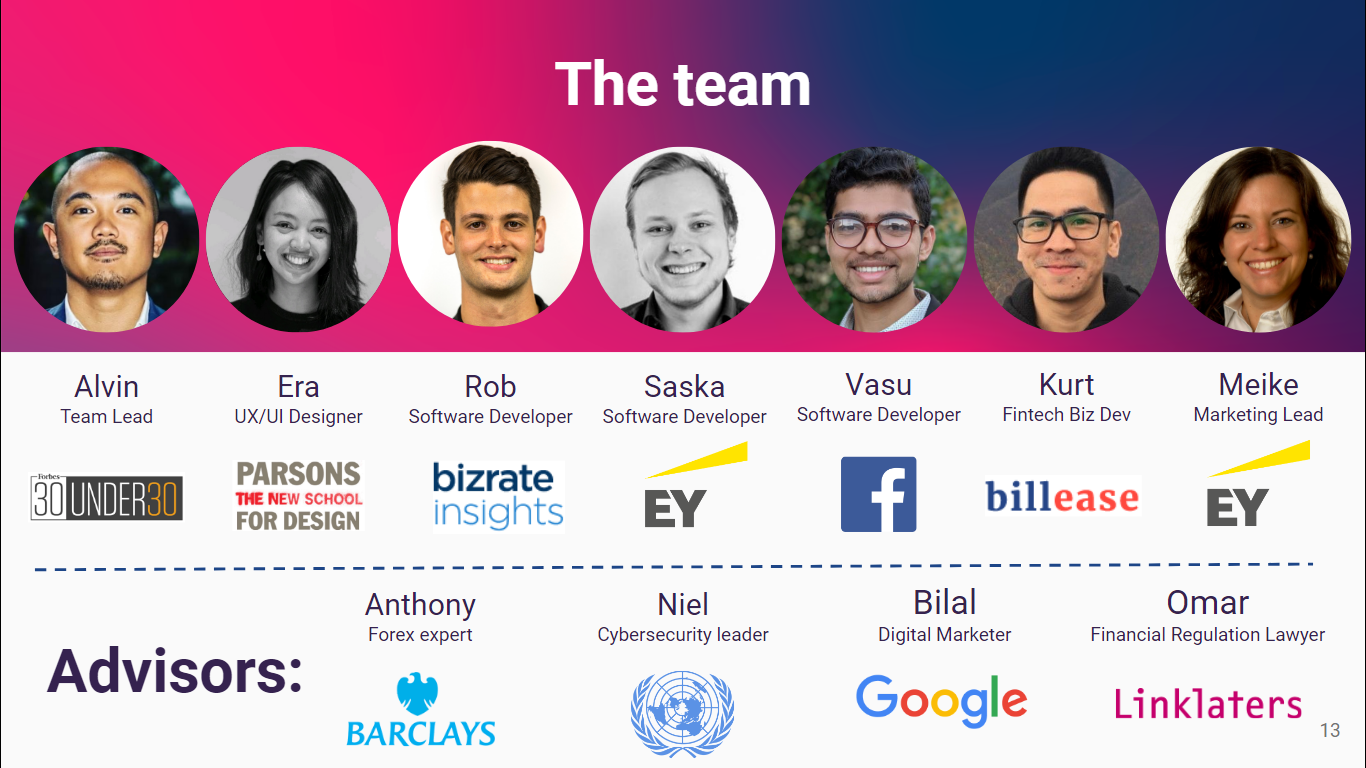
Our team is made of a stellar cast of A-star players: We have entrepreneurial leaders who have built companies and led organisations that serve migrants, fintech specialists, marketing experts, UX/UI designers, and full-stack developers who have built fintech products.
This team is backed up by senior advisors who are leaders who have been recognised in their respective fields. Our advisors have worked for the United Nations, Google, Barclays, Bank of America Merrill Lynch, Linklaters, EY, General Assembly, and a Y-Combinator backed forex startup.
This is what sets us apart from the competition: We have the people with the abilities, skill-sets, and knowledge to build this solution. In one of the weekend's hackathon masterclasses, Jordan Valdma (CEO, Producement) said, “your team is your product”. We believe one of our achievements early on is building a team that understands the market, and can lead an organisation to provide a new solution for migrant workers.
The app can be used globally, but we have identified our best first customers to be millennial Filipino nurses based in London, and their families in the Philippines. This is due to the essential roles they play in society, our team’s current connections, and the size of this segment market. The Philippines alone receives $35bn in remittances annually (competing with Mexico for 3rd largest volume received, just behind India and China), and there are 2.2m overseas Filipino workers who send money to their relatives. We are focused on one corridor (UK-Philippines) at first, in order to onboard our first target customers, avoid too many regulatory issues, and iterate our product for future expansion.
Sustainability
We will ensure that our supply chains are made up of environmentally friendly companies, and work with climate change think-tanks and charities/non-profits to understand in more depth the potential for revolutionising remittance services by providing green solutions.
Otherwise, our financial modelling outlines a financially sustainable business model, earning revenue through withdrawal fees and referral fees through our loyalty programme. In the long term, depending on the needs of users, we will increase the number of transfer corridors, and add features (for example, customers have already asked whether they can access loans and physical cards to pay for goods after the lockdown).
Resources needed
To build the resources we need to undertake this, and achieve our impact, business, marketing, and technology goals, we are seeking 18 months of financing to serve 10,000 customers and handle $25m volume of transactions. We outline these plans in more depth in the attached slide-deck.
Thank you for considering our pitch. It has been a wonderful 48-hours - we've thoroughly enjoyed the hackathon. Going forward, we hope to work with you and others to help the millions of people who rely on remittances every single day.
Built With
- docker
- github-actions
- javascript
- kubernetes
- mongodb
- nginx
- node.js
- react
- react-hooks





Log in or sign up for Devpost to join the conversation.