

Financial Literacy AI Resource
Answers are fair when you're asking FLAIR

Inspiration
Involvement in the criminal justice system creates barriers that are far beyond the physical ones created when in prison, such as the massive hurdle of financial literacy and inclusion. A 2014 study by the UALR Institute on Race and Ethnicity found that incarcerated people were less likely to have ever had a checking account or credit card. They were also more than twice as likely to take out payday loans. We were inspired to create a solution that helps formerly incarcerated people’s re-entry to society and help understand the financial world they must navigate when released.
With further research, we found that there are many underbanked communities. Newcomers to the U.S. have a hard time navigating a new financial system. Disabled people have difficulty juggling their medical costs and government benefits. The elderly have new and often unexpected expenses as they age. The list goes on and on.
It takes a lot of time and research to find answers to all your financial questions; currently, there is no single resource that can help you. And how do you know the answer you find is trustworthy? Is someone just trying to sell you their product? Is that Yahoo answer a joke? The more you dig, the more confusing it becomes. So, we created FLAIR – the most comprehensive, trustworthy, and intuitive financial literacy resource.
Let’s face it – finance is hard to understand for most of us, so a solution like this can support and equip so many different underbanked communities with the financial knowledge they desperately need.
What it does
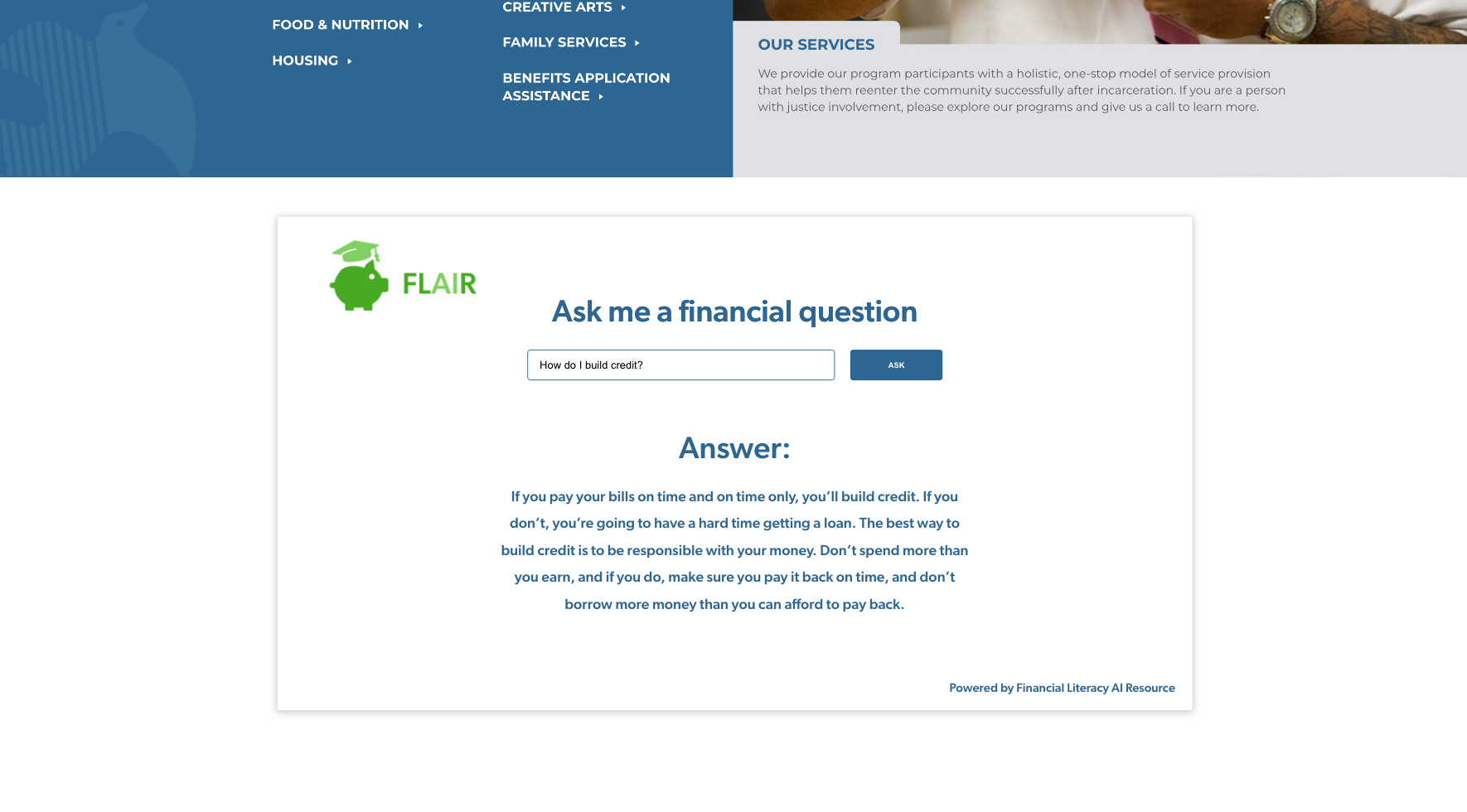
FLAIR – Financial Literacy AI Resource – is a service that provides factual, trustworthy, and easy-to-understand answers to all your financial questions. FLAIR utilizes natural language processing and state of the art AI models to provide answers to financial literacy questions. Being trained only on resources provided by the US government, the answers are fact based and bias free to support sustainable and inclusive finance.
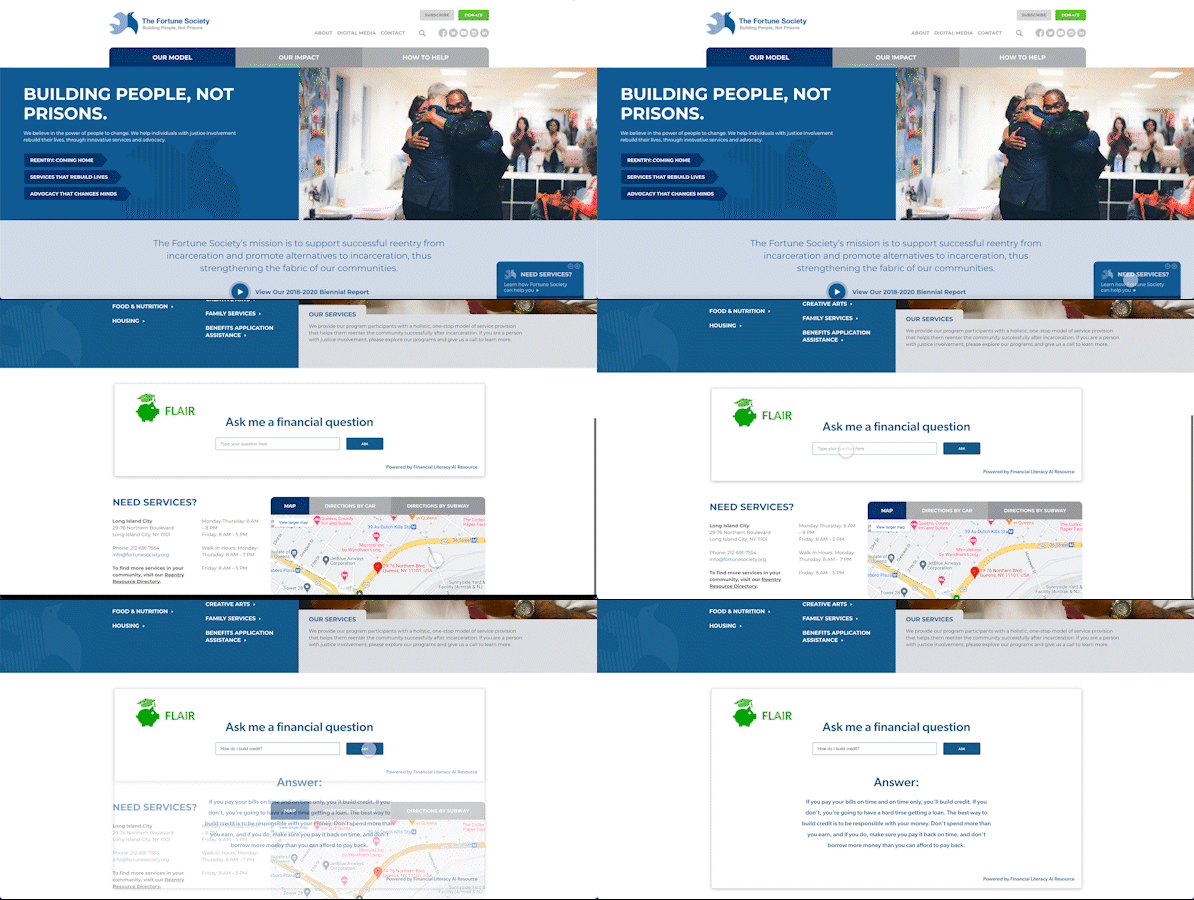
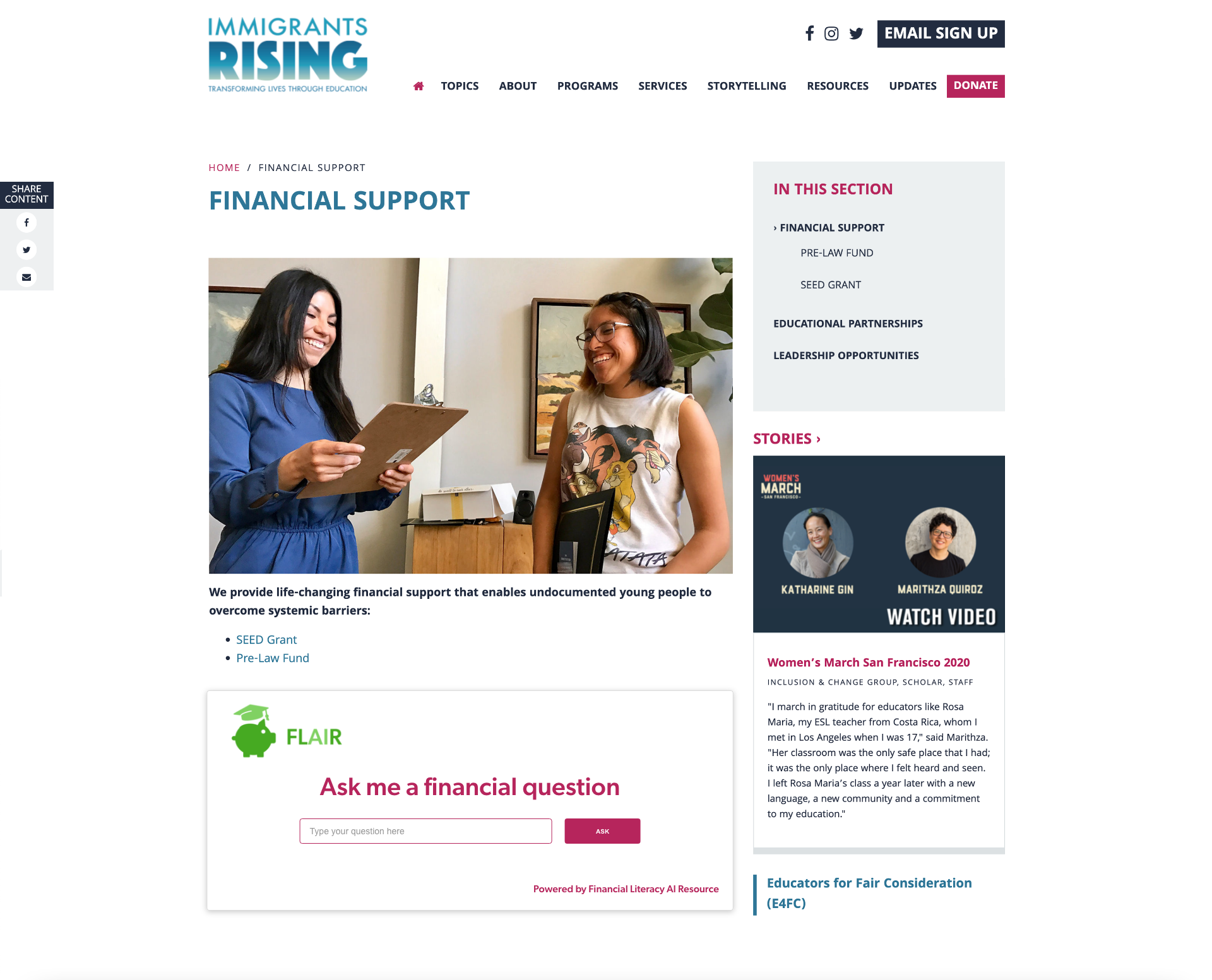
FLAIR complies all the information you need into one easy-to-use search engine, without the pesky ads, opinion pieces, and conflicting answers that traditional search engines provide. It can be embedded in websites that are already providing resources to underserved populations, such as the formerly incarcerated, disabled, immigrant, and military communities.
Answers are fair when you’re asking FLAIR!
How we built it
In short: Python and Hugging Face
The primary component of FLAIR is a python implementation of a machine learning model called long-form question answering. The algorithm consists of 2 transformer models, whose weights were pulled from Hugging Face. The data used to answer the questions came from government-published PDFs, which we parsed using Python.
Specific Technologies The algorithm consisted of two AI models. We used this Question Answer Retriever model, which has a base model of BERT and was fine-tuned on the ELI5 (Explain it Like I’m 5) dataset. We also used this Sequence-to-Sequence Answer Generation model, which has a base model of BART and was also fine-tuned on the ELI5 dataset.
Challenges we ran into
A big hurdle to our project was collecting data. Many of the resources the U.S. government provides are in PDF format, which is difficult for computers to parse. We solved this by carefully writing a PDF parsing script. However, this is something that can be improved in the future.
Additionally, the vast amount of resources available to formerly incarcerated people were overwhelming and made it tedious to choose just one to embed FLAIR onto.
Finding government resources wasn't difficult, but finding all the government resources was. There are many official U.S. government sites that provide financial literacy information, which makes it challenging to collect all of that data to incorporate into our model. As a result, we didn't include as much data as we would wish (see "What's Next").
Accomplishments that we're proud of
We managed to creating a working prototype of our application that can be accessed on Google Colab. Despite the challenges of the spread and format of government resources, we were able to collect and parse many documents about financial literacy. Additionally, we were able to successfully work with a team spread across different time zones.
What we learned
We empathized with many different underserved communities; we love being able to help these communities! We learned about new technologies around advanced NLP concepts and were able to implement them in our project. We also became aware of practices, such as high-fee release cards and payday loans, that prey on vulnerable, underserved communities , etc.)
What's next for FLAIR - Financial Literacy AI Resource
The first step to improve the application would be to gather more resources around financial literacy from the many government websites. We would parse these documents and add them to our financial literacy dataset. This data would be used to improve the NLP model, providing more accurate, readable answers on a broader set of topics.
Additionally, we would like to tailor FLAIR for specific groups’ needs and embed it in more places. One example is connecting with sites that help formerly incarcerated people find jobs. These sources could point us toward relevant educational resources, laws, policies, and initiatives by the US government. By integrating this information into a targeted version of the model, FLAIR will be better able to answer questions on specialized topics, such as paychecks, taxes, and benefits.
We would like to interview and continue learning about the various underserved communities, such as incarcerated/formerly incarcerated people, immigrants, etc. By learning about their biggest financial problems, we can improve FLAIR to be more knowledgeable and inclusive of their communities.


Log in or sign up for Devpost to join the conversation.