-
-
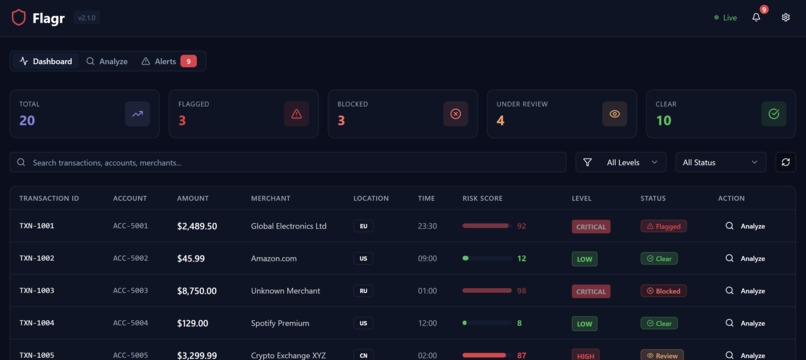
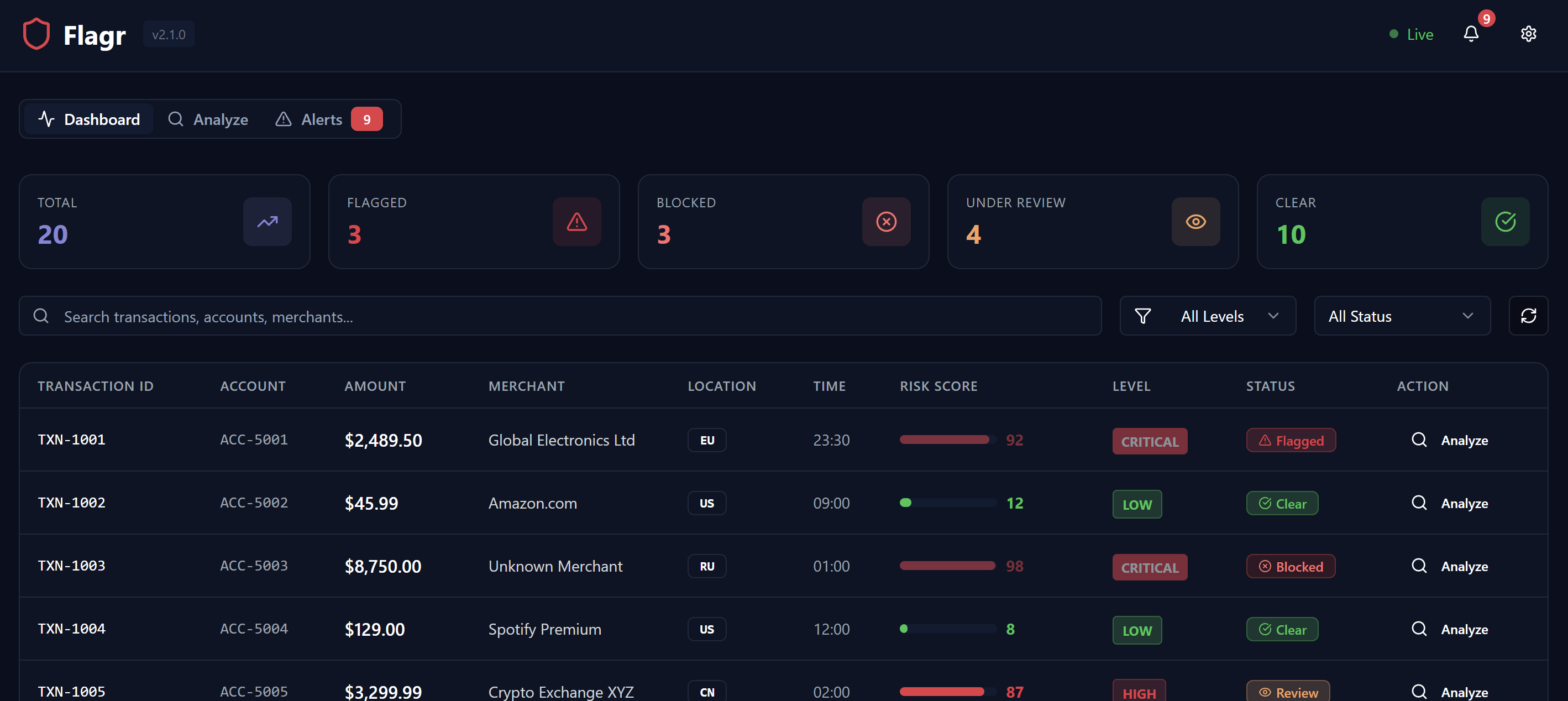
Flagr compliance dashboard — 20 transactions monitored in real time, risk scored and categorized automatically.
-
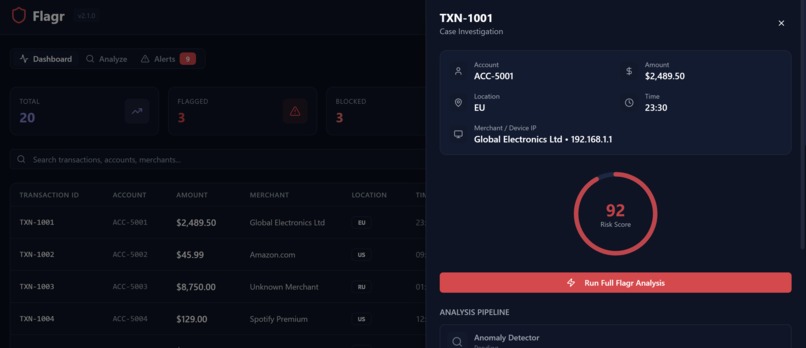
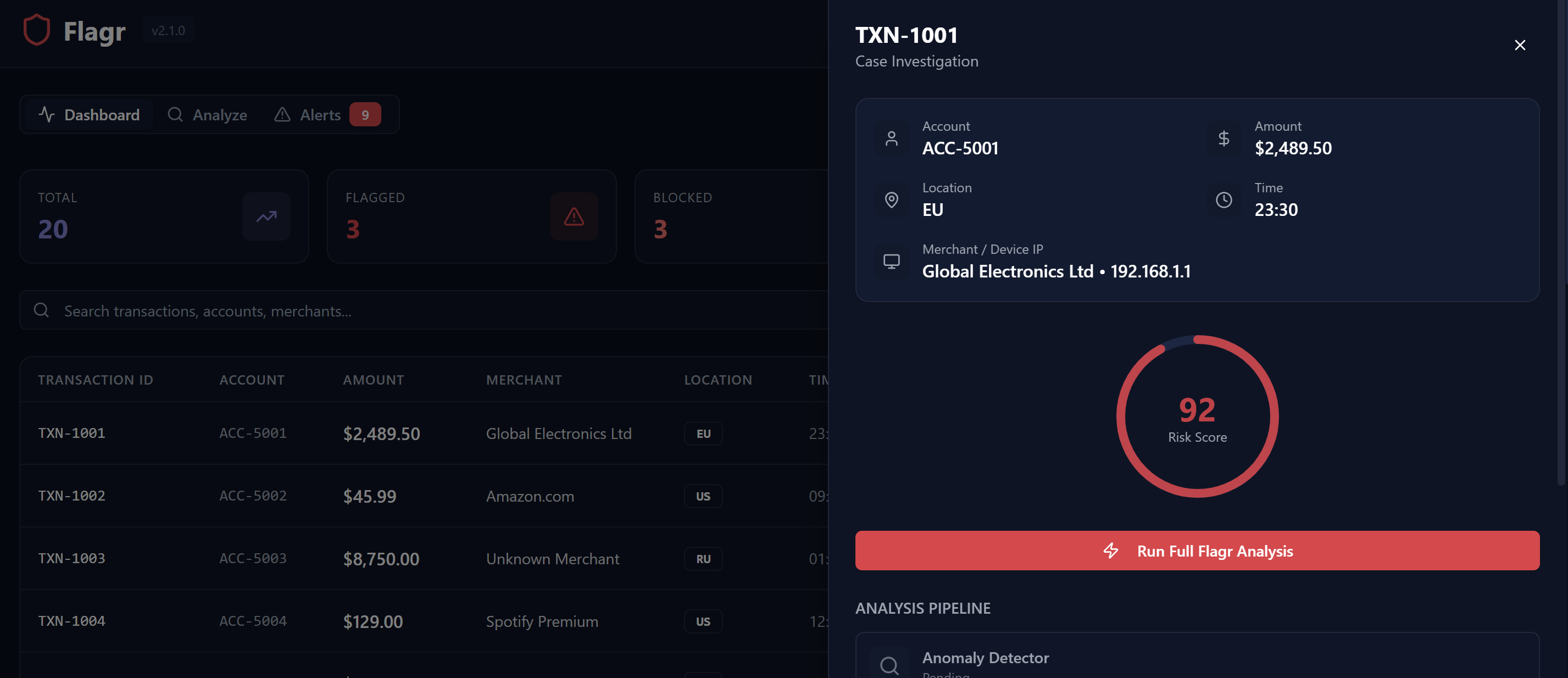
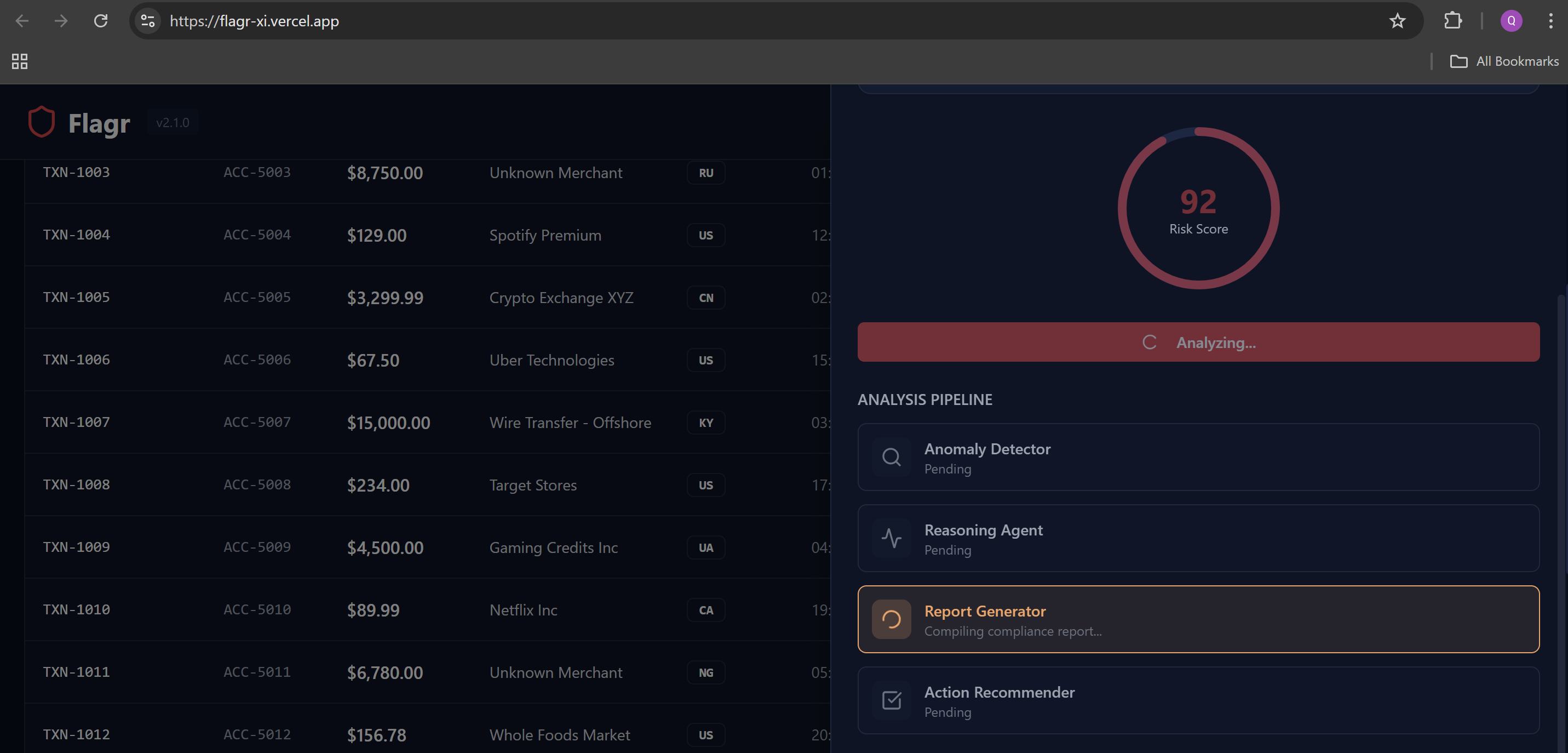
Click any transaction to open a case investigation with full details and a risk score gauge.
-
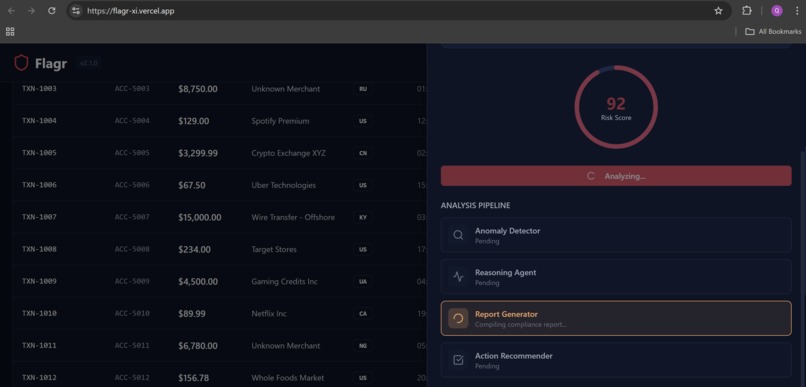
4 AI agents running in sequence — Anomaly Detector, Reasoning Agent, Report Generator, Action Recommender.
-
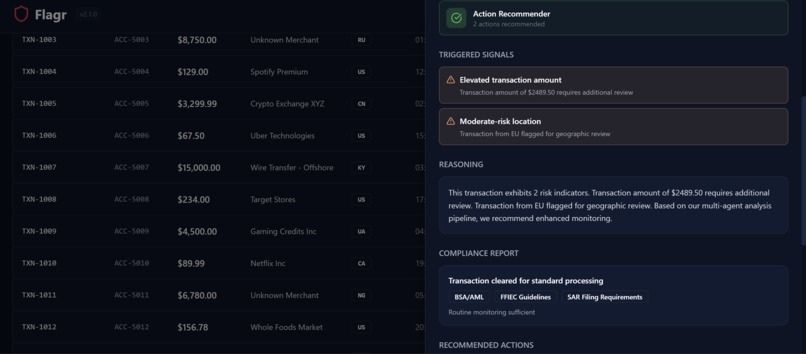
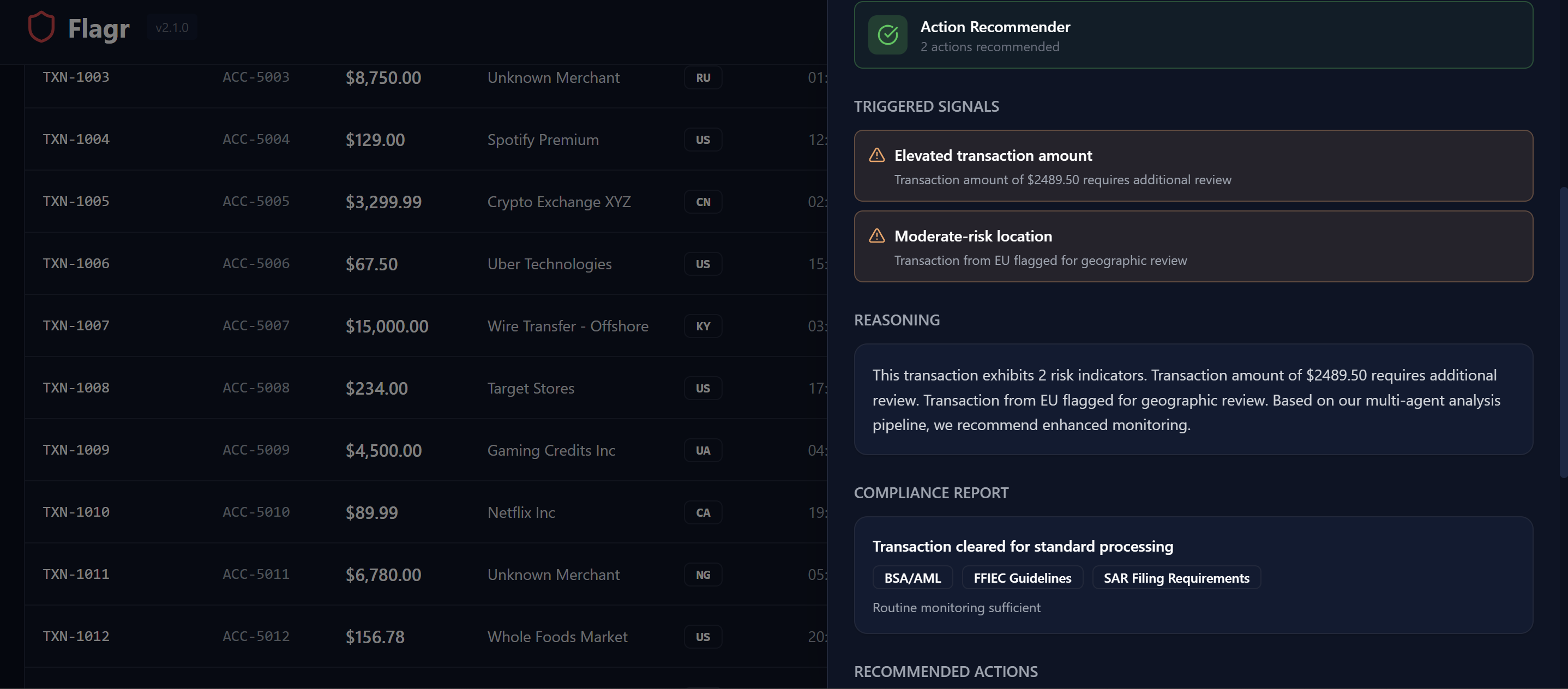
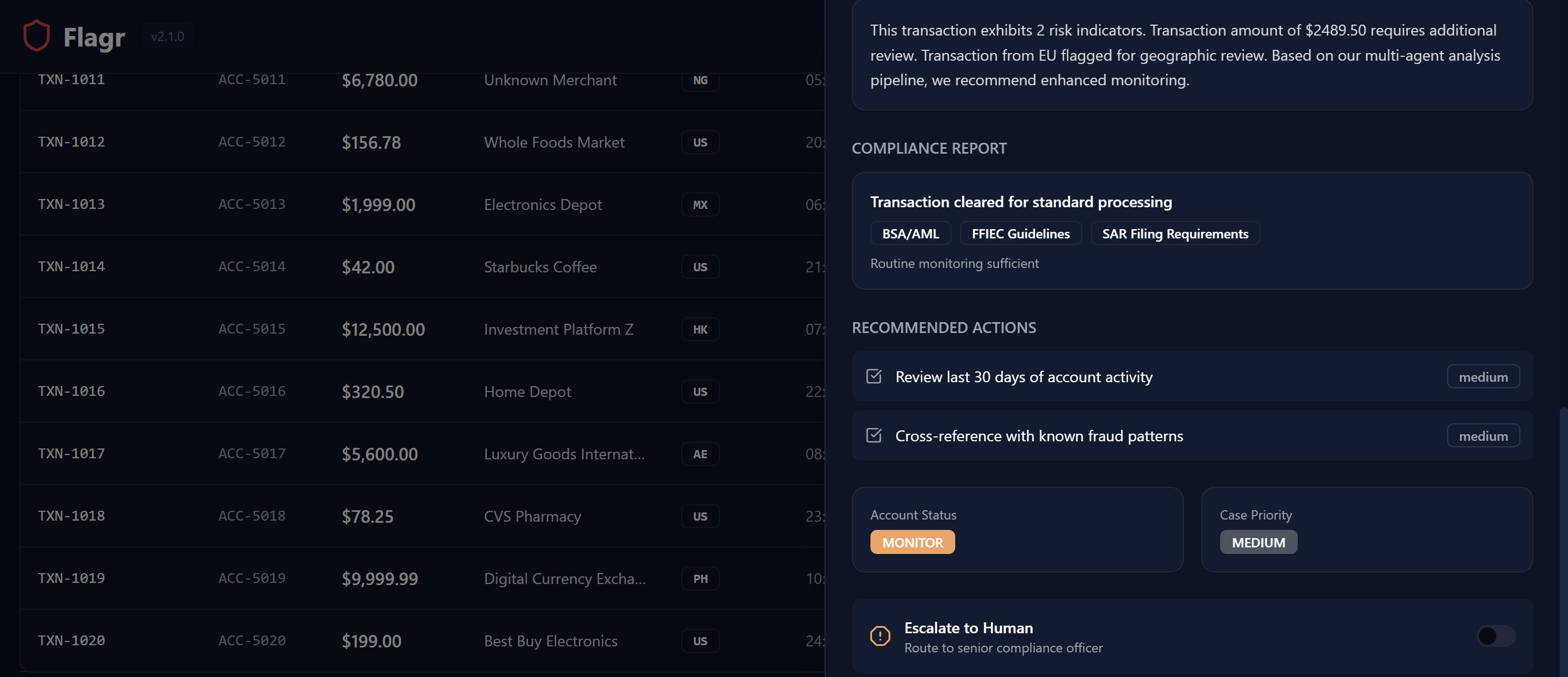
Triggered signals and plain English reasoning generated automatically by the agent pipeline.
-
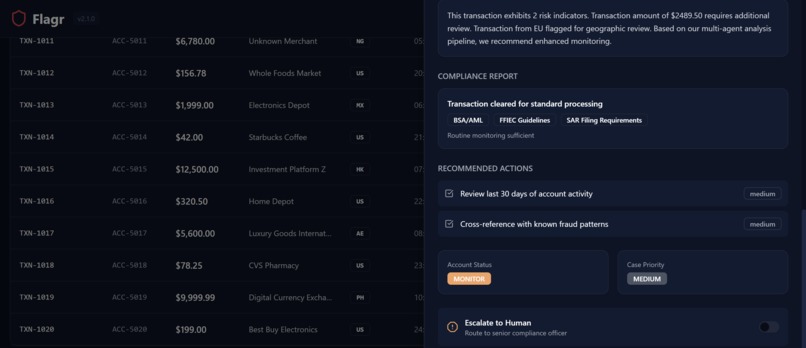
Full compliance report with BSA/AML flags, recommended actions, account status, and escalation routing.
Inspiration
Financial fraud costs banks billions annually. Existing rule-based systems flag too many false positives and provide no reasoning. Compliance officers are left drowning in alerts with no context. I wanted to build something that does not just detect fraud, but explains it and tells the bank exactly what to do next. TD Bank's fraud detection challenge at GenAI Genesis 2026 gave me the perfect opportunity.
What it does
Flagr is a B2B multi-agent fraud intelligence platform for bank risk and compliance teams. When a transaction comes in, Flagr runs it through a 4-agent pipeline powered by Google ADK and Gemini 2.5 Flash:
- Anomaly Detector scores transaction risk 0-100 based on amount, location, time, merchant, and behavioral signals
- Reasoning Agent explains in plain English why the transaction is suspicious
- Report Generator produces a formal compliance report with regulatory flags
- Action Recommender tells the bank exactly what to do: APPROVE, REVIEW, or BLOCK, with account status and customer notification
The bank's compliance team sees everything in a professional real-time dashboard.
How I built it
- Google ADK for multi-agent orchestration with Gemini 2.5 Flash
- Vertex AI Agent Builder for visual agent design and testing
- Next.js 14 for the frontend dashboard
- FastAPI (Python) for the backend API
- Vercel for frontend deployment
- Render for Python backend deployment
Challenges I ran into
- Wiring Google ADK agents to a production FastAPI backend while keeping authentication simple
- Getting Gemini to return clean JSON across all 4 agents without markdown or extra text
- Deploying a Python backend and Node frontend from the same GitHub monorepo across two platforms
- Making the UI feel genuinely enterprise-grade rather than a hackathon prototype
- Designing the agent instruction sets so each agent produces clean structured output without bleeding into the next agent's responsibility
Accomplishments I am proud of
- Shipped a fully working 4-agent pipeline in under 24 hours solo
- The dashboard looks and feels like a real bank compliance tool, not a student project
- Backend and frontend both fully deployed and live
- Each agent has distinct responsibilities and passes structured data to the next cleanly
What I learned
- Google ADK makes multi-agent orchestration surprisingly clean once you understand the Runner and SessionService pattern
- B2B product framing matters. Designing for a compliance officer instead of a consumer completely changes UI and UX decisions
- Splitting Python backend and Next.js frontend across Render and Vercel is a clean production pattern for AI apps
- Prompt engineering for structured JSON output across chained agents requires explicit instructions at every step
What is next for Flagr
- Connect to real bank transaction streams via webhook integration
- Add a Memory Bank so agents learn from historical fraud patterns per account
- Integrate Moorcheh AI semantic memory so agents retain context across transactions and learn account-level fraud patterns over time
- Add SAR (Suspicious Activity Report) auto-generation for regulatory compliance
- Multi-bank deployment with isolated data environments per institution
- Real-time alerting via SMS and email when CRITICAL transactions are detected
Built With
- fastapi
- gemini-2.5-flash
- google-adk
- next.js
- python
- render
- vercel
- vertex-ai

Log in or sign up for Devpost to join the conversation.