-

Fixzi
-
API Contracts

Inspiration
Fixzi didn’t start as a “startup idea.” It started as frustration. I’ve been working with APIs for years, and the same pattern kept repeating:
- A JSON breaks because of one tiny mistake
- An API response changes silently
- XML parsing fails in production
- You spend more time debugging data than building features
The breaking point was when a third-party API changed its response structure without notice. Everything looked fine from logs, but users started reporting issues. By the time we noticed, damage was already done. That moment stuck with me.
- Why are we always reacting to broken data?
- Why don’t we have something that continuously checks it?
That’s where Fixzi came from.
What it does
Fixzi → https://fixzi.ai
It’s a developer workspace focused on one thing: making sure your data is always correct. Right now it helps with:
- JSON & XML validation, formatting, and fixing
- Smart diff (compare responses when things break)
- Schema validation
- Converters (JSON → XML, CSV, etc.)
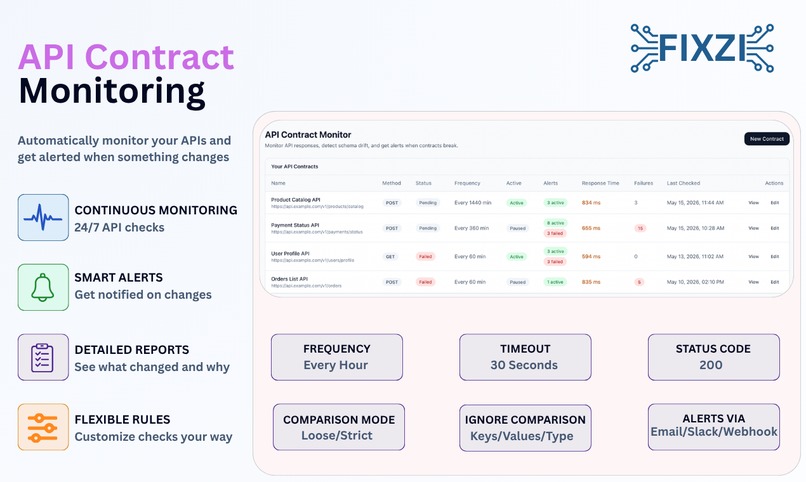
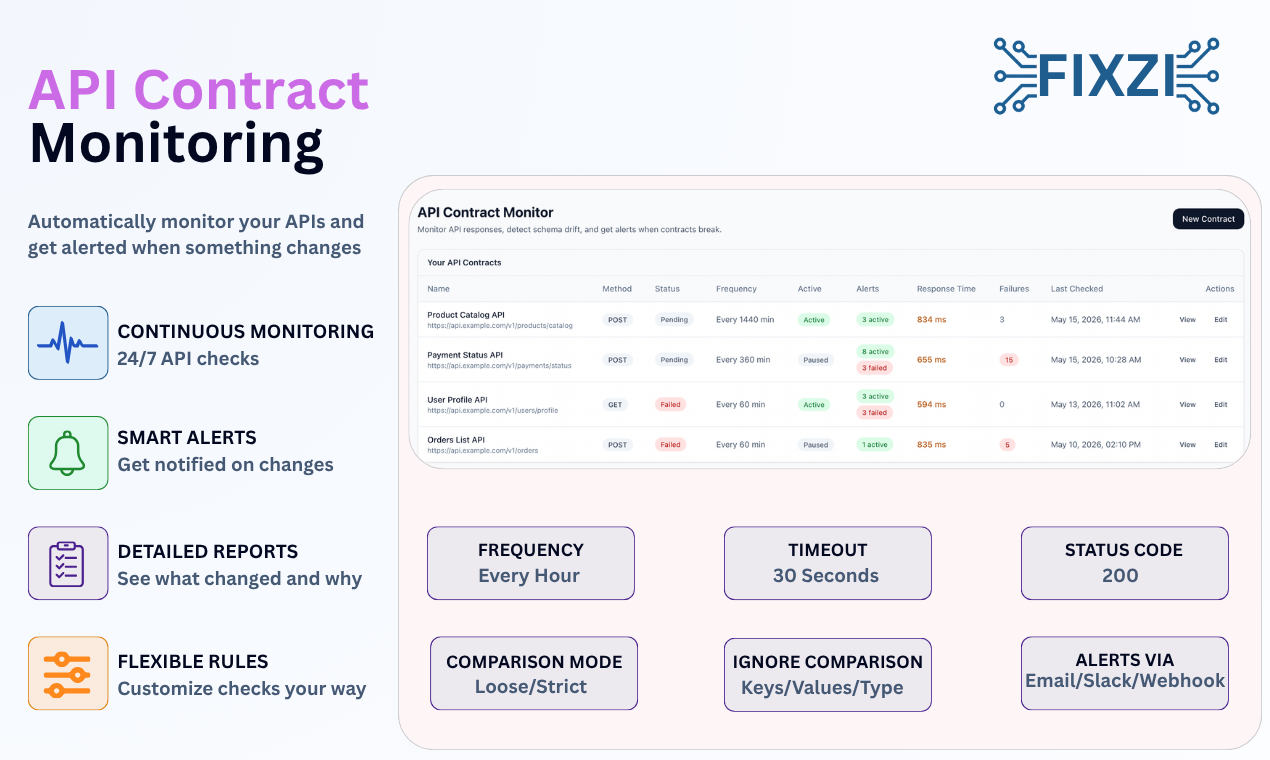
- API contract monitoring (detect changes before users do)
The goal isn’t to build “another validator” — it’s to reduce all the small, annoying data problems into one place.
How I built it
I built Fixzi using:
- Laravel (backend)
- Vue 3 + Inertia (frontend)
- Tailwind (UI)
The architecture is pretty simple but intentional:
- Fast client-side tools for validation/formatting
- Backend for heavier processing + history + monitoring
- Queue system for API contract checks
I also focused a lot on UX:
- Drag & drop files
- Instant validation
- Clean diff view
- No clutter
Because honestly, dev tools should feel fast and invisible.
Challenges I ran into
Biggest challenges were not technical — they were practical:
- Too many tools already exist and convincing myself this is worth building was hard. There are 100+ validators out there.
- Scope creep It’s easy to keep adding features:
- Let’s add schema generation
- Let’s add TypeScript support
Let’s add AI fixing Had to constantly pull back.
Performance & UX
Handling large JSON/XML without lag is tricky.
Users expect instant response.
SEO for dev tools: Most traffic comes from search and Competing with established tools is not easy.
API monitoring edge cases: Handling Timeouts, Auth, Dynamic fields, and False positives. It took more effort than expected.
Accomplishments that I'm proud of
- Took it from idea → working product
- Built a clean, usable interface (no clutter)
- API contract monitoring actually works in real scenarios
- Getting early users and feedback organically
- Seeing Fixzi appear in search results (slowly but happening)
What I learned
- Most good products come from repeated irritation, not sudden inspiration
- Developers don’t want more features — they want less friction
- Simplicity is harder than complexity
- Distribution (SEO, visibility) is as hard as building
- You don’t need a perfect idea — just a real problem
What's next for Fixzi - Your data workspace. Always correct
The path is clear:
- Make Fixzi a complete data workspace, not just tools
- Improve API contract monitoring (alerts, reliability, insights)
- Add more developer-focused utilities (schema, typing, automation)
- Make collaboration easier (share, history, teams)
- Keep everything fast and simple Long term, I want Fixzi to be something you open by default whenever you’re dealing with data.

Log in or sign up for Devpost to join the conversation.