-
-
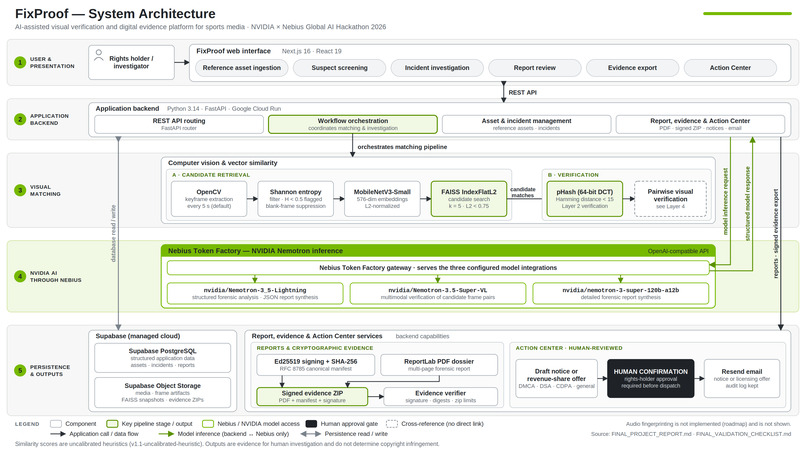
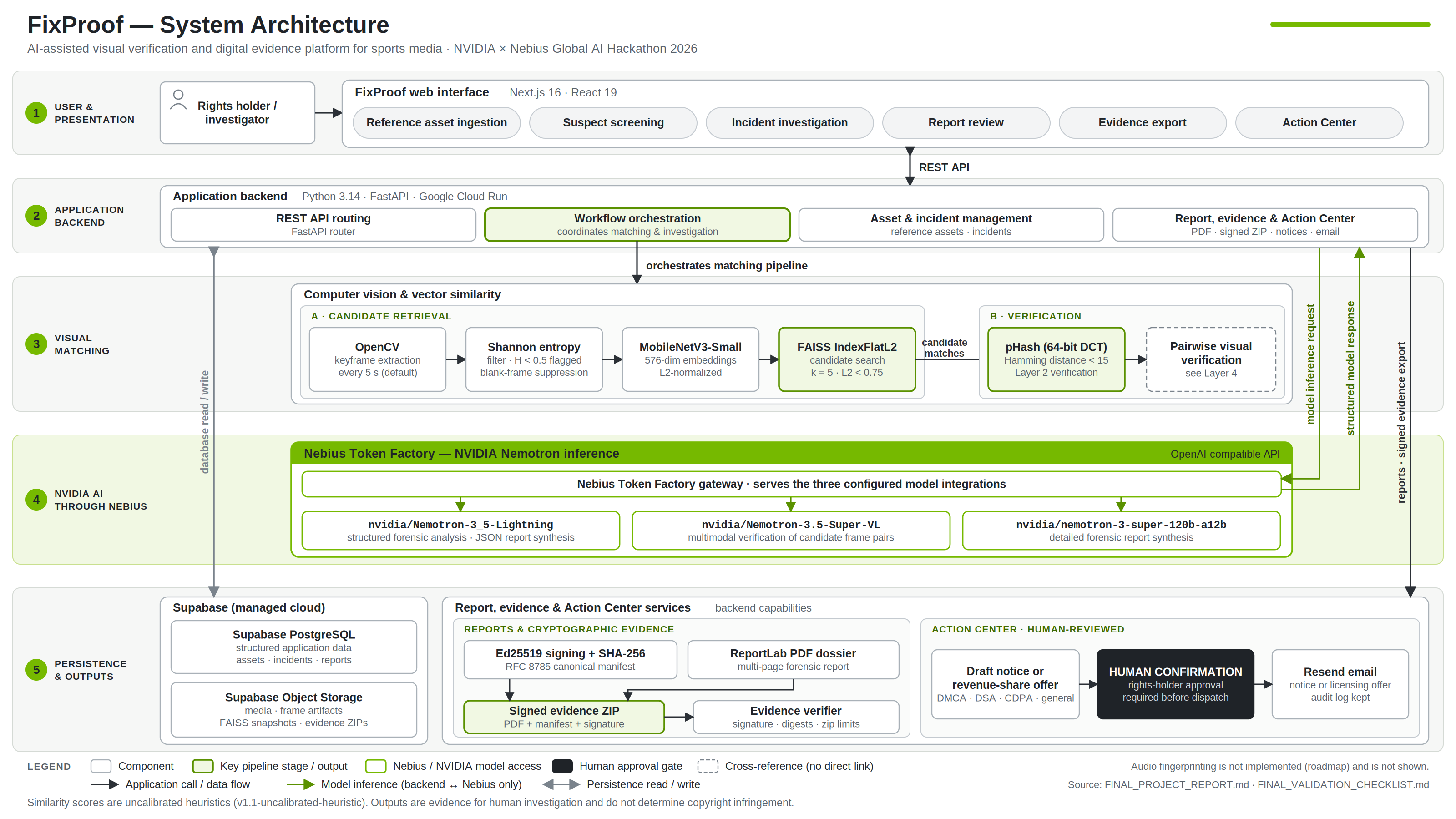
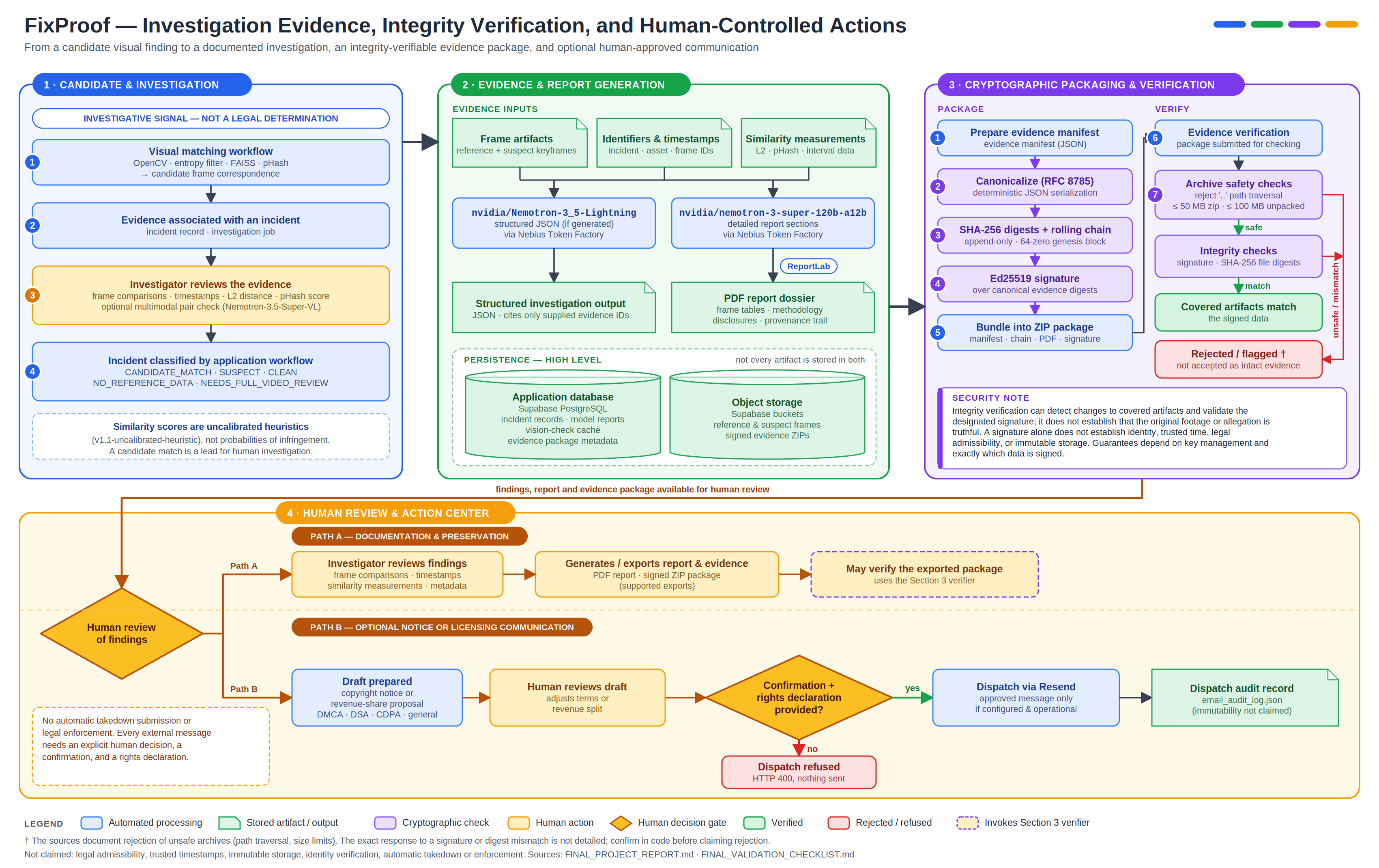
System Architecture
-
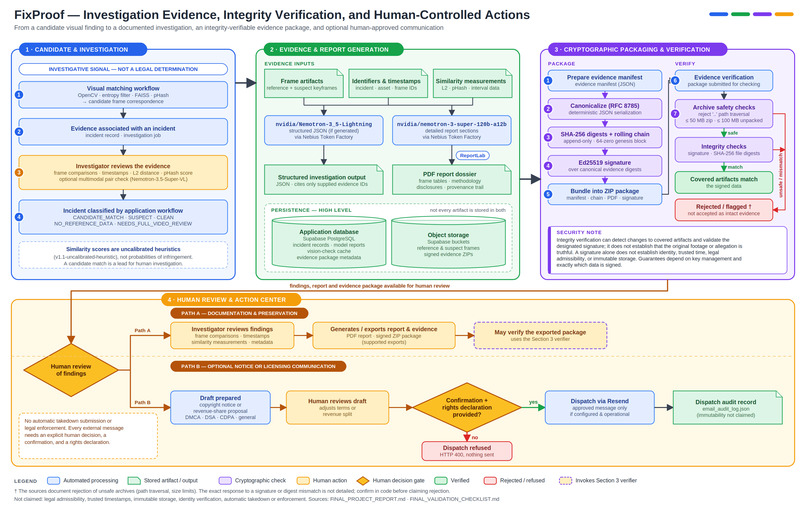
Evidence lifetime workflow
-
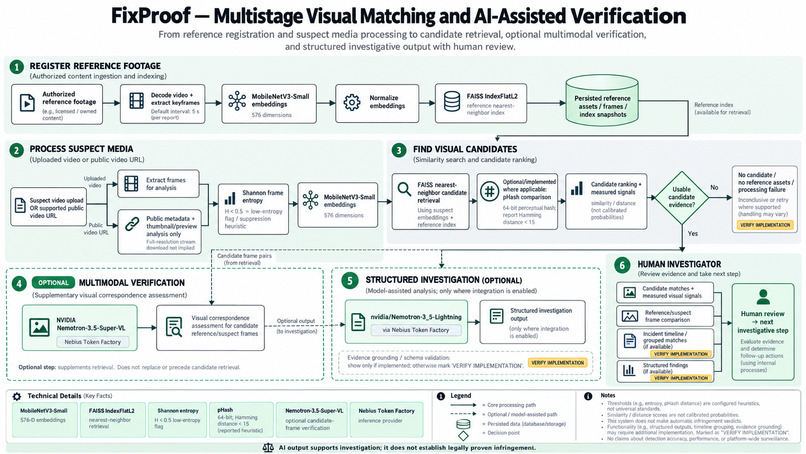
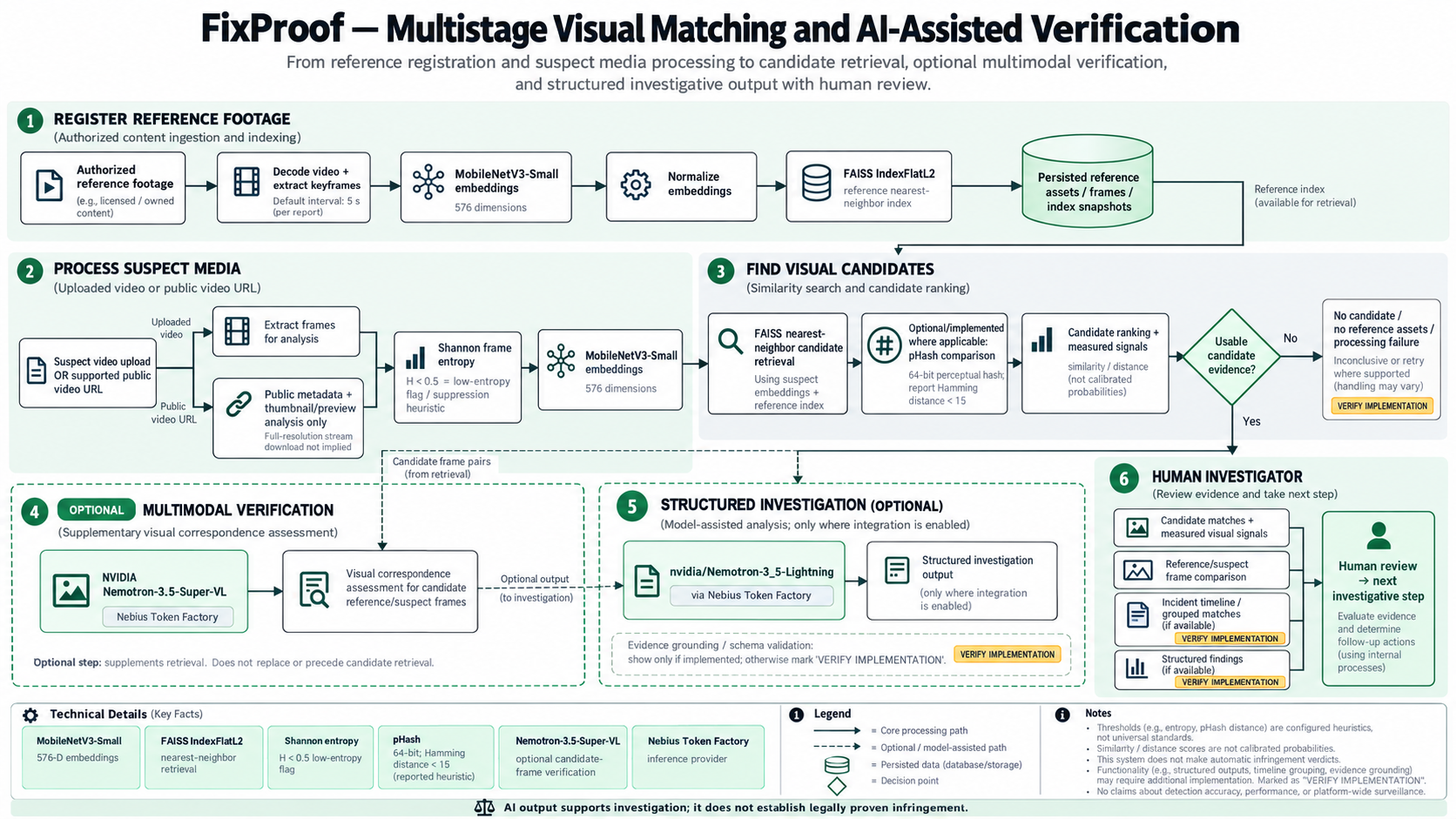
Visual Verification Workflow
-

Digital Asset Vault Page
-

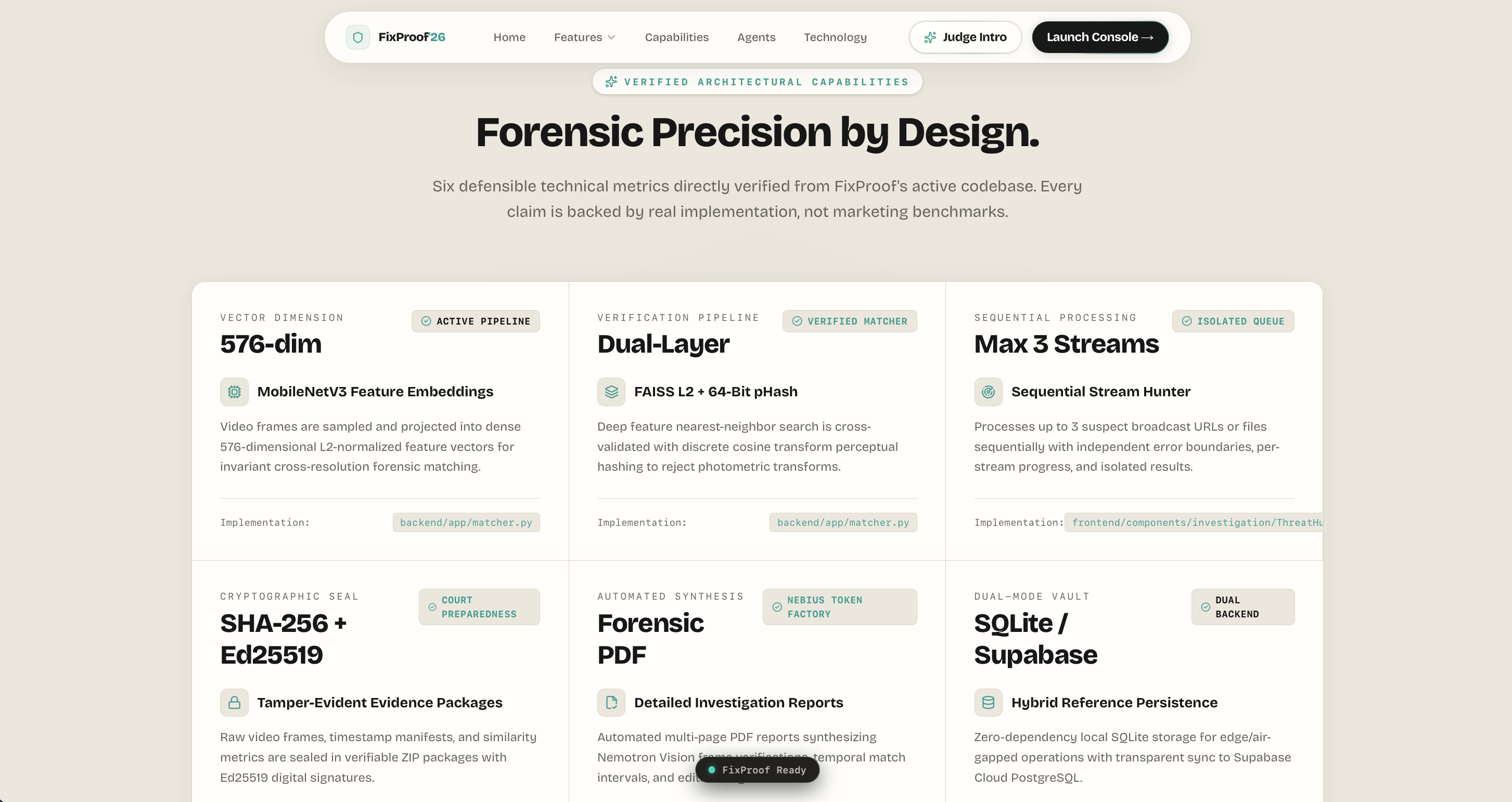
Features Page
-
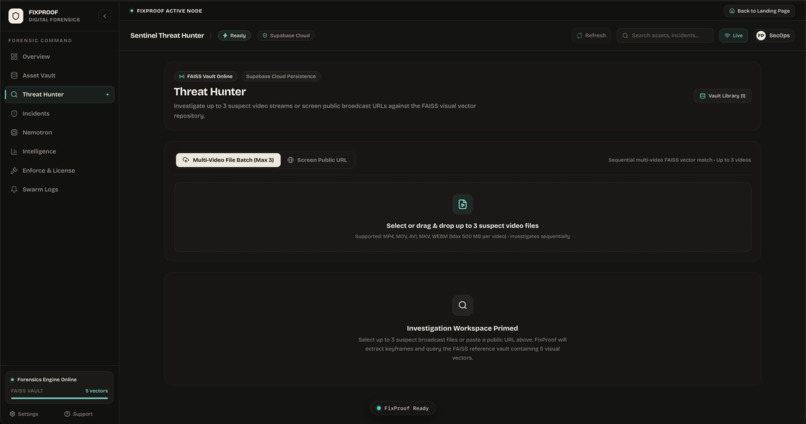
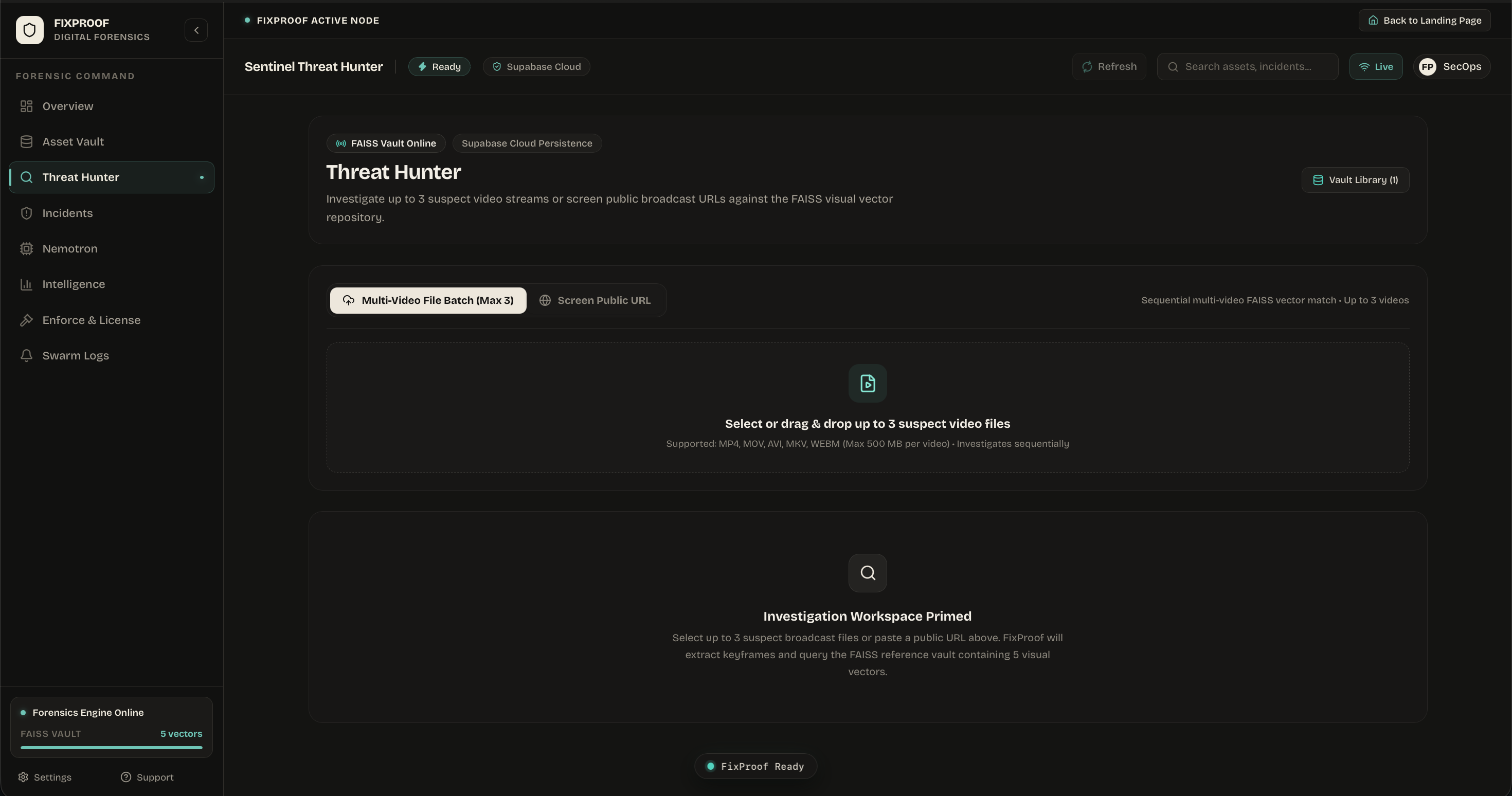
Threat Hunter page
-

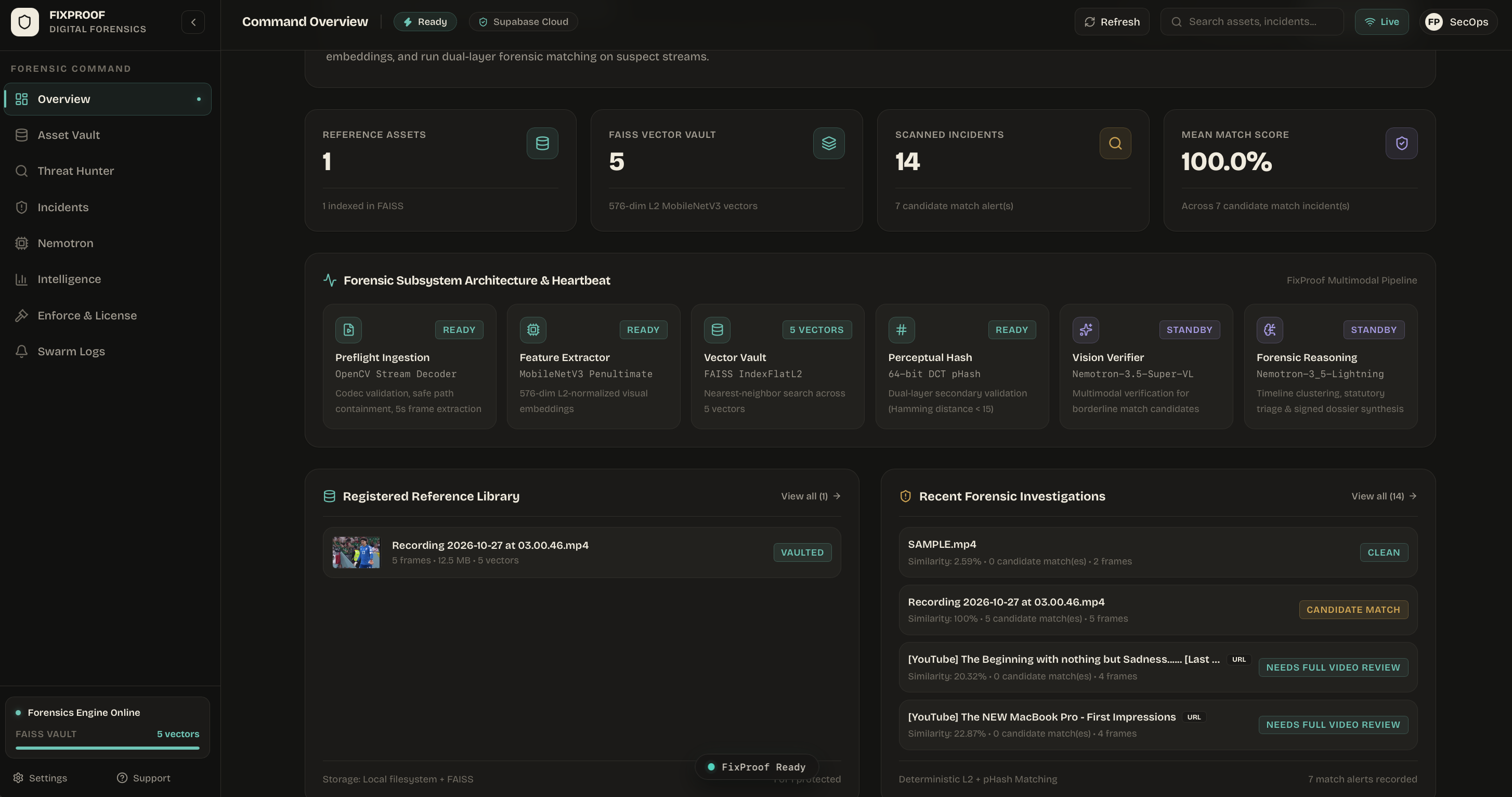
Overview Page
-
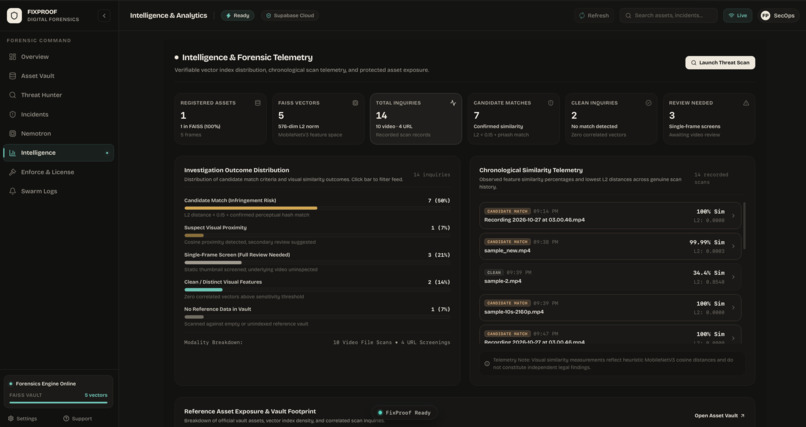
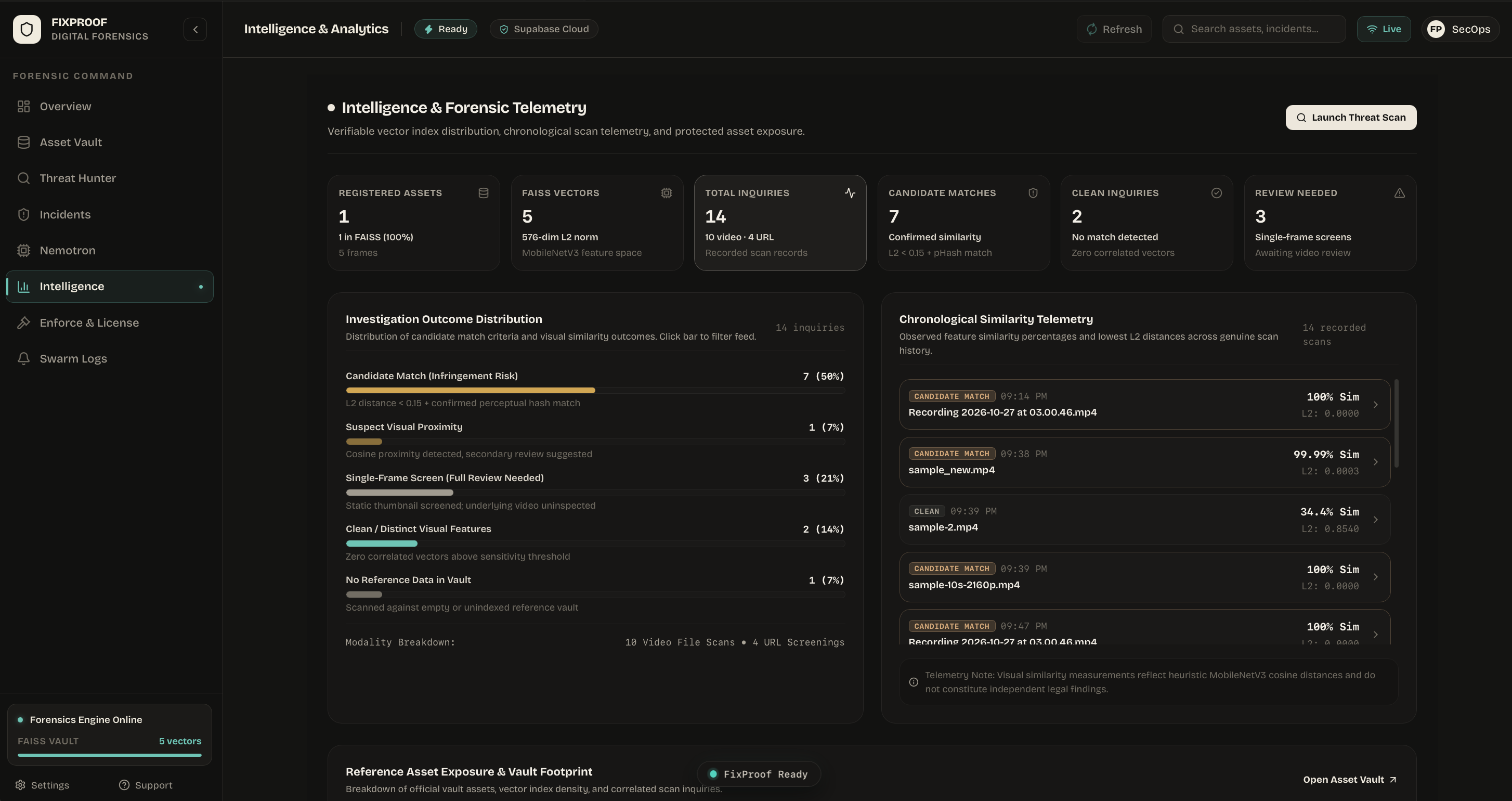
intelligence and forensics Page
-

-- Nemotron Investingation and Reporting Page
-
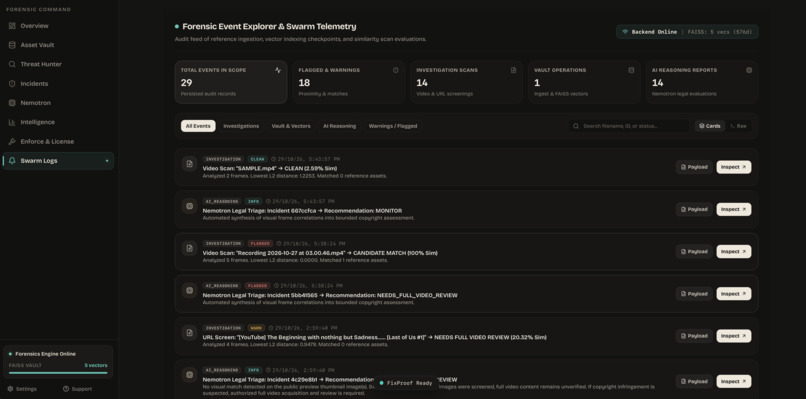
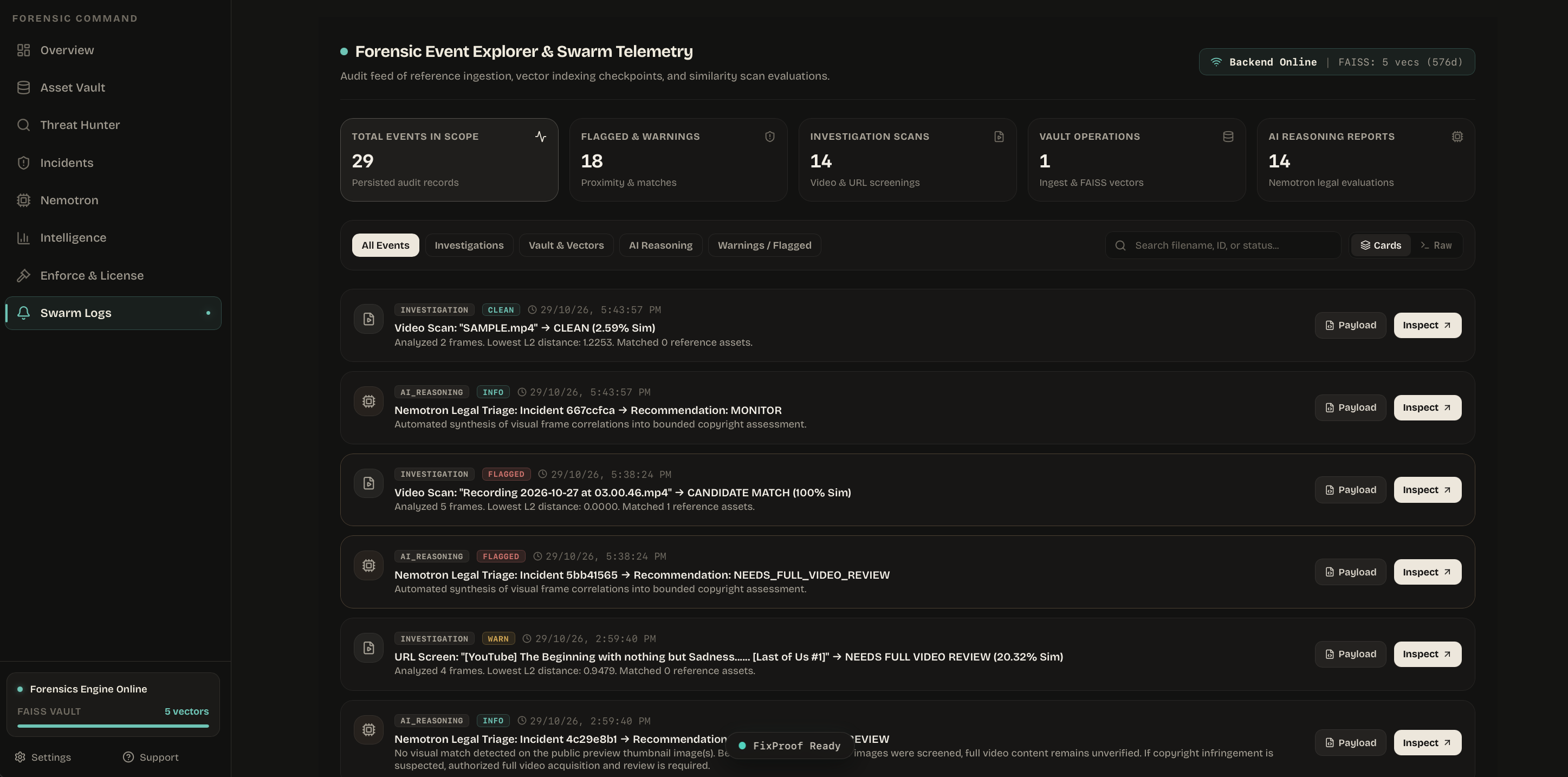
Swarm logs page
-

Landing page
-
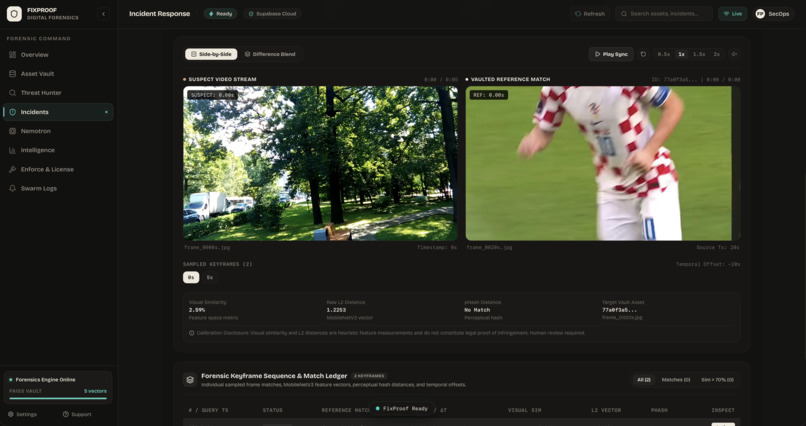
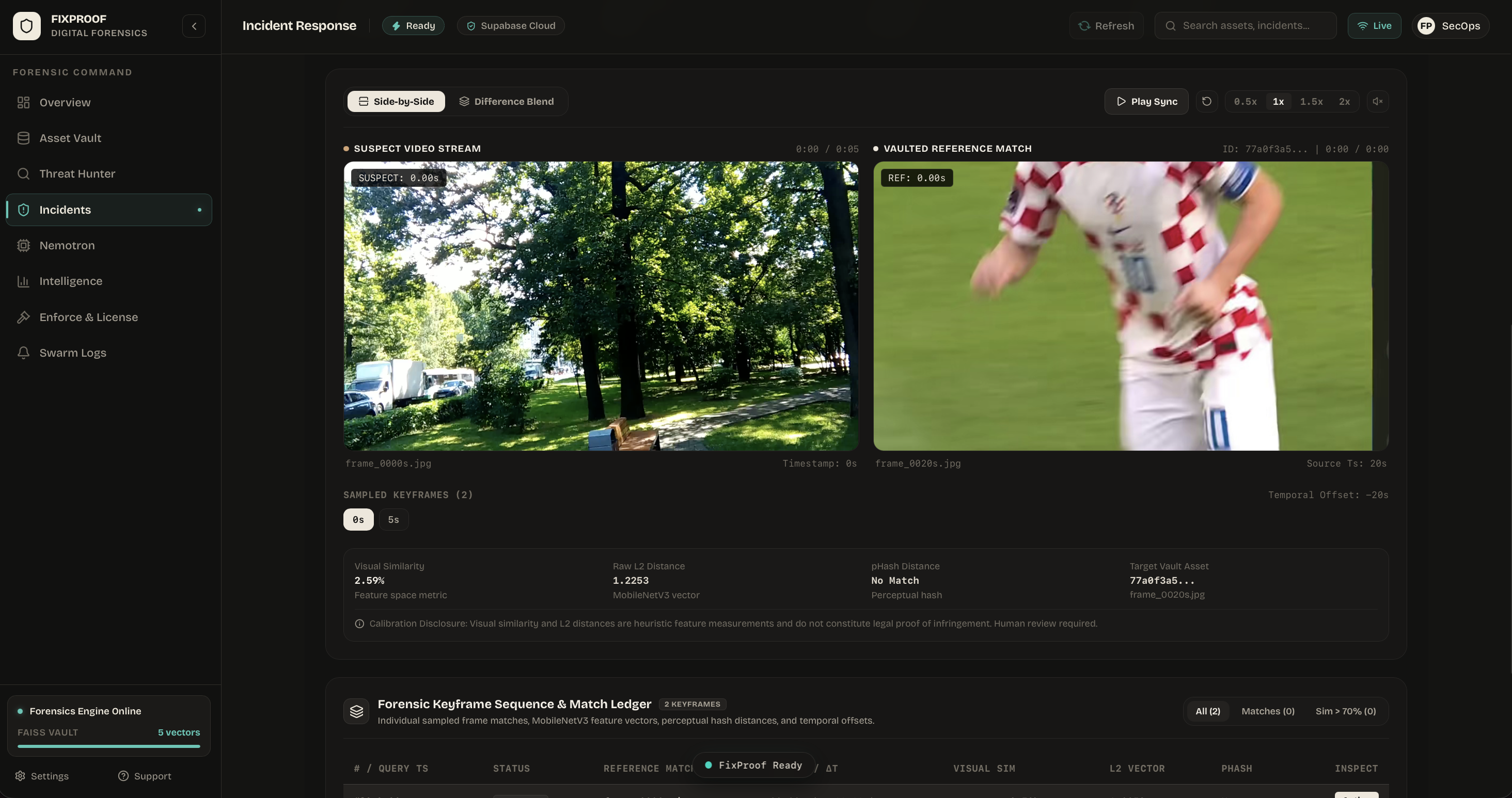
Working Incident page - side by side comparison



FixProof — A Six-Agent AI Investigation System for Sports Media Protection
Inspiration
The sports media ecosystem operates at an extraordinary scale. A single broadcast can be clipped, transformed, cropped, compressed, redistributed, and monetized across dozens of platforms within minutes.
For sports rights holders, broadcasters, and investigators, identifying unauthorized reuse is not simply a matter of finding a similar video. It requires discovering candidate sources, matching visual content across different formats, examining contextual evidence, establishing integrity, and preparing defensible investigation records.
Traditional workflows are fragmented. Video analysis, similarity detection, evidence collection, legal research, and reporting often require separate tools and considerable manual effort.
We asked a different question:
What if sports media investigations could be orchestrated by a specialized team of AI agents, each responsible for a distinct stage of the investigation?
That question became FixProof.
FixProof is an AI-assisted sports-footage investigation platform designed around six specialized agents. Together, they form a coordinated workflow that moves from trusted reference ingestion to candidate discovery, visual verification, evidence-grounded reasoning, and human-approved action preparation.
We are not building another video similarity checker. We are building an investigation infrastructure layer for the sports media ecosystem.
What it does
FixProof orchestrates six specialized agents, each with a defined responsibility within the investigation pipeline.
01 — ARCHIVIST
Trusted Reference Ingestion & Indexing
Establishing the ground truth.
Archivist maintains the trusted reference vault. It processes official sports footage, extracts representative frames, generates visual embeddings, and constructs a searchable reference index.
Unlike ordinary file storage, Archivist transforms reference media into a structured visual intelligence layer.
Its pipeline combines:
- OpenCV-based configurable frame sampling.
- MobileNetV3-Small 576-dimensional visual embeddings.
- L2-normalized feature vectors.
- FAISS IndexFlatL2 nearest-neighbor retrieval.
- SHA-256 asset fingerprinting and structured manifests.
Reference assets and suspect evidence are kept logically separated, preserving the distinction between trusted source material and material under investigation.
Live capabilities: Reference video ingestion, frame extraction, embedding generation, searchable FAISS indexing, and asset fingerprinting.
02 — SPIDER
Candidate Discovery & Stream Screening
Finding what deserves investigation.
Spider represents the discovery layer of FixProof. Its purpose is to identify candidate sports-media sources and prepare them for downstream visual investigation.
It supports manual URL submission and multi-video upload through Threat Hunter, with candidate previews and sequential screening.
Its intended discovery architecture includes:
- Candidate source identification and platform metadata.
- Preview and storyboard extraction.
- Sequential investigation queues, with a maximum of three streams in the current design.
- Independent failure handling for individual candidate sources.
- Source attribution and investigation context.
Spider is designed to reduce the amount of irrelevant material entering the investigation pipeline.
Live capabilities: Manual URL submission, multi-video upload, and candidate screening.
Roadmap: Continuous autonomous platform crawling and expanded stream discovery.
03 — SENTINEL
Visual Vector Matching & Frame Verification
Finding the visual connection.
Sentinel is the core visual intelligence engine of FixProof.
It compares suspect footage against the trusted reference vault using complementary visual signals. Instead of relying on a single similarity score, it combines learned visual representations, perceptual hashing, and temporal information to identify promising candidate matches.
Its technical stack includes:
- MobileNetV3-Small 576-dimensional visual embeddings.
- FAISS L2 nearest-neighbor retrieval.
- 64-bit DCT perceptual hashing.
- Frame-level similarity analysis.
- Temporal overlap and match-interval mapping.
- Optional Nemotron multimodal visual verification of shortlisted frames.
The combination provides multiple independent signals for investigating visually similar footage, including content that may have undergone transformations.
The key principle: A visual match is a candidate for investigation, not a legal conclusion.
04 — ADJUDICATOR
Evidence-Grounded Interpretation & AI Triage
Turning raw matches into explainable assessments.
Retrieval identifies candidates. Adjudicator examines what those candidates actually mean.
Powered by NVIDIA Nemotron through Nebius Token Factory, Adjudicator synthesizes recorded similarity metrics, available visual-verification results, temporal evidence, and missing information into structured investigation assessments.
Its responsibilities include:
- Structured reasoning over recorded evidence.
- Evidence-grounded explanations.
- Explicit identification of missing or weak signals.
- Uncertainty-aware confidence and triage.
- Identification of relevant contextual and fair-use considerations.
- Escalation to human investigators when evidence is insufficient.
Rather than allowing a language model to make unsupported conclusions, the workflow emphasizes grounding its analysis in the evidence supplied to it.
Adjudicator is designed to assist investigators, not replace legal professionals.
05 — ENFORCER
Evidence Packaging & Human-Approved Action Preparation
Turning investigation findings into verifiable records.
Enforcer transforms investigation results into organized, reviewable evidence packages and draft response documents.
Its capabilities include:
- Multi-page forensic PDF generation.
- Investigation timelines and supporting visual evidence.
- SHA-256 integrity verification.
- Ed25519 digital signatures.
- Downloadable, tamper-evident evidence archives.
- Editable copyright notice drafts, including DMCA and EU DSA-oriented templates.
- Explicit human authorization before dispatch.
The architecture deliberately prevents autonomous takedowns.
No AI-generated assessment should independently trigger a legal notice or enforcement action. Every consequential action remains subject to human review and approval.
06 — BROKER
Legitimate Licensing & Fan-Content Monetization
Moving from enforcement toward shared value.
Not every derivative sports video should be treated as an enforcement problem.
Fan edits, commentary, highlights, and transformative sports content can also represent opportunities for legitimate licensing and revenue sharing.
Broker explores a complementary approach: helping rights holders and eligible creators move from conflict toward potential collaboration.
Its current and proposed capabilities include:
- AI-assisted revenue-sharing proposal drafting.
- Commercial versus editorial content triage.
- Licensing opportunity identification.
- Micro-licensing workflows.
- Smart-contract-based revenue settlement.
Live capabilities: Proposal drafting through the Nemotron Action Center.
Roadmap: On-chain escrow, automated revenue distribution, and decentralized micro-licensing infrastructure.
Broker reflects a broader vision for sports media protection: an ecosystem that does not merely identify unauthorized reuse, but can also create pathways toward legitimate content monetization.
How we built it
FixProof combines conventional computer vision, vector retrieval, multimodal AI, cloud infrastructure, and cryptographic evidence handling into one coordinated application.
Visual intelligence layer
The video-processing pipeline uses OpenCV for frame extraction and MobileNetV3-Small to generate 576-dimensional visual embeddings.
These embeddings are normalized and indexed using FAISS IndexFlatL2, enabling efficient nearest-neighbor retrieval against reference footage.
We complement vector similarity with 64-bit DCT perceptual hashing and temporal alignment to provide additional comparison signals.
Multi-agent AI architecture
We organized the investigation workflow around six specialized agent roles: Archivist, Spider, Sentinel, Adjudicator, Enforcer, and Broker.
These agents are not six independently trained neural networks. They represent specialized responsibilities implemented through a combination of computer-vision models, retrieval systems, application logic, and AI-powered workflows.
NVIDIA Nemotron integration
We integrated NVIDIA Nemotron models through Nebius Token Factory.
Nemotron-powered workflows support structured investigation analysis, report drafting, and optional multimodal visual verification of shortlisted frames.
This allows FixProof to combine deterministic visual retrieval with model-assisted interpretation rather than depending on a language model to perform the entire investigation.
Full-stack infrastructure
- Frontend: Next.js and React.
- Backend: Python FastAPI.
- Computer vision: OpenCV and MobileNetV3-Small.
- Vector search: FAISS.
- AI: NVIDIA Nemotron through Nebius Token Factory.
- Database and object storage: Supabase.
- Cloud deployment: Google Cloud Run.
- Evidence integrity: SHA-256 and Ed25519.
The architecture separates trusted reference media, suspect footage, investigation results, and evidence packages into distinct parts of the workflow.
Challenges we ran into
The biggest challenge was not integrating an AI model. It was making multiple technical systems operate as one coherent investigation pipeline.
Video processing, embedding generation, vector retrieval, multimodal verification, cloud persistence, and evidence generation each introduce different failure modes.
One particularly important engineering challenge was maintaining reference-data integrity. A similarity engine cannot identify a reference match if the relevant footage has not been ingested, processed, and indexed correctly.
We also had to distinguish candidate retrieval from actual verification. Visually similar frames do not necessarily originate from the same recording, and a high similarity score cannot establish infringement.
Another challenge was making AI analysis evidence-grounded. Model-generated conclusions must be traceable to the actual frames, metrics, and investigation context available to the system.
Finally, cloud-backed testing required careful separation between application failures and missing test fixtures or reference data.
These challenges shaped an important architectural decision: FixProof must communicate uncertainty, preserve evidence provenance, and keep consequential decisions under human control.
Accomplishments we're proud of
We built a full-stack sports-footage investigation platform that brings together:
- Six specialized investigation-agent roles.
- A searchable visual reference vault.
- A 576-dimensional visual embedding pipeline.
- FAISS-based nearest-neighbor retrieval.
- Perceptual hashing and temporal comparison.
- NVIDIA Nemotron-powered investigation analysis.
- Optional multimodal visual verification.
- Structured forensic PDF generation.
- SHA-256 integrity checks and Ed25519 signatures.
- Human-approved action preparation.
What makes us particularly proud is the way these capabilities fit together.
Instead of presenting a chatbot wrapped around an API, we designed a domain-specific system in which AI has a defined responsibility within a larger technical workflow.
Our vision extends beyond detecting similar footage. We want to help transform sports-media investigations from fragmented manual processes into structured, searchable, explainable, and verifiable workflows.
What we learned
We learned that building useful AI infrastructure requires much more than selecting a powerful model.
The surrounding retrieval system, data quality, model orchestration, persistence layer, evidence integrity, and user experience are equally important.
We also learned that an effective AI investigation system should know what it cannot establish.
Similarity is not proof. Model confidence is not legal certainty. A generated report is not a substitute for human judgment.
Working with NVIDIA Nemotron through Nebius Token Factory helped us explore how model-powered reasoning and multimodal verification can complement conventional computer-vision systems.
Most importantly, we learned to design AI as part of an accountable system rather than treating it as an autonomous decision-maker.
What's next for FixProof
We envision FixProof evolving into a broader sports-media investigation and licensing ecosystem.
Our next priorities include:
- Expanding and diversifying the trusted reference dataset.
- Improving matching across resolution changes, cropping, compression, overlays, and different broadcast conditions.
- Strengthening reproducible end-to-end evaluation.
- Expanding candidate-source discovery.
- Improving evidence provenance and explainability.
- Developing licensing and revenue-sharing workflows.
- Exploring smart-contract settlement and micro-licensing infrastructure.
Our long-term ambition is to build an intelligent infrastructure layer that helps sports-media organizations discover, investigate, document, and responsibly resolve potential unauthorized content reuse.
Six agents. One coordinated investigation workflow. A more accountable future for sports media protection.
That's FixProof.


Log in or sign up for Devpost to join the conversation.