FixIT — Because Renters Deserve Proof
Inspiration
FixIT started with something we experienced firsthand. Our apartment flooded.
Dealing with the damage was frustrating. What made it worse was arguing with building management over the security deposit, especially about damage that was already there before we moved in.
As college students, we realized how hard it is for renters to prove when something went wrong. Photos get lost, maintenance requests get buried, and most people don't think about documenting their apartment until there's already a dispute.
We also learned that Madison already has strong tenant protections, like the Minimum Housing and Property Maintenance Code (MGO Chapter 27), rent abatement and anti-retaliation rules. Most renters never use them because the process is confusing and everyone deals with it alone.
We wanted to change that. What if renters could spot problems, document evidence, and understand their options before things escalated?
That's how FixIT began.
What it does
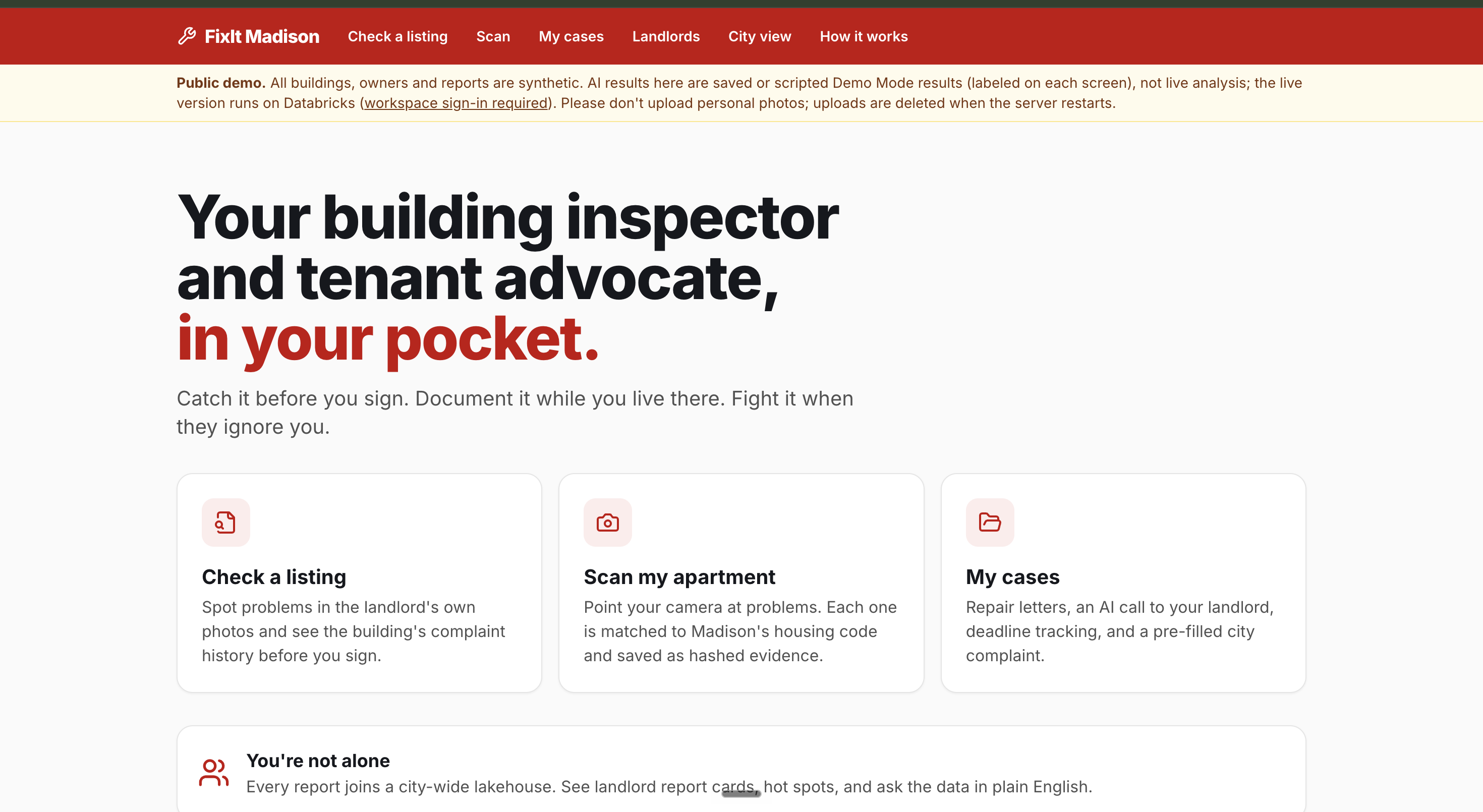
FixIT is an AI-powered platform that helps renters spot apartment maintenance problems, document evidence, and hold property management accountable.
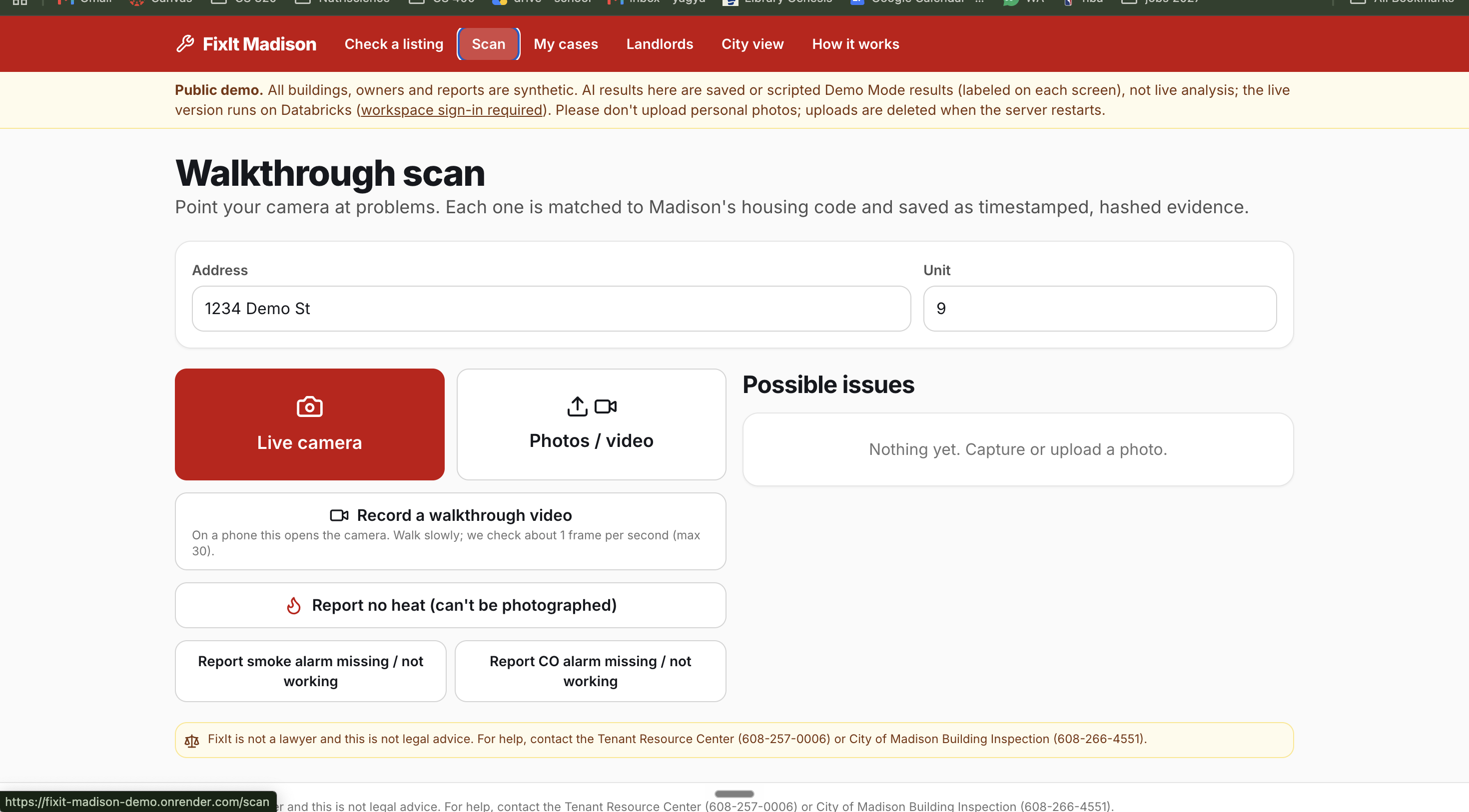
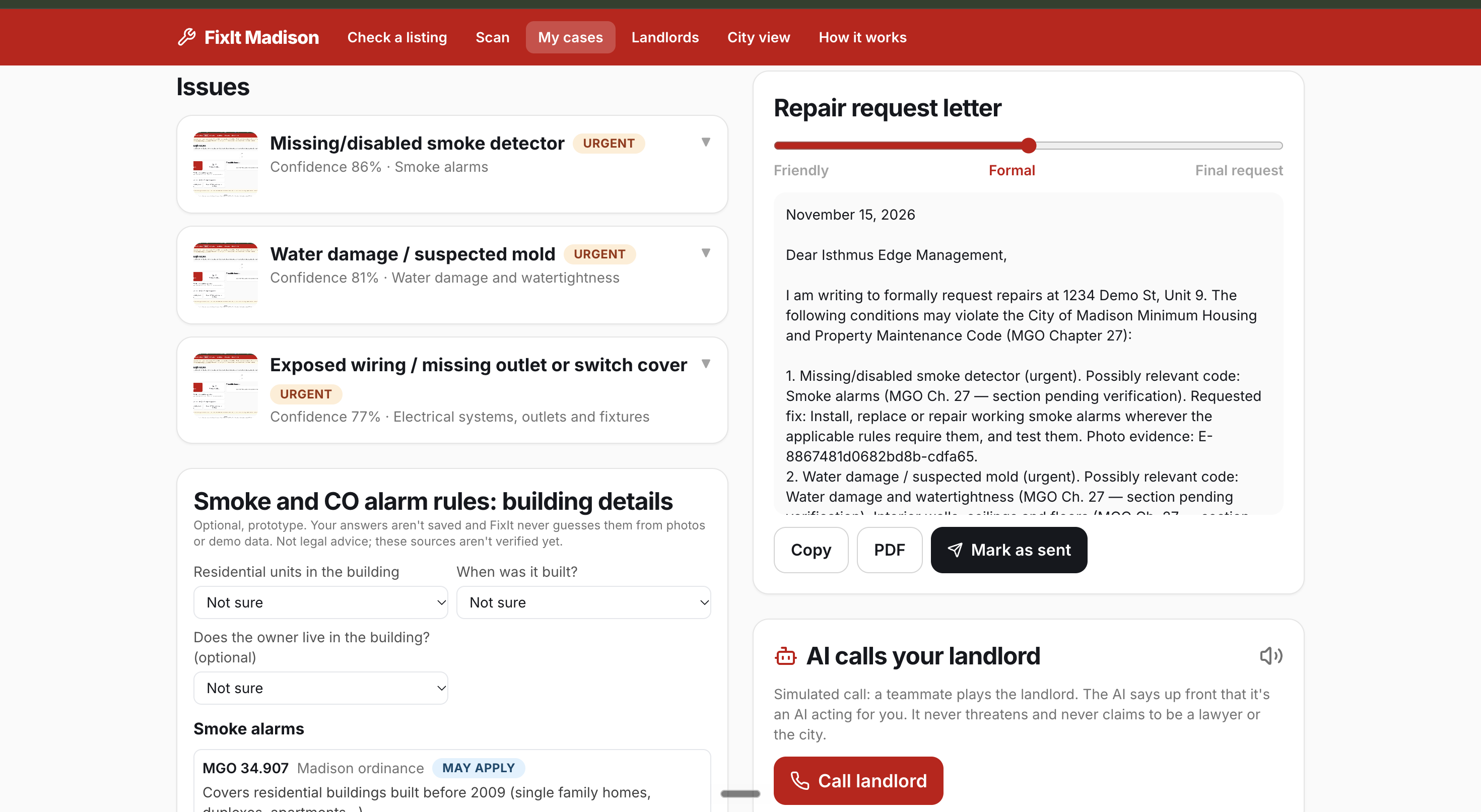
Users can upload apartment photos, use their phone camera, or record a walkthrough video. FixIT samples frames from the video and analyzes them with a multimodal AI model. It looks for possible issues like water damage, exposed wiring, damaged surfaces, leaks, pests and broken locks. Every finding links back to the exact frames that show it.
But FixIT goes beyond detecting damage. It also offers:
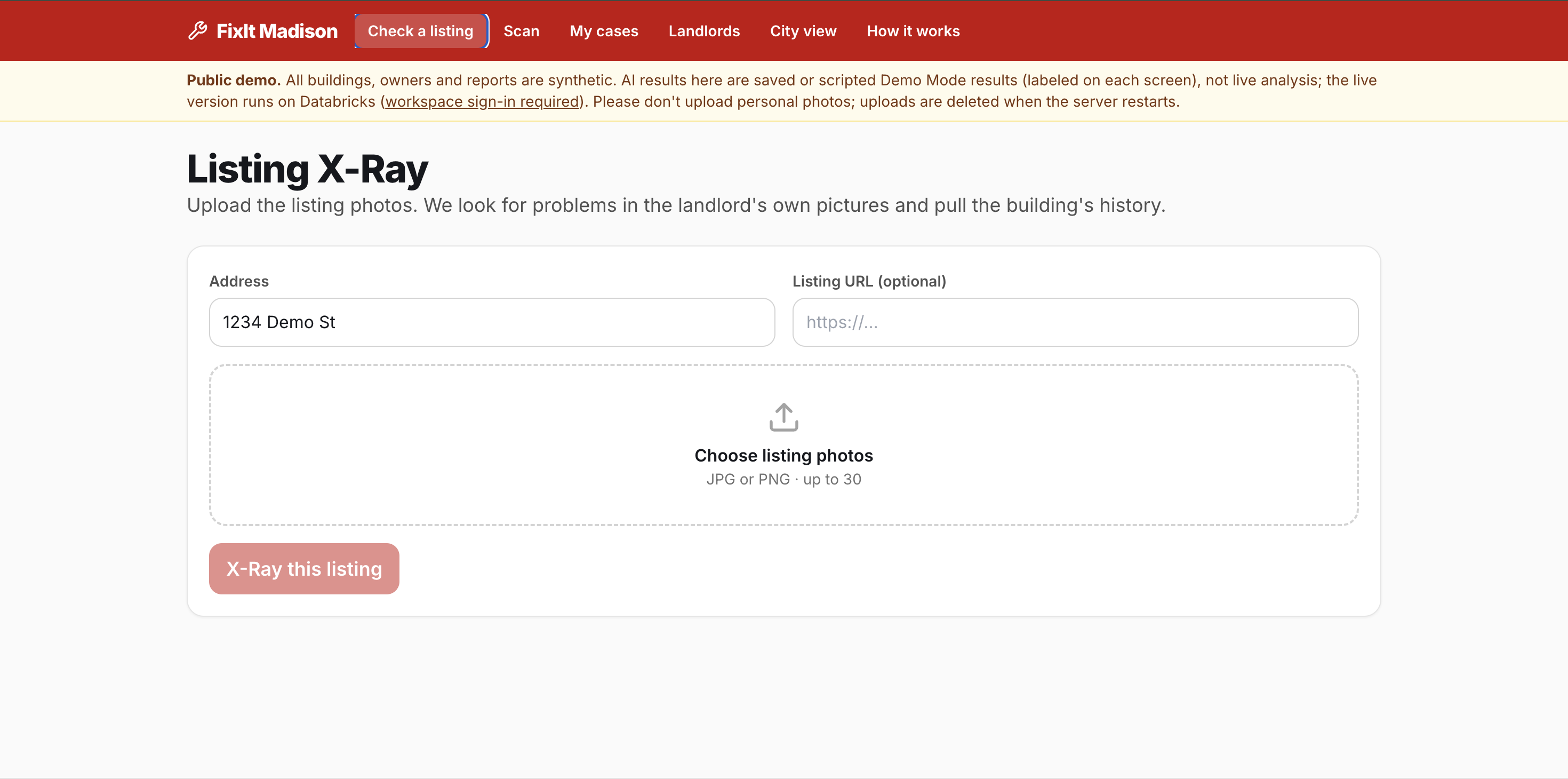
- Listing X-Ray: Upload a rental listing's photos and address before signing. FixIt looks for possible problems in the landlord's own photos and pulls the building's complaint history and the owner's grade. You get a verdict (Sign / Ask first / Don't sign yet), tour questions and a lease addendum.
- Evidence Locker: Every photo and frame is stored with a SHA-256 hash and timestamps, then bundled into a downloadable evidence packet PDF.
- Housing-Code Guidance: Each finding is matched to the relevant Madison housing code section. Only citations a human has checked against the official Chapter 27 text are shown as verified. Everything else is labeled "possibly relevant".
- AI Landlord Assistant: Generates repair letters in three tones and runs a simulated landlord call that discloses it's an AI, cites the code, and captures the promised repair date. It then tracks a follow-up deadline and, if the landlord misses it, pre-fills a City Building Inspection complaint (never auto-submitted). We also built a real AI phone call with Retell AI, limited to consenting test numbers.
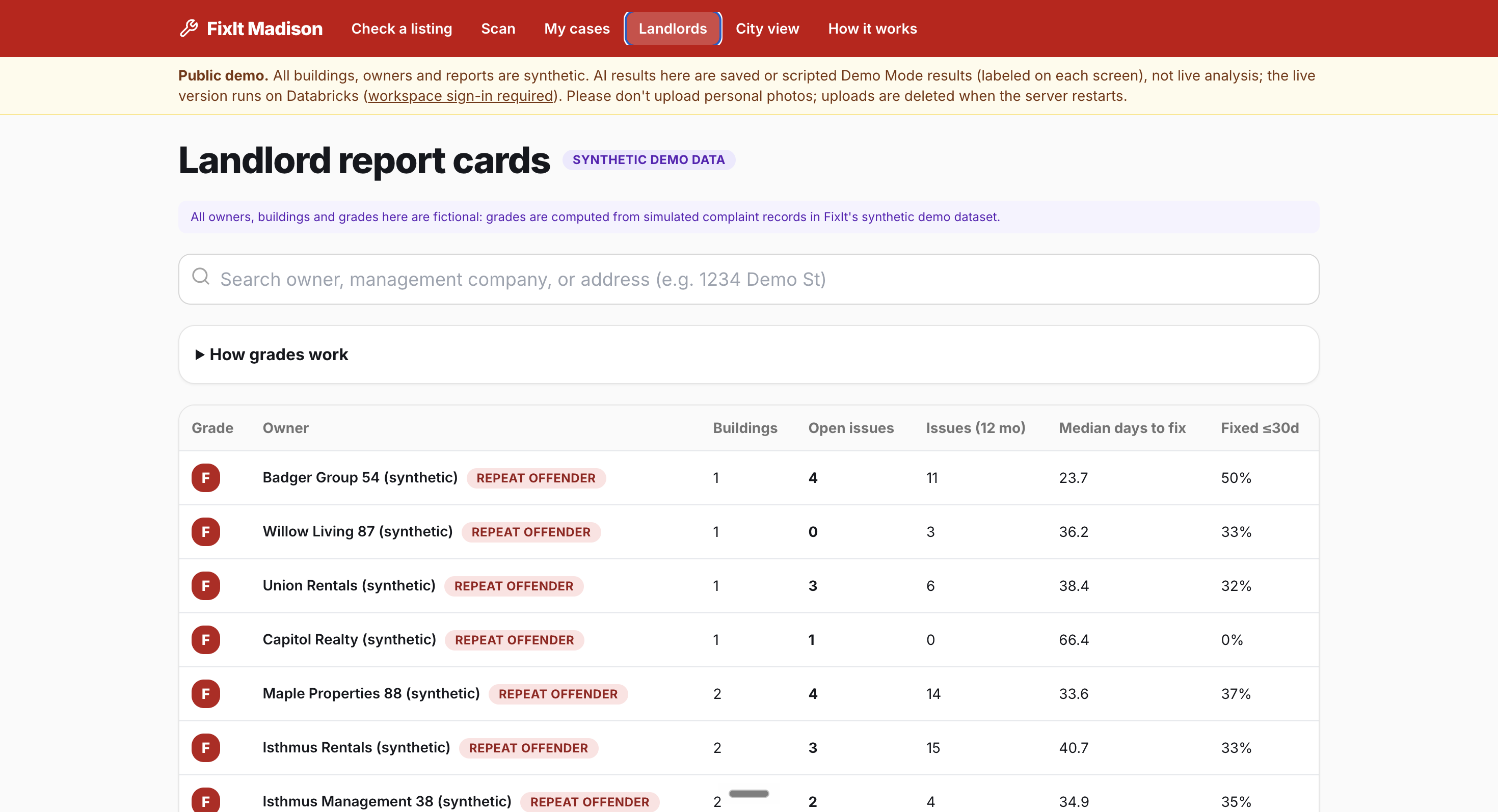
- Landlord Analytics: "You're not alone" matches your report with neighbours in the same building and the same owner's other buildings, so tenants can file together. It also includes landlord report cards, a city map of open issues, and plain-English questions answered by Databricks Genie.
Our goal is to make housing documentation easier, more accessible, and actually useful when renters need it.
How we built it
We built the frontend with React, TypeScript, Vite, and Tailwind CSS, with Python and FastAPI powering the backend. The whole thing is deployed as a Databricks App.
For visual analysis, the app uses Meta's Llama 4 Maverick through Databricks Model Serving. We give it our violation taxonomy and require strict JSON back, validate every response, retry on bad output, and label anything below the confidence threshold as "possible issue — verify in person."
Our video pipeline samples frames in the browser (1 per second, up to 30 spread across the clip). It sends them in batches of 5 with parallel model calls and retries when the endpoint rate-limits us. Repeated sightings of the same problem across frames are merged into one finding that cites exactly those frames.
We also ran two YOLO26-OBB detector experiments on Databricks Serverless GPU. We trained on a deduplicated, leak-checked dataset of cracks, damp, holes, mold-like growth and stains, and compared the results against Llama on the same 50 test images. YOLO didn't beat Llama overall, so Llama stays the detector, but a YOLO + Llama hybrid looked promising for some damage types.
We use Databricks SQL, Delta tables, Unity Catalog, UC Volumes, and Genie to store cases, evidence and housing data and to produce property-level insights. The App's service principal gets only the permissions it needs. We parsed the official MGO Chapter 27 PDF and reviewed citations by hand before switching any of them on. We also created a synthetic dataset of 2,004 Madison buildings, 251 owners, and 11,941 maintenance reports to demonstrate how recurring housing problems could be identified. Every synthetic record is labeled as demo data in the app.
Every AI step has a Demo Mode fallback (cached or scripted results), and the UI always shows whether a result came from a live model, a cache or a fallback.
Challenges we ran into
One of our biggest challenges was getting AI findings to match what was actually visible. The model would sometimes report a "missing smoke detector" just because none was in the frame, and it missed a stain we drew on the ceiling. We changed the pipeline so the absence of something in a photo is never treated as a finding, and we made uncertainty clearer.
Processing walkthrough videos was another challenge. Analyzing many frames meant latency, duplicate findings, and API rate limits (HTTP 429s). We fixed this with frame sampling spread across the whole clip, batching, parallel calls, bounded retries, and merging repeat findings. We also fixed video bugs like recordings with unknown length and seeks that hung.
We had to handle housing regulations carefully. We wanted to give useful guidance without calling a possible maintenance issue a confirmed legal violation. We checked every citation against the official Chapter 27 text, and only the ones a human approved are shown as verified. The rest stay labeled "possibly relevant".
Working within Databricks Free Edition limits was its own puzzle. Some models weren't offered, a GPU session capped at 30 minutes, and we had to manage service-principal permissions carefully.
Finally, integrating computer vision, Databricks, phone calls, and a full-stack application within a hackathon meant constant debugging, prioritizing features, and making sure everything worked together.
Accomplishments that we're proud of
We're proud that FixIT is more than a simple AI image analyzer.
We built an end-to-end platform that connects apartment scanning, evidence collection, repair documentation, and landlord accountability in one experience. It's deployed and running on Databricks.
We're especially proud of our walkthrough video pipeline, our Databricks integration, and our honest approach to legal citations. We're also proud of the synthetic housing dataset, which shows how individual tenant reports can reveal larger maintenance patterns.
Most importantly, we turned a problem we personally experienced into a working application that could genuinely help other renters.
What we learned
We learned a lot about integrating computer vision, multimodal AI, and data engineering into a real application.
One of our biggest takeaways was that AI accuracy isn't just about detecting something. The finding has to be backed by evidence, and the app has to say when it isn't sure. Our YOLO experiments also showed us that better labeled data matters more than a different model.
We also gained experience with Databricks, building reliable backend pipelines, handling model latency and rate limits, and designing features around real user problems.
Above all, we learned how important it is to build technology that's not just impressive technically, but actually useful.
What's next for FixIT
We want to improve detection with better labeled data and a YOLO26 + Llama hybrid, expand mobile support, and add move-in versus move-out comparisons so renters can show damage was already there during security-deposit disputes.
We also plan to finish verifying the remaining housing-code citations, bring real AI landlord phone calls to production, integrate verified public housing data, expand beyond Madison, and build smarter maintenance follow-ups and collaborative tenant reporting.
Our long-term goal is to make FixIT a reliable housing accountability tool that renters can use throughout their entire lease.
