Inspiration
Everyone knows a Frank. His chair wobbles, so he has two options: spend $289 on a new one, or watch a 47-minute tutorial and somehow end up with a leg above the backrest.
Most broken things aren't really broken. A chair wobbles because one screw backed out. A faucet drips because a 30-cent washer wore out. But most people can't tell what is wrong, so they replace the whole thing. That's expensive, and it's a lot of furniture in landfills.
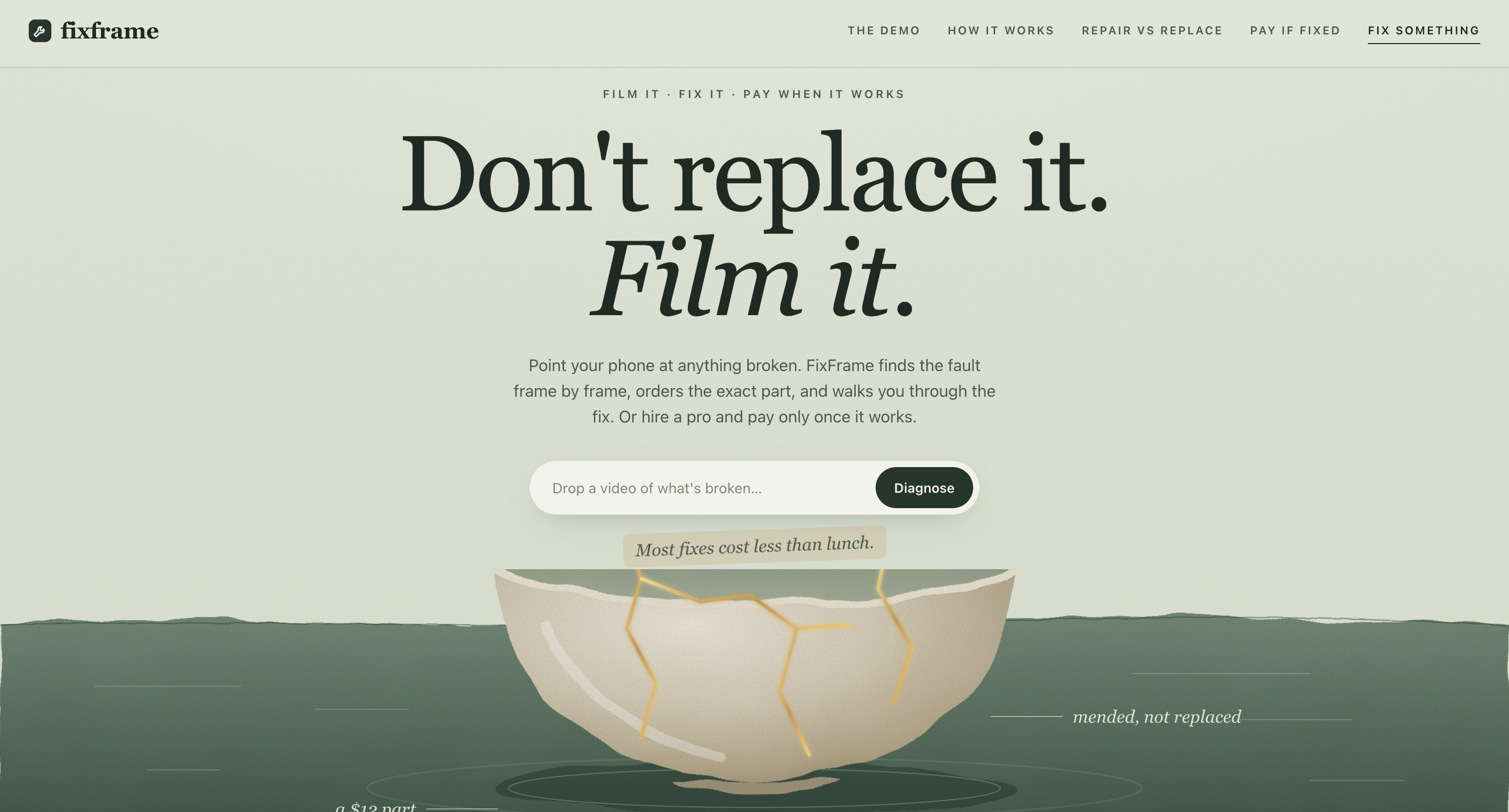
I wanted the shortest possible path from "this is broken" to "this is fixed": just film it.
What it does
- Film the broken thing. Upload a short video or photo, plus an optional note.
- Get a diagnosis pinned to your video. FixFrame finds each fault and boxes it at the exact second it shows up, like "screw backing out of the joint at 0:05". You also get a confidence score, the tools you need and a safety note.
- See repair vs. replace. For Frank's chair: about $9 to repair vs. $289 for a new chair. That's $280 saved and 6.5 kg kept out of landfill.
- Follow step-by-step instructions. Click any step and the video jumps to the moment that shows it.
- Buy the exact parts. Channel3 searches real stores for each part. You compare offers in an AG Grid table, and you can even search by a photo crop taken from your own video.
- Pay with PayPal. One checkout for all the parts.
- Or hire a pro, and pay only if it's fixed. PayPal authorizes the pro's quote but doesn't charge it. After the repair, you film the item again. FixFrame compares the after-clip to the original problem:
$$ \text{payment} = \begin{cases} \text{capture (pro gets paid)} & \text{if fixed with confidence} \geq \tau \ \text{void (you pay nothing)} & \text{otherwise} \end{cases} $$
No more paying for a "fix" that falls apart the moment you sit down.
How I built it
- Backend: Node.js + Express. Uploaded videos go through ffmpeg, which pulls evenly spaced frames with timestamps and crops regions for photo search.
- Diagnosis: the frames go to a multimodal AI model (Anthropic API) with a strict JSON schema: item, problem, markers with timestamps and bounding boxes, steps, parts, tools, safety notes and a replacement estimate. The server validates and cleans the response before the UI ever sees it.
- Parts: each part becomes a Channel3 search, by text query or by a photo crop from the frame where the fault appears. The cheapest in-stock offer is picked by default.
- Comparing offers: AG Grid with custom cell renderers for the pick buttons, product thumbnails and stock labels. Change a pick and the cart total updates live.
- Payments: PayPal Orders v2.
intent: CAPTUREfor parts, andintent: AUTHORIZE→ capture or void for the pay-only-if-fixed flow. - Hosting: Render, with a Docker blueprint so ffmpeg is available in production.
- Frontend: plain HTML, CSS and JS, with an editorial design, and a video player with a marker timeline that stays in sync with the step list.
Savings are calculated as:
$$ \text{saved} = P_{\text{replace}} - \sum_{i} \min_j \, p_{ij} $$
where $p_{ij}$ is the price of offer $j$ for part $i$.
Challenges
- Pinning faults to the right moment. Getting the model to say what's wrong was easy. Getting it to say when and where in the video was hard. I send the timestamp with every frame and ask for normalized bounding boxes, then clamp and validate everything.
- Turning a diagnosis into something you can buy. "Loose joint" isn't a product. Each part needed a shopping query specific enough to return wood glue and #8 screws, not a whole new chair.
- Getting pay-only-if-fixed right. Authorize, then capture or void, sounds simple. But the timing of each step, and showing the user clearly what's held vs. charged, took a few rewrites.
- Making the demo reliable. Live AI and live search can be slow or fail during judging, so FixFrame recognizes its sample clips and has a fallback mode. The app always works, even without keys.
What I learned
- Using PayPal's authorize-and-capture flow as a trust tool, not just a way to take payments.
- Prompting a vision model for structured output grounded in time and space, and never trusting that output without validation.
- That the best demo is a story. Nobody gets excited about "multimodal diagnosis", but everyone gets Frank.
What's next
- Live video mode: point your phone at the problem and get guided through the fix in real time.
- A repair history for each item, so FixFrame knows the chair you fixed last spring.
- A pro marketplace with verified reviews based on how many repairs actually passed the after-clip check.
Built With
- ag-grid
- anthropic
- channel3
- computer-vision
- css3
- docker
- express.js
- ffmpeg
- html5
- javascript
- multer
- node.js
- paypal
- paypal-orders-api
- render
