Pathway: Hackathon Pathway
Inspiration
At school and around our neighborhood, broken things (a leaking water fountain, a dead streetlight, a damaged ramp) get reported again and again, or not at all. Facilities teams get a pile of duplicate, unclear complaints and no easy way to tell what matters most. We wanted to make reporting simple and make the work list clear.
What it does
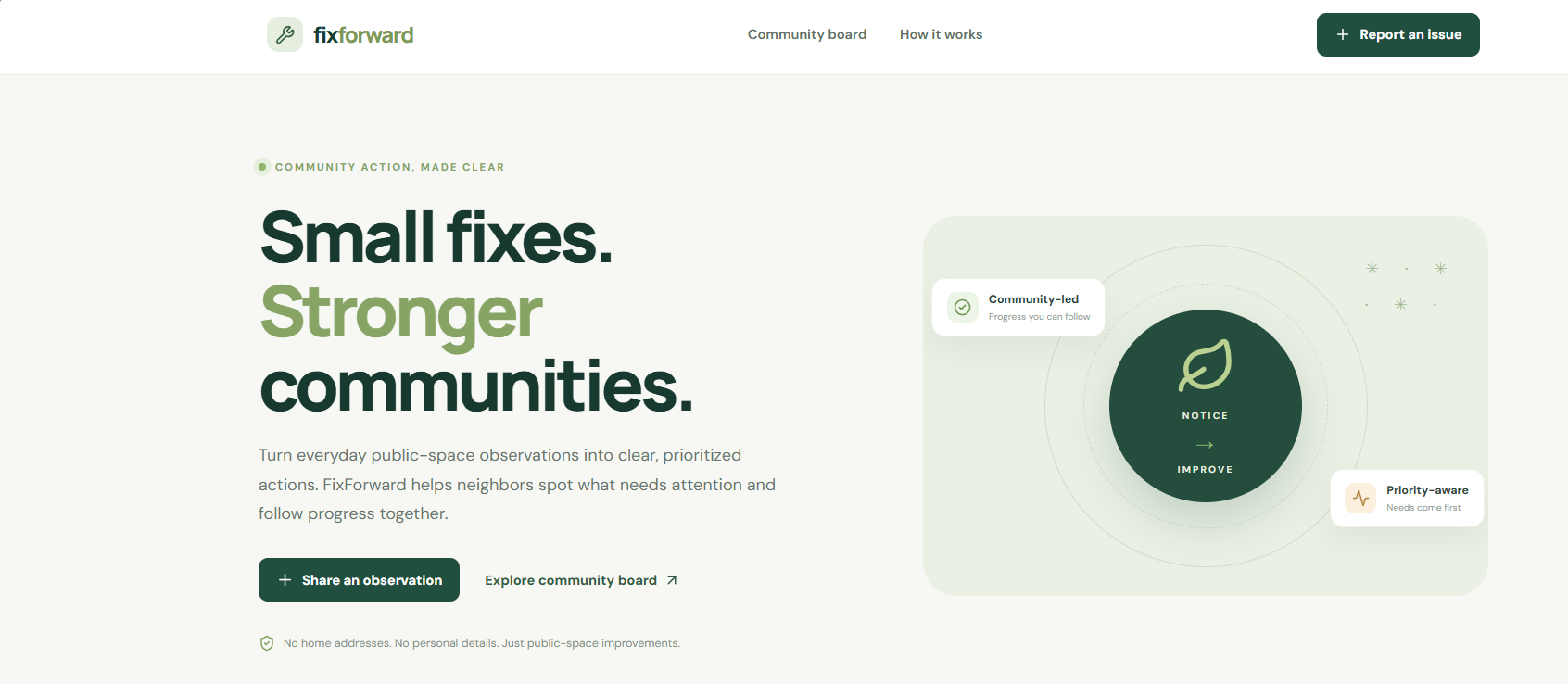
FixForward is a community maintenance board.
- Report an issue with a location, category and description.
- Duplicate detection: when a new report looks like an existing one, FixForward suggests "support this instead," so one issue collects many voices instead of splitting into many tickets.
- Explainable priority: every issue gets a priority score with a visible breakdown (for example safety risk, number of supporters, and how long it has been open), so anyone can see why something is ranked where it is.
- Status history: each issue shows its full timeline from reported to fixed, so the community can see progress.
- Action brief export: facilities teams can export a clean, ranked brief of what to fix first.
How we built it
FixForward is a React web app. Duplicate detection compares new reports with open ones by location, category and text similarity. The priority score is a transparent weighted formula rather than a black box, so it can be explained and adjusted.
Challenges we ran into
Balancing duplicate detection so it catches real repeats without merging different problems, and designing a priority score that is fair but still simple enough to explain on screen.
What we learned
Transparency builds trust: people accept a ranking much more readily when they can see how it was calculated.
What's next
Pilot FixForward at our school, collect real reports, and measure how much faster issues get resolved.
AI & third-party resources
We used AI coding assistants to help write and debug parts of the code and to draft documentation. We used open-source libraries including React.
Built With
- civic-tech
- javascript
- react
