Inspiration
University students and staff frequently encounter maintenance problems such as broken fans, faulty lights, water leaks, and damaged equipment. However, reporting these issues and tracking repairs can be slow, confusing, and difficult to manage.
We wanted to create a smarter, more organized way for universities to handle everyday maintenance problems.
That's how FixFlow — Smarter Campus. Faster Fixes. was born.
Our vision is to connect students, maintenance teams, and campus administrators through one digital platform that makes reporting and managing maintenance issues easier.
What it does
FixFlow is a Jac-powered campus maintenance management platform that helps universities organize and track repair requests.
Our application includes:
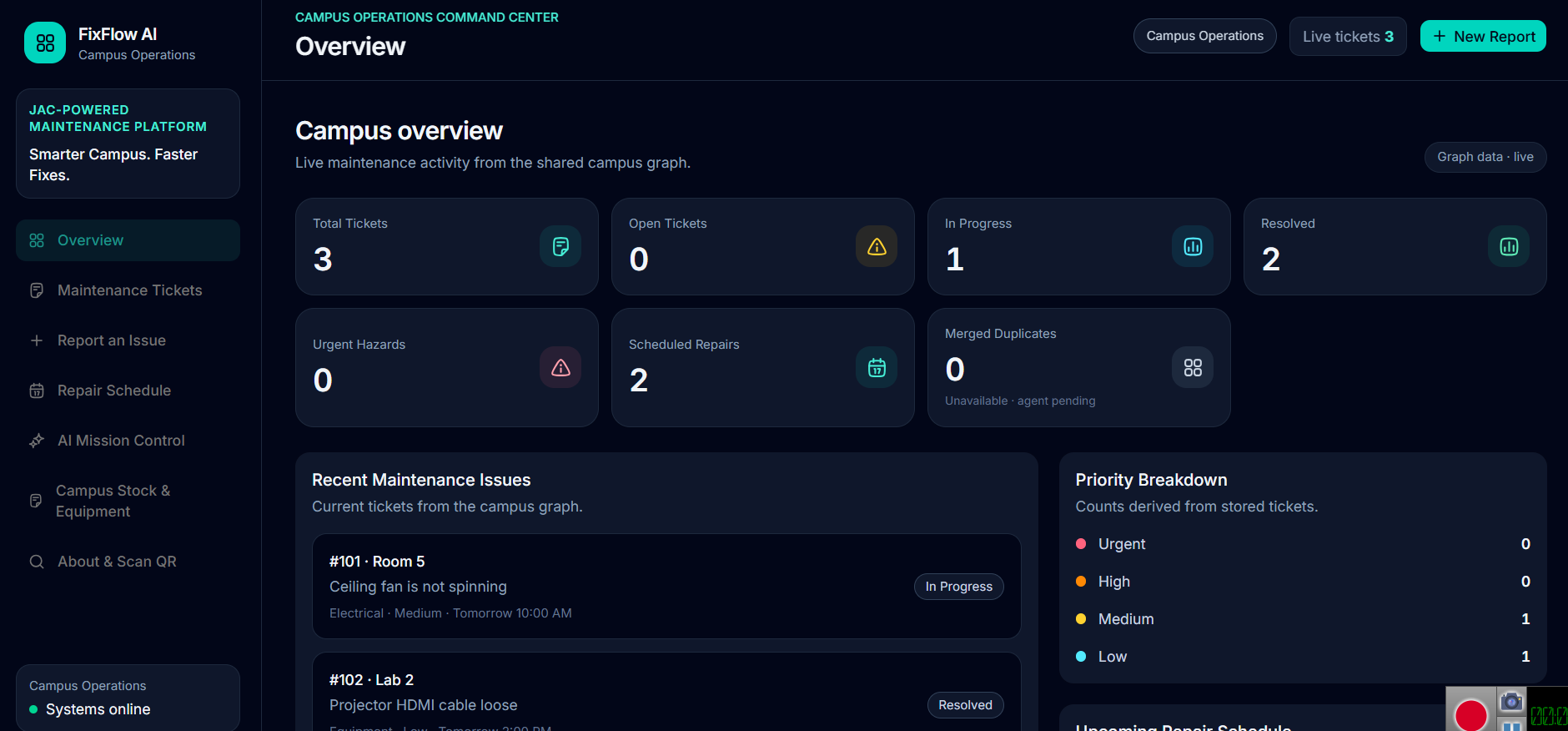
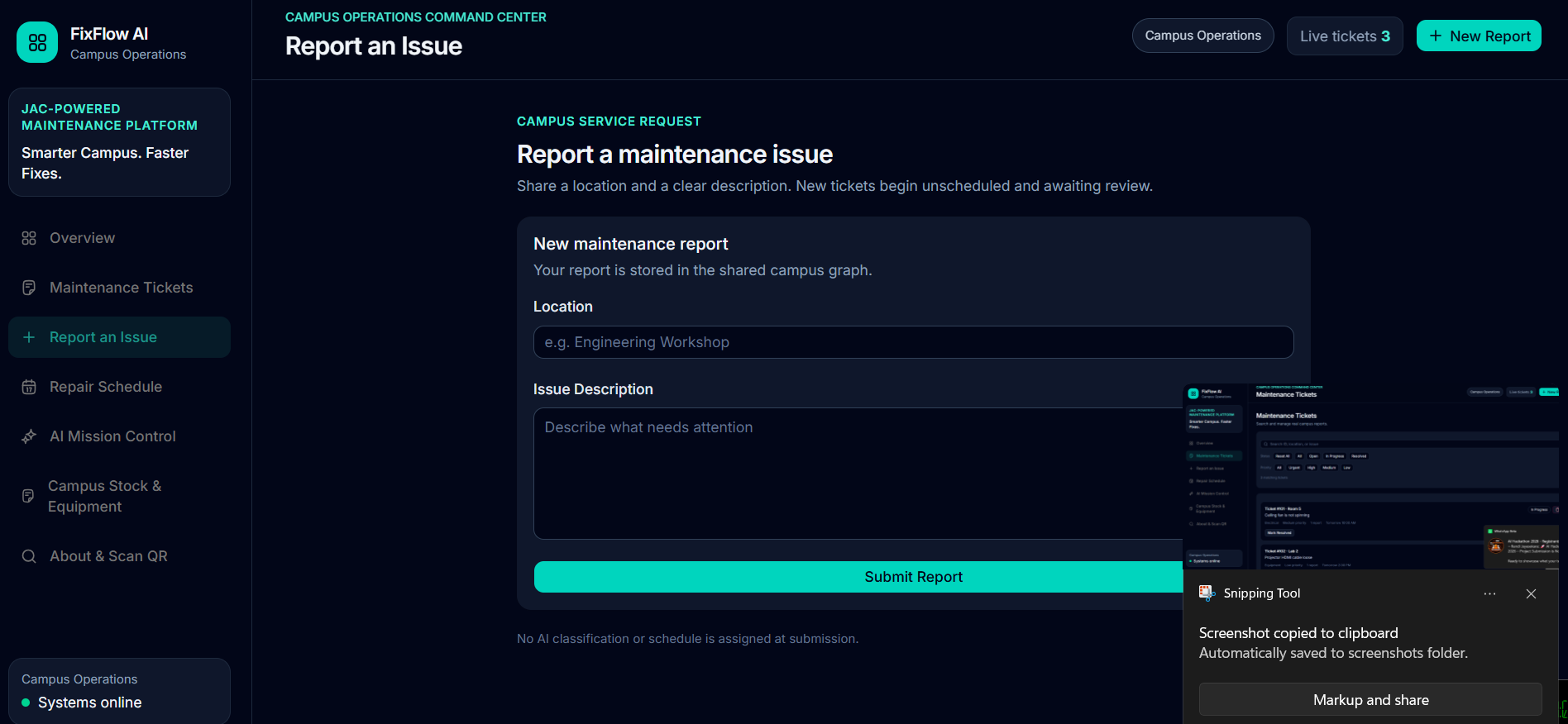
- Campus Operations Dashboard: A modern interface showing maintenance ticket statistics, repair progress, and recent issues.
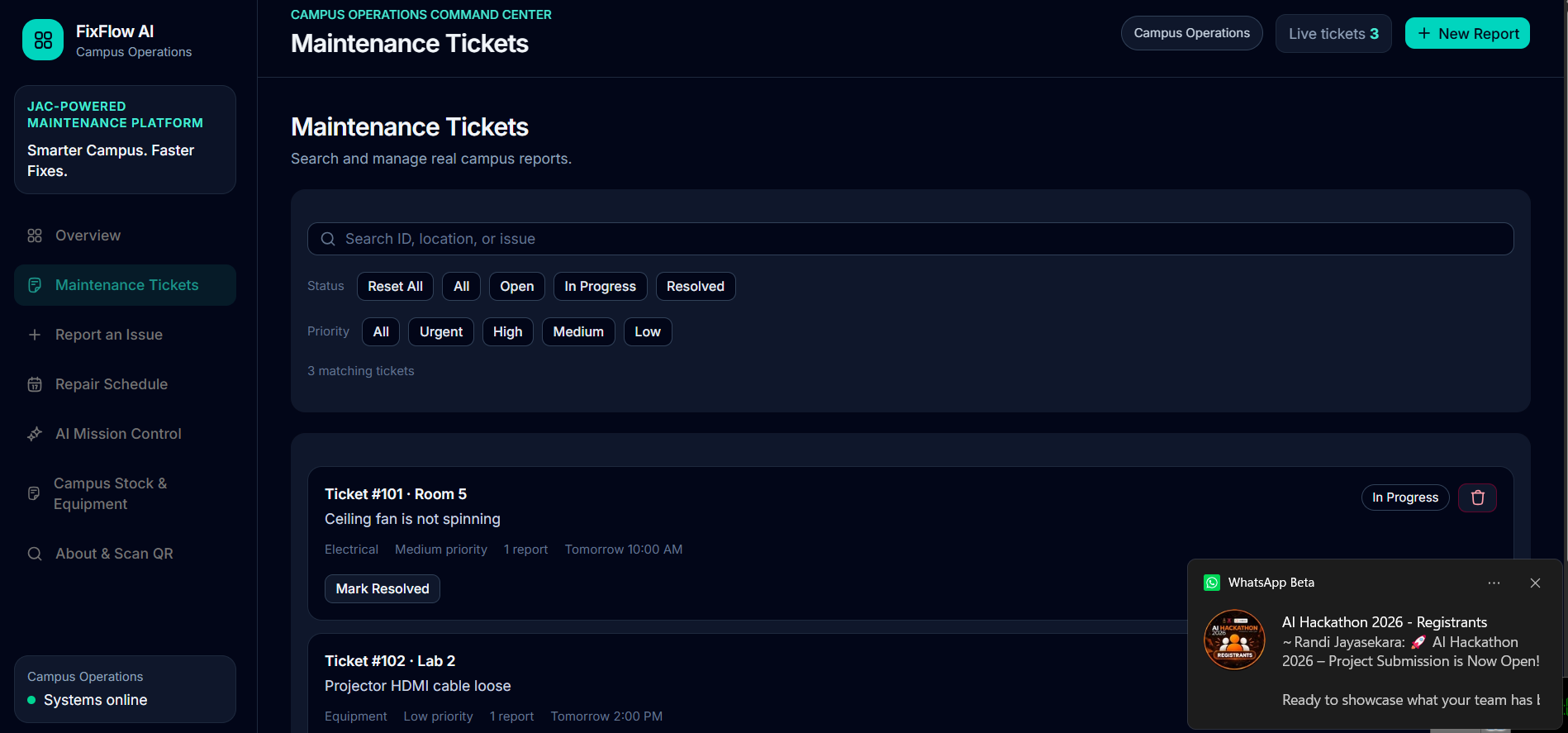
- Maintenance Ticket Management: Users can report problems, search and filter tickets, update their status, and delete unwanted reports.
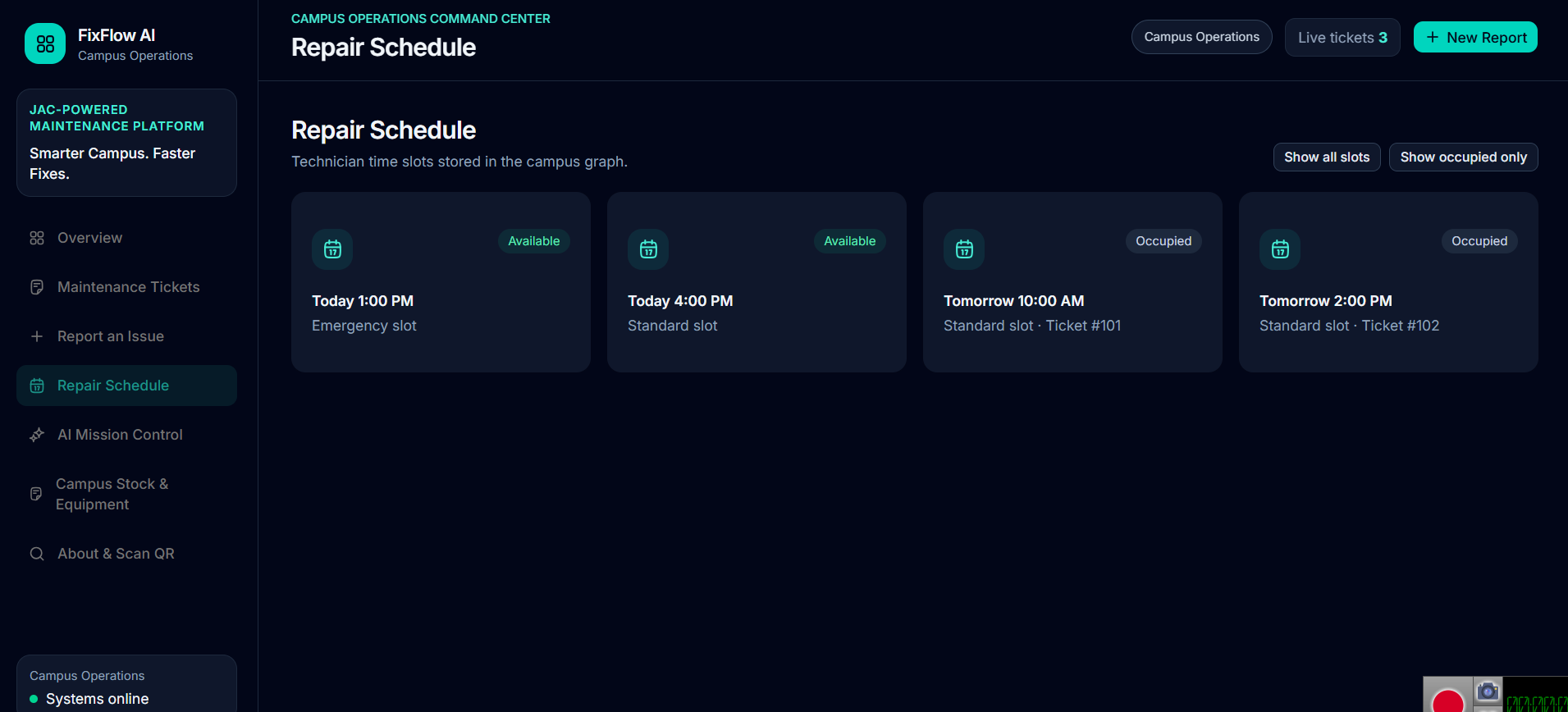
- Repair Scheduling: Displays available and occupied maintenance time slots, helping staff track scheduled repairs.
- Campus Inventory Integration: A dedicated area designed to connect maintenance requests with equipment and spare-part stock information.
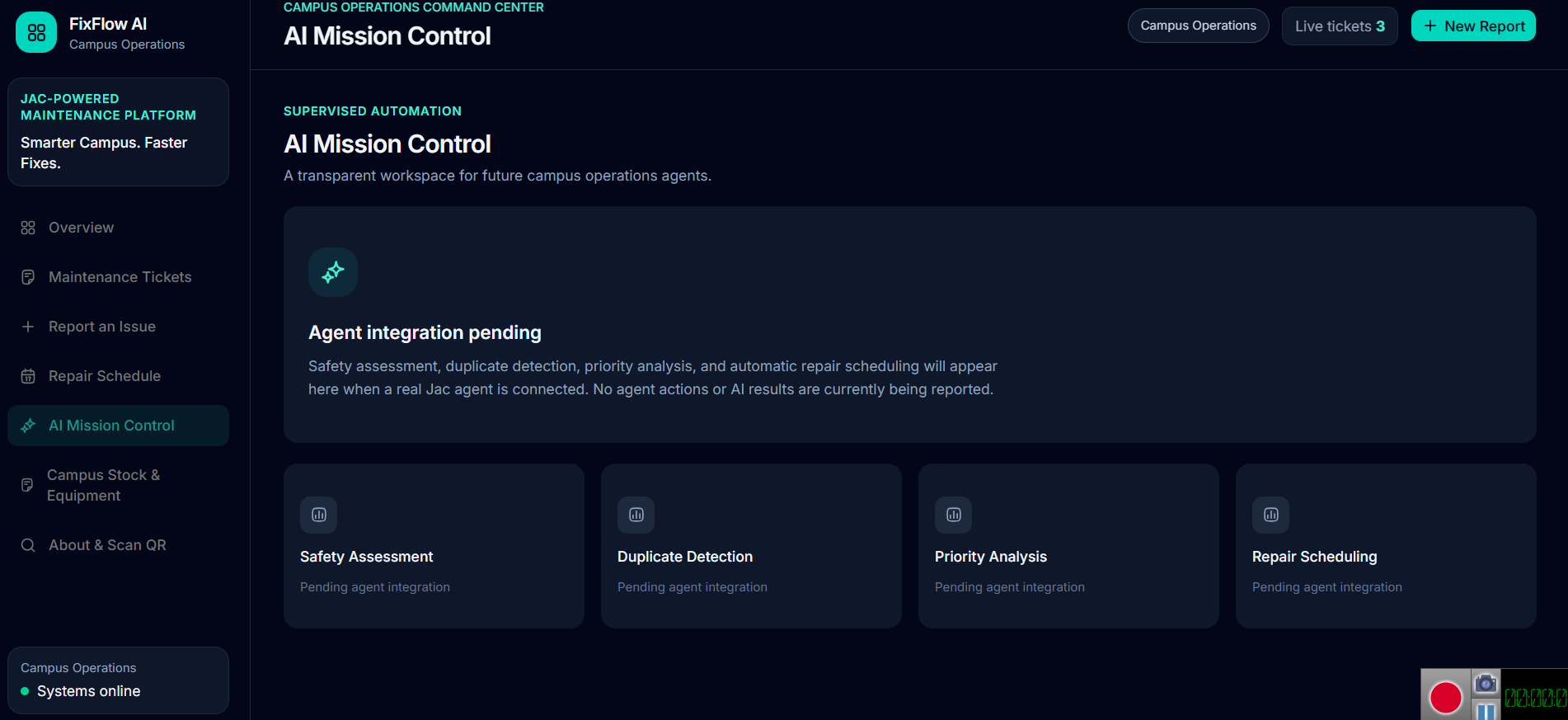
- AI Mission Control: A dedicated interface intended to display intelligent issue classification, safety assessments, duplicate detection, and scheduling decisions as agent functionality is integrated.
- QR-Based Reporting Concept: QR codes can be printed and placed around campus, allowing students to scan them and access a Google Form to report maintenance issues.
The planned Google Forms integration would allow submitted reports to flow into the maintenance dashboard. This automatic synchronization was not fully completed in the version demonstrated.
How we built it
We developed FixFlow as a three-member team during the AI Hackathon 2026 using Jac, Jaseci, Jac Hammer, and GitHub.
We used Jac to implement the application's main functionality, including graph-based maintenance data, ticket relationships, service functions, and backend operations.
Our implementation uses concepts such as:
- Jac graph nodes to represent maintenance tickets and repair time slots.
- Graph edges to connect tickets to scheduled repair slots.
- Jac service functions and walkers to create, retrieve, update, and manage maintenance data.
- Jac-powered frontend components for the dashboard and application interface.
- GitHub collaboration so team members could develop frontend, agent, and additional features in parallel.
Jac Hammer helped us generate, edit, preview, test, and debug the application.
We built the project incrementally, starting with a basic dashboard, adding graph-backed maintenance records, and developing it into a modern Campus Operations Command Center.
Challenges we faced
Our biggest challenge was connecting the frontend interface to the Jac backend reliably.
Although the application compiled, certain buttons initially failed to trigger backend functions. During debugging, we encountered frontend runtime errors, including issues with event handlers and reactive state updates.
We overcame these challenges through repeated testing, smaller diagnostic experiments, and improvements to the frontend event handling.
We also had to carefully manage multiple GitHub branches while working simultaneously as a three-person team.
Another challenge was balancing ambitious AI and QR-based features against the limited time available during a one-day hackathon.
Accomplishments we're proud of
We are proud that we developed a working campus maintenance application using Jac and Jaseci technologies in a single hackathon day.
Key achievements include:
- Building a modern, responsive operations dashboard.
- Implementing graph-backed maintenance tickets and repair schedules.
- Enabling ticket creation and status management.
- Adding ticket search, filtering, and deletion.
- Building interactive dashboard cards and navigation.
- Collaborating through GitHub.
- Preparing the interface for inventory integration, QR-based reporting, and intelligent maintenance workflows.
Rather than building only a static prototype, we focused on real application functionality and testing.
What we learned
This project helped us understand:
- How Jac supports application development using graph-based programming.
- How frontend interfaces communicate with backend services.
- How to manage persistent maintenance records and their relationships.
- How to debug runtime issues beyond basic compilation errors.
- How to collaborate using GitHub branches and version control.
- How important reliable testing and clear user experience are when building an AI-powered product.
We also learned that building a useful application requires balancing technical ambition with stability and user needs.
What's next for FixFlow?
Our next goal is to expand FixFlow into a more intelligent campus maintenance ecosystem.
Future improvements include:
- Completing integration of the Jac-based AI maintenance agent.
- Improving hazard detection and automated issue prioritization.
- Detecting duplicate maintenance complaints.
- Making repair scheduling more intelligent.
- Fully integrating campus inventory and spare-part tracking.
- Connecting QR-based Google Form submissions directly to the maintenance ticket system.
- Adding more detailed maintenance analytics and notifications.
Our long-term vision is to make campus maintenance faster, safer, more transparent, and easier to manage.
FixFlow — Smarter Campus. Faster Fixes.


Log in or sign up for Devpost to join the conversation.