-
-
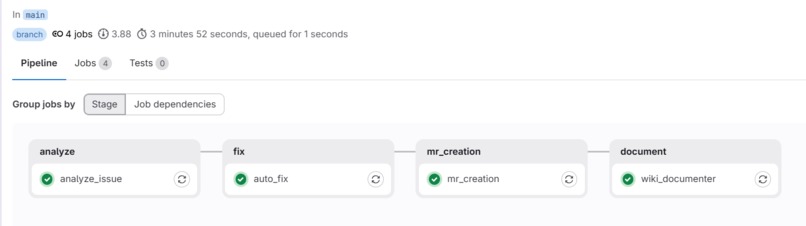
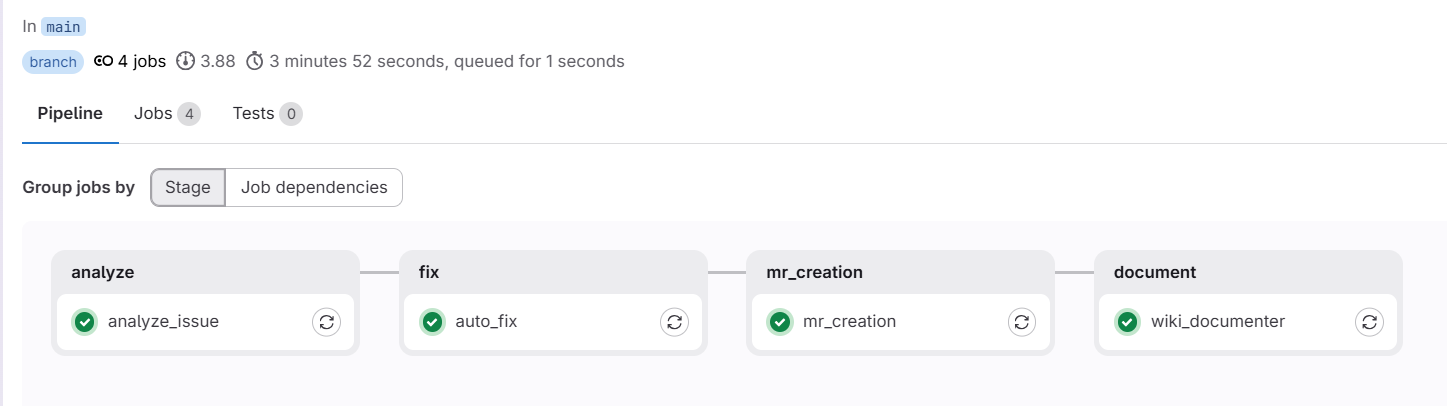
Pipeline involves 4 jobs Analyze_issue, auto_fix, mr_creation,wiki_documenter
-
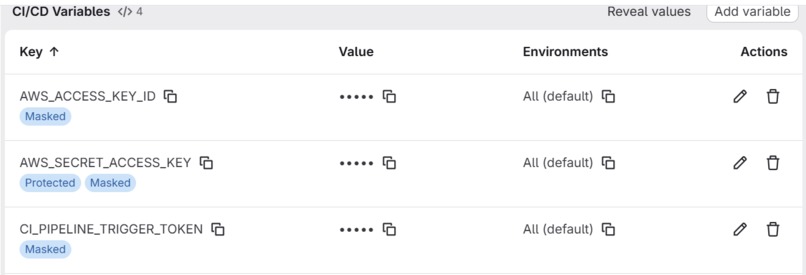
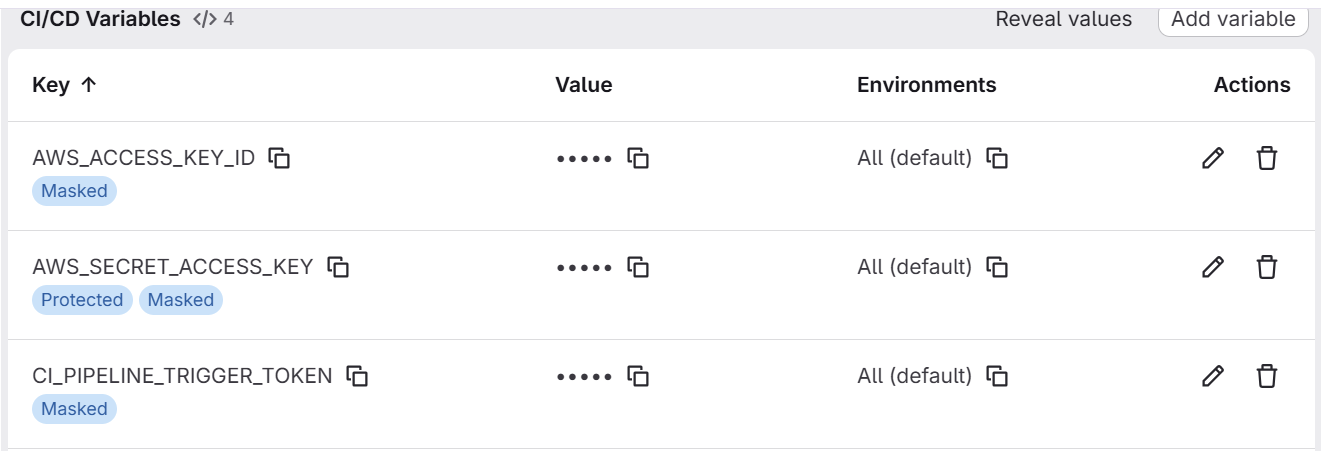
GitLab variables created to authenticate the bedrock service in aws
-
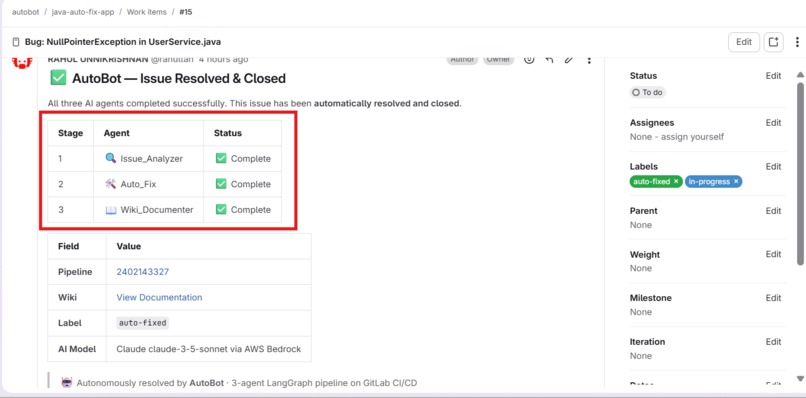
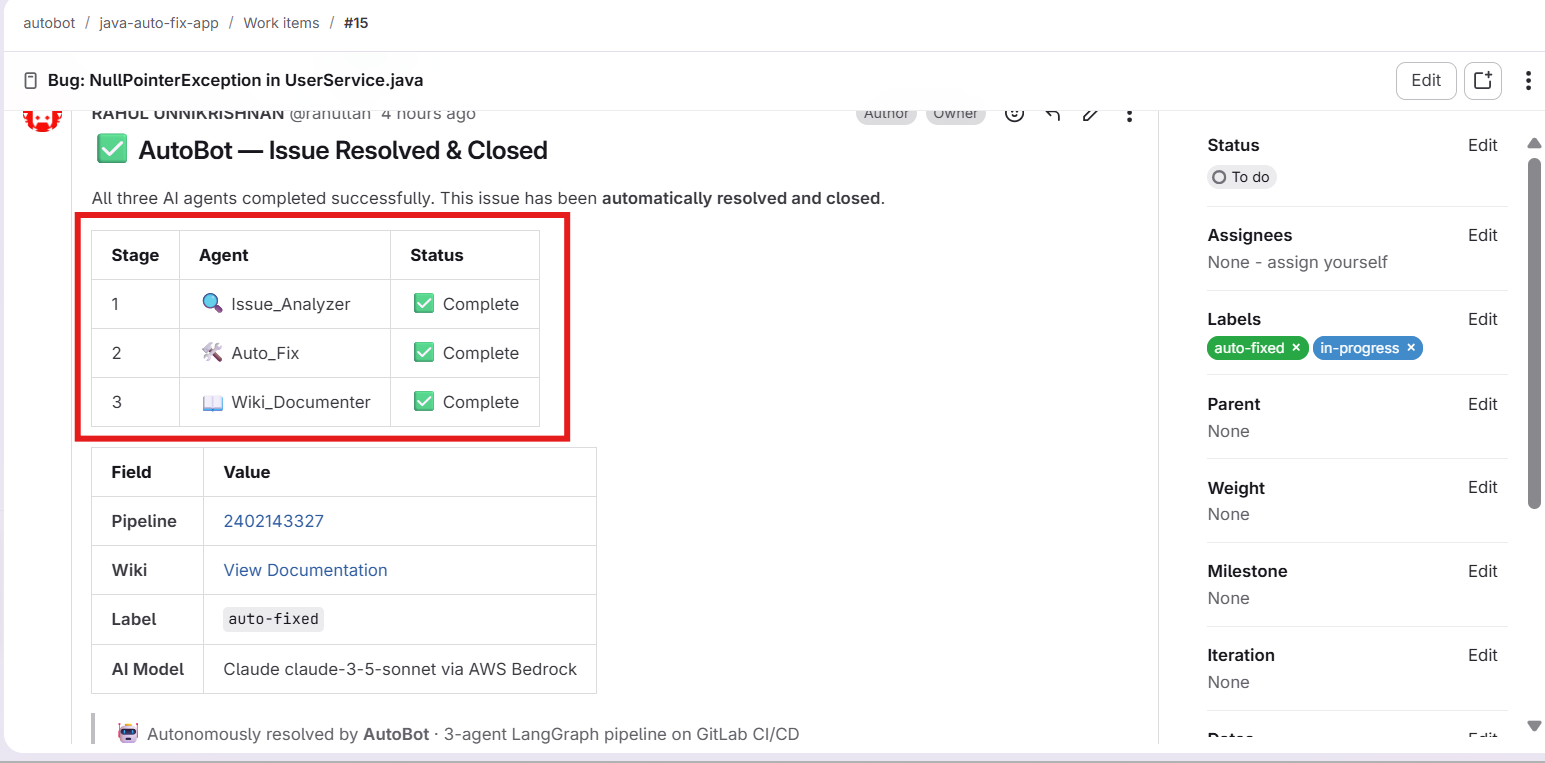
Completion of Issue has been updated by the AI agent with the status check and the detailed description of the changes
-
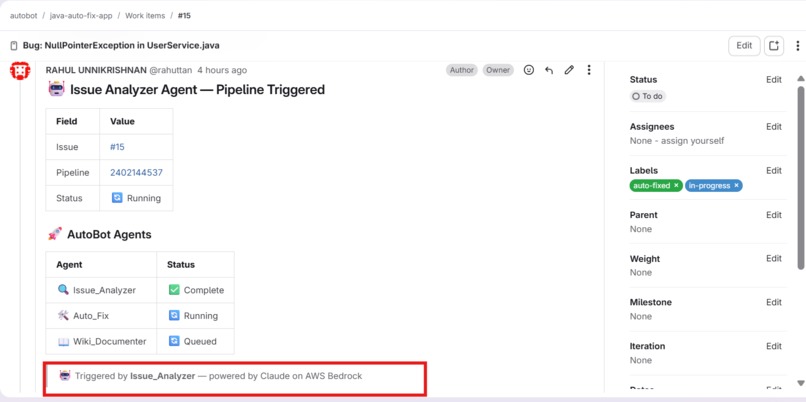
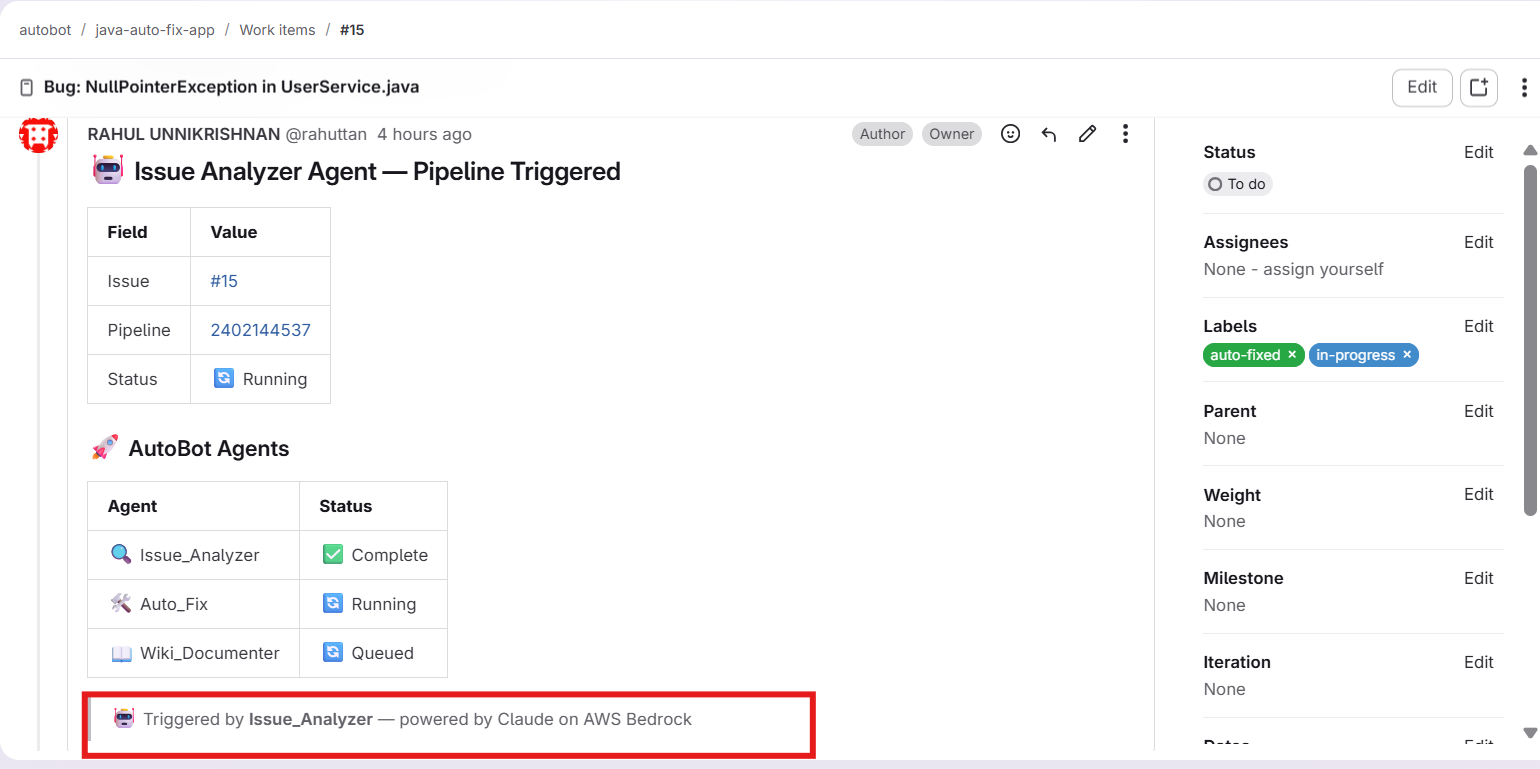
Issue has been updated by agent automatically and starting of the task resolution. Changing the status to In progress.
-
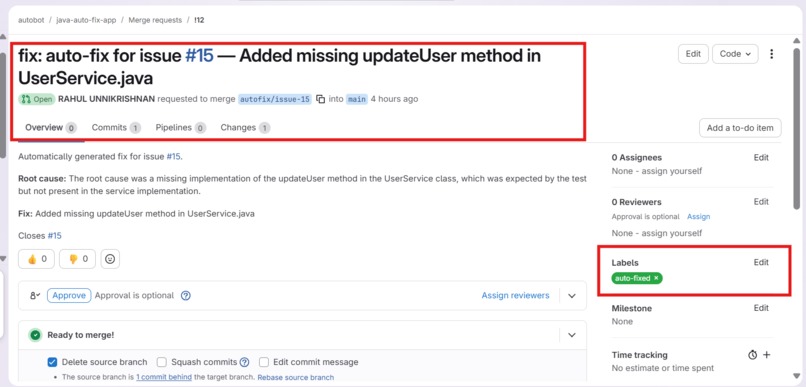
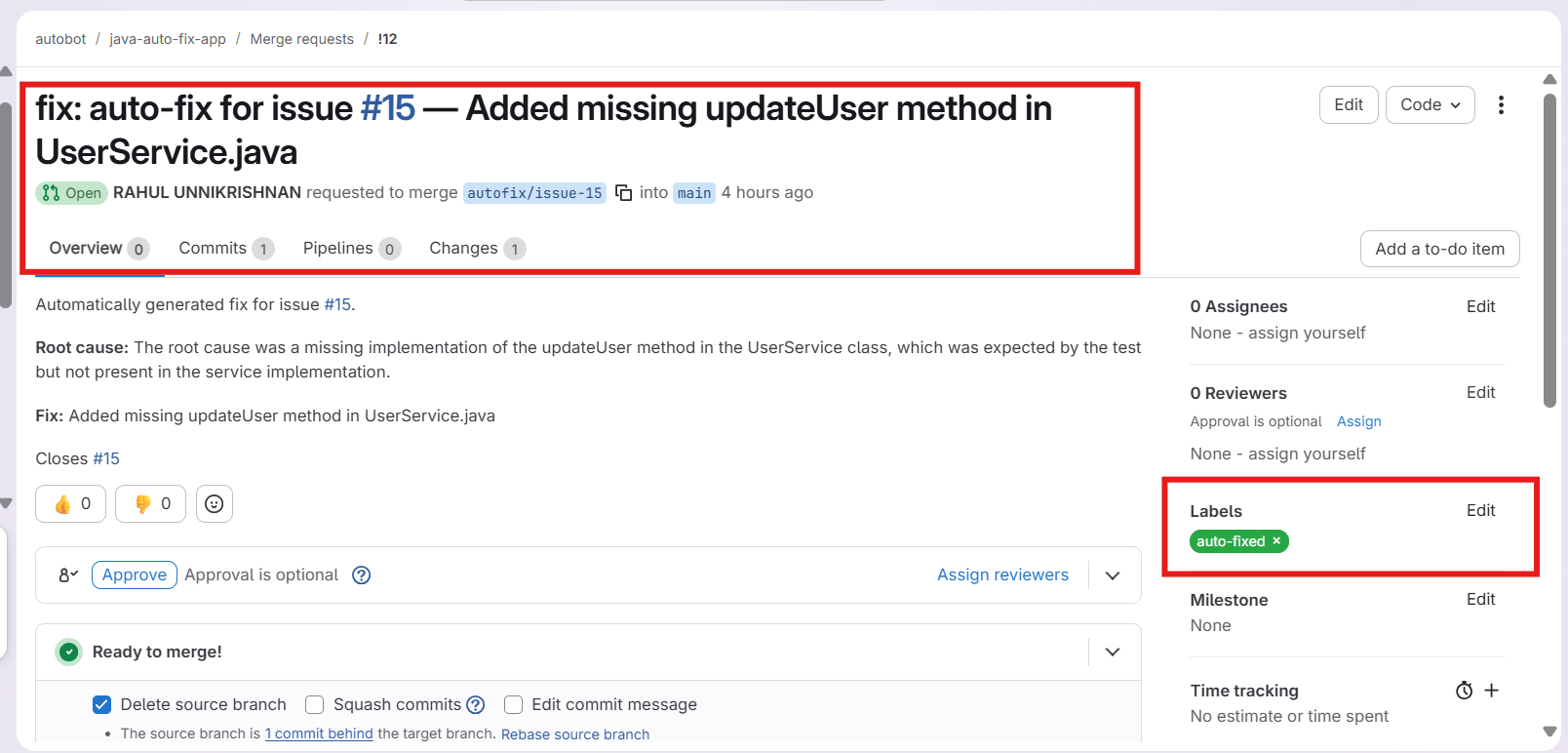
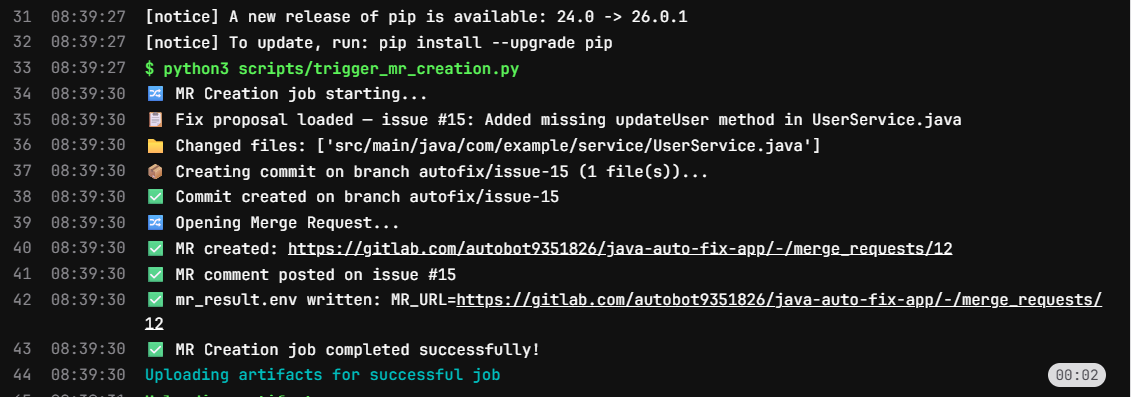
MR auto created created by AI agent and setting the labels and detailed description
-
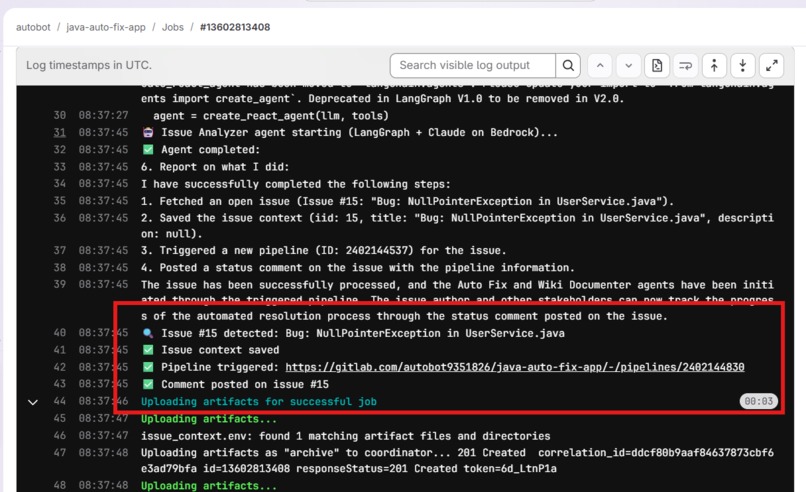
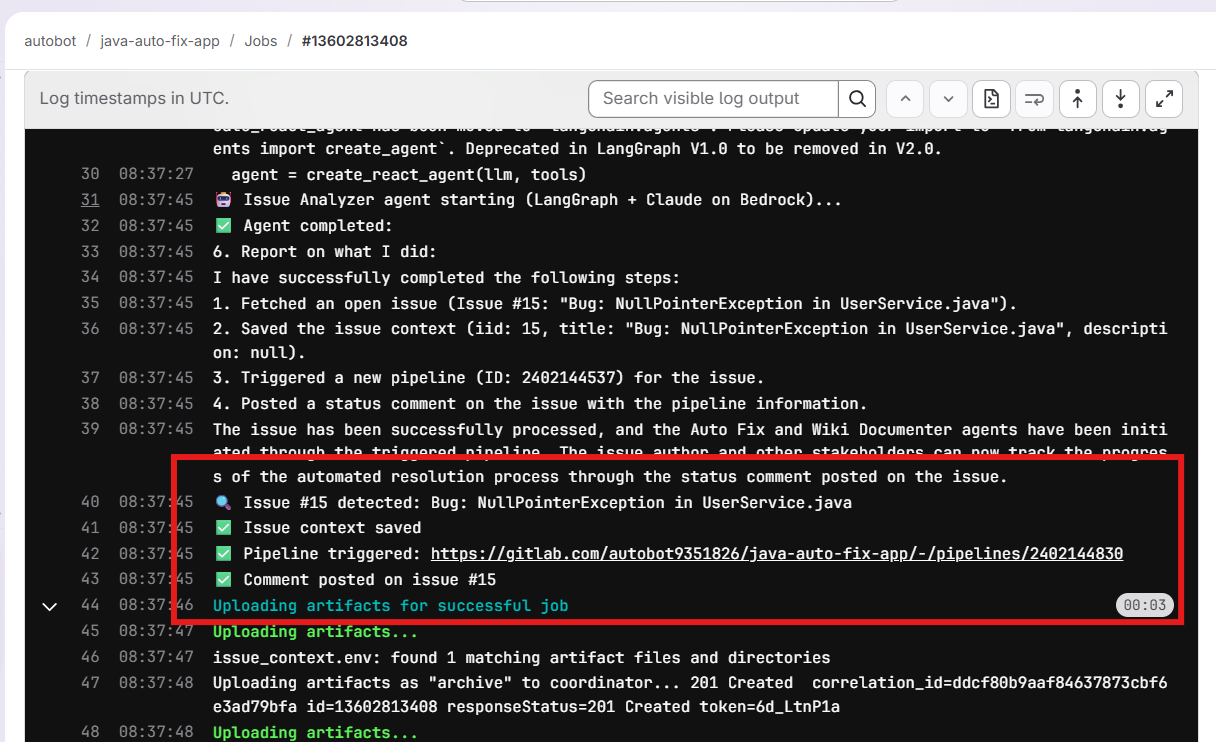
Analyze job will get the details from the open issues and try to identify the issues reported by the QA team
-
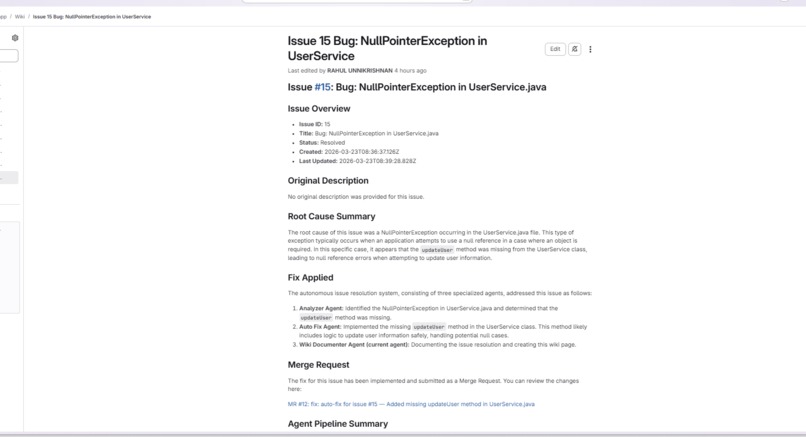
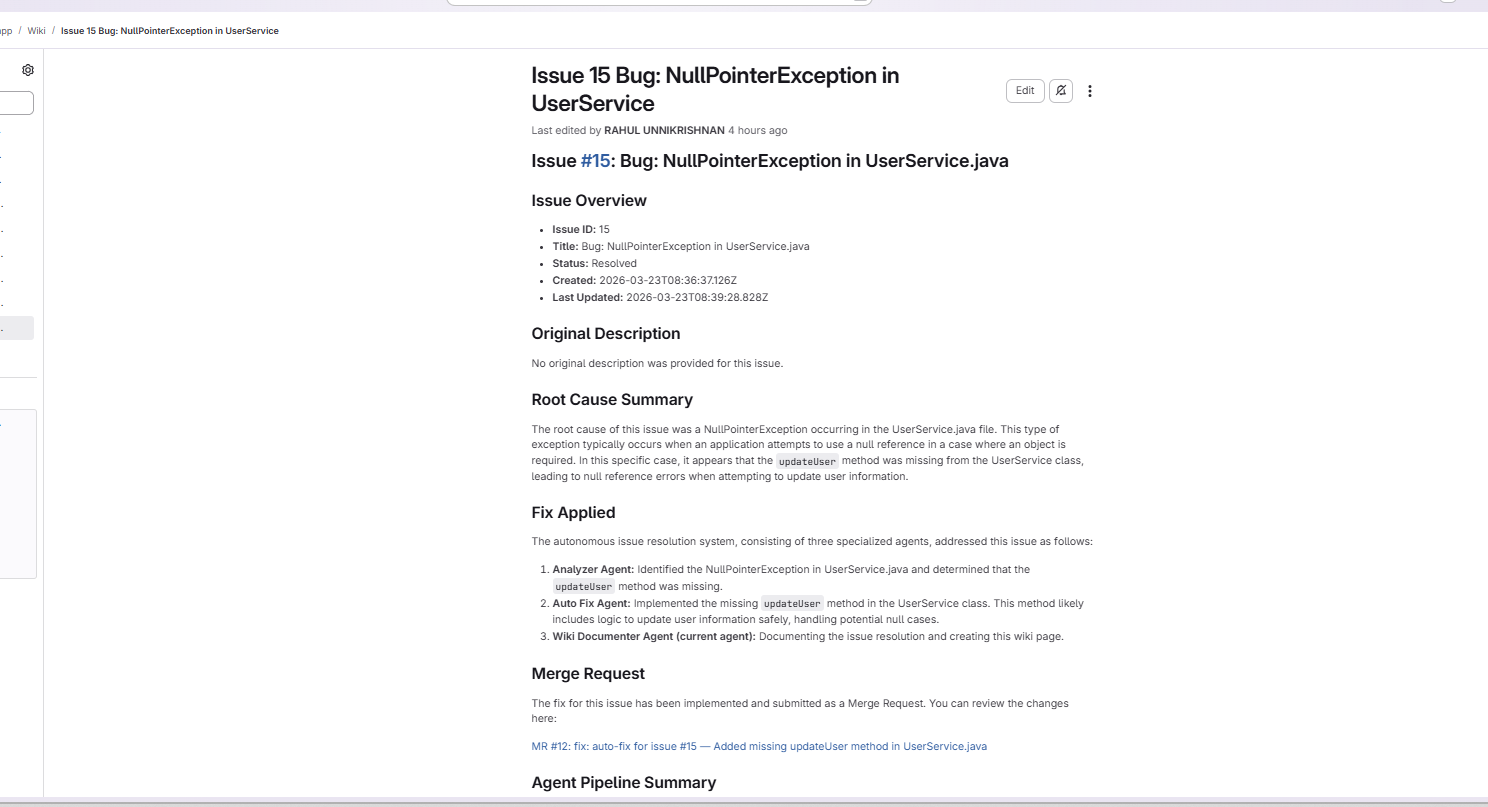
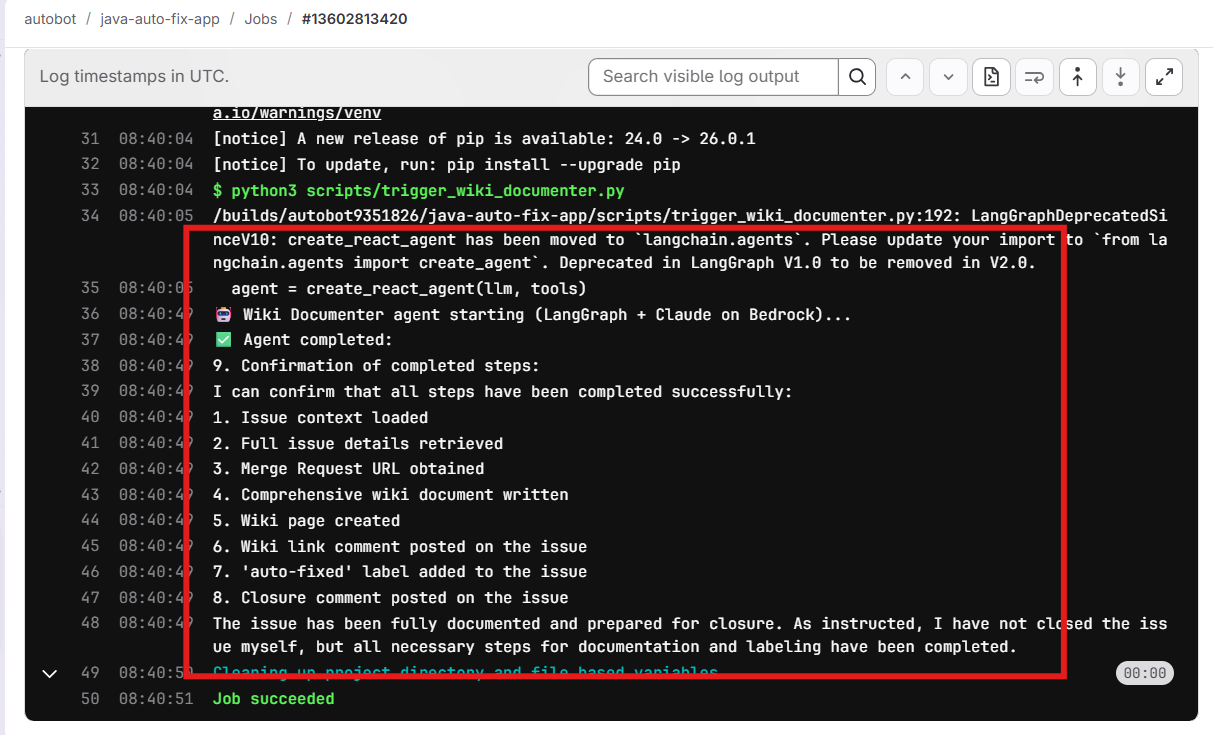
Wiki documenter agent clearly updates the Wiki with the status, MR details, RCA etc
-
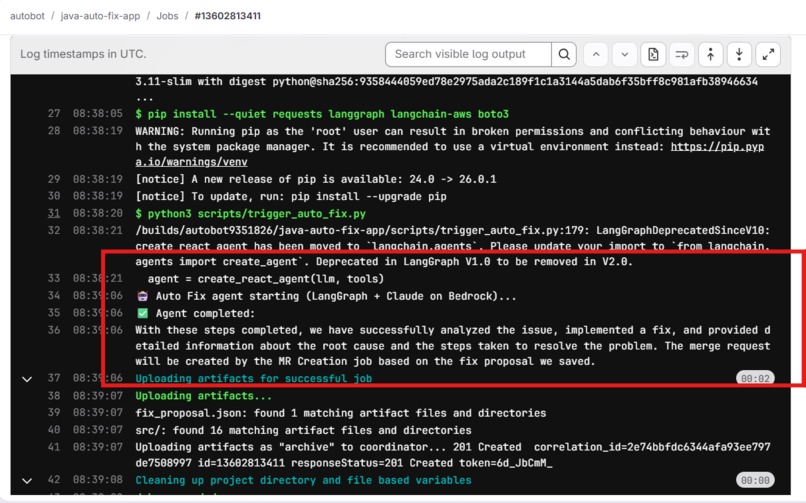
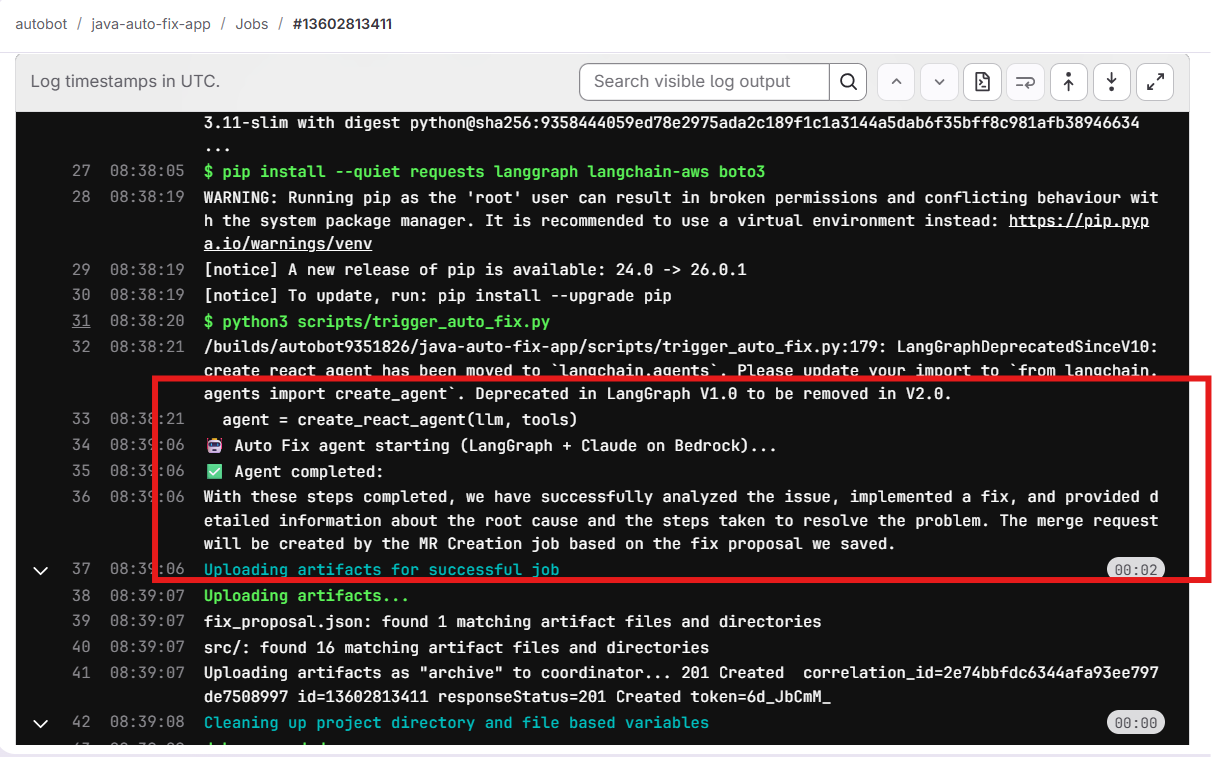
Autofix job will identify the issues within the source code using AI and identify the fixes required to resolve the issues
-
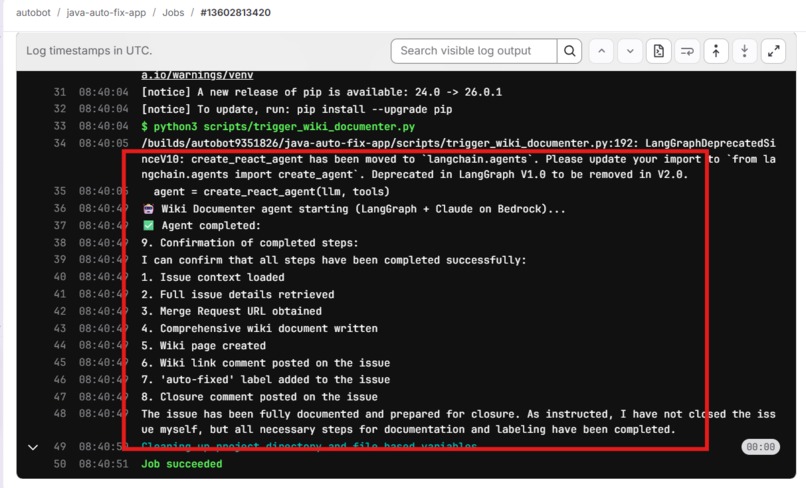
Wiki documenter job agent in action. It connects to the wiki and update the release notes with the MR details, issues descriptions, etc.
-
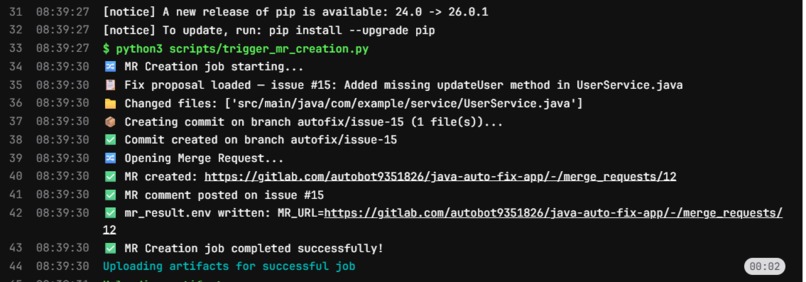
Agents will identify the issue, fix the issue and create a MR automatically
AutoBot — Autonomous Multi-Agent Issue Resolution System
Hackathon Submission — AutoBot is a fully autonomous 4-agent CI/CD system built on GitLab, LangGraph, and AWS Bedrock. It detects software issues, analyzes Java source code, writes a real patch, raises a Merge Request, and documents everything — with no human intervention until MR review.
Our Story
During a sprint retrospective, our team noticed a pattern: we kept fixing the same class of bugs over and over — a NullPointerException in a payment service, a missing null guard in a user lookup, a validation edge case that slipped through review. The triage cycle was always the same: locate the issue, read the code, write the fix, review, merge, close. Hours spent on predictable, repeatable work.
We asked: what if the pipeline could do this itself?
AutoBot is our answer. It turns GitLab CI/CD into an autonomous reasoning system powered by Claude 3.5 Sonnet on AWS Bedrock. When a developer opens an issue, four specialized AI agents wake up, read the actual source code, fix the bug, raise a Merge Request, and write permanent documentation — all within minutes.
Executive Summary
| Dimension | Value |
|---|---|
| Agents | 4 (3 LangGraph + Claude, 1 deterministic Python) |
| Pipeline | GitLab CI/CD — 4 sequential stages |
| AI Model | Claude 3.5 Sonnet via AWS Bedrock |
| Agent Framework | LangGraph ReAct |
| Application Under Test | Java 17 + Maven + JUnit 4 |
| Mean Time to Resolution | Under 15 minutes |
| Human Intervention | MR review only — everything else is automated |
Problem Statement
Engineering teams waste significant time on predictable, repeatable bug resolution:
- Issue created
- Engineer triages manually — reads code, identifies root cause
- Fix written, reviewed, and merged — hours or days later
- Issue closed manually
- No documentation written
- Same bug resurfaces months later because no one documented it
The core problem: the resolution cycle for common bug patterns (null pointer exceptions, missing validations, incorrect guards) is mechanical and repeatable — exactly the kind of work AI should handle.
Solution Overview
AutoBot turns GitLab CI/CD into an autonomous agent runtime. Four agents activate sequentially on every new issue:
| Stage | Agent | Runtime | What it does |
|---|---|---|---|
analyze |
Issue Analyzer | LangGraph + Claude | Detects the issue, saves context, triggers the pipeline |
fix |
Auto Fix | LangGraph + Claude | Reads Java source, identifies root cause, writes the patch |
mr_creation |
MR Creation | Python (deterministic) | Commits the fix and opens a Merge Request |
document |
Wiki Documenter | LangGraph + Claude | Writes wiki documentation including the MR link |
Multi-Agent Architecture
GitLab Issue Created
        │
        ▼
┌─────────────────────────────────────────────────────────────────────────┐
│                        .gitlab-ci.yml  (4 stages)                       │
│                                                                         │
│  ┌──────────┐    ┌──────────┐    ┌─────────────┐    ┌──────────────┐  │
│  │ analyze  │───▶│   fix    │───▶│ mr_creation │───▶│   document   │  │
│  │          │    │          │    │             │    │              │  │
│  │ Agent 1  │    │ Agent 2  │    │  Agent 3    │    │  Agent 4     │  │
│  │LangGraph │    │LangGraph │    │  Python     │    │  LangGraph   │  │
│  │+ Claude  │    │+ Claude  │    │  (GitLab    │    │  + Claude    │  │
│  │          │    │          │    │   API)      │    │              │  │
│  └──────────┘    └──────────┘    └─────────────┘    └──────────────┘  │
│       │               │                │                  │            │
│ issue_context    fix_proposal.json  mr_result.env      Wiki page       │
│     .env          + patched src/    (MR_URL)           + comments      │
└─────────────────────────────────────────────────────────────────────────┘
Artifact Chain
issue_context.env        (Agent 1 → Agent 2, Agent 4)
       ↓
fix_proposal.json + src/ (Agent 2 → Agent 3)
       ↓
mr_result.env (MR_URL)   (Agent 3 → Agent 4)
       ↓
Wiki page + labels       (Agent 4 → GitLab)
Agent Deep Dive
Agent 1 — Issue Analyzer (agents/agent1_analyze_issue.py)
Runtime: LangGraph ReAct + Claude 3.5 Sonnet (AWS Bedrock)
The entry point. Polls GitLab for open issues not yet labelled auto-fixed, saves context into issue_context.env, and triggers the downstream pipeline.
LangGraph Tools:
fetch_open_issue— GET /issues?not[labels]=auto-fixedsave_issue_context— writesissue_context.envartifacttrigger_pipeline— POST /trigger/pipeline with ISSUE_IIDpost_comment_on_issue— posts 4-agent status table on the issue
Loop prevention: Three-layer guard (not[labels]=auto-fixed filter + CI_PIPELINE_SOURCE check + TRIGGERED_BY variable) prevents infinite re-triggering.
Agent 2 — Auto Fix (agents/agent2_auto_fix.py)
Runtime: LangGraph ReAct + Claude 3.5 Sonnet (AWS Bedrock)
The AI engineer. Reads actual Java source and test files, reasons about the root cause, writes a complete corrected file, and saves a fix proposal.
LangGraph Tools:
load_context— readsissue_context.envget_issue_details— GET /issues/:iidmark_issue_in_progress— creates and appliesin-progresslabellist_java_files— globssrc/**/*.javaread_java_file— reads source and test fileswrite_java_file— writes patched file to disk, stages in_pending_changessave_fix_proposal— writesfix_proposal.json, clears pending changespost_fix_comment— posts root-cause analysis on the issue
Claude's reasoning loop:
load_context → get_issue_details → mark_issue_in_progress →
list_java_files → read_java_file × N →
[Claude reasons about root cause] →
write_java_file × N → save_fix_proposal → post_fix_comment
Agent 3 — MR Creation (agents/agent3_mr_creation.py)
Runtime: Plain Python 3.11 (no AI — deterministic)
The MR raiser. Reads fix_proposal.json, commits patched files to branch autofix/issue-<n>, opens a Merge Request targeting main with Closes #<n> in the description, and writes mr_result.env with the MR URL for Agent 4.
Key functions: load_fix_proposal() → create_mr(proposal) → post_mr_comment() → save_mr_result()
Agent 4 — Wiki Documenter (agents/agent4_wiki_documenter.py)
Runtime: LangGraph ReAct + Claude 3.5 Sonnet (AWS Bedrock)
The documentation agent. Uses Claude to author a comprehensive Markdown wiki page (including the MR link and root-cause analysis), applies the auto-fixed label, and posts a final 4-agent closure summary on the issue.
LangGraph Tools:
load_context— readsissue_context.envget_issue_details— GET /issues/:iidget_merge_request_url— readsMR_URLenv var (API fallback)create_wiki_page— POST /wikis with Claude-authored Markdownpost_wiki_comment— posts wiki link on the issueadd_auto_fixed_label— creates and appliesauto-fixedlabelpost_closure_comment— posts 4-agent pipeline summary
Note: Agent 4 does NOT close the issue. Issues remain open pending MR review and merge by a human.
Shared Module — flows/gitlab_client.py
All agents import shared constants, helpers, and the LLM builder from a single module:
from flows.gitlab_client import API_URL, GL_HEADERS, PROJECT_ID, build_llm, post_issue_comment
This module provides: API_URL, GL_HEADERS, PROJECT_ID, GITLAB_TOKEN, TRIGGER_TOKEN, load_issue_context(), build_llm(), post_issue_comment(), ensure_label(), apply_label().
Technology Stack
| Layer | Technology |
|---|---|
| CI/CD Platform | GitLab CI/CD |
| Agent Framework | LangGraph (ReAct pattern) |
| LLM | Claude 3.5 Sonnet (anthropic.claude-3-5-sonnet-20240620-v1:0) |
| LLM Runtime | AWS Bedrock (langchain-aws, boto3) |
| HTTP Client | requests (GitLab REST API v4) |
| Shared Module | flows/gitlab_client.py |
| Application Under Test | Java 17, Maven 3.9.6, JUnit 4.13.2 |
| Container | python:3.11-slim per CI job |
Key Design Decisions
1. Separation of Concerns
AI agents handle reasoning. Plain Python handles deterministic Git operations. Each job has a single, auditable responsibility.
2. ReAct Agent Pattern
Agents 1, 2, and 4 use LangGraph ReAct — Claude reasons about tool outputs before deciding the next action, enabling multi-step code understanding without hardcoded logic.
3. Artifact-Based Communication
Agents communicate exclusively through GitLab CI artifact files and dotenv injection. No shared database, no external queue — the platform's built-in mechanism is sufficient and reliable.
4. Human-in-the-Loop Safety
No auto-merge. Every fix goes through a reviewable Merge Request. Issues stay open until a human approves and merges.
5. Shared flows/ Module
Extracting common GitLab API logic into flows/gitlab_client.py eliminates duplication across all four agents and makes the system easier to extend.
Impact
| Metric | Before AutoBot | With AutoBot |
|---|---|---|
| Mean Time to Resolution | Hours to days | Under 15 minutes |
| Manual triage effort | High | Zero for known patterns |
| Wiki documentation rate | 0% | 100% of auto-fixed issues |
| Duplicate bug risk | High | Reduced (wiki + label history) |
| MR review process | Same | Unchanged — human still approves |
Repository Structure
java-auto-fix-app/
├── .gitlab-ci.yml                              # 4-stage pipeline definition
├── .ai-catalog-mapping.json                    # GitLab AI Catalog mapping
├── agents/
│   ├── agent1_analyze_issue.py                 # Agent 1 — Issue Analyzer (LangGraph + Claude)
│   ├── agent2_auto_fix.py                      # Agent 2 — Auto Fix (LangGraph + Claude)
│   ├── agent3_mr_creation.py                   # Agent 3 — MR Creation (Python)
│   ├── agent4_wiki_documenter.py               # Agent 4 — Wiki Documenter (LangGraph + Claude)
│   └── agents.yml                              # GitLab AI Catalog item definition
├── flows/
│   ├── gitlab_client.py                        # Shared config, helpers, build_llm()
│   └── flows.yml                               # GitLab AI Catalog flow definition
├── src/
│   ├── main/java/com/example/service/
│   │   ├── PaymentService.java
│   │   ├── UserService.java
│   │   └── User.java
│   └── test/java/com/example/service/
│       ├── PaymentServiceTest.java
│       └── UserServiceTest.java
└── pom.xml                                     # Java 17 + JUnit 4.13.2
Demo Walkthrough
- Create a GitLab issue:
NullPointerException in PaymentService — amount is null - Pipeline triggers (schedule or manual) — Agent 1 detects the issue
in-progresslabel applied — Agent 2 marks the issue immediately- Root-cause comment posted — Claude identifies
processPayment()callsamount.multiply()without null guard - Branch
autofix/issue-<n>created — Agent 3 commits the patchedPaymentService.java - Merge Request opened —
Closes #<n>in description, ready for human review - Wiki page created — full Markdown documentation with MR link
auto-fixedlabel applied — prevents reprocessing- Closure summary comment — 4-agent pipeline summary posted on issue
Setup
Required CI/CD Variables
| Variable | Description | Masked |
|---|---|---|
GITLAB_PAT |
Personal Access Token with api + write_repository scopes |
Yes |
CI_PIPELINE_TRIGGER_TOKEN |
Pipeline trigger token | Yes |
AWS_ACCESS_KEY_ID |
AWS credentials for Bedrock | Yes |
AWS_SECRET_ACCESS_KEY |
AWS credentials for Bedrock | Yes |
AWS_DEFAULT_REGION |
Bedrock region (default: ap-southeast-1) |
No |
Trigger
# Manual API trigger
curl --request POST \
  --form "token=$CI_PIPELINE_TRIGGER_TOKEN" \
  --form "ref=main" \
  --form "variables[ISSUE_IID]=42" \
  "https://gitlab.com/api/v4/projects/$CI_PROJECT_ID/trigger/pipeline"
Future Roadmap
- More bug patterns — dependency errors, test failures, configuration issues (Claude already handles arbitrary patterns; just needs more test cases)
- Maven build validation — run
mvn testinside Agent 2 to verify the fix compiles before committing - Slack / Teams notification — notify on-call engineers when a fix is raised
- Severity routing — triage critical bugs to immediate pipelines, low-severity to batch
- Changelog generation — append to a master
CHANGELOG.mdwiki page on each fix
AutoBot · GitLab CI/CD · LangGraph · Claude 3.5 Sonnet · AWS Bedrock · Python 3.11
Built With
- amazon-web-services
- anthropic
- api
- bedrock
- claude
- duo
- ghcp
- gitlab
- java
- junit
- langgraph
- maven
- python
Log in or sign up for Devpost to join the conversation.