Inspiration
What it does
FixFlow AI
The Problem
Small home-service businesses lose valuable time managing customer requests, deciding which jobs need human attention, scheduling technicians, and keeping operational information organized.
A customer might simply say:
"My air conditioner stopped working. I need someone tomorrow, but please give me a quote before any repairs."
For a small business, this can trigger several manual steps: understand the request, identify the service, determine urgency, decide whether approval is required, schedule a technician, and record what happened.
We wanted to explore a different approach: what if AI could operate the workflow instead of simply answering questions?
The Idea
FixFlow AI is an AI operations platform designed for home-service businesses such as HVAC, plumbing, electrical, cleaning, and maintenance companies.
The goal is not just to build a chatbot. The goal is to build an operational system where AI can understand incoming requests and turn them into concrete business actions.
A typical workflow is:
Customer Request
       ↓
Customer Agent
       ↓
Classification + Urgency
       ↓
Business Rules
       ↓
Approval when required
       ↓
Scheduling Agent
       ↓
Job Creation
       ↓
Technician Assignment
       ↓
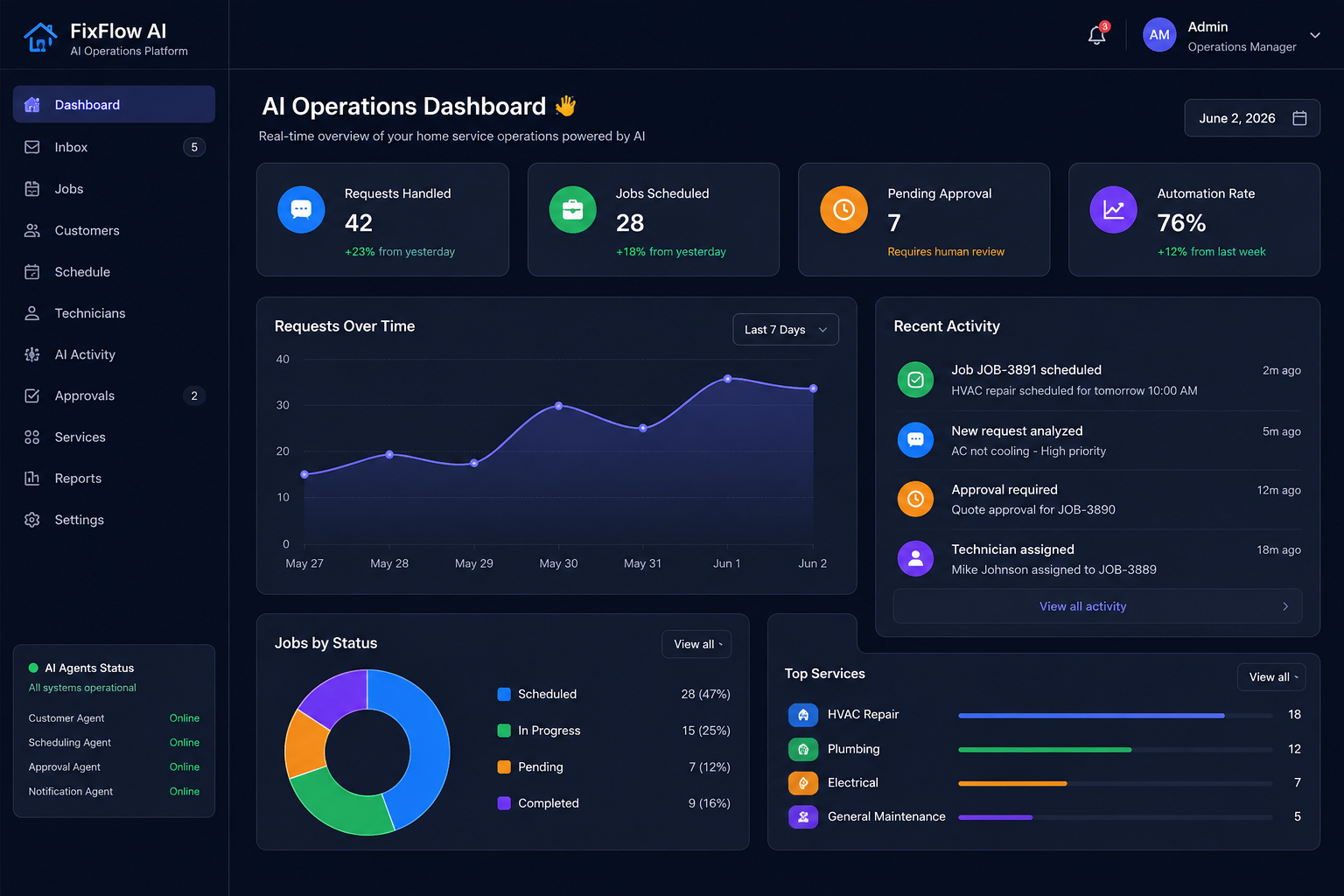
AI Operations Dashboard
How We Built It
FixFlow AI was built with Next.js, React, TypeScript, Prisma, SQLite, and Google's Gemini API.
The Customer Agent uses Gemini to classify customer messages into structured information:
- Service type
- Urgency
- Problem summary
- Recommended next action
We then separate AI interpretation from deterministic business rules.
For example, requests involving quotes, prices, refunds, payments, cancellations, insurance, or complaints can trigger a human-approval requirement. This prevents the language model from independently making sensitive business decisions.
Once a request is eligible for scheduling, the Scheduling Agent creates a persistent job through Prisma and assigns a technician according to the service type.
The dashboard then exposes the operational state through Jobs, Inbox, Customers, and AI Activity views.
What We Learned
One of our biggest lessons was that an AI product becomes much more useful when the model is not responsible for everything.
Instead of asking Gemini to make every decision, we use Gemini where natural-language understanding is valuable and deterministic application logic where business rules need to be predictable.
This creates a simple separation:
AI understands. Business rules decide. Application code executes. The dashboard provides visibility.
We also learned the importance of persistent state. An AI response that disappears after a request is not enough for an operations product. Jobs, approvals, assignments, and activity need to become durable records that the business can inspect later.
Challenges
The main technical challenge was connecting AI classification to a real operational workflow.
It was relatively easy to generate a structured AI response. The harder problem was making that response reliably drive the rest of the application.
We had to handle API validation, structured JSON responses, Prisma persistence, scheduling, technician assignment, dashboard state, and error handling while keeping the TypeScript code reliable.
Another challenge was designing the dashboard so that AI actions are understandable to a human operator. We wanted the user to see not only the final job, but also the operational state around it.
During development we repeatedly tested the complete workflow using HVAC requests, verified the resulting Jobs API, checked the Activity API, tested approvals, assigned technicians, and validated the database schema.
Why FixFlow Matters
Home-service businesses are operationally intensive but many of them do not have large engineering or operations teams.
FixFlow AI explores how a small business could delegate repetitive operational work to AI while keeping humans involved when decisions require judgment or authorization.
The long-term vision is to create an AI-operated operations layer for service businesses where people focus on customer relationships, skilled field work, exceptions, and business growth while AI handles repetitive coordination.
FixFlow AI is our prototype toward that vision: not an AI that only talks, but AI that helps run the workflow.

Log in or sign up for Devpost to join the conversation.