-
-
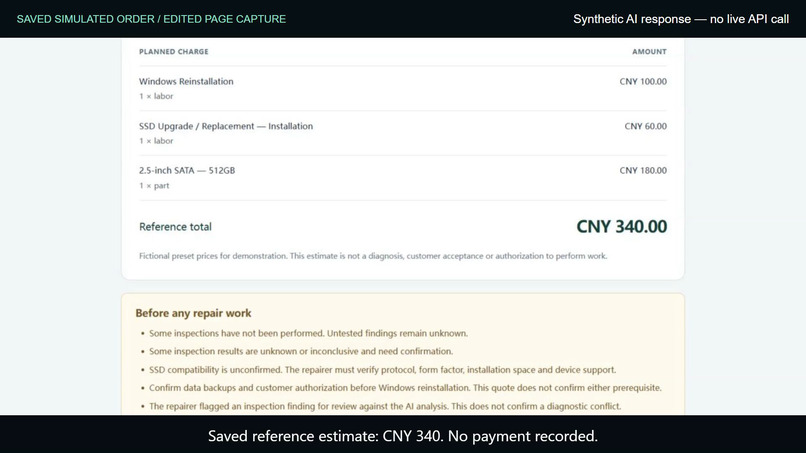
Saved simulated order with a unique ID and read-only status, awaiting customer confirmation. Synthetic data; no repair is authorized.
-
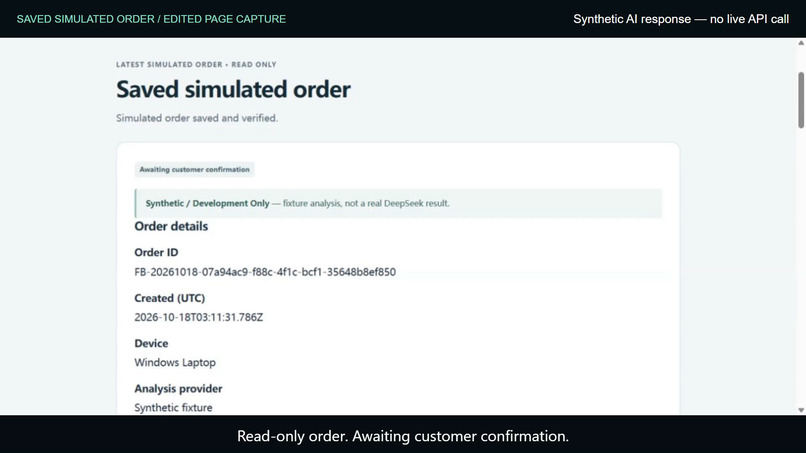
Saved reference estimate: 512GB SATA SSD CNY 180, installation CNY 60, Windows reinstallation CNY 100. Total CNY 340. Fictional prices.
Inspiration
Every laptop repair begins with a conversation.
A customer might say, "My laptop takes forever to start." But that simple complaint does not reveal whether the problem comes from Windows, software, storage, or another component.
Through my experience with computer assembly, hardware upgrades, and troubleshooting, I became interested in a practical question: Could AI help repair technicians organize incomplete information without replacing their professional judgment?
That question inspired FixBiz AI.
Instead of building another general-purpose chatbot, I wanted to create a focused tool for independent repair technicians and small repair shops.
Before fixing a computer, we need to understand the problem.
What it does
FixBiz AI is an AI-assisted repair intake and preliminary screening prototype for Windows laptop technicians.
It guides technicians through a four-step workflow:
- Customer Intake & AI Screening: Record the customer's symptoms and receive structured advisory suggestions, possible causes, safe checks, and follow-up questions.
- Manual Inspection: Record actual technician observations while distinguishing tested, untested, and unknown conditions.
- Services & Estimate: Select parts and repair services from a predefined catalog. Prices are calculated by deterministic application rules, not invented by AI.
- Review & Simulated Order: Review the findings, risks, and costs before saving a simulated order locally.
For example, a 512GB SATA SSD (CNY 180), installation (CNY 60), and Windows reinstallation (CNY 100) produce a transparent reference estimate of CNY 340.
The product follows one principle:
AI suggests. Technicians verify. Pricing stays deterministic.
How we built it
I built FixBiz AI using a structured, AI-assisted software development workflow.
The application uses:
- React, TypeScript, and Vite for the frontend.
- Node.js and Express for the backend.
- DeepSeek API for optional AI-assisted screening.
- Zod for structured response and data validation.
- Browser localStorage for verified local saving of simulated orders.
- Vitest and Playwright for automated testing.
The architecture separates AI-generated hypotheses from customer statements and technician observations. Pricing and order eligibility are controlled by application logic rather than language-model output.
I also implemented request limits, timeouts, server-side API key handling, and validation of AI responses.
The project followed the Devpost Learn workflow: defining scope, preparing a PRD, writing a technical specification, implementing features, and validating the result. The official Skill Pack initially failed to install, so I used its publicly available guidance for early planning. Installation succeeded during the specification stage, and subsequent development incorporated the available guidance.
For the demonstration video, I combined genuine application footage with fictional AI-generated repair-shop scenes, using Seedance and Remotion.
Challenges we ran into
The biggest challenge was making AI assistance useful without allowing AI suggestions to become unsupported facts.
For example, an AI model may suggest that storage performance contributes to slow startup. However, it cannot claim that an SSD has failed unless a technician has actually performed the relevant checks.
To address this, I designed separate representations for customer descriptions, AI hypotheses, and manual inspection evidence.
Another challenge was building a reliable estimation system. Instead of asking AI to generate prices, I implemented fixed-price calculations with explicit service and part selections.
I also encountered challenges involving malformed model responses, API failures, request boundaries, local-storage reliability, and browser-based testing.
Finally, presenting the project honestly required distinguishing simulated AI responses from genuine model calls and AI-generated cinematic footage from real software operation.
Accomplishments that we're proud of
I am proud of transforming a practical repair-shop problem into a working, testable full-stack prototype.
FixBiz AI now includes:
- A complete four-step repair intake workflow.
- Structured advisory screening.
- Human-controlled inspection records.
- Transparent, deterministic repair estimates.
- Locally saved simulated orders.
- A free, key-free Synthetic demonstration mode.
- Automated tests and reproducible setup instructions.
The development process recorded 961 passing Vitest tests and 58 passing Playwright cases using controlled and simulated test conditions.
A separate real DeepSeek initial-analysis test was also completed successfully. However, real supplementary analysis and full live-AI-to-saved-order acceptance remain untested.
I also completed the project's public GitHub release, including source code, planning documents, tests, and an English demonstration video.
What we learned
This project changed how I think about building AI applications.
Connecting an AI API is only a small part of the engineering challenge. A useful product also needs clear requirements, reliable data validation, predictable business rules, meaningful error handling, and reproducible testing.
I learned to use AI coding agents as development collaborators while maintaining human responsibility for decisions, acceptance criteria, and verification.
I also learned that a narrowly defined workflow can be more valuable than a feature-heavy application.
Most importantly, AI should support professional judgment, not pretend to replace evidence or expertise.
What's next for FixBiz AI
My next goal is to move beyond a controlled prototype and test the workflow with actual repair technicians.
Potential improvements include:
- Usability testing with independent repair shops.
- More laptop fault categories and device types.
- Better technician-facing workflows.
- Optional persistent order management.
- Additional security and data-protection measures.
- Further real-model integration and acceptance testing.
- Validation of pricing and hardware compatibility using real-world information.
Before commercial deployment, the application would require additional testing, privacy safeguards, and operational validation.
FixBiz AI is currently an educational prototype, not a deployed commercial repair platform.
The published demonstration uses fictional customer data, simulated AI screening responses, and genuine application interface footage. It does not represent a completed repair, customer authorization, payment, or successful end-to-end live AI operation.
Built With
- deepseek
- express.js
- localstorage
- node.js
- playwright
- react
- remotion
- typescript
- vite
- vitest
- zod

Log in or sign up for Devpost to join the conversation.