Inspiration
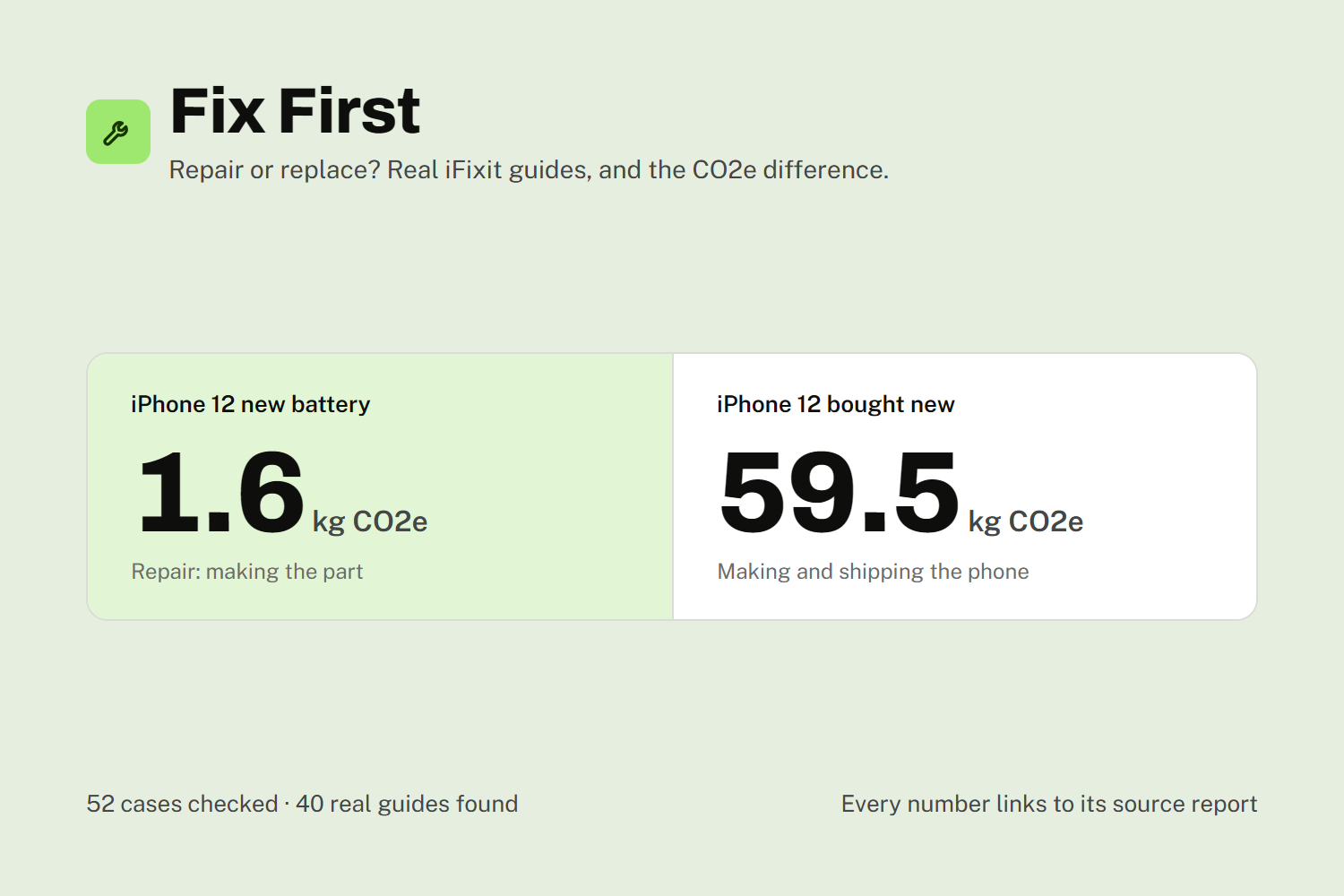
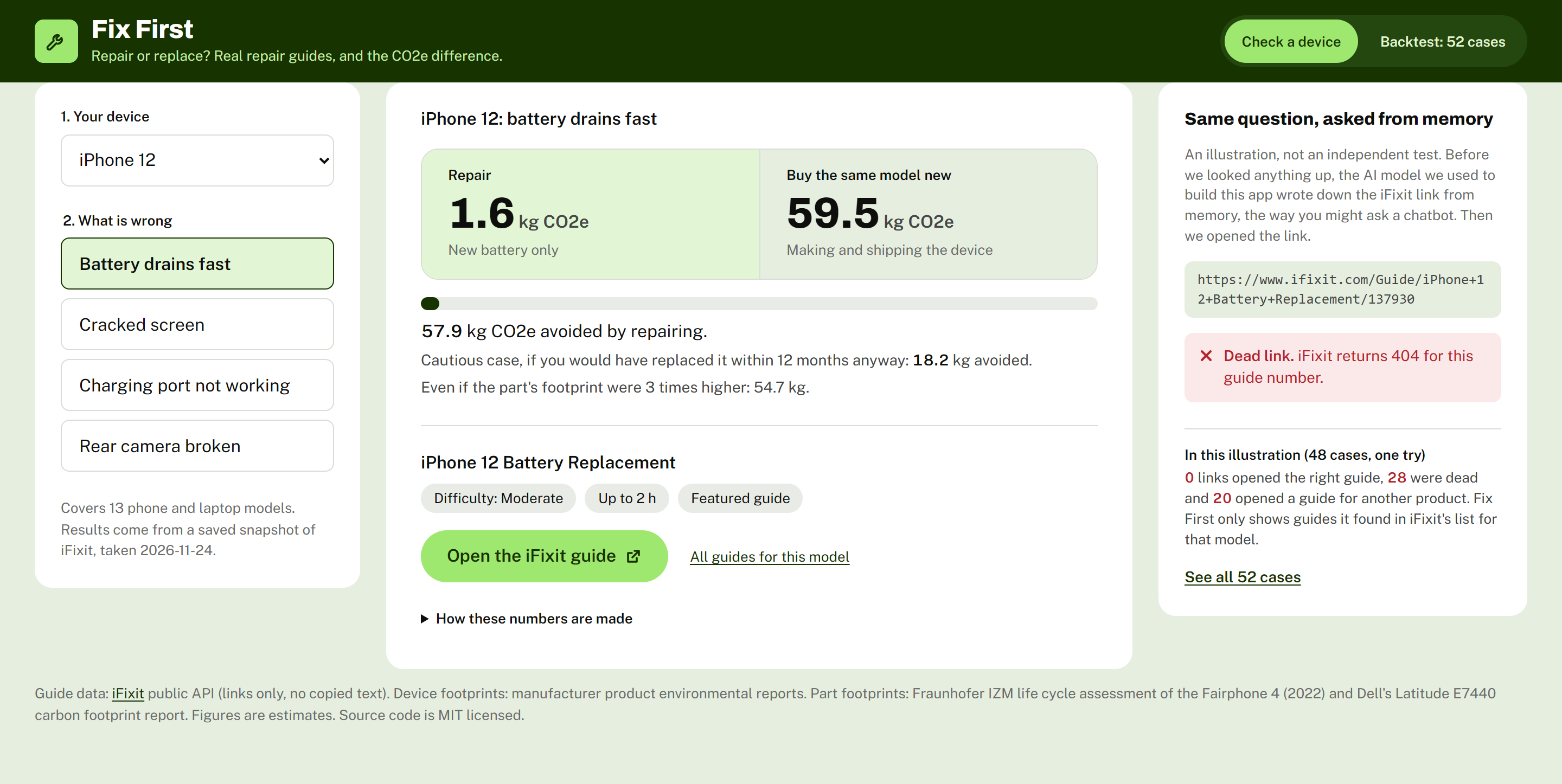
Your iPhone 12 dies by mid-afternoon. At the store you hear that a new phone is the quicker fix. A new battery would add about 1.6 kg CO2e. A new iPhone 12 adds 59.5 kg, because Apple puts 83% of the phone's 70 kg life cycle footprint in production (Apple, 2020).
Multiply that choice by everyone. In 2022 the world produced about 62 million tonnes of e-waste, and only 22.3% was documented as formally collected and recycled (WHO, citing the Global E-waste Monitor 2024).
The problem
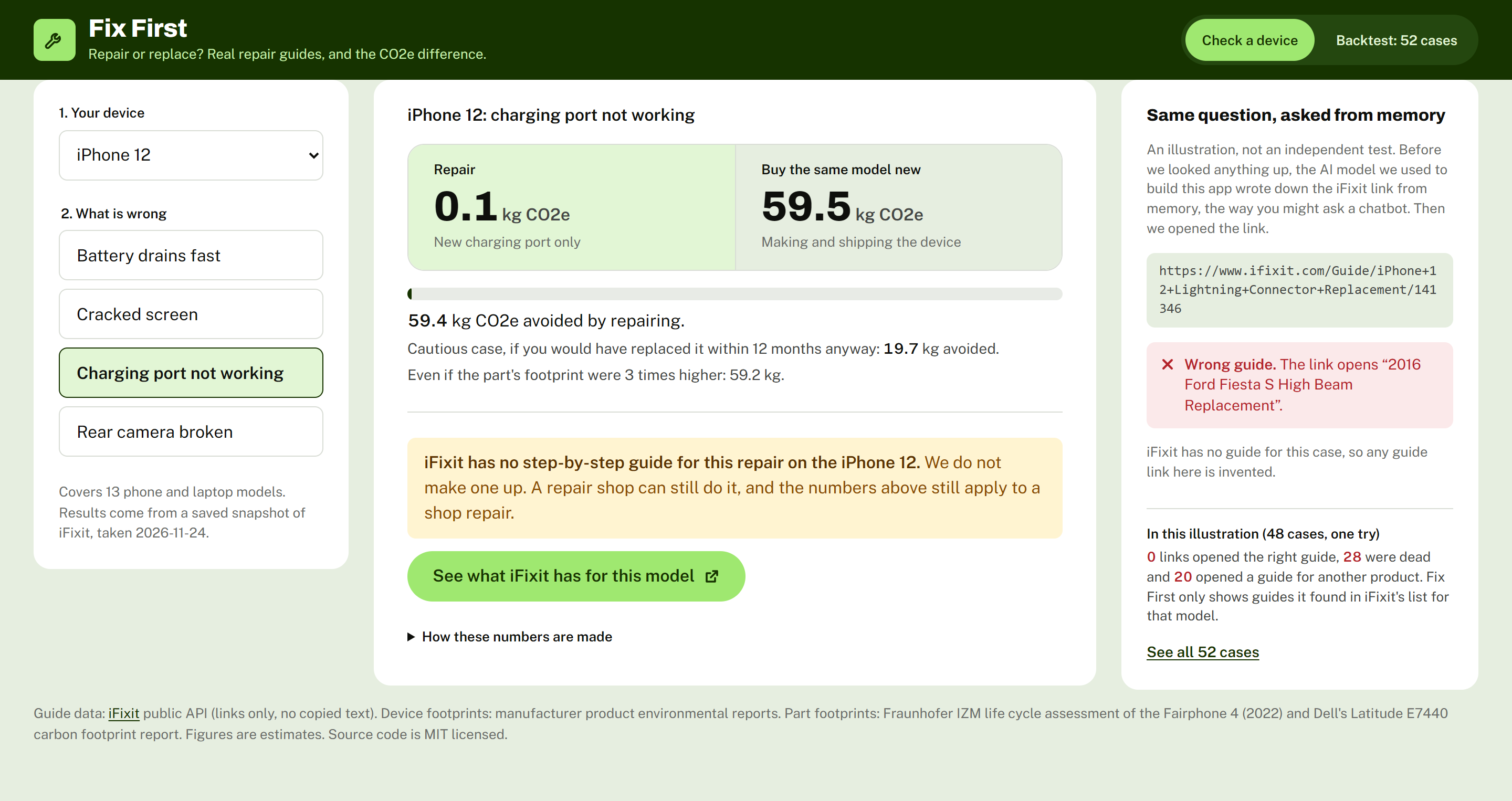
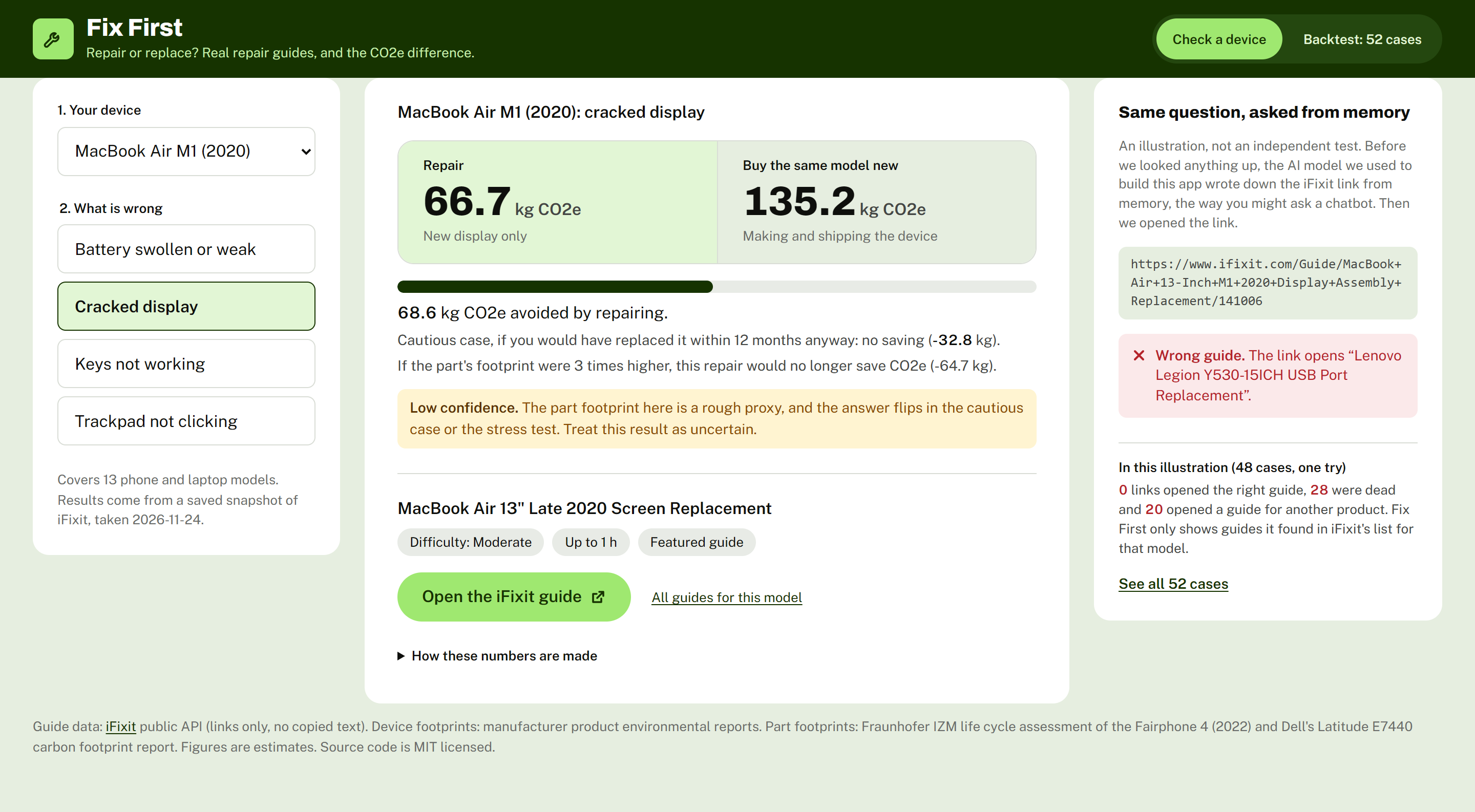
People who want to keep a device need a quick, trustworthy answer: can this fault be fixed on my model, and is there a guide? A chatbot will answer, but its links need checking. As an illustration (not an independent test), the AI model we used to build this app wrote down the iFixit link for 48 cases from memory before we looked anything up. We opened every link. None led to the right guide; one for an iPhone 12 charging port opened a guide for a 2016 Ford Fiesta.
Who it is for
People with a worn battery, cracked screen, dead charging port or similar fault who are deciding whether to buy new, and repair cafes that want a fast first answer at the door.
What it does
- Pick one of 13 models (10 phones, 3 laptops) and one of 4 faults.
- See the iFixit guide for that exact model, with difficulty and time. If iFixit has none, the app says so.
- See kg CO2e for repairing next to buying the same model new, plus a cautious case and a stress test. Each number links to its source.
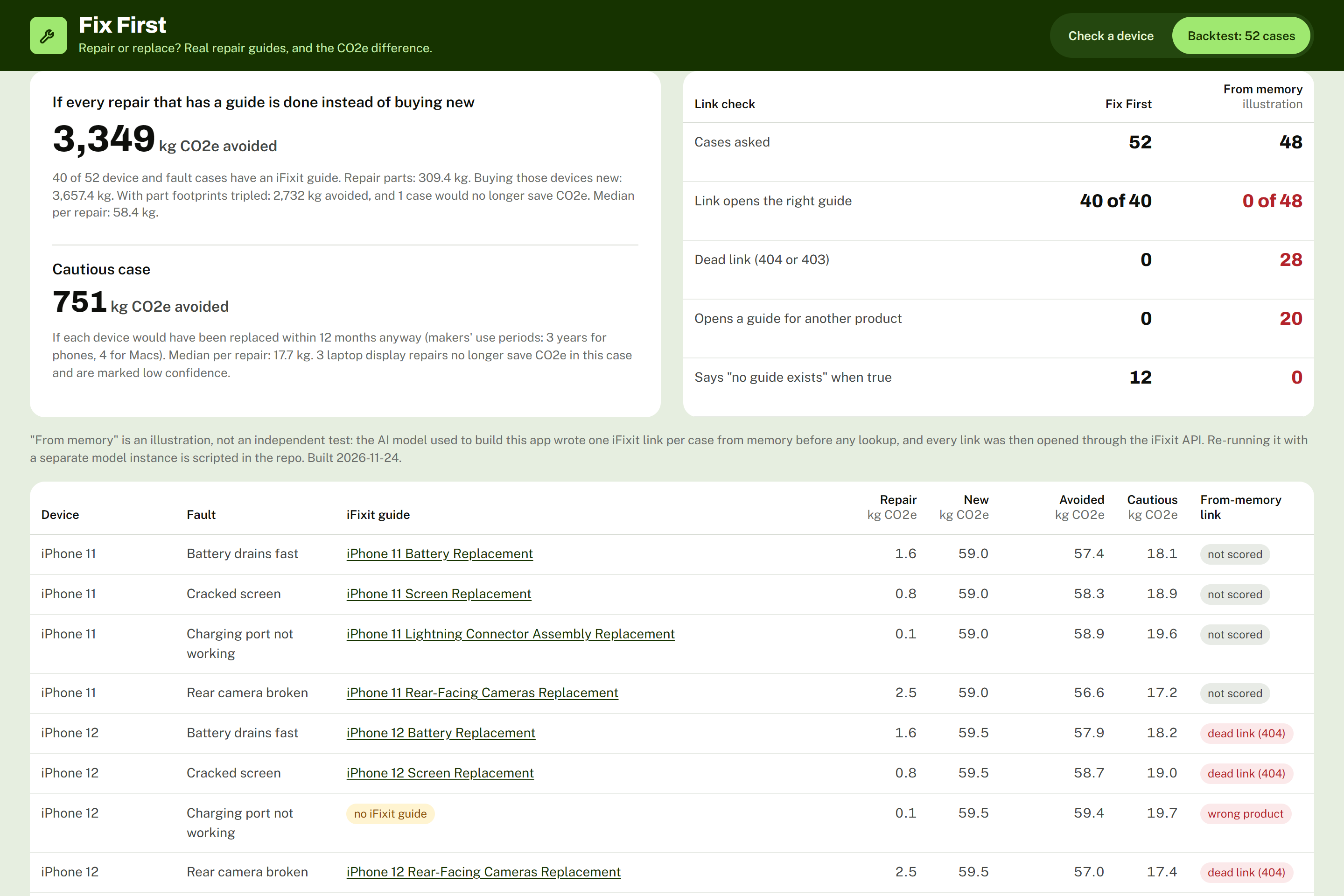
- The Backtest tab shows all 52 cases in one table.
Three results are marked low confidence: the laptop display repairs (MacBook Air M1, MacBook Pro 14 and 16), where the part proxy is rough and the saving disappears in the cautious case.
Environmental impact
All numbers come from one file, data/results.json.
| 40 repairs that have an iFixit guide | kg CO2e avoided | Median per repair |
|---|---|---|
| Repair instead of buying the same model new | 3,349 | 58.4 |
| Cautious case: you would have replaced it within 12 months anyway | 751 | 17.7 |
| Stress test: every part footprint tripled | 2,732 |
- Buy new = the maker's life cycle footprint × (production % + transport %), from Apple and Google product environmental reports.
- Repair = footprint of making the part. Makers do not publish these, so we use proxies: Fairphone 4 modules from Fraunhofer IZM (2022) for phones, component shares in Dell's Latitude E7440 report for laptops.
- Cautious case = 12 months' share of the new device's footprint, minus the part. Use periods are the makers' own: Apple 3 years for iPhone and 4 for Mac (Apple), Google 3 years for the Pixel 7.
- All 40 guide links Fix First shows were opened through the iFixit API: 40 of 40 are the right guide for that model.
How we built it
- A Node script reads each model's guide list from the iFixit public API, picks the replacement guide for each fault, and caches it. A second script opens every link the app will show.
- Footprint values are typed from the source PDFs into
data/carbon_sources.json, each with its URL. - A build script writes
results.json; the page, README, this text and the video read from it. - Plain HTML, CSS and JavaScript. No accounts, keys or tracking.
- 15 Node tests, including checks that every number recomputes from the sources and every shown guide belongs to the right device.
- The demo video is recorded from the running app with headless Chrome, with Kokoro TTS narration.
Challenges
- iFixit has no charging port guide for 9 of our 10 phones. We first assumed our matching was broken; the guide lists showed the port is not documented as a separate repair on those models.
- No maker publishes part footprints for these devices, so we used published proxies and added the cautious case and stress test to show where the answer is weak.
Limits
- Part footprints are proxies from other devices; the laptop display proxy (a 2014 Dell laptop) is the weakest.
- The from-memory links are an illustration: one model, one try, written by the same AI model that helped build the app. A script to re-run it with a separate model instance is in the repo.
- 13 models only, from an iFixit snapshot dated 2026-11-24.
- No prices: we found no citable price source across these models.
- No safety advice for opening devices; the iFixit guide covers that.
What's next
- Rank the fault list by what repair events actually see, using the Open Repair Alliance open data.
- Offer the backtest table and the "no guide" list to three public repair networks: Repair Café, The Restart Project and Fixit Clinic.
- Add models by re-running the fetch script and the link check.
Try it
Live demo: https://fix-first-omega.vercel.app Source code: https://github.com/StuartYo/fix-first
Built With
- css
- ffmpeg
- html
- ifixit-api
- javascript
- kokoro-tts
- node.js
- puppeteer
