-
-
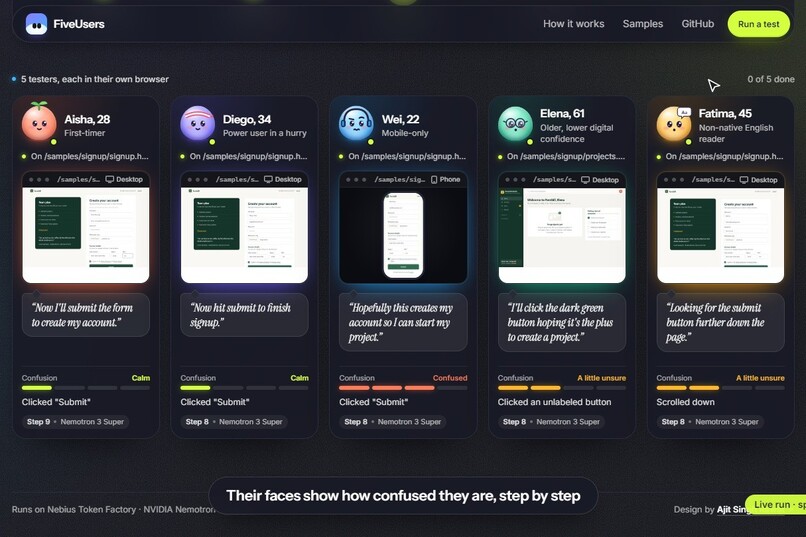
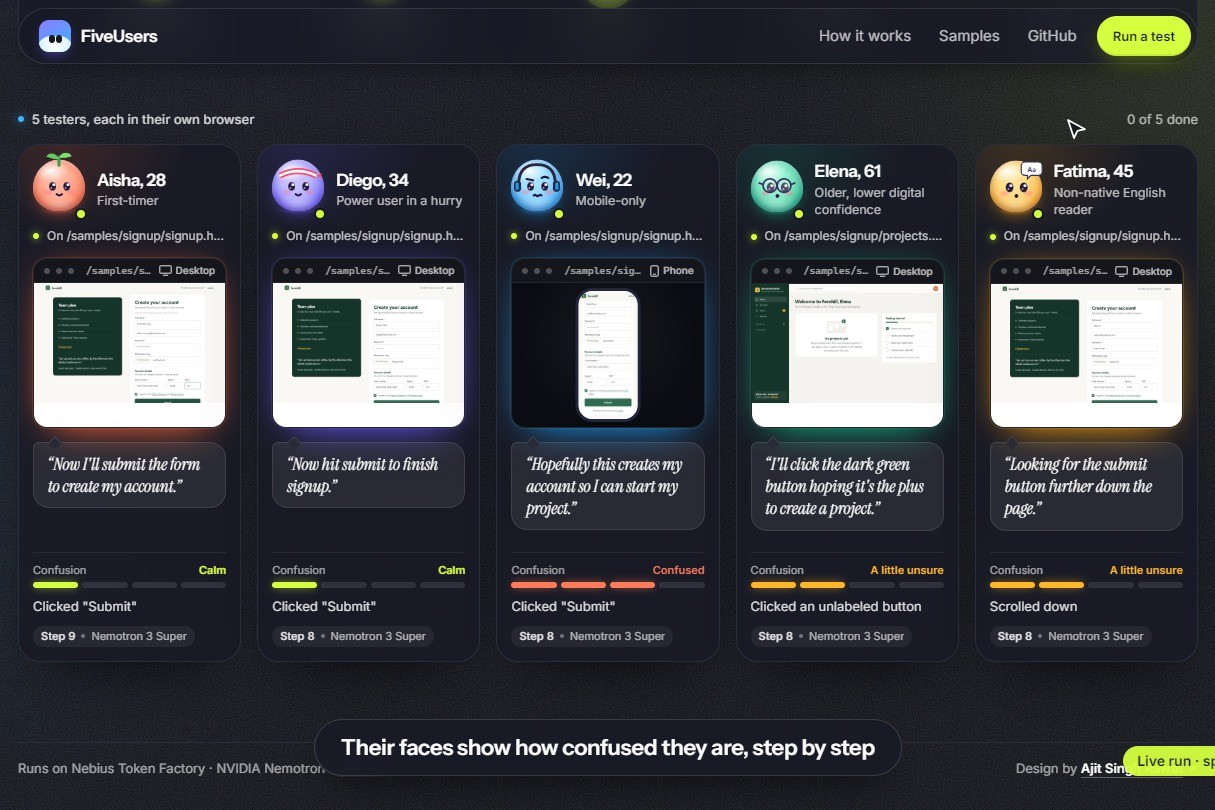
The live lab: five AI testers use the site at once, each in their own browser, thinking out loud.
-
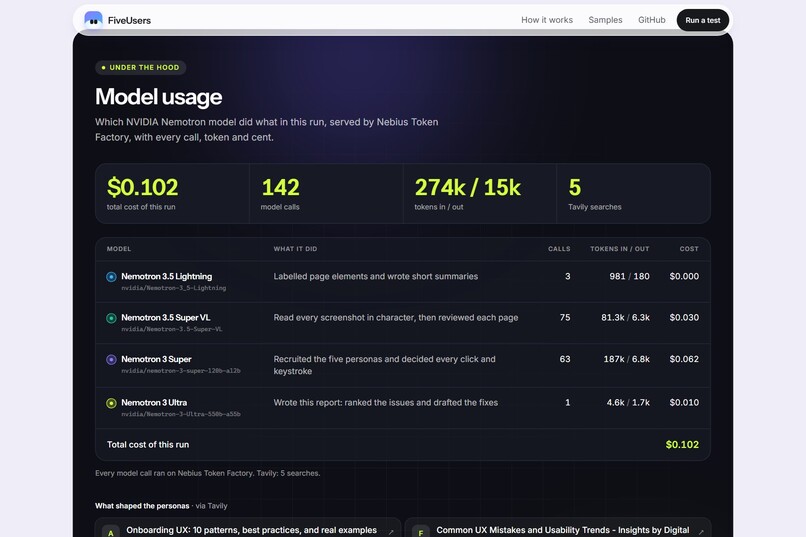
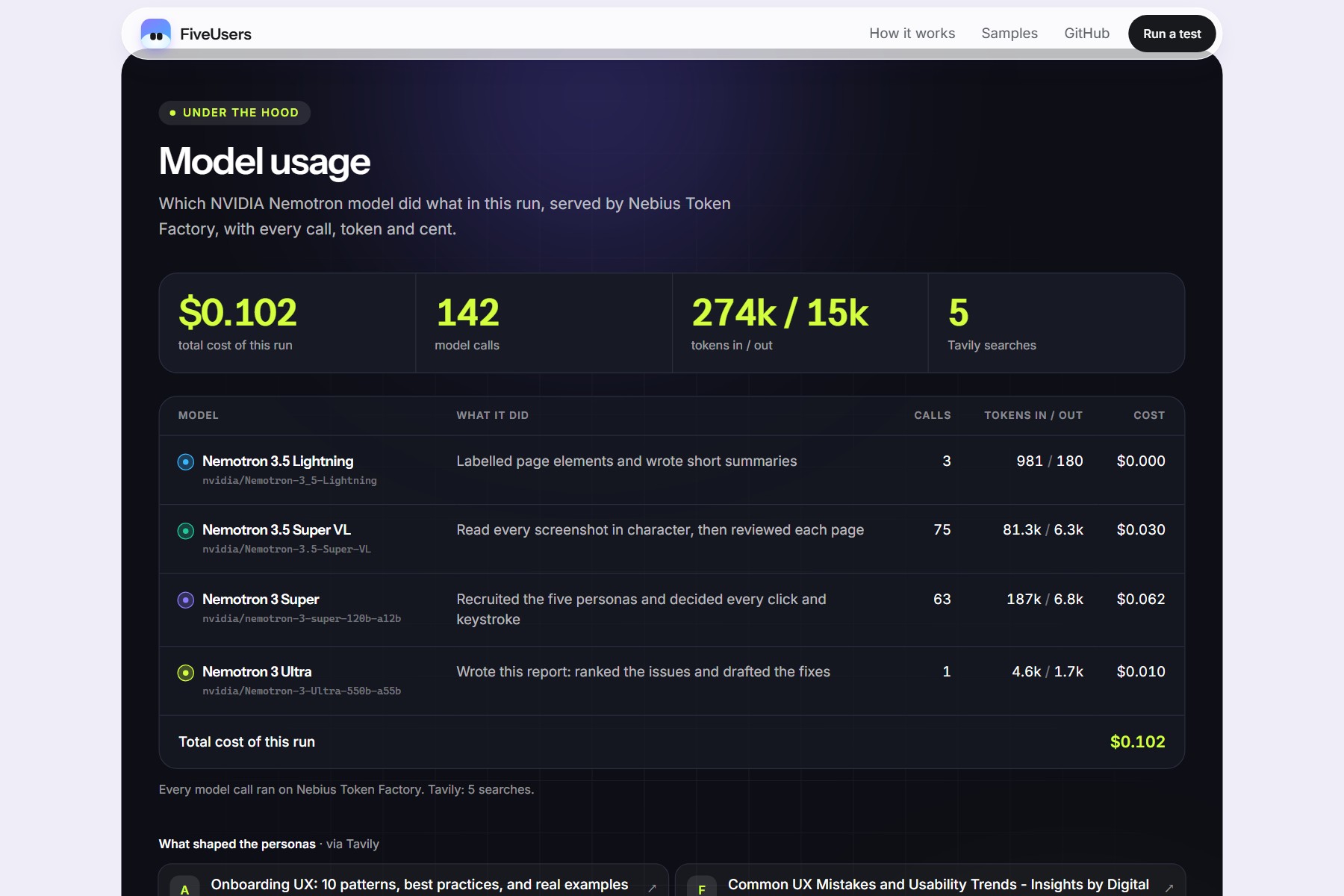
Model usage: which NVIDIA Nemotron model did what on Nebius Token Factory, with every call and cent.
-
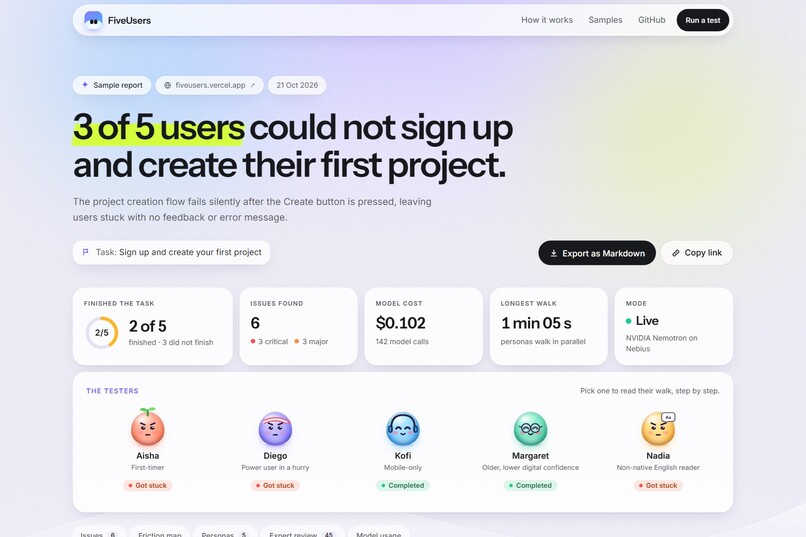
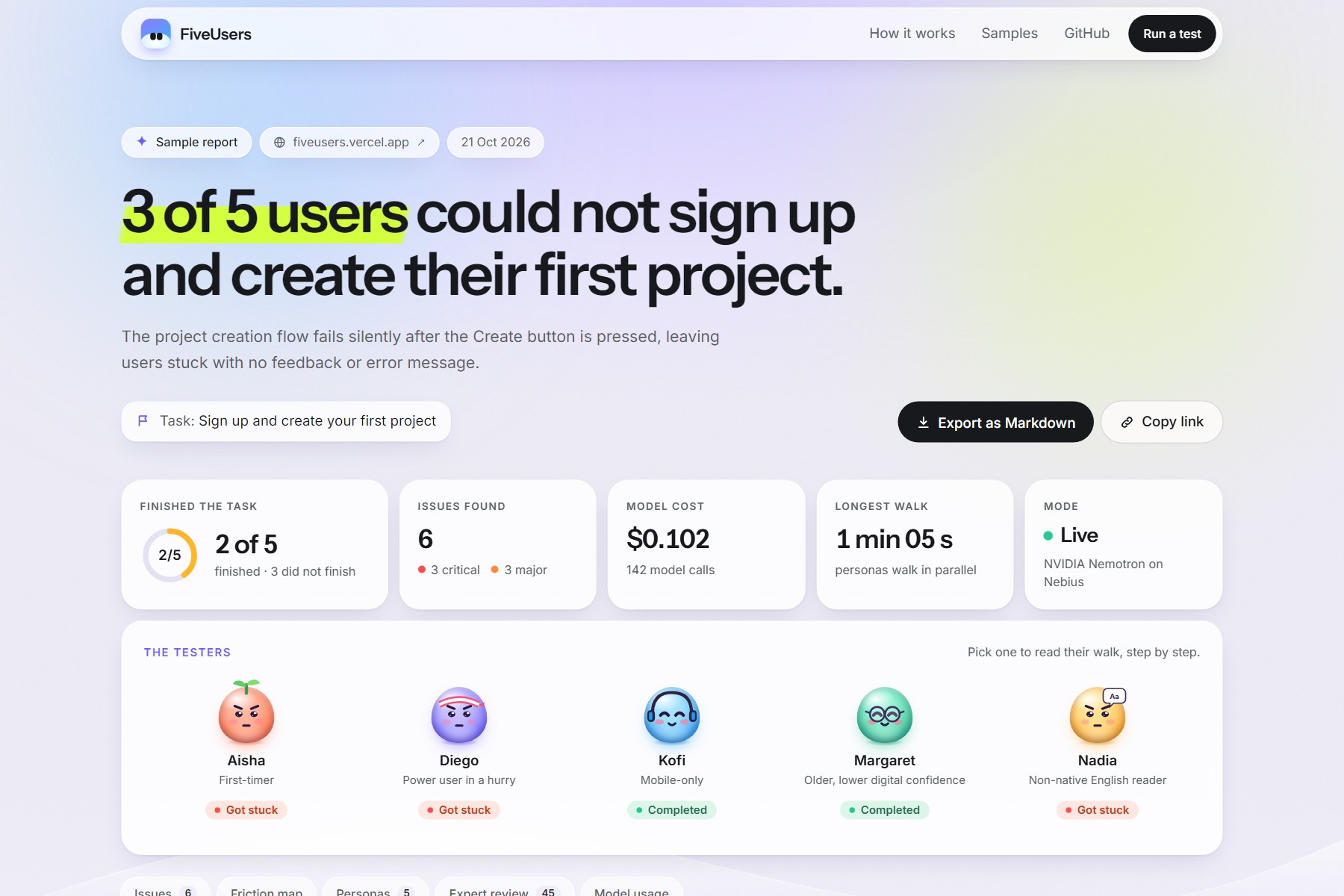
The report: who finished, who got stuck, and what it cost, stated as a plain fact.
-
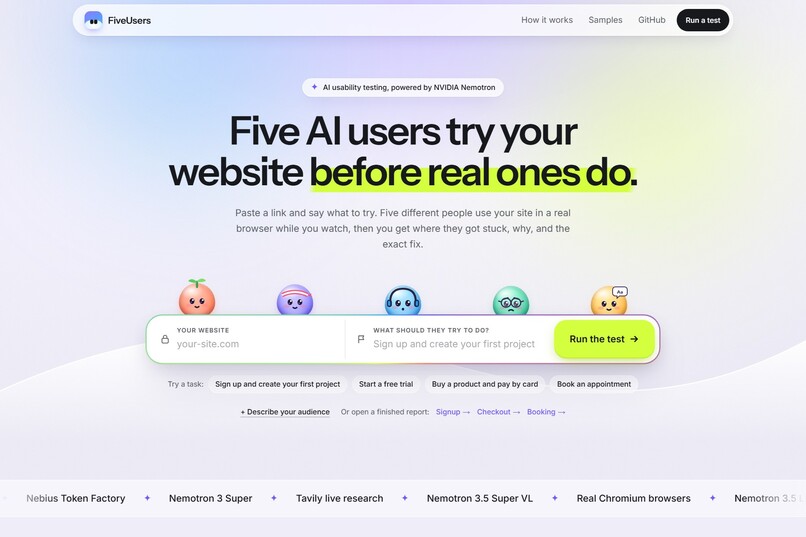
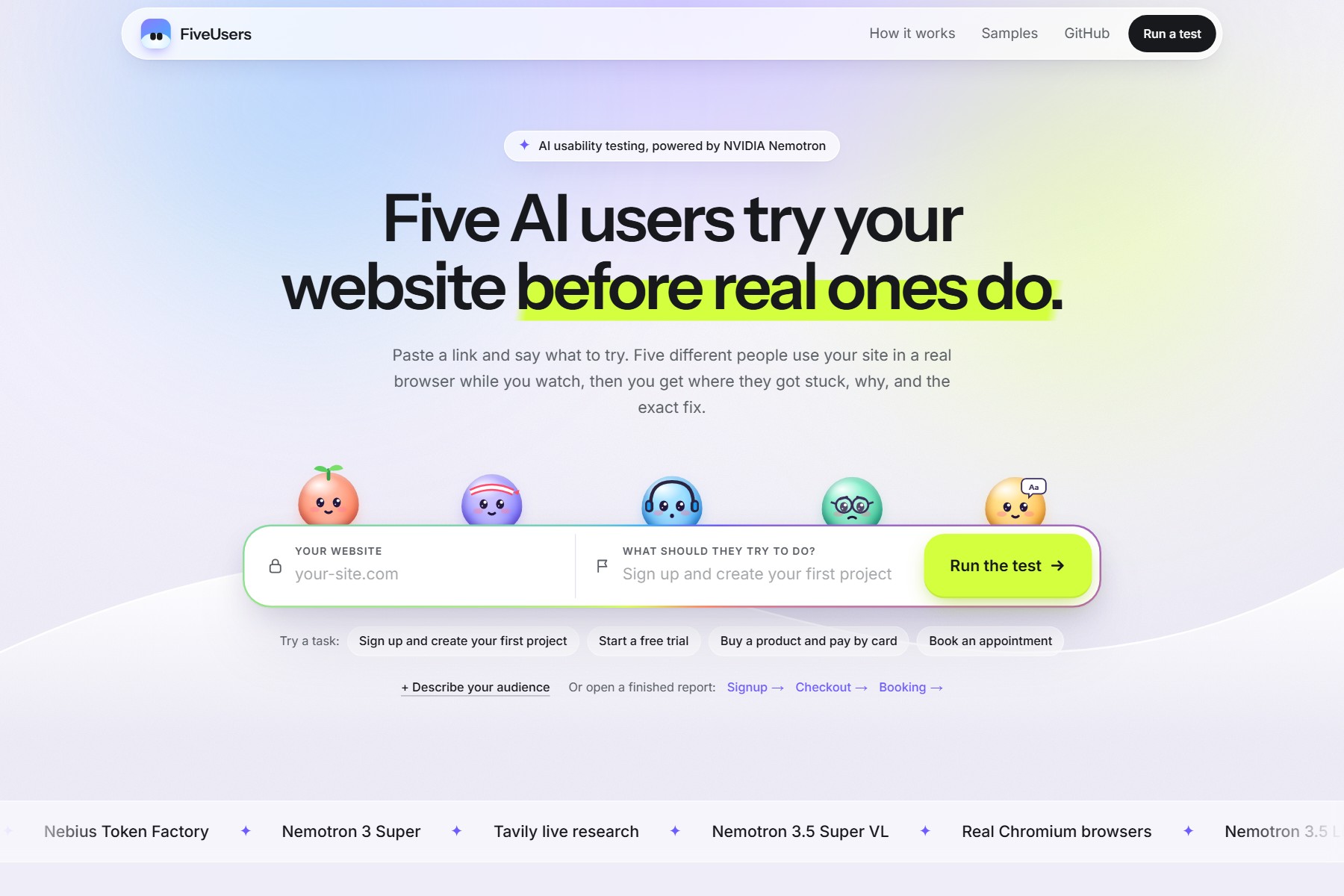
Paste a link, say what to try, and run the test.
-
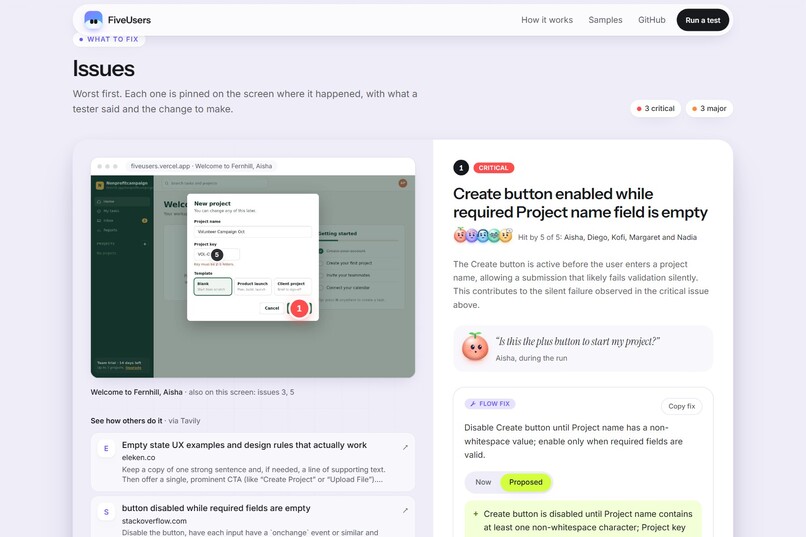
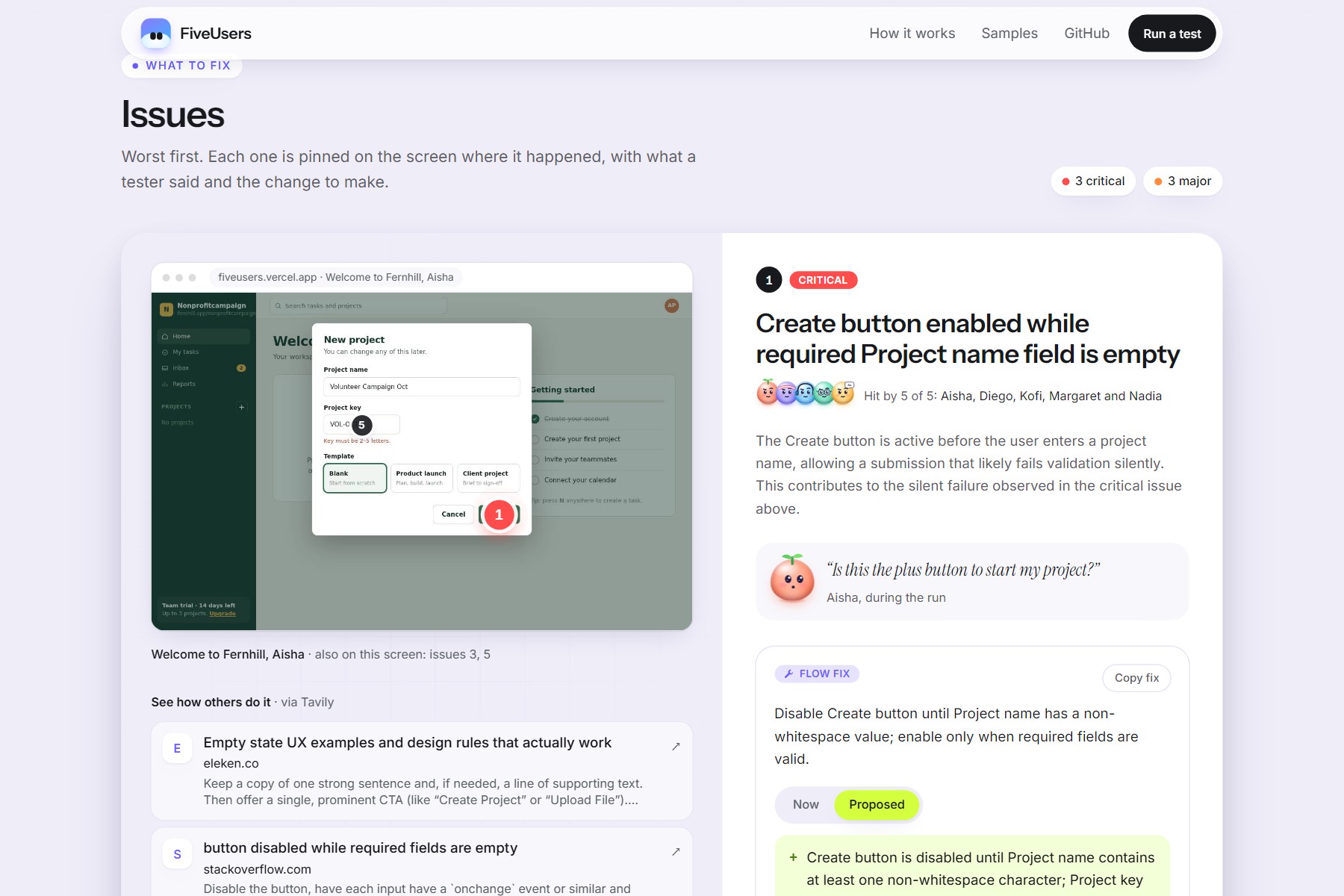
Every issue is pinned on the real screen, in the tester's own words, with a fix to ship.
Inspiration
I'm a product designer. The most useful thing I can do before a release is watch five people try to use what I designed, and it's the step that gets skipped every time: recruiting takes days, sessions cost money, and small teams have neither. So designers end up asking a colleague "does this make sense?": one person, same context, same blind spots. Nielsen's old finding is that five users surface most usability problems. Five was never the problem. Getting five was.
What it does
You give FiveUsers a URL and a task, like "sign up and create your first project". It:
- Recruits five personas for your product (a first-timer, a power user in a hurry, a phone-only user, someone with low digital confidence, a non-native English reader), grounded in live web research about your product's category.
- Lets each one actually use your site in a real browser, at the same time. Every step, the persona looks at the screenshot, says what it notices in its own voice, and decides what to do: click, type, fill a form, scroll, wait, go back, give up, or finish. You watch the five of them live.
- Reviews every screen they saw against usability heuristics, plus quick accessibility checks (labels, names, contrast, tap targets).
- Writes the report: how many people finished, where they got stuck, severity-ranked issues with a numbered pin on the actual screenshot, the persona's own words, and a concrete fix for each (a copy rewrite, a CSS change or a flow change), with links to how comparable products handle the same step.
A run takes two to three minutes and costs about ten cents in model calls: 126 to 142 Nemotron calls in the three sample runs, $0.10 to $0.14 each.
How I built it
Every model call runs on NVIDIA Nemotron through Nebius Token Factory, and each Nemotron tier does the job it's best at:
- Product category: Nemotron 3.5 Lightning (tiny call, cheapest tier)
- Five personas: Nemotron 3 Super (grounded in Tavily research, structured JSON)
- Every step: "what do I see?": Nemotron 3.5 Super VL (reads the screenshot in the persona's voice)
- Every step: "what do I do?": Nemotron 3 Super (tool calling: click / type / fill / scroll / wait / back / give up / done)
- Every "done": is it really done?: Nemotron 3.5 Super VL (judges the goal from the screenshot, not the persona's claim)
- Expert review per screen: Nemotron 3.5 Super VL (Nielsen heuristics from the screenshot)
- The report: Nemotron 3 Ultra (one call over every step, finding and quote)
Tavily runs twice per test: to research the product category before writing personas, and to find "how others do it" references for the top issues.
The backend is Python (FastAPI + Playwright) on Modal, which scales to zero between tests; the web app is Next.js on Vercel and serves the sample reports itself; the live view streams over Server-Sent Events.
A few decisions that make the report trustworthy:
- Evidence is grounded, not generated. Pins are placed on the bounding box of the real element the persona touched. Quotes must match a line the persona actually "thought" during the run. Persona ids, screens and steps are validated against the recorded log before anything reaches the report.
- It degrades instead of failing. Vision unavailable → decide from the element list. Tool calls come back as text → parse them, then JSON mode. Ultra unavailable → Super writes the report (and the report says so).
- It's safe to point at the internet. The test browser goes through an egress filter that refuses private addresses, stays on the site under test, and every run has hard time and budget limits.
Challenges I ran into
- Pages that change after you click. Many forms show "Submitting…" and move on a second later. My personas kept judging a screen that was about to disappear and "got stuck" on perfectly good flows. The browser now waits until the page is quiet and isn't showing a busy state, and personas got a
waittool. - Making a model's findings checkable. A model will happily write confident issues with nothing behind them, so the report only keeps issues it can ground in a recorded step, element and quote. That's what makes it something a designer can trust.
- Forms ate patience. One action per field meant a six-field form used half a persona's patience. A
filltool that completes several fields at once made the walks realistic and saves two model calls for every extra field. - Proving the personas could succeed. I built a script that drives all three sample flows through the personas' own eyes, choosing elements only from what the model sees. It failed 6 of 6 at first; each failure was a real gap (a dropdown whose options the persona couldn't see, a late navigation). Now 6 of 6 pass on desktop and phone.
- My first live run said 0 of 5 users finished. It was my bug, not the site. I had used each persona's patience as a hard step limit, and the sample flow needs about nine actions, so the hurried personas could never finish. Now everyone gets the same screen budget, patience lives in the prompt, and quitting is the persona's own decision.
- Personas said "done" when they weren't. One declared victory on an empty projects page. Every "done" is now checked by Nemotron 3.5 Super VL looking at the screenshot. Text-only checks failed here: a kanban board's own "Done 0" column fooled them. On 24 labelled screenshots the vision check judged all 24 correctly, and it also catches people who reached the goal without noticing.
- Ultra thought itself out of tokens. With reasoning on, Nemotron 3 Ultra used all 12,000 output tokens thinking about a 5,000-token prompt and returned half a JSON report with one issue. With reasoning off it writes a full report in about five seconds for about one cent. Truncated output is now treated as an error, never as a report.
- The models didn't know what day it is. A correct October 2026 calendar was reported as a critical "wrong month" bug. Every prompt now carries today's date.
Accomplishments that I'm proud of
- The report reads like a researcher wrote it, and every claim in it points at evidence.
- Watching five lanes come alive and one persona quietly give up is exactly what a real test feels like.
- Three deliberately flawed sample products with a written answer key, so anyone can check whether the report found the real problems. In the committed signup report, the issues and the expert review caught 6 of the 13 planted flaws (the pricing wall before signup, a card asked for a free trial, an unlabeled email field, the cookie bar covering the main button, an unnamed "+" create control, the "project key" jargon), plus problems I hadn't planted, like a Submit button that stays enabled while the required Terms box is unticked. Each run's cast finds a slightly different set, like real people.
- The personas are drawn as small characters whose faces show the same confusion score the agents report on every step, so you can see someone getting lost before you read a word.
What I learned
- Routing by tier matters. Across the three sample runs Nemotron 3 Super carries about 55% of the cost (personas and every decision), Super VL about 24% (every screenshot and every "done" check), Ultra about 21% (about one cent when the report comes back right the first time; in one run the first attempt was unusable and the retry paid twice), and Lightning almost nothing.
- Nemotron 3 Super returned clean, structured tool calls from the first test, fast enough (about a second) to drive five agents at once. For anything about what's on a screen, the vision model is the right judge, not text.
- Reasoning is a budget, not a free upgrade: turn it on where it pays and cap it, because a runaway think costs tokens and can cut the answer off.
What's next for FiveUsers
- Figma prototypes as input, so designs get tested before they're built
- Logged-in flows with test credentials
- A CI check: run the five users on every preview deploy and comment the report on the pull request
- Token Factory Sandboxes and the Batch API for cheaper nightly runs
Design
Product and visual design by Ajit Singh Rawat: https://ajitrawat.framer.website/
Try it
- Live demo: https://fiveusers.vercel.app
- Sample reports: https://fiveusers.vercel.app/samples
- Video: https://youtu.be/VljfakEzpJk
Built With
- fastapi
- modal
- nebius-token-factory
- next.js
- nvidia-nemotron
- playwright
- python
- react
- sqlite
- tailwindcss
- tavily
- typescript
- vercel

Log in or sign up for Devpost to join the conversation.