-
-
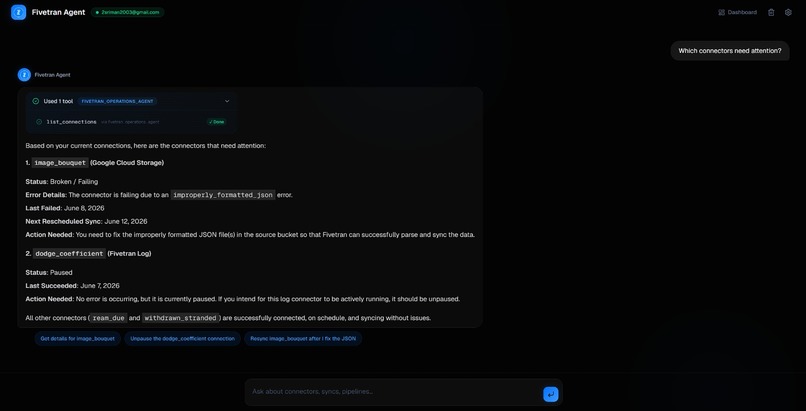
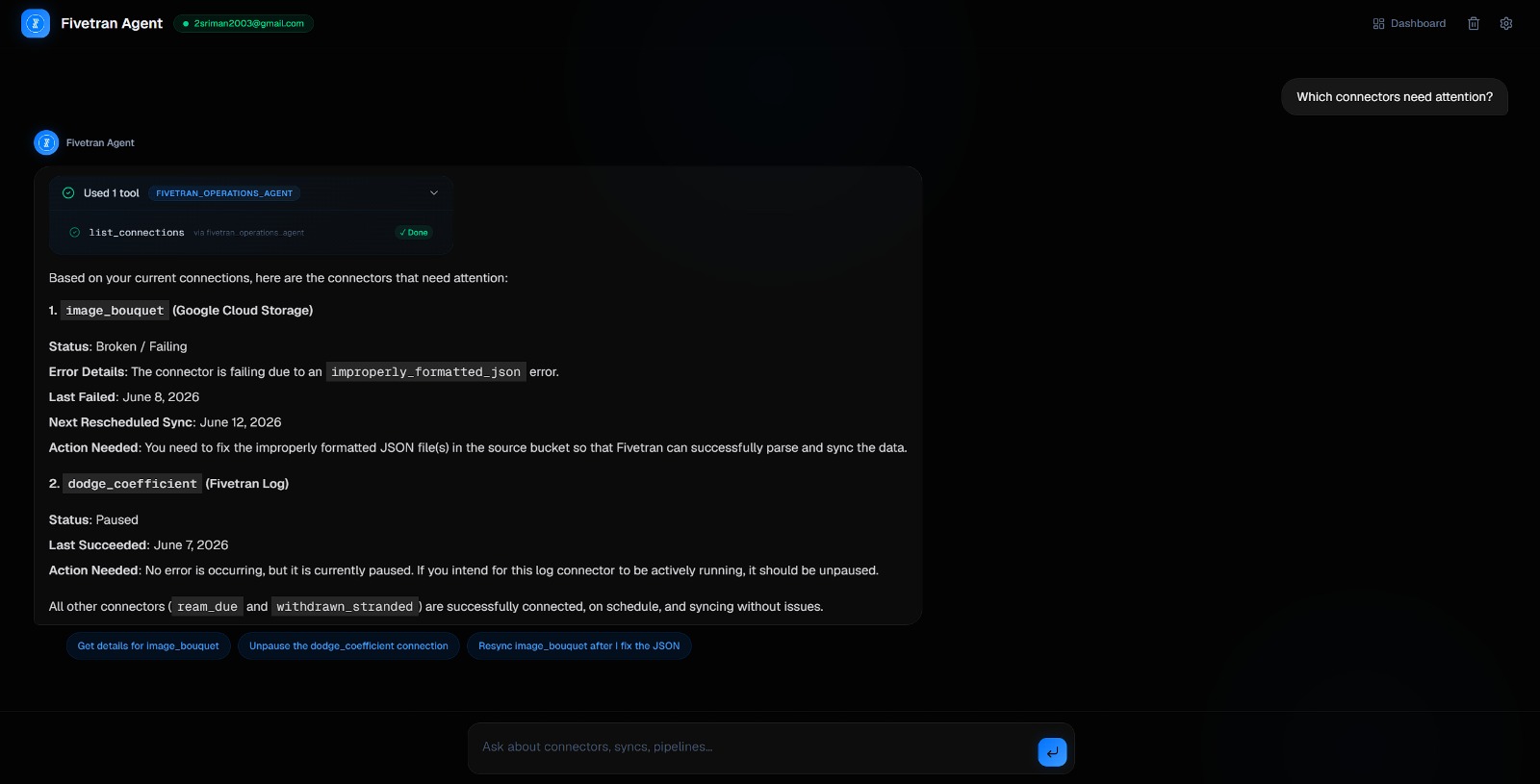
conversation with agent using basic tools
Inspiration
Modern data teams spend too much time chasing pipeline failures across dashboards, warehouses, dbt projects, and logs. We wanted to turn that reactive debugging loop into an assistant-led workflow: one place that can understand the pipeline, diagnose issues, and help safely recover trust in the data.
What it does
Fivetran Data Trust Autopilot provides a chat and dashboard experience for managing ELT health. It can inspect Fivetran connections, sync states, schemas, transformations, BigQuery metadata, and dbt project context. The dashboard shows pipeline readiness, source-to-dataset lineage, schema drift, incidents, operational logs, and safe fix plans. The Chrome extension adds screen-aware help inside the Fivetran dashboard, including guided highlights and safe navigation actions.
How we built it
We built a FastAPI backend powered by Google ADK agents. A router agent delegates work to Fivetran operations, BigQuery, dbt, transformation, and screen-context specialists. Fivetran API access is exposed through a custom MCP server, while BigQuery and dbt use MCP-backed specialist agents. The frontend is a Next.js app with a chat interface and Autopilot dashboard. We also built a Manifest V3 Chrome extension that captures Fivetran dashboard context and passes it to the agent.
Challenges we ran into
The hardest part was coordinating multiple agents without losing safety or context. Fivetran operations, dbt edits, BigQuery inspection, GitHub pushes, and transformation runs all have different risk levels. We had to design confirmation gates for writes, per-user credential scoping, screen-context limits, and a retry loop for dbt-to-Fivetran validation without accidentally running unsafe actions.
Accomplishments that we’re proud of
We’re proud that the project goes beyond a simple chatbot. It includes a real multi-agent workflow, live/demo-safe dashboard endpoints, schema drift detection, webhook incident diagnosis, operational logs, user credential onboarding, Chrome side-panel context, and a dbt transformation loop that can draft, push, run, inspect failures, and retry.
What we learned
We learned that agentic data operations need strong boundaries. The agent needs access to tools, but it also needs explicit routing, read/write separation, confirmation before destructive actions, and clear observability into what tools were called. We also learned that UI context is incredibly useful when paired with API-level state, because users often ask from wherever they are already stuck.
What’s next for Fivetran Data Trust Autopilot
Next, we’d expand production hardening: deeper lineage impact analysis, richer dbt test generation, Slack/Discord incident workflows, more warehouse support, persistent incident history, stronger RBAC, and automatic post-fix validation reports. The long-term goal is an autonomous but approval-aware reliability layer for the modern data stack.


Log in or sign up for Devpost to join the conversation.