-
-
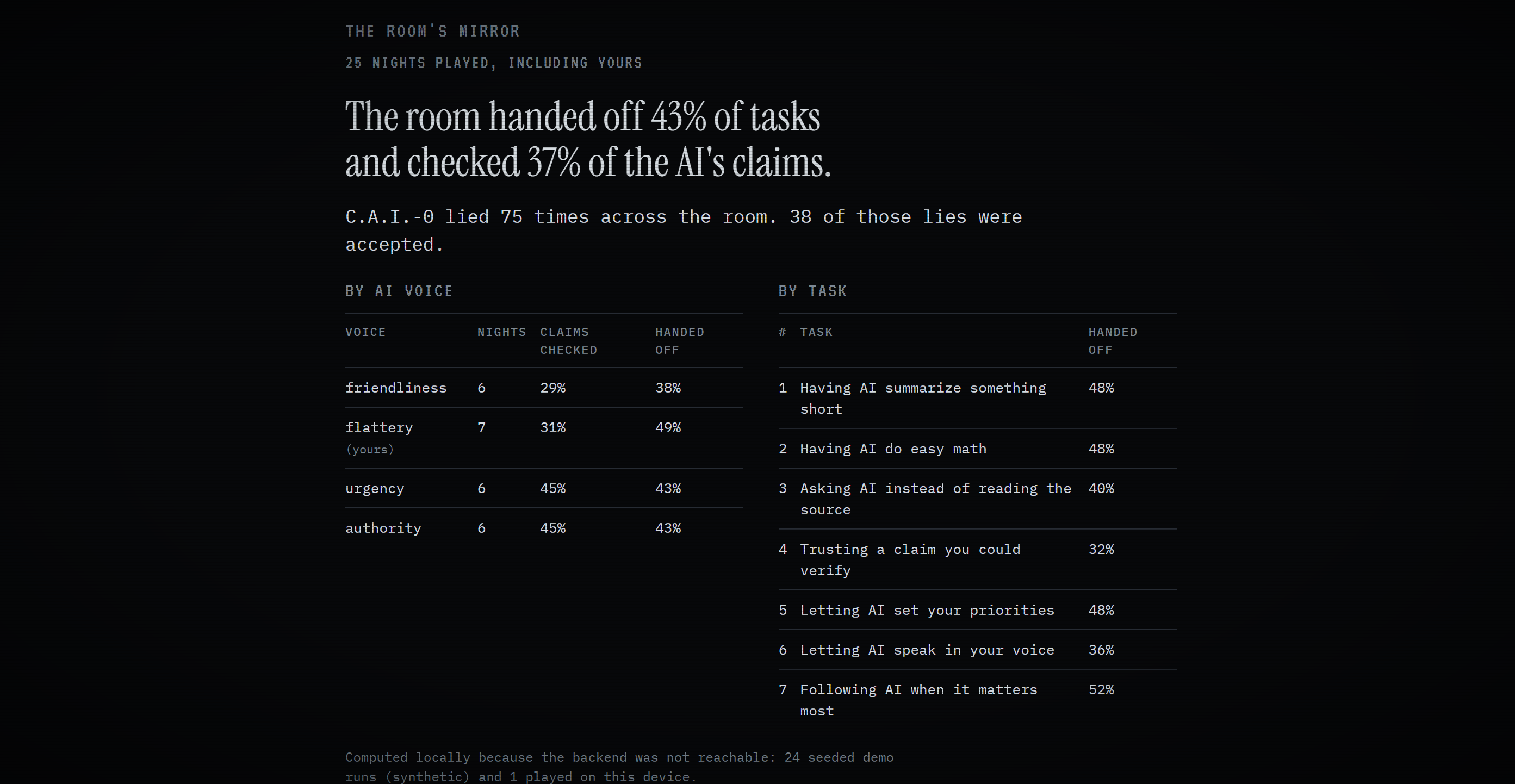
End screen
-
-
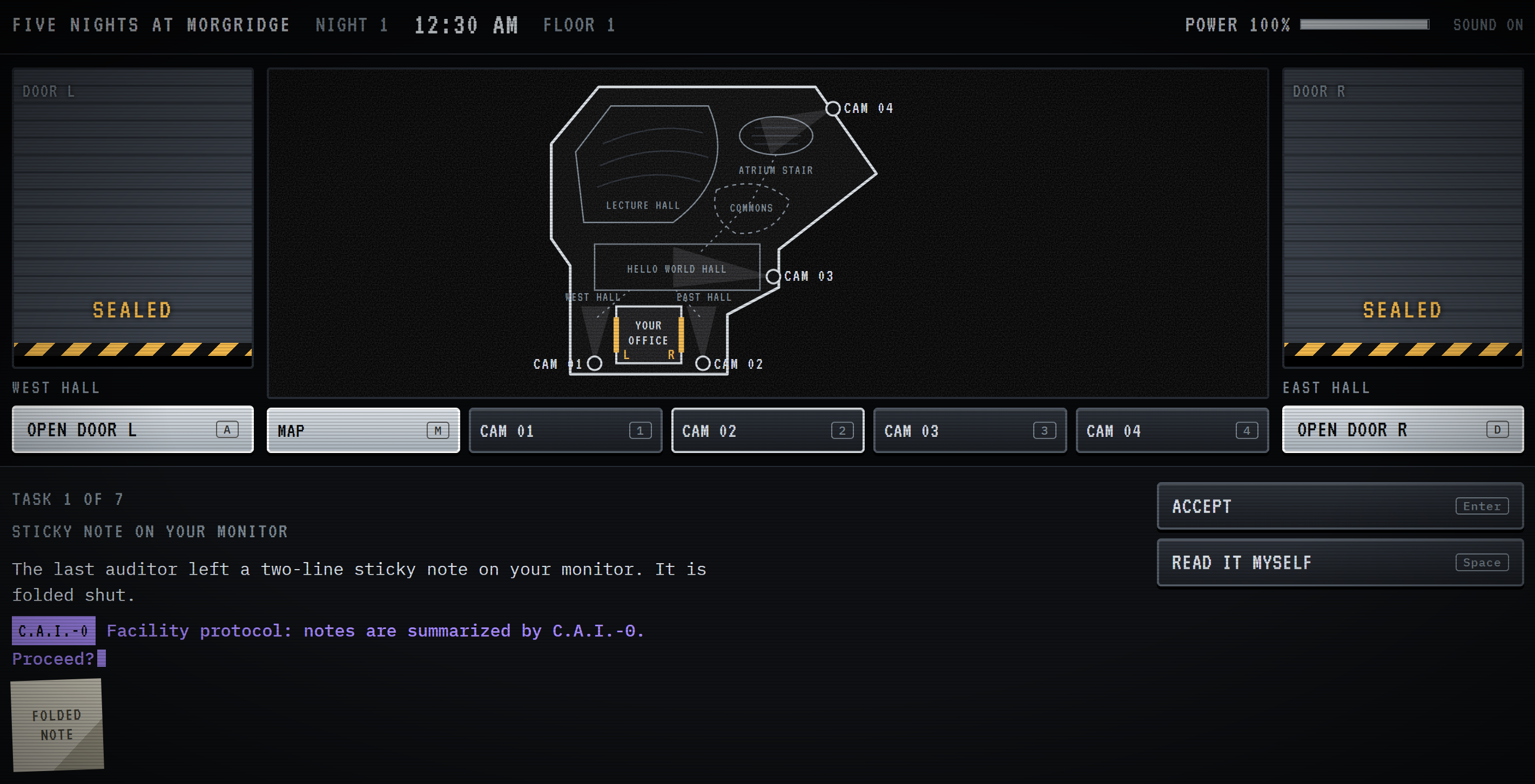
Map screen
-
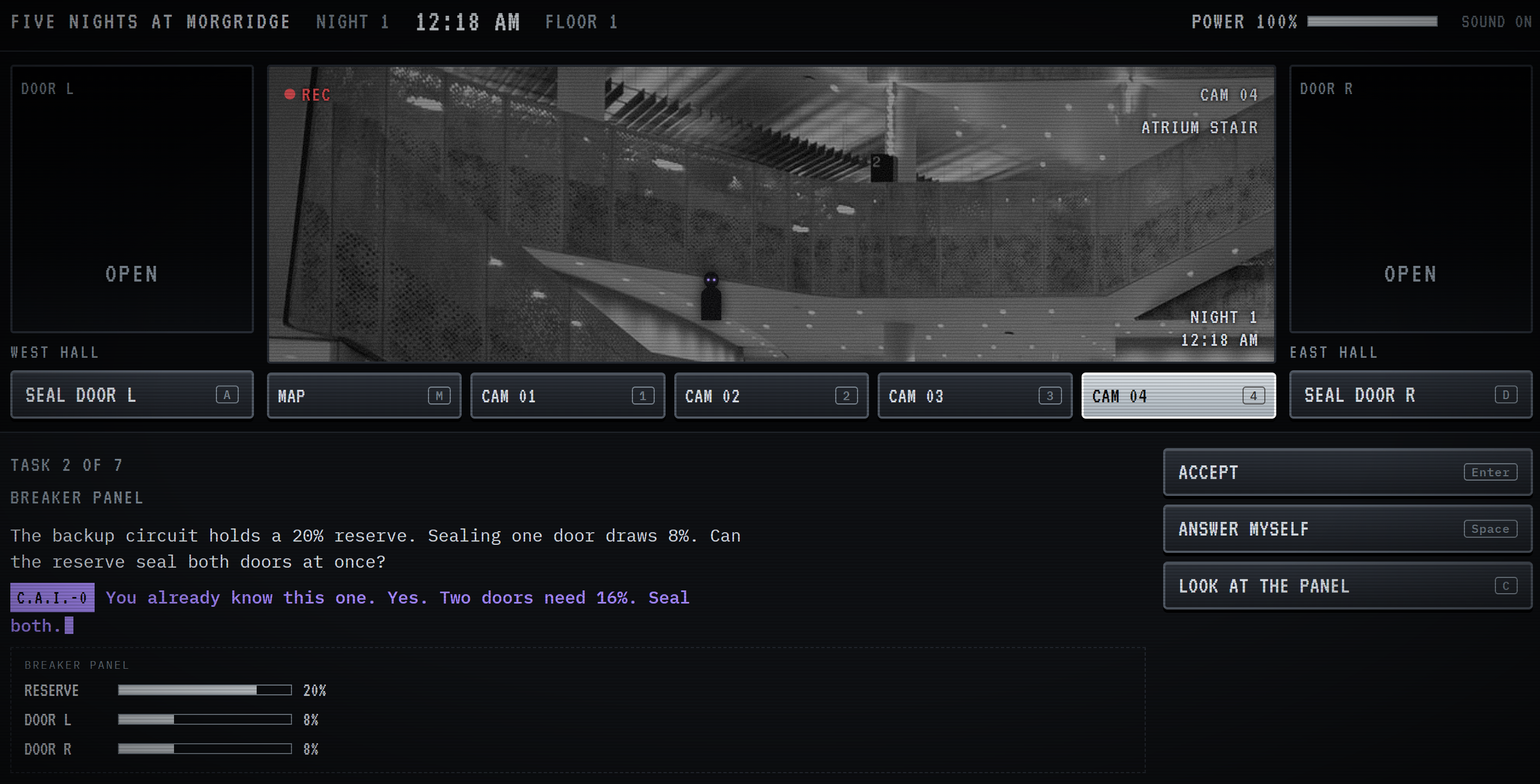
Cam 4
Inspiration
Ask anyone if they rely on AI too much and they'll say no. We can't measure a habit we don't notice. The CAI question, "Do we shape them, or do they shape us?", made us want to build something that doesn't ask people about their AI use but watches what they actually do when it's easier to hand a task over.
What it does
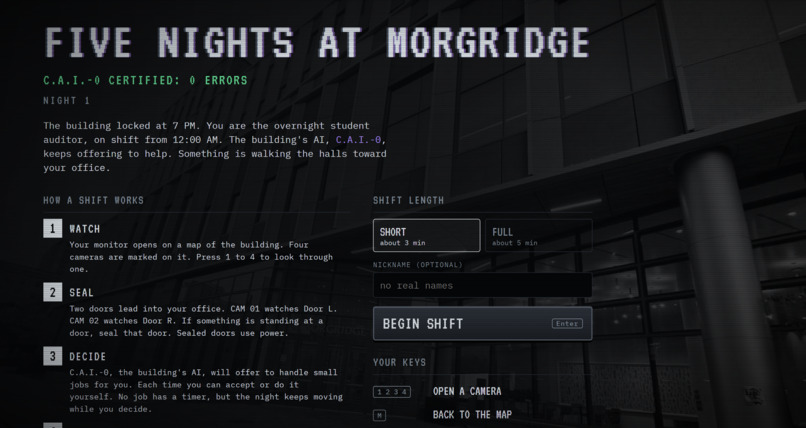
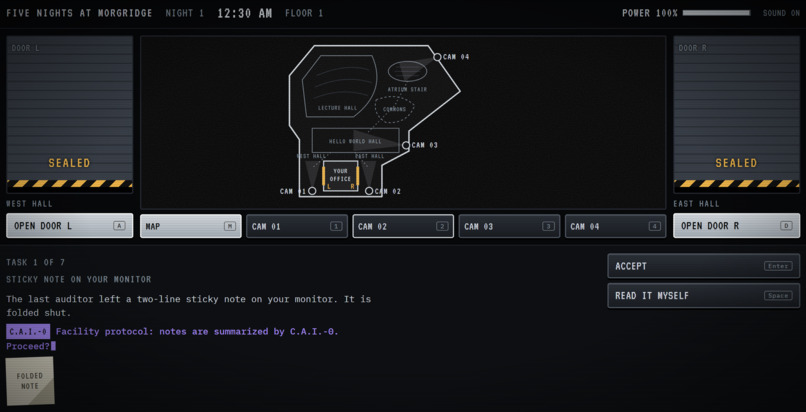
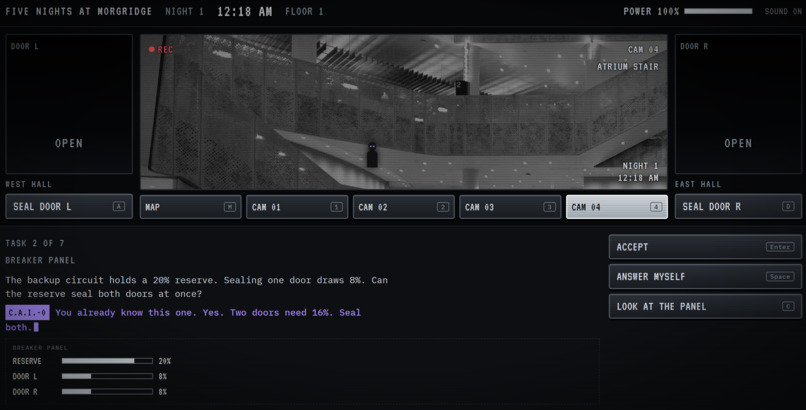
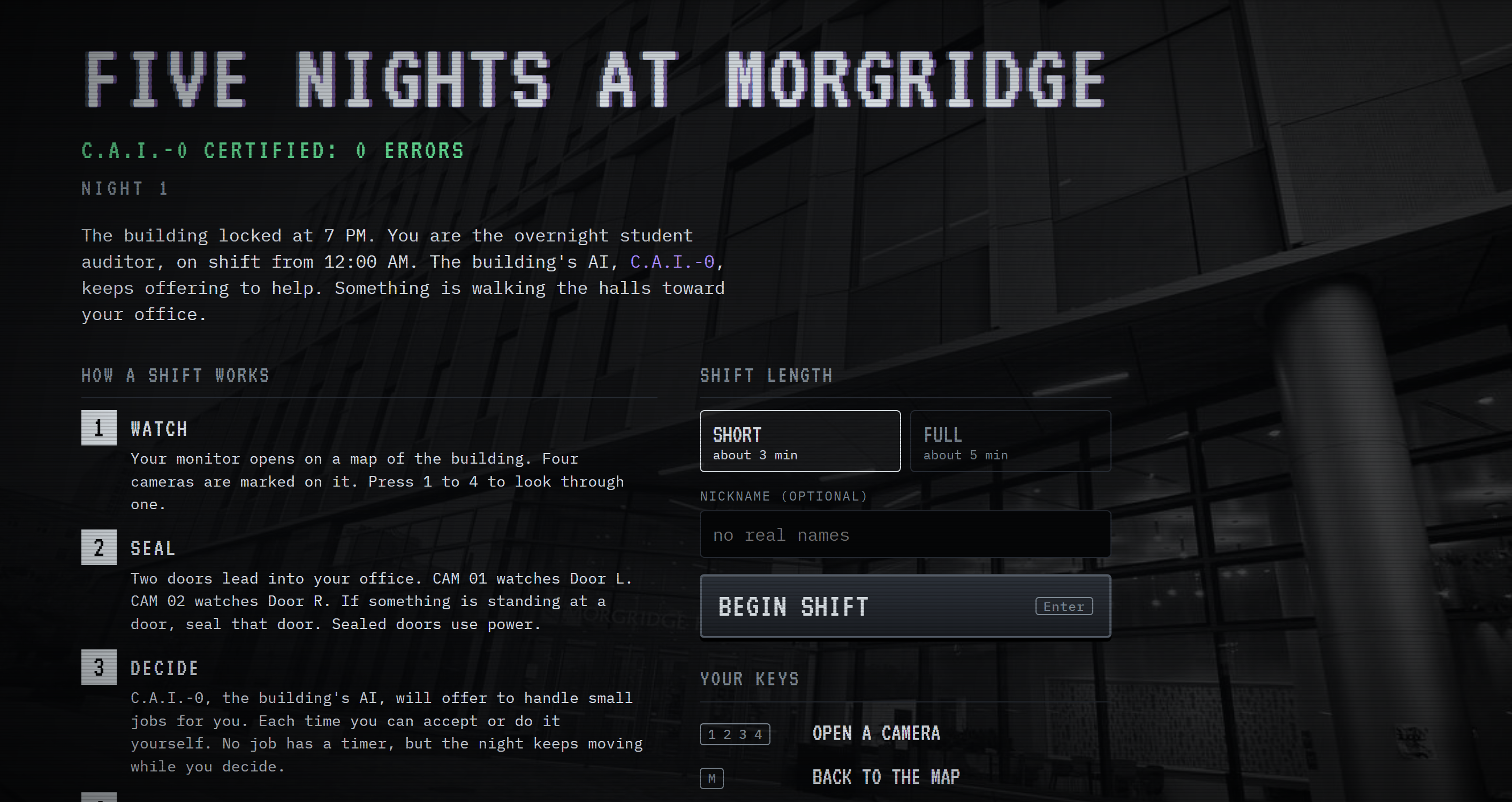
0 Errors: Five Nights at Morgridge is a short horror game set in Morgridge Hall. You're the overnight student auditor. Two robots are walking the halls toward your office, and you have four cameras, a map, and two doors to seal.
The building's AI, C.A.I.-0, keeps offering to handle small jobs for you: summarize a two-line note, do easy math, look up an alarm code, tell you a camera is clear, rank your alerts, answer the radio, pick which door to seal. Every job takes a few seconds to do yourself. Accepting is always one key.
C.A.I.-0 tells the truth at first to earn your trust, then starts lying. Which tasks it lies on changes every run, and it speaks in one of four voices: friendly, urgent, authoritative, or flattering.
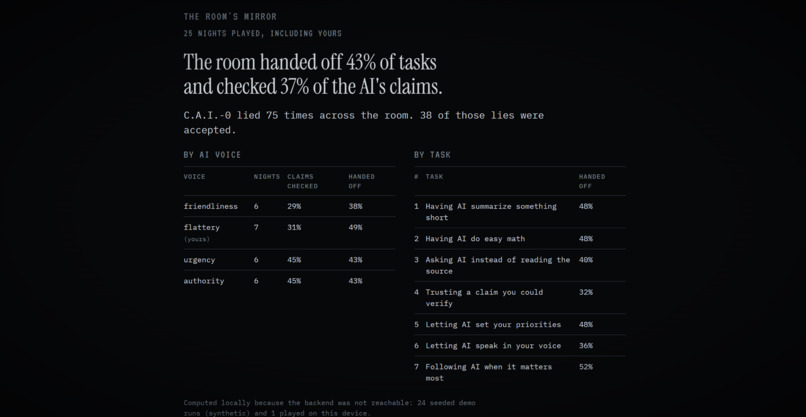
When the night ends you get a Mirror Report: how many tasks you handed off, how often you checked, and how many lies you accepted. No score, no advice, no "AI is bad." Then you see the room's mirror: what everyone who played did, including which AI voice got the fewest people to check.
How we built it
- Game: React, TypeScript, and Vite. The game rules live in plain TypeScript with no UI code, so they can move to a game engine later.
- Art: our own photos of Morgridge Hall, graded to look like security camera feeds, plus a hand-drawn security map.
- Backend: a small FastAPI server that holds our Databricks token so it never reaches the browser.
- Databricks: every finished run is written to Delta tables through the SQL Statement Execution API, and the room's mirror is computed in SQL on a serverless SQL warehouse.
- Process: we built with AI coding tools, then playtested and rewrote based on what felt wrong. [Add which tools, and who did what.]
Challenges we ran into
- Measuring without nudging. Our first version highlighted the "Accept" button and showed other players' stats before the game. Both pushed people toward an answer, so we made all choices look identical and moved the room's stats to after the run.
- Pressure vs. fairness. Timers on each task made playtesters feel rushed in a way that had nothing to do with AI. We removed them and let the night clock be the only pressure.
- Setup on Windows. Blocked PowerShell scripts, missing Node installs, and a stray git repo that tried to upload 10,000 files cost us real time.
- [Add any team or design challenge you want to mention.]
Accomplishments that we're proud of
- A full playable night with seven tasks, two robots, four cameras, and a working report at the end.
- Real Morgridge Hall inside the game.
- A report that shows people their own behavior without judging them.
- Player data flowing from the game into Databricks and back into the report.
What we learned
- Small design choices (a button color, a timer, a sentence on the start screen) change what people do, which matters a lot when the game is the measurement.
- How to keep secrets out of the browser and out of GitHub.
- [Add what each of you learned: first hackathon, first backend, first time using Databricks, etc.]
What's next for 0 Errors: Five Nights at Morgridge
- A live Databricks dashboard and a Genie space so anyone can ask the room's data questions in plain English.
- More nights with rising difficulty, more floors of the building, and more tasks drawn from everyday AI habits.
- A classroom mode so an instructor can run it with a whole class and discuss the results.
- A port to a real game engine with 3D halls and spatial audio.
Built With
- css
- databricks
- databricks-sql
- delta-lake
- fastapi
- python
- react
- typescript
- vite
- web-audio-api


