Inspiration
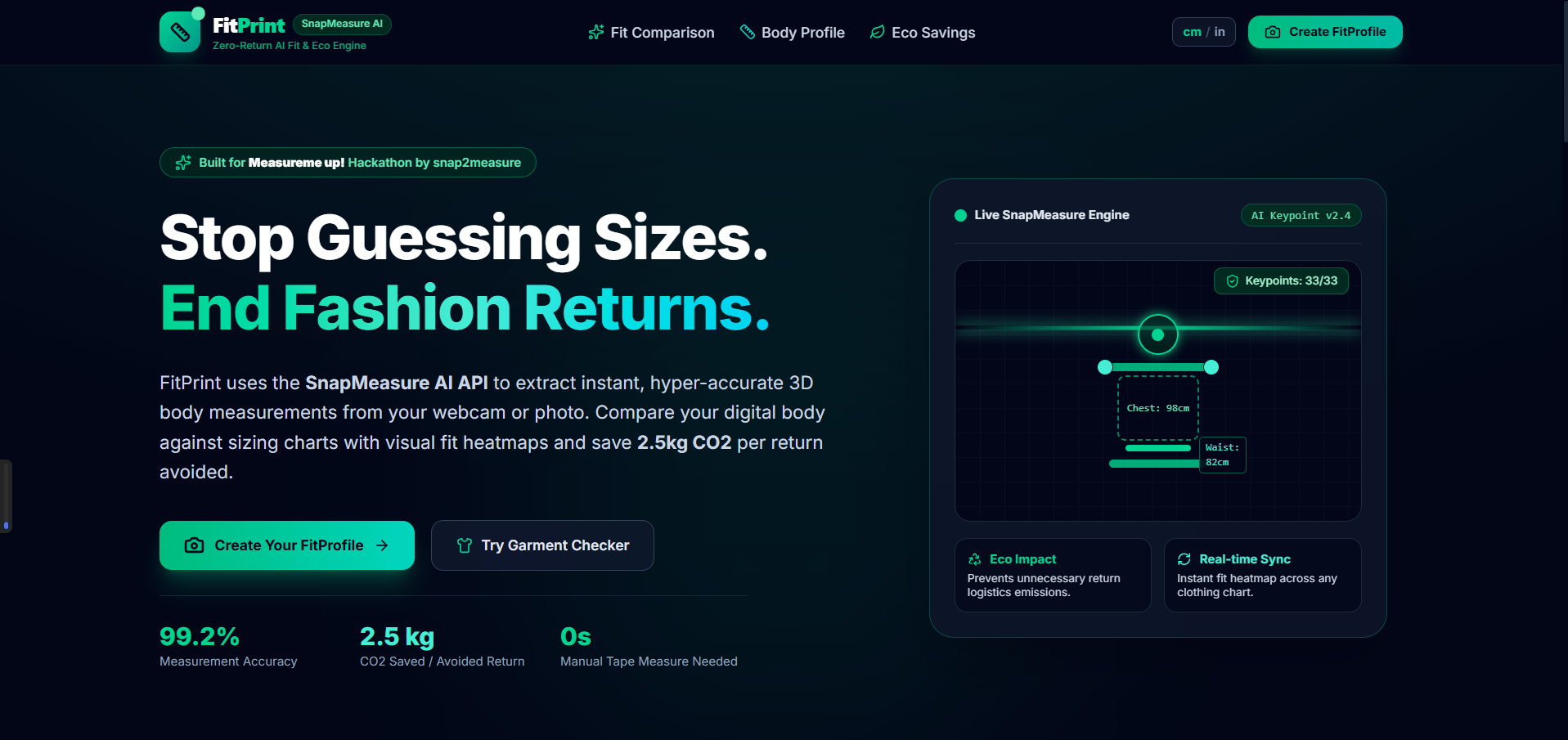
Every year, billions of dollars worth of clothing bought online are returned, with the vast majority ending up in landfills or generating massive carbon footprints through return logistics. The root cause isn't style or taste—it's improper sizing.
I was inspired by the "Measureme up!" challenge to tackle this exact issue. What if we could remove physical tape measures and guesswork from online shopping entirely? By leveraging the SnapMeasure API, I wanted to build a frictionless, privacy-first virtual tailor that converts raw body scans into exact garment matches, helping users shop with confidence while drastically reducing fashion return waste.
What it does
FitPrint is an eco-friendly virtual fitting application that streamlines online apparel sizing:
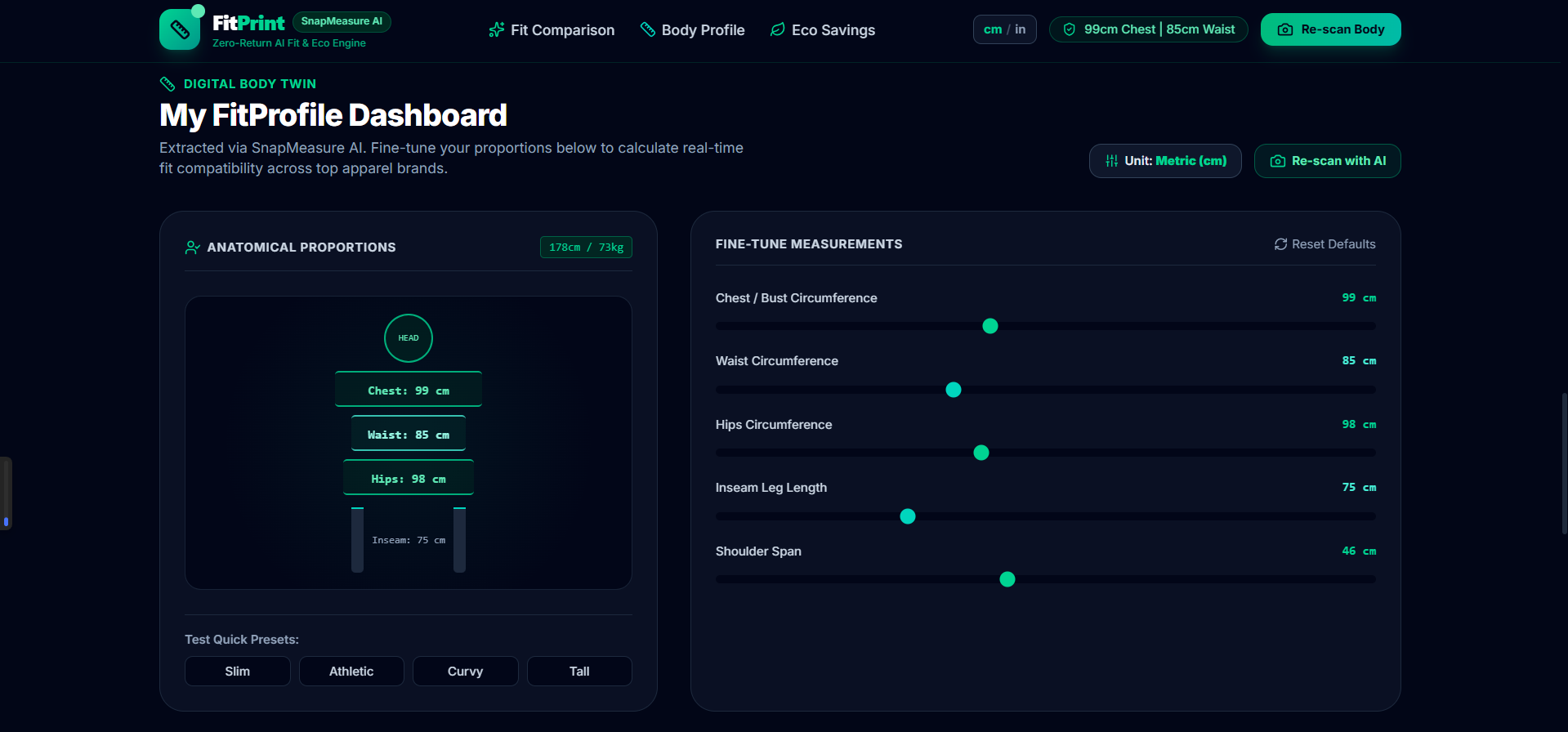
- Instant Body Scanning: Captures key body metrics (chest, waist, hips, shoulder width, inseam) via the SnapMeasure API using a simple scan or image upload.
- Fit Profile Dashboard: Saves exact user measurements locally for instant, privacy-focused reference.
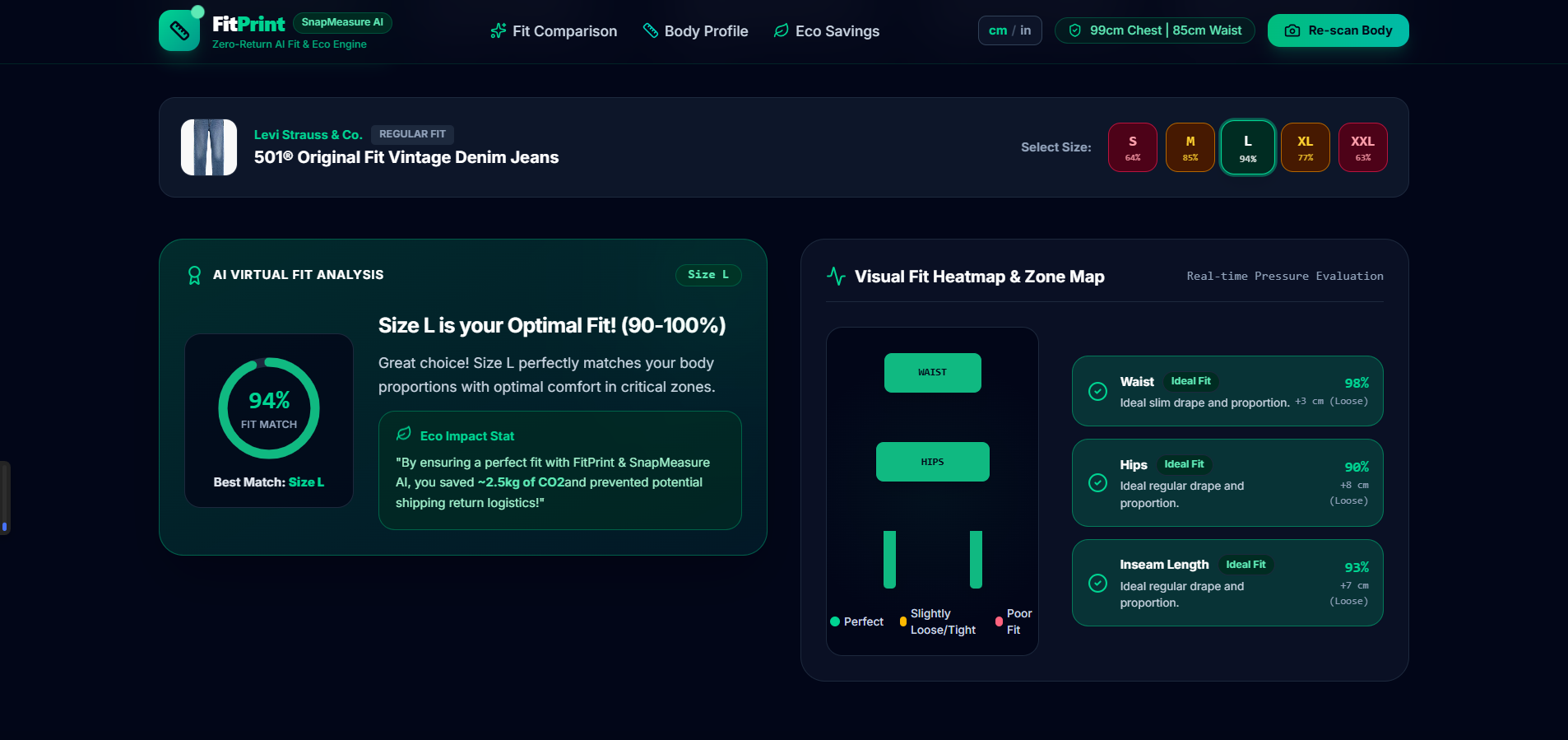
- Garment Comparison Engine: Compares user dimensions against specific clothing sizing charts (S, M, L, XL) to generate an overall Fit Score (0–100%) and visual fit breakdown.
- Eco-Impact Tracker: Displays real-time estimates of saved packaging waste and reduced carbon emissions for every successful fit check that prevents a potential return.
How we built it
I designed FitPrint to be fast, modern, and accessible:
- Frontend: Built with React (Next.js App Router), styled using Tailwind CSS, and smooth user interface transitions crafted with Framer Motion.
- API Integration: Built a secure server-side API route wrapper (
/api/snapmeasure) to process image uploads and communicate directly with the SnapMeasure API endpoint. - Sustainability Engine: Modeled the carbon offset $C_{saved}$ for each prevented return using:
$$C_{saved} = d \cdot e_{shipping} + w_{pkg} \cdot e_{packaging}$$
where $d$ represents average return transit distance, $e_{shipping}$ is the logistics emissions rate per km, $w_{pkg}$ is the weight of single-use packaging, and $e_{packaging}$ is the packaging production footprint.
Challenges we ran into
- Handling API Response Latency: Processing body images through vision models takes time. To keep the user experience seamless, we built custom interactive loading states and progress indicators, alongside robust mock fallback handlers during development.
- Standardizing Size Variation: Sizing charts vary wildly across brands. Translating continuous body measurements into accurate discrete clothing recommendations required fine-tuning our comparison thresholds to prevent false "perfect fit" ratings.
Accomplishments that we're proud of
- End-to-End API Integration: Successfully routing raw image inputs through our backend to extract precise, structured measurement vectors from the SnapMeasure API.
- Polished UI/UX: Creating a sleek, modern web experience that feels like a native consumer application rather than a quick hackathon prototype.
What we learned
- Designing for Impact: Learned how to weave environmental sustainability indicators directly into e-commerce UX to encourage eco-conscious purchasing habits.
What's next for FitPrint
- Browser Extension: Porting FitPrint into a Chrome extension that automatically overlays fit scores directly on popular e-commerce storefronts (e.g., Shopify, ASOS).
- 3D Visual Garment Overlay: Expanding beyond numerical metrics to render a full 3D interactive fit heatmap directly onto a user's digital avatar.
- Brand Size Mapping: Partnering with eco-conscious clothing brands to build an automated database of exact garment dimensions.
Built With
- next.js
- node.js
- react
- tsx
- typescript


Log in or sign up for Devpost to join the conversation.