-
-
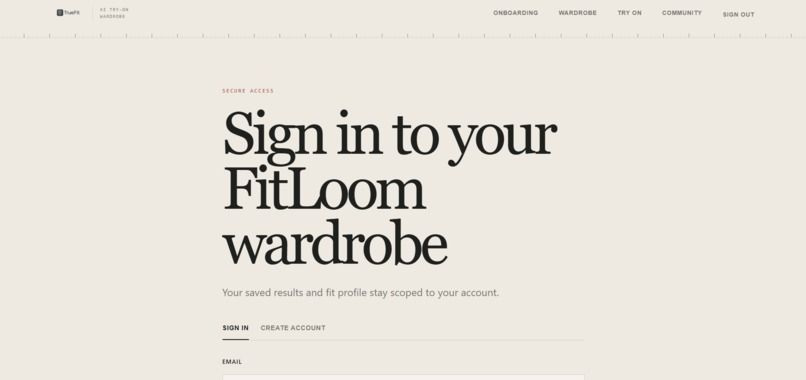
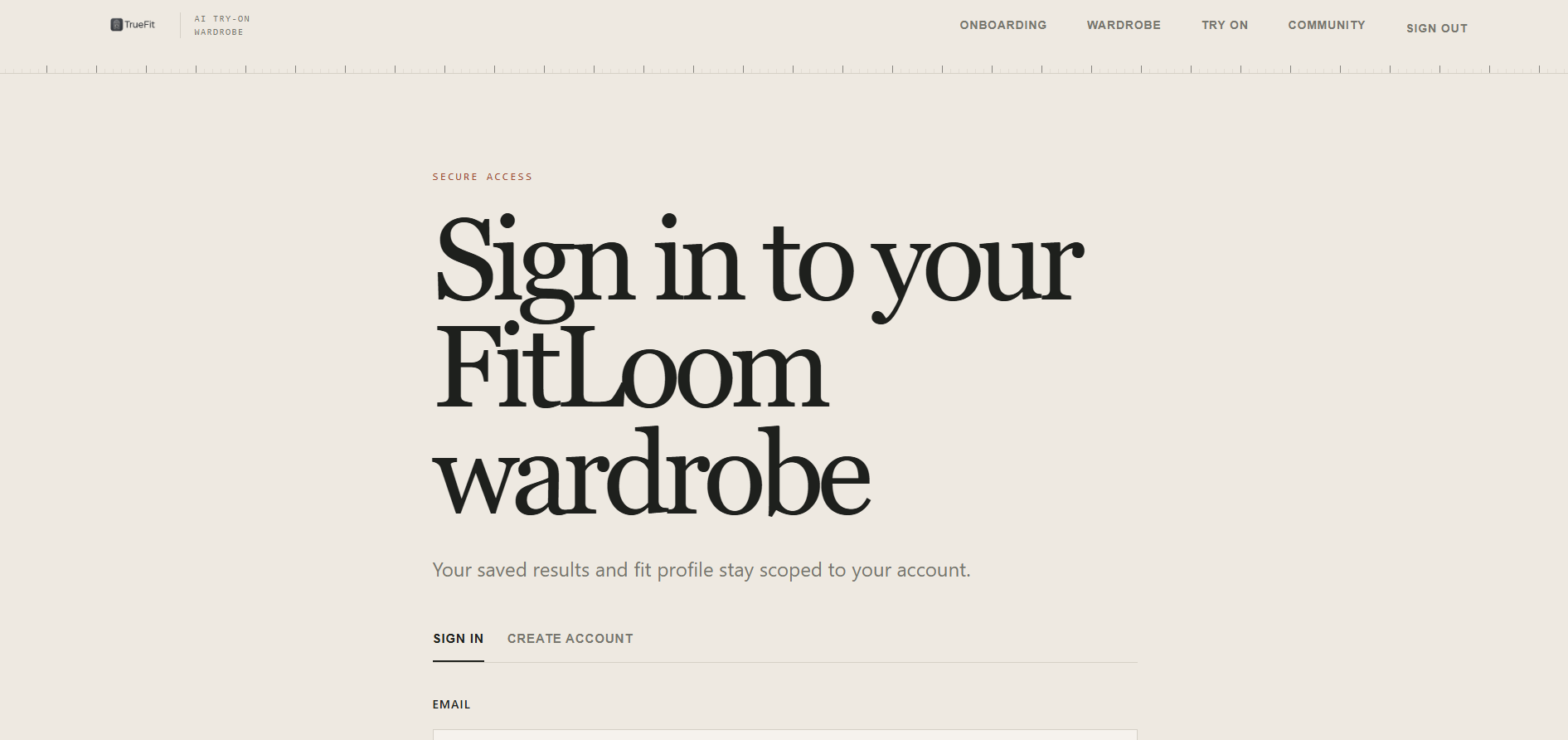
Sign In page
-
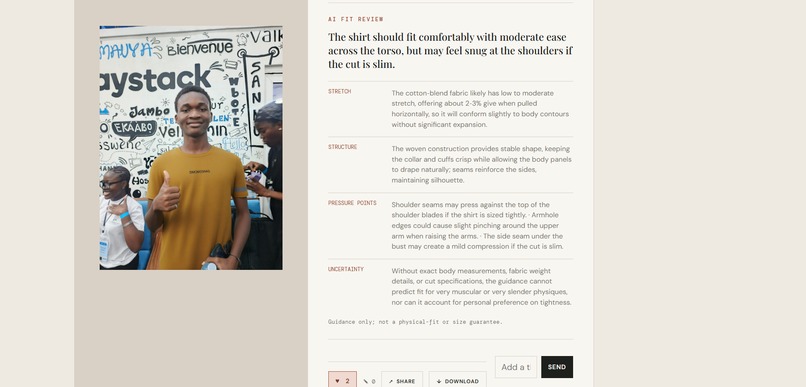
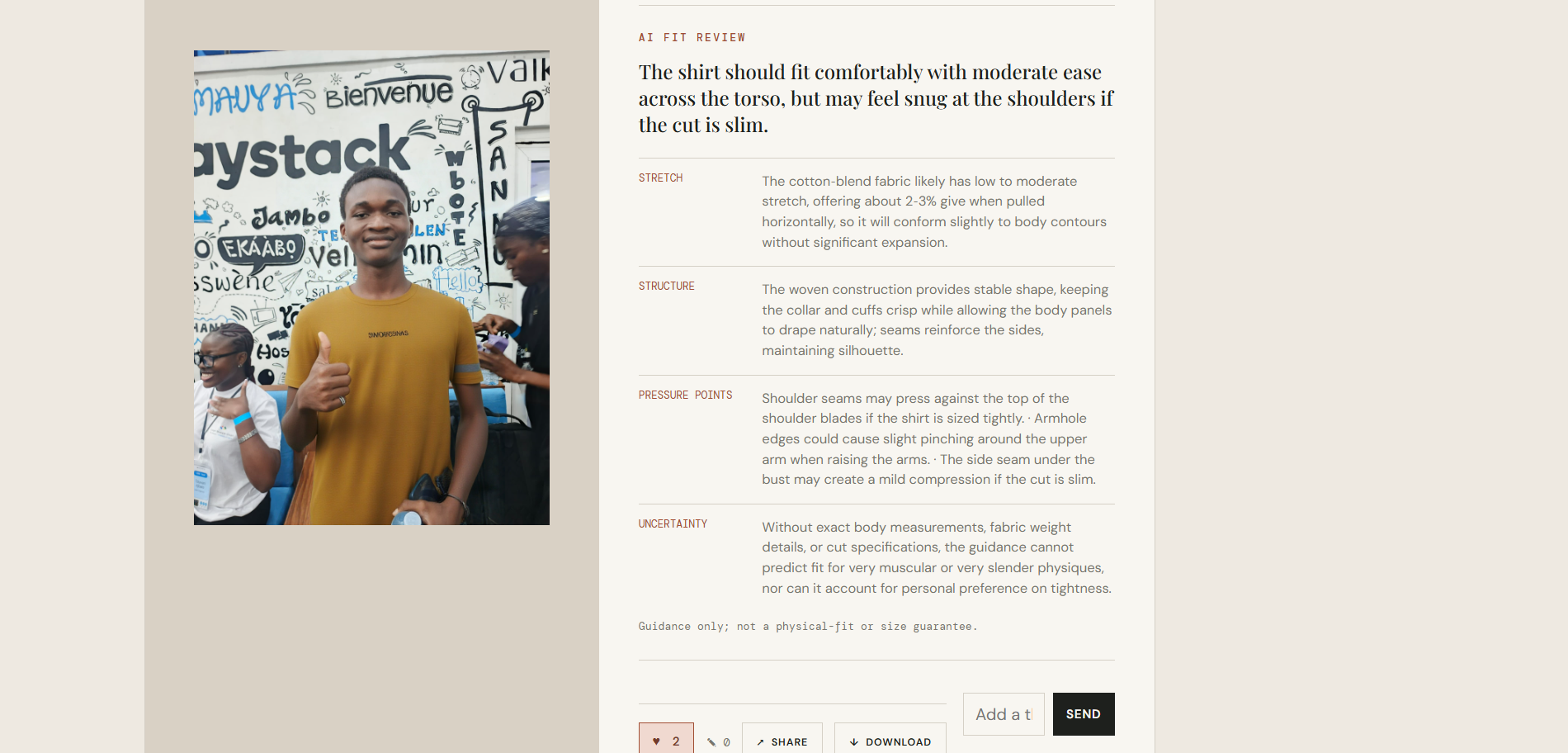
Community Page Screenshot
Inspiration
Buying clothes online should feel exciting, not uncertain.
The idea for FitLoom started with something surprisingly ordinary. My dad ordered a shirt online, waited several days for it to arrive, and when it finally did, it wasn’t what he expected. The size looked right on paper, but the fit was completely off. The fabric felt different from the product photos, the shirt didn’t sit properly on his body, and returning it meant paying additional shipping fees and waiting even longer to find a replacement.
What should have been a five-minute purchase became days of frustration.
As we looked into the problem, we discovered that his experience wasn’t unusual it reflected one of the biggest challenges in fashion e-commerce. Millions of clothing items are returned every year, and the majority aren’t returned because they’re damaged or defective. They’re returned because shoppers couldn’t confidently answer one simple question before clicking Buy Now:
“Will this actually fit me?”
Traditional size charts reduce every body to a handful of measurements, even though two people wearing the same size can have completely different body shapes. Existing virtual try-on solutions improve visualization, but many still leave shoppers guessing how a garment will actually fit. Even more concerning, many require users to upload personal photos without making privacy a first-class part of the experience.
That led us to ask a question that shaped the entire project:
Can we help people shop with confidence without asking them to sacrifice their privacy?
FitLoom is our answer.
Rather than simply recommending a size or generating an AI image, FitLoom combines realistic virtual try-on with explainable fit analysis to help shoppers understand why a garment is expected to fit the way it does. At the same time, we designed privacy as a core architectural principle instead of an afterthought. User images are processed only with explicit consent, exist only for the lifetime of a request by default, and are never permanently stored unless the user intentionally chooses to save them.
Our goal isn’t just to reduce returns.
It’s to make online fashion shopping feel as confident, trustworthy, and informed as trying on clothes in a physical store while giving users complete control over their personal data.
What it does
FitLoom is a privacy-first AI shopping assistant that helps people answer the biggest question in online fashion before they make a purchase:
“Will this actually fit me?”
Instead of relying on generic size charts or static product photos, FitLoom combines realistic virtual try-on with explainable AI to help shoppers understand not only how a garment looks on their body, but also how it’s expected to fit.
The experience begins where people already shop. Through our Chrome Extension, FitLoom detects supported clothing items directly on participating e-commerce websites and launches a virtual try-on without requiring users to leave the page or interrupt their shopping journey.
After a user provides consent, FitLoom generates a realistic visualization of the selected garment using Perfect Corp’s AI virtual try-on technology. But we wanted to go beyond simply showing an image.
Most virtual try-on platforms answer one question:
“How do I look?”
FitLoom answers the question shoppers care about just as much:
“How will this actually fit?”
Every try-on is accompanied by a Fit-Physics Note, an AI-generated explanation that describes how the garment is expected to behave on the user’s body. Rather than producing generic fashion commentary, FitLoom explains practical details such as expected stretch, structure, drape, overall silhouette, and potential pressure points. This gives shoppers meaningful context before purchasing instead of leaving them to interpret an image on their own.
Trust is just as important as accuracy.
Because virtual try-on requires personal photos, privacy is built into every stage of the experience. Images are processed only after explicit user consent and, by default, exist only in memory during processing. They are never permanently stored unless the user intentionally chooses to save a try-on to their personal wardrobe.
To further protect users, every uploaded image and every AI-generated result is automatically moderated with Google Cloud Vision SafeSearch before being displayed, helping ensure that the experience remains safe and appropriate.
FitLoom is built around three connected experiences that work together seamlessly:
• Chrome Extension – Detects supported garments on participating fashion websites and launches a virtual try-on directly from the product page, allowing shoppers to stay within their existing browsing experience.
• Next.js Web Application – Handles user onboarding, authentication, privacy consent, and a personal wardrobe where users can optionally save and revisit previous try-ons.
• Express + TypeScript API – Securely orchestrates AI image generation, moderation, authentication, and Fit-Physics Note generation while maintaining a privacy-first processing pipeline.
FitLoom currently supports T-shirts, shirts, hoodies, jackets, and other outerwear, with future support planned for pants, dresses, skirts, shoes, and complete outfit visualization.
Our goal isn’t simply to generate realistic AI images.
It’s to help shoppers make confident purchasing decisions, reduce unnecessary returns, protect their privacy, and bring more trust to online fashion shopping.
How we built it
We designed FitLoom around a simple principle:
Privacy should be part of the architecture and not something added later.
Rather than treating virtual try-on as a single AI request, we built FitLoom as three connected applications coordinated by a secure backend. Each component has a specific responsibility, allowing the platform to remain modular, scalable, and privacy-first from end to end.
• Chrome Extension — Bringing virtual try-on to where people already shop
Most virtual try-on platforms ask shoppers to leave the retailer’s website, upload an image somewhere else, and then return to complete their purchase. We wanted to eliminate that extra friction.
Our Manifest V3 Chrome Extension detects supported garments directly on participating e-commerce websites, allowing shoppers to launch a virtual try-on without interrupting their browsing experience. After confirming the selected garment and granting consent, users receive a side-by-side comparison of the original product and their AI-generated try-on, all while staying close to the shopping experience they already know.
• Next.js Web Application — User identity, consent, and personal wardrobe
The web application serves as the control center for FitLoom.
Built with Next.js, it manages user authentication through Supabase, onboarding, privacy consent, and a personal wardrobe where users can optionally save and revisit previous try-ons.
We intentionally separated permanent user data from temporary AI processing. Saving a try-on is always an explicit user decision, giving people full control over what becomes part of their wardrobe and what disappears after processing.
• Express + TypeScript API — The orchestration layer
At the heart of FitLoom is an Express + TypeScript API that coordinates every stage of the virtual try-on pipeline.
Rather than acting as a simple backend, the API orchestrates authentication, AI image generation, image moderation, Fit-Physics Note generation, and secure communication between all integrated services.
This orchestration layer ensures that each request follows the same privacy-first workflow before any result reaches the user.
Privacy-first image processing
Handling personal photos responsibly was one of the most important architectural decisions we made.
By default, uploaded images exist only in memory while a request is being processed. They are never written to disk or permanently stored unless the user explicitly chooses to save the completed try-on to their personal wardrobe.
This approach minimizes unnecessary data retention while giving users complete ownership over their personal images.
AI-powered virtual try-on
To generate realistic clothing visualizations, FitLoom integrates Perfect Corp’s YouCam Virtual Try-On technology.
Instead of attempting to build our own image generation pipeline from scratch, we focused on building the surrounding experience privacy, orchestration, safety, and explainability while leveraging a production-grade AI model for high-quality virtual try-on rendering.
Explainable fit with AI
Generating a realistic image is only part of the shopping decision.
After each successful try-on, FitLoom generates a Fit-Physics Note using Groq-powered AI. Rather than receiving raw images or unnecessary personal information, the model receives only approved garment metadata and the minimum user profile information required to explain how the garment is expected to fit.
By intentionally minimizing the information shared with the language model, we preserved user privacy while still producing meaningful explanations about stretch, drape, structure, silhouette, and potential pressure points.
Automated safety moderation
Trust extends beyond privacy.
Every uploaded image and every AI-generated result passes through Google Cloud Vision SafeSearch before it is shown to the user. This additional moderation layer helps ensure that inappropriate or unsafe content is filtered automatically, creating a safer experience for everyone using the platform.
Data management with Supabase
Supabase powers authentication, database management, and secure storage for users who choose to save their try-ons.
Importantly, permanent storage is never the default behavior. Images and generated results become part of a user’s wardrobe only after explicit consent through the Save action, reinforcing FitLoom’s privacy-first philosophy throughout the entire product.
Throughout development, every major technical decision was guided by the same question:
How can we deliver an intelligent virtual try-on experience while giving users complete control over their personal data?
The result is a platform where AI, privacy, and user experience work together instead of competing with one another.
Challenges we ran into
Building FitLoom wasn’t simply about integrating AI services, it was about balancing three priorities that often compete with one another: user experience, privacy, and reliability.
Every major challenge forced us to rethink part of the system, and in many cases, those obstacles ultimately led to stronger engineering decisions.
Designing a privacy-first virtual try-on pipeline
Virtual try-on inherently requires users to upload personal photos, making privacy one of the most important technical challenges we faced.
Our initial focus wasn’t just generating realistic results it was ensuring that users remained in control of their personal data throughout the entire experience.
This led us to redesign the processing pipeline around explicit consent. Images are processed only after user approval, exist only for the lifetime of the request by default, and are never permanently stored unless a user intentionally saves a completed try-on to their personal wardrobe.
Treating privacy as an architectural requirement rather than a feature significantly influenced how every other part of the platform was built.
Going beyond image generation
A realistic AI image alone doesn’t solve the uncertainty of online shopping.
We wanted FitLoom to explain why a garment would fit the way it does, not simply show what it might look like.
Building the Fit-Physics Note required extensive experimentation with prompt engineering and AI outputs to consistently produce practical, actionable insights about garment structure, stretch, drape, silhouette, and pressure points instead of generic fashion descriptions.
Finding the right balance between technical accuracy and user-friendly language took far more iteration than we initially expected.
Integrating multiple AI services into one seamless workflow
FitLoom relies on several independent services that each play a different role in the user journey.
Coordinating authentication, virtual try-on generation, image moderation, and AI-generated fit explanations into a single, reliable workflow required careful orchestration to ensure each stage completed successfully before the next began.
Rather than treating these services as isolated integrations, we designed the backend to coordinate them as one continuous privacy-first pipeline.
Working with third-party tooling
Integrating external AI platforms introduced challenges beyond the code itself.
During development, the YouCam documentation portal proved significantly more resource-intensive than expected, slowing local development and increasing the time required to test and validate integrations.
Although this impacted development speed, it encouraged us to improve our testing workflow and better isolate integration issues as we built the platform.
Development environment constraints
Part of our development environment restricted package installation because of npm registry permission (403) policies.
Instead of allowing this to halt progress, we adapted our workflow by validating dependencies, completing builds, and performing type checking within an alternative development environment while maintaining the same codebase.
Although unexpected, this reinforced the importance of building a flexible development process that could continue even when infrastructure limitations appeared.
Every challenge ultimately reinforced the same lesson:
Building an AI product isn’t just about selecting the right models. It’s about designing an end-to-end system where privacy, reliability, user experience, and responsible engineering work together to create a product people can trust.
Accomplishments that we’re proud of
We’re proud that FitLoom grew beyond a virtual try-on demo into a product designed around a real problem people experience every day. Every major feature was built with the same goal: helping shoppers make confident purchasing decisions while respecting their privacy.
Building privacy into the foundation instead of adding it later
One of our biggest accomplishments was treating privacy as a product feature, not a legal requirement.
From the beginning, we designed FitLoom around explicit user consent. Images are processed only after approval, exist only in memory during processing by default, and are never permanently stored unless a user intentionally saves a completed try-on to their personal wardrobe.
Rather than asking users to simply trust us, we wanted the architecture itself to earn that trust.
Turning virtual try-on into decision support
Most virtual try-on experiences stop after generating an image.
We wanted to go one step further.
The Fit-Physics Note transforms a visual preview into a practical shopping assistant by explaining how a garment is expected to fit whether it may feel structured or relaxed, how the fabric is likely to drape, where pressure points may occur, and what shoppers can realistically expect before placing an order.
We’re especially proud that FitLoom doesn’t just help users see clothing, it helps them understand it.
Bringing the experience directly into online shopping
Instead of building another standalone fashion platform, we chose to integrate FitLoom into the shopping journey people already have.
Our Chrome Extension allows shoppers to launch a virtual try-on directly from supported product pages, reducing friction and making AI feel like a natural part of online shopping rather than a separate destination.
Building a complete AI pipeline, not just an AI feature
FitLoom combines multiple services including virtual try-on generation, image moderation, authentication, secure data management, and AI-powered fit explanations into a single seamless workflow.
Successfully orchestrating these components into one reliable, privacy-first experience was one of the most rewarding engineering achievements of the project.
Designing for trust as much as intelligence
We’re proud that every major technical decision was driven by the user experience rather than the technology itself.
Automatic image moderation helps create a safer platform, explicit consent gives users meaningful control over their personal data, and explainable AI provides context instead of asking shoppers to blindly trust an algorithm.
Together, these decisions reflect the product we set out to build: one that is intelligent, transparent, and worthy of user confidence.
Ultimately, our greatest accomplishment isn’t simply building an AI-powered virtual try-on platform.
It’s demonstrating that privacy, explainability, and great user experience can coexist in a product designed to make online fashion shopping more confident, more transparent, and more trustworthy.
What we learned
Building FitLoom taught us that creating a successful AI product is about far more than integrating powerful models. The real challenge lies in designing an end-to-end system where intelligence, privacy, and user trust reinforce one another.
AI is only as strong as the system surrounding it
We quickly learned that delivering a reliable virtual try-on experience depends on much more than choosing the right AI model.
Image validation, moderation, secure request handling, data flow, and orchestration all play a critical role in the quality of the final experience. Even small implementation details such as how image data is transmitted between services or how requests are validated before reaching downstream APIs can significantly impact reliability.
A well-designed pipeline proved just as important as the AI itself.
Explainability creates confidence
One of our biggest realizations was that shoppers don’t just want predictions they want understanding.
A realistic virtual try-on image helps users visualize an outfit, but it doesn’t always explain how that garment is expected to fit or why. Developing the Fit-Physics Note showed us that combining AI-generated visualization with clear, human-readable explanations creates a much more trustworthy experience than either approach alone.
We learned that explainability isn’t just valuable in healthcare or finance, it has an important place in consumer products as well.
Privacy can be a competitive advantage
Many AI applications treat privacy as something to address after the product works.
Building FitLoom challenged us to think differently.
By designing around explicit user consent, temporary in-memory processing, and data minimization from the very beginning, we discovered that privacy-first engineering doesn’t restrict innovation, it strengthens it. Giving users greater control over their personal data ultimately made the product feel more trustworthy and intentional.
User experience extends beyond the interface
Before this project, we often associated user experience with visual design.
FitLoom taught us that user experience is equally shaped by what happens behind the scenes: how quickly a request completes, how clearly AI decisions are explained, how safely personal information is handled, and how confidently users feel while interacting with the platform.
Some of the most meaningful UX improvements came from architectural decisions rather than interface changes.
Building responsibly requires balancing trade-offs
Every major feature forced us to balance competing priorities: realism versus privacy, intelligence versus simplicity, and innovation versus user trust.
Those trade-offs taught us that building impactful AI products isn’t about maximizing the number of features. It’s about making thoughtful engineering decisions that align with real user needs and long-term trust.
More than anything, FitLoom reinforced our belief that the future of AI-powered shopping isn’t defined solely by smarter models it’s defined by products that are transparent, privacy-conscious, and genuinely designed to help people make better decisions.
What’s next for FitLoom
We’re building FitLoom with a long-term vision: making online fashion shopping as confident, personalized, and trustworthy as trying on clothes in a physical store without compromising user privacy.
Our goal isn’t simply to generate better virtual try-ons. We want FitLoom to become the intelligence layer that helps shoppers make better purchasing decisions while helping retailers reduce costly returns and build greater customer confidence.
• Smarter personalization
Our next milestone is making FitLoom increasingly personalized over time.
Rather than relying solely on standard size charts, we plan to learn from each user’s body profile, previous try-ons, and saved wardrobe to deliver increasingly accurate recommendations across different brands.
We’re also exploring Brand Size Normalization, allowing shoppers to receive personalized recommendations even when sizing varies dramatically between retailers. Instead of guessing whether a Medium in one brand matches a Large in another, FitLoom will translate those differences into recommendations tailored to the individual.
• Richer virtual try-on experiences
We’re expanding beyond single-garment previews to create a more complete shopping experience.
Future updates will introduce multi-angle visualizations, allowing shoppers to view garments from the front, side, and back, followed by complete outfit generation that combines tops, bottoms, shoes, and accessories into a single virtual look.
Alongside these visual improvements, we plan to introduce a Fit Confidence Score that combines garment characteristics, body measurements, and historical fit data to provide an easy-to-understand confidence rating before every purchase.
• AI shopping companion
We believe AI should become a long-term shopping assistant rather than a one-time tool.
Our roadmap includes an AI Wardrobe Assistant capable of remembering saved try-ons, recommending outfits based on existing clothing, suggesting complementary pieces, and helping users prepare looks for specific occasions, weather conditions, color preferences, and personal style.
We’re also exploring Smart Fabric Intelligence, enabling FitLoom to predict how different materials are likely to stretch, drape, wrinkle, or shrink over time helping shoppers understand far more than a traditional product description can provide.
• Learning from the community while protecting privacy
Shopping decisions often become easier when people can learn from others with similar experiences.
We’re exploring Community Fit Insights, allowing users to anonymously share fit feedback with others who have similar body profiles. This would provide additional confidence while preserving user privacy and maintaining complete control over personal information.
• Bringing FitLoom to more platforms
Our vision extends beyond a browser extension.
We’re planning dedicated iOS and Android applications that allow users to access virtual try-ons, saved wardrobes, personalized recommendations, and AI styling assistance wherever they shop.
At the same time, we’re developing a Retailer Integration API so fashion brands and e-commerce platforms can embed FitLoom directly into their own product pages, helping retailers reduce return rates while giving customers greater confidence before checkout.
• Measuring fashion’s environmental impact
Every avoided return represents more than a saved purchase it also reduces unnecessary shipping, packaging waste, and carbon emissions.
We’re developing a Sustainability Dashboard that helps users understand the positive environmental impact of shopping with greater confidence, reinforcing the connection between better purchasing decisions and more sustainable e-commerce.
Ultimately, we envision FitLoom becoming more than a virtual try-on platform.
We see it evolving into a trusted AI shopping companion that empowers consumers to buy with confidence, enables retailers to reduce costly returns, and helps shape a future where fashion e-commerce is more intelligent, more transparent, and more sustainable for everyone.
Built With
- chrome
- express.js
- googlecloudvision
- groq
- next.js
- supabase
- tensorflow
- typescript
- youcam


Log in or sign up for Devpost to join the conversation.