Inspiration
In fast-paced environments like customer service, sales, and team collaboration, the efficiency and quality of real-time communication are paramount. We observed that manually analyzing call content, identifying key information, and providing immediate feedback is a time-consuming and error-prone task. LiveAssist-AI draws its inspiration from this, aiming to leverage advanced AI technologies to provide businesses and individuals with a powerful real-time call analysis and assistance tool, thereby enhancing communication efficiency and optimizing decision-making processes.
What it does
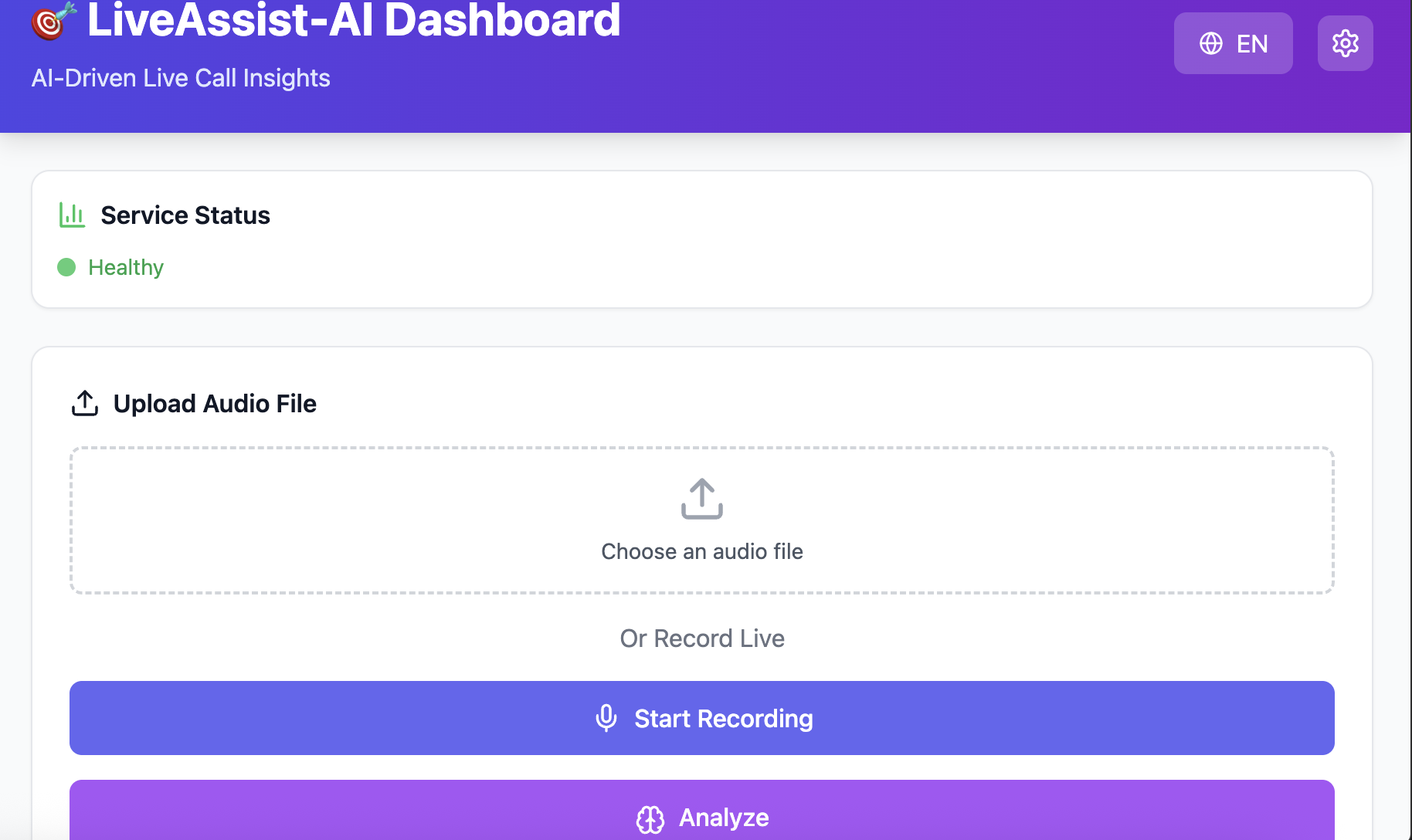
LiveAssist-AI is an innovative full-stack application capable of real-time processing and analysis of voice calls, providing instant insights and intelligent assistance. Key features include:
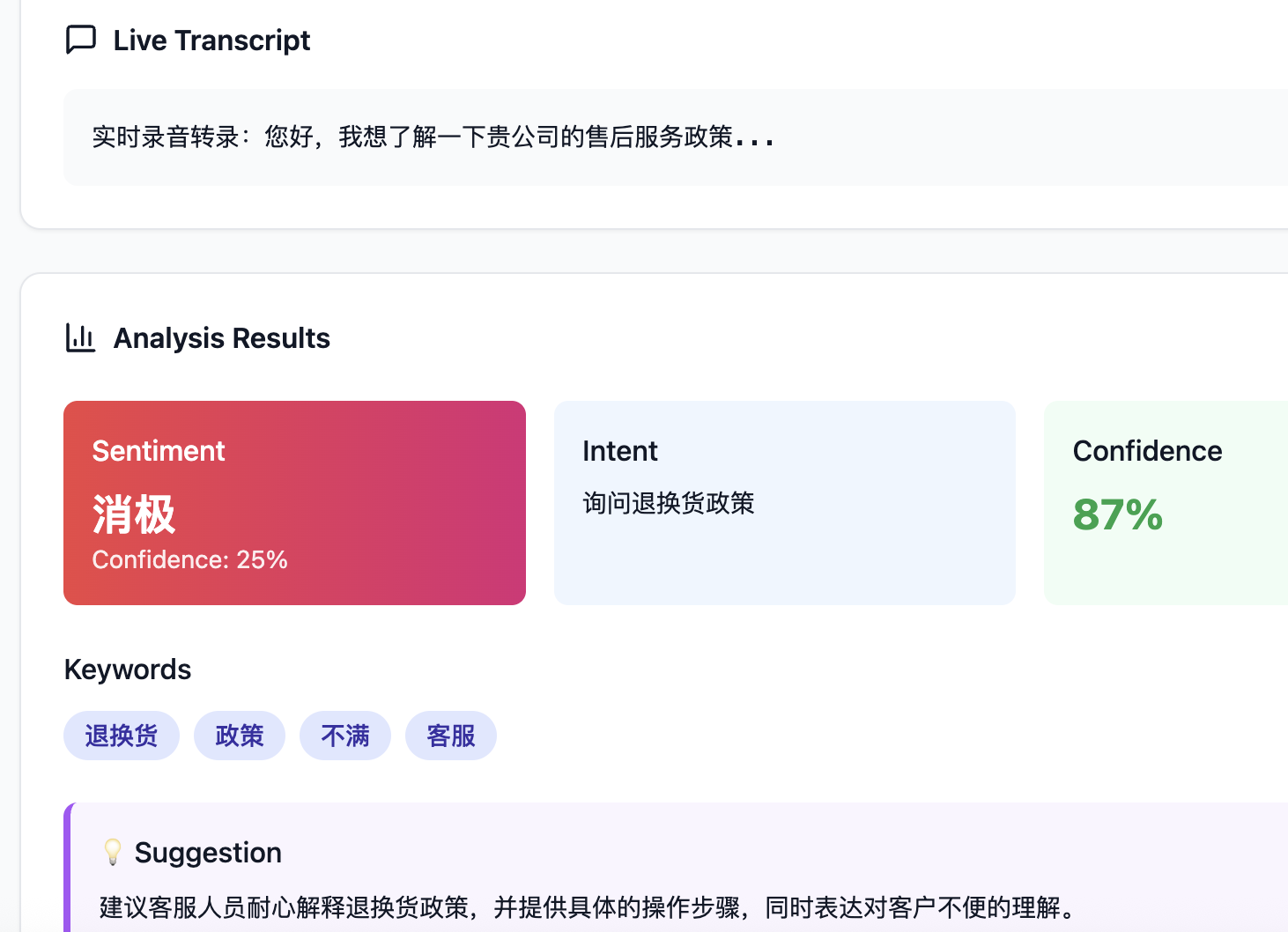
Real-time Speech Transcription: Accurately converts call content into text, supporting multiple languages (e.g., Chinese and English). Sentiment Analysis: Identifies emotions (positive, negative, neutral) within calls, helping users understand the conversation's atmosphere. Keyword Extraction: Automatically identifies and highlights important topics and key phrases in the conversation. Intent Recognition: Analyzes the purpose of the dialogue, such as customer inquiries, complaints, sales intentions, etc. Intelligent Suggestions & Assistance: Provides immediate suggestions, relevant information, or next steps based on real-time analysis results. Call History & Analysis: Saves and allows users to review past calls for in-depth analysis and trend insights. User-Friendly Interface: Displays all analysis results through an intuitive dashboard, supporting audio uploads and real-time recording.
How we built it
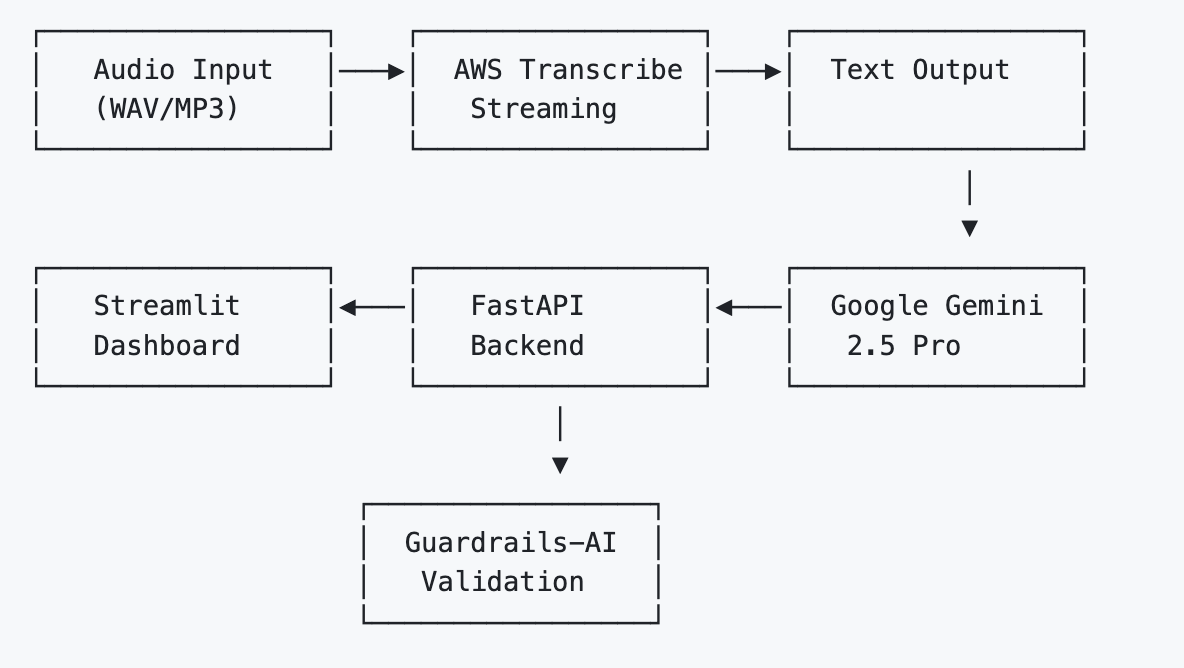
LiveAssist-AI is built with a modern technology stack, ensuring high performance, scalability, and user experience:
Frontend: React: For building dynamic and responsive user interfaces. Tailwind CSS: For rapid and consistent UI styling. Web Audio API: For handling browser-side audio recording and playback. Backend: FastAPI: For building high-performance asynchronous API services, handling voice data and AI model inference requests. Python: For backend logic and integrating AI models. AI/ML Models: Speech Recognition (ASR): Integrates advanced speech-to-text models. Natural Language Processing (NLP): Utilizes pre-trained NLP models for sentiment analysis, keyword extraction, and intent recognition. Deployment & Environment: Docker / Docker Compose: Used for containerizing backend and frontend services, ensuring consistent development and deployment environments. WebContainer: Provides a powerful in-browser development environment, accelerating development iteration.
Challenges we ran into
Real-time Audio Processing and Synchronization: Ensuring stable capture of frontend audio streams, their transmission to the backend for processing, and real-time reception of analysis results while maintaining low latency was a technical challenge. AI Model Integration and Optimization: Seamlessly integrating different AI models (ASR, sentiment analysis, intent recognition) into the FastAPI backend and optimizing their inference speed to meet real-time requirements. Cross-Platform Compatibility: Ensuring a consistent user experience across different browsers and devices. Development Environment Configuration: In specific environments like WebContainer, configuring and running complex Python/Docker applications required a deep understanding of the toolchain.
Accomplishments that we're proud of
Achieved End-to-End Real-time Call Analysis Flow: The entire chain from audio input to intelligent insights has been automated and made real-time. Built an Intuitive and Feature-Rich User Interface: Even complex AI analysis results are presented to users in a clear and understandable manner. Successfully Integrated Multiple Advanced AI Technologies: Combined speech recognition and various NLP tasks within a unified platform. Demonstrated the Potential of Building Complex Applications in a WebContainer Environment: Overcame environmental limitations to successfully deploy a full-stack application.
What we learned
Best practices for real-time data stream processing and WebSocket communication. How to effectively deploy machine learning models as scalable API services. Strategies for efficient data interaction between frontend and backend. Techniques for development and debugging in constrained environments.
What's next for LiveAssist-AI
Integrating More AI Features: Such as automatic call summarization, action item identification, speaker diarization, etc. User-Customizable Models: Allowing users to upload their own data to train or fine-tune domain-specific AI models. Third-Party Integrations: Integrating with CRM systems, conferencing platforms, etc., to expand application scenarios. Mobile Support: Developing native mobile applications for a more convenient experience. Performance Optimization: Further enhancing the responsiveness and accuracy of real-time processing.
Built With
- asr)
- docker
- fastapi
- google-gemini
- javascript
- python
- react
- tailwind
- webcontainer

Log in or sign up for Devpost to join the conversation.