-
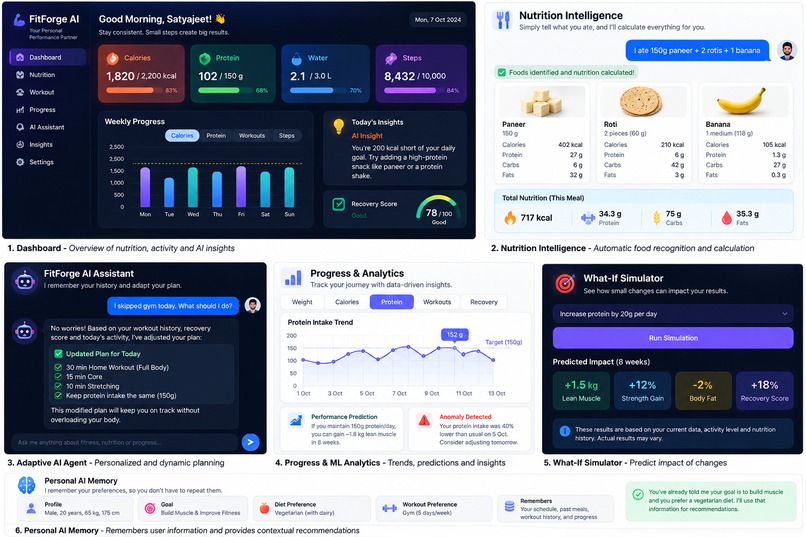
FitForge AI — Adaptive nutrition, training, recovery, ML analytics, and personalized performance insights.
Inspiration
Fitness and wellness apps often provide generic plans and repeatedly ask users for the same information. We wanted to build something different: an intelligent system that remembers a user's history, understands their current intent, and continuously adapts to their changing needs.
What We Built
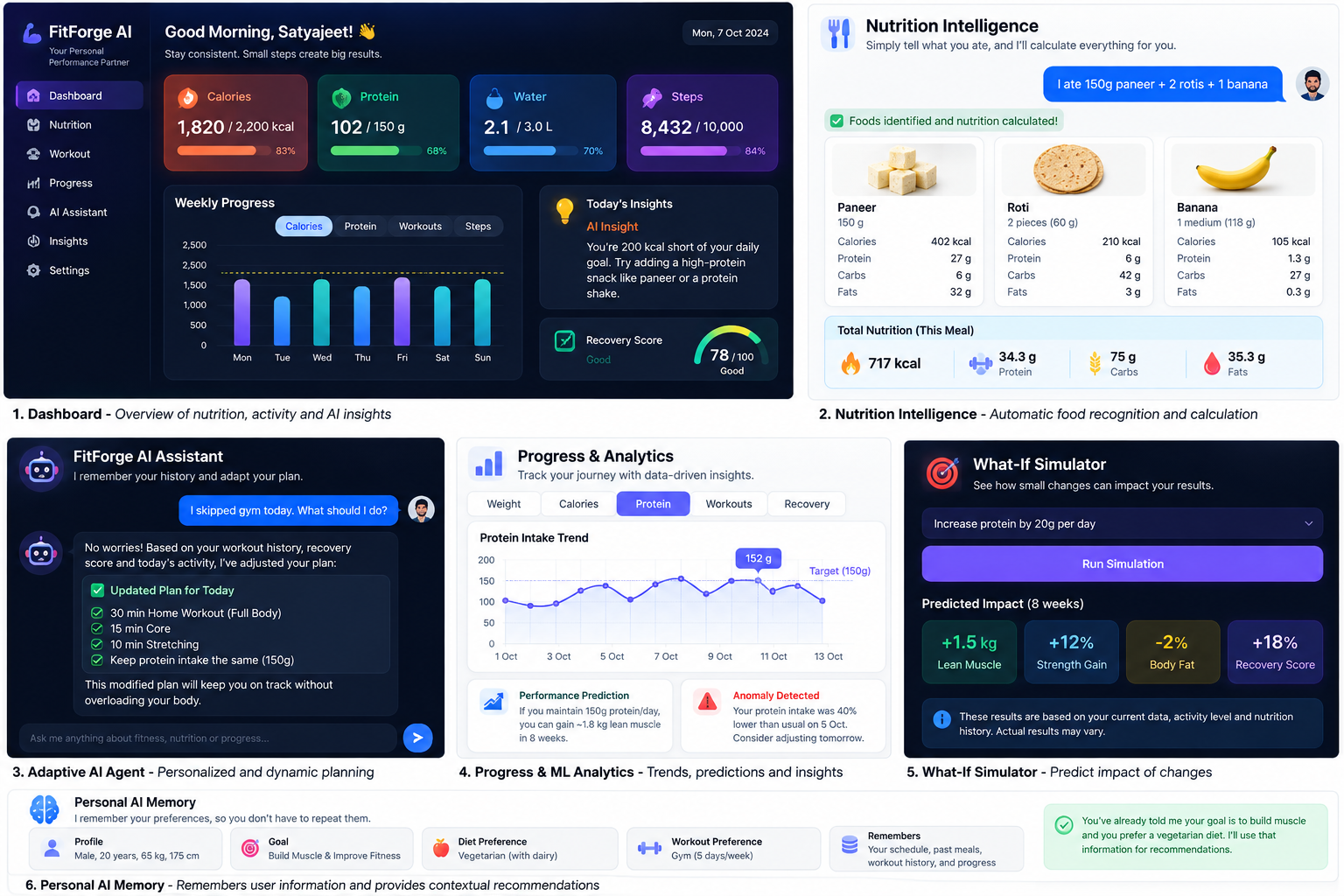
FitForge AI is an agentic personal performance intelligence system that combines AI agents, machine learning, nutrition intelligence, training analysis, and recovery tracking. Users can interact through natural language or dynamic UI cards instead of filling long forms.
The system remembers stable information such as goals, preferences, and profile data, while continuously learning from dynamic data such as meals, workouts, sleep, recovery, and progress.
For example, a user can enter 150g paneer + 2 rotis, and FitForge automatically identifies the foods, resolves spelling variations, calculates calories and protein, and updates the user's daily nutrition history. If a user says, I skipped the gym today, the system analyzes their existing schedule, training history, and recovery data before adapting the plan.
How We Built It
The architecture uses a central intent and relevance layer connected to specialized agents for nutrition, training, recovery, and progress. Machine learning models are used for performance prediction, trend analysis, and anomaly detection, while deterministic calculations handle nutrition values.
We used React for the interactive frontend and Python/FastAPI for the backend, with Pandas, NumPy, and Scikit-learn for data processing and ML. A structured nutrition database and persistent user history provide the foundation for personalization.
Challenges
One of the biggest challenges was making the system genuinely adaptive rather than creating a simple chatbot with predefined responses. We designed a relevance engine that determines what information is actually needed and prevents repetitive questions.
Another challenge was combining LLM reasoning with reliable numerical calculations. Instead of allowing AI to guess nutrition values or statistics, we separated language understanding from deterministic data processing.
What We Learned
Building FitForge AI taught us how to combine agentic workflows, machine learning, structured data, and adaptive user interfaces into one system. We learned that effective AI applications are not just about generating answers—they should remember context, use reliable data, make decisions, and continuously adapt based on user feedback and history.
Built With
- fastapi
- llm
- machine-learning
- multi-agent-ai
- natural-language-processing
- numpy
- pandas
- python
- react
- rest
- scikit-learn
- sqlite

Log in or sign up for Devpost to join the conversation.