Inspiration
Fitness apps often assume a Western food database, constant internet access, generic routines, and paid cloud AI. That leaves many Pakistani users manually estimating meals such as biryani, daal, roti, karahi, and chai while switching between separate apps for coaching, routines, workout tracking, and calculators.
FitDesi AI was built around a simple product vision: one private, culturally relevant Android companion that helps users decide what to eat, how to train, and how to stay consistent—even without a paid AI API or reliable internet connection.
The pain point
The people FitDesi AI is designed for face several connected problems:
- Pakistani meals are poorly represented in many mainstream calorie databases.
- Generic workout plans do not account for available equipment, experience, goals, or schedule.
- Fitness guidance is fragmented across food trackers, note apps, workout timers, calculators, and chatbots.
- Cloud-dependent coaching can introduce cost, privacy, latency, and connectivity barriers.
- Many fitness apps show impressive dashboards but fail to preserve real user routines, sessions, and progress reliably.
What FitDesi AI does
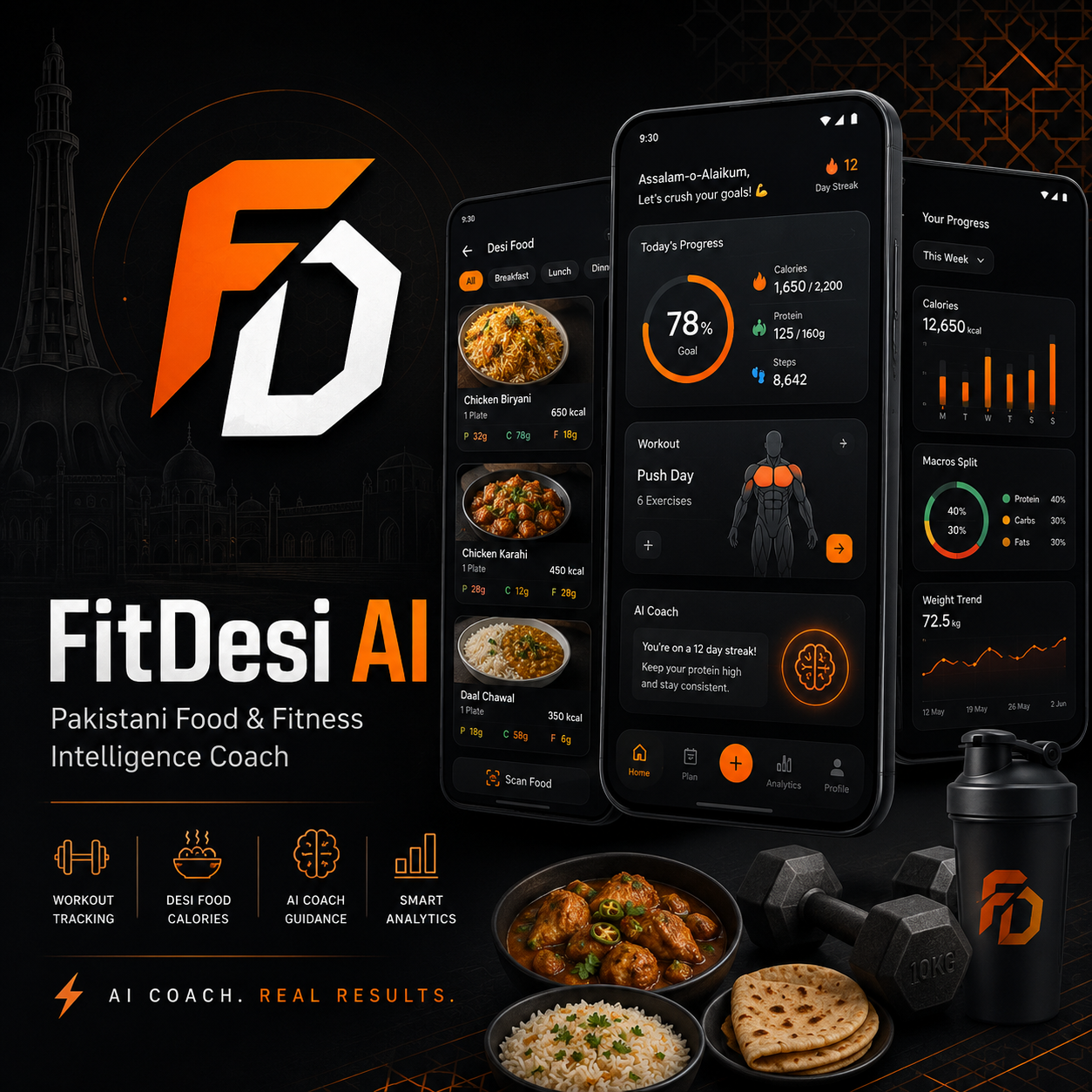
FitDesi AI is a native Android fitness and nutrition product that combines:
- a deterministic offline AI Coach;
- personalized workout and diet guidance;
- Build Routine and multiple saved routines;
- active workout tracking;
- workout history and progress analytics;
- Pakistani food calorie and macro tracking;
- persistent calorie logs;
- Macro Calculator;
- One-Rep-Max Calculator;
- profile-based recommendations;
- light and dark themes;
- a polished, submission-ready Android experience.
The core demo runs locally and does not require a paid model API key.
Product vision
FitDesi AI aims to become a localized personal fitness operating system for users who are underserved by generic global fitness products.
The long-term product is not just a calorie counter or workout generator. It is a unified health-and-training companion that can connect a user's profile, goals, food choices, workout history, available equipment, recovery signals, and progress into one understandable daily experience.
The product can eventually serve:
- beginners who need safe structure;
- home-workout users with limited equipment;
- gym users tracking progressive overload;
- Pakistani users seeking culturally relevant nutrition data;
- privacy-conscious users who prefer local-first tools;
- users in regions where paid subscriptions and reliable connectivity are barriers.
Key features
Offline AI Coach
The Coach provides structured local guidance for workout planning, diet questions, exercise selection, progress, and safety-aware fitness support. It uses deterministic offline logic in the submitted APK, so the main judging path works without credentials or remote model access.
Pakistani Food Tracker
Users can search and log culturally relevant foods rather than translating every meal into approximate Western equivalents. The experience supports calorie and macro awareness with persistent daily logging.
Build Routine and saved plans
Users can create custom routines, choose training preferences and equipment, and keep multiple saved routines without one plan overwriting another.
Workout tracking
Users can track real sessions, sets, reps, weight, rest, and completion. History and analytics are based on persisted workout data rather than fabricated dashboard values.
Practical fitness tools
The app includes a Macro Calculator and One-Rep-Max Calculator, placing frequently needed tools inside the same fitness workflow.
Profile-driven experience
User profile data, goals, metrics, preferences, and persisted state are used to keep the experience coherent across sessions.
What makes it unique
FitDesi AI combines several qualities that are rarely delivered together:
- Cultural relevance — Pakistani food intelligence is part of the core experience, not an afterthought.
- Offline-first coaching — the submitted Coach works without a paid API key.
- One connected product — coaching, routines, tracking, history, nutrition, calculators, and profile data live in one Android app.
- Real persistence — saved routines, workout sessions, calorie logs, and profile state survive restarts.
- Accessible deployment — GitHub Actions produces a traceable APK that can be installed and tested on a physical phone.
- Honest AI architecture — the submission clearly distinguishes Codex/GPT-5.6 development assistance from the deterministic local runtime.
What existed before Build Week
FitDesi AI began as a pre-existing Android fitness application with basic workout, nutrition, profile, and utility concepts. It also contained incomplete navigation, placeholder or fabricated states, inconsistent persistence, disconnected features, and an early UI that did not yet feel like a coherent product.
The submission does not claim the entire application was created from scratch during Build Week.
What was added or substantially improved during Build Week
During OpenAI Build Week, the project received substantial engineering and product upgrades:
- redesigned Home, Workout, AI Coach, Tools, Nutrition, and Profile experiences;
- new five-tab root navigation with corrected Android Back behavior;
- offline AI Coach improvements and main-tab integration;
- Build Routine workflow improvements;
- multiple saved-routine persistence;
- active workout tracking and history improvements;
- corrected workout volume and analytics logic;
- removal of fabricated profile and workout data;
- Pakistani Food Tracker expansion and persistent calorie logging;
- Macro Calculator and One-Rep-Max Calculator;
- saved workout and diet plan flows;
- stable Room/DataStore persistence behavior;
- adaptive launcher icon and native Android splash branding;
- GitHub Actions APK generation and stable signing workflow;
- security, evidence, migration, and before/after documentation.
How Codex and GPT-5.6 were used
Codex with GPT-5.6 was the primary engineering partner during Build Week.
It accelerated:
- repository and architecture analysis;
- scoped implementation planning;
- Kotlin and Jetpack Compose development;
- navigation and state debugging;
- Room/DataStore persistence design;
- test creation and failure analysis;
- UI migration from references into native Compose components;
- security and credential checks;
- GitHub Actions troubleshooting;
- APK versioning and signing workflows;
- documentation and evidence capture;
- submission-readiness cleanup.
Major decisions were made through focused Codex tasks with explicit protected paths, changed-file reports, validation steps, and human review before commits. GitHub Actions served as the authoritative compiler and APK builder, while the resulting builds were installed and tested on a physical Android phone.
The submitted APK does not claim to call GPT-5.6 at runtime. GPT-5.6 powered the Codex development workflow; the runtime Coach remains deterministic and offline-first.
Technical architecture
- Kotlin for Android application logic
- Jetpack Compose for the UI
- Material 3 for accessible native components
- Room for workout and calorie persistence
- DataStore for profile, preferences, and saved-plan state
- Local structured coaching logic for the offline AI Coach
- Git and GitHub for traceable version control
- GitHub Actions for reproducible APK builds and artifacts
- JDK 17 / Gradle for Android compilation
Privacy and responsible guidance
FitDesi AI treats its coaching as general educational fitness guidance—not medical diagnosis or emergency advice. The Coach includes bounded safety language and escalation guidance for concerns that require a qualified health professional.
The core submitted experience works locally, reducing the need to transmit personal fitness and nutrition data to a remote model provider.
Challenges
The hardest parts were not simply adding screens. They were turning an existing prototype into a coherent and trustworthy product:
- separating pre-existing work from Build Week contributions;
- replacing fake states with real persisted data;
- keeping routines from overwriting one another;
- preserving data across Room changes;
- correcting navigation and Back behavior across nested screens;
- creating a usable local Coach without pretending a cloud model was active;
- producing repeatable signed APK updates on limited local hardware;
- redesigning the UI without breaking working fitness flows.
Accomplishments
- A working, physically tested Android APK
- A polished five-tab product experience
- Offline coaching without a paid runtime API
- Culturally relevant Pakistani nutrition tracking
- Real saved routines, sessions, profile data, and calorie logs
- Reproducible GitHub Actions builds
- Stable APK update installation
- Clear Build Week baseline, evidence, and Codex session records
- A product architecture that can grow into a broader localized fitness platform
Potential impact and benefits
FitDesi AI can reduce the friction that causes users to abandon fitness tools. Instead of switching between a chatbot, calorie tracker, workout notebook, timer, and calculator, users get one coherent workflow.
Its local-first design can make personalized fitness support more accessible in markets where subscriptions, payment methods, connectivity, privacy, and localized data remain real barriers.
For Pakistani users specifically, culturally relevant food tracking can make daily nutrition decisions more realistic and sustainable. For broader audiences, the same architecture can later support other regional food systems, languages, and training cultures.
What is next
Future development may include:
- broader verified Pakistani food coverage;
- multilingual Urdu and Roman Urdu guidance;
- improved accessibility and larger-device layouts;
- richer progress visualizations;
- optional privacy-preserving server-side AI providers;
- wearable and health-platform integration;
- coach memory based on user-approved local history;
- stronger exercise-catalogue coverage with properly licensed media;
- more extensive device and usability testing.
FitDesi AI's long-term goal is to make personalized fitness guidance feel local, private, practical, and available to users who are often ignored by one-size-fits-all products.