-
-
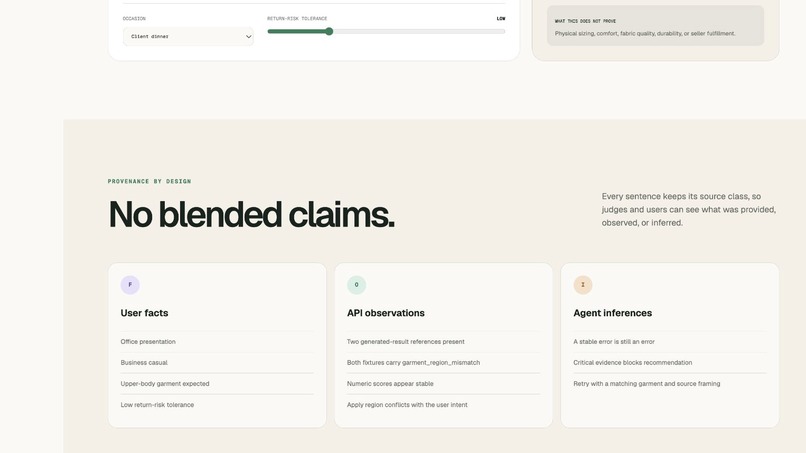
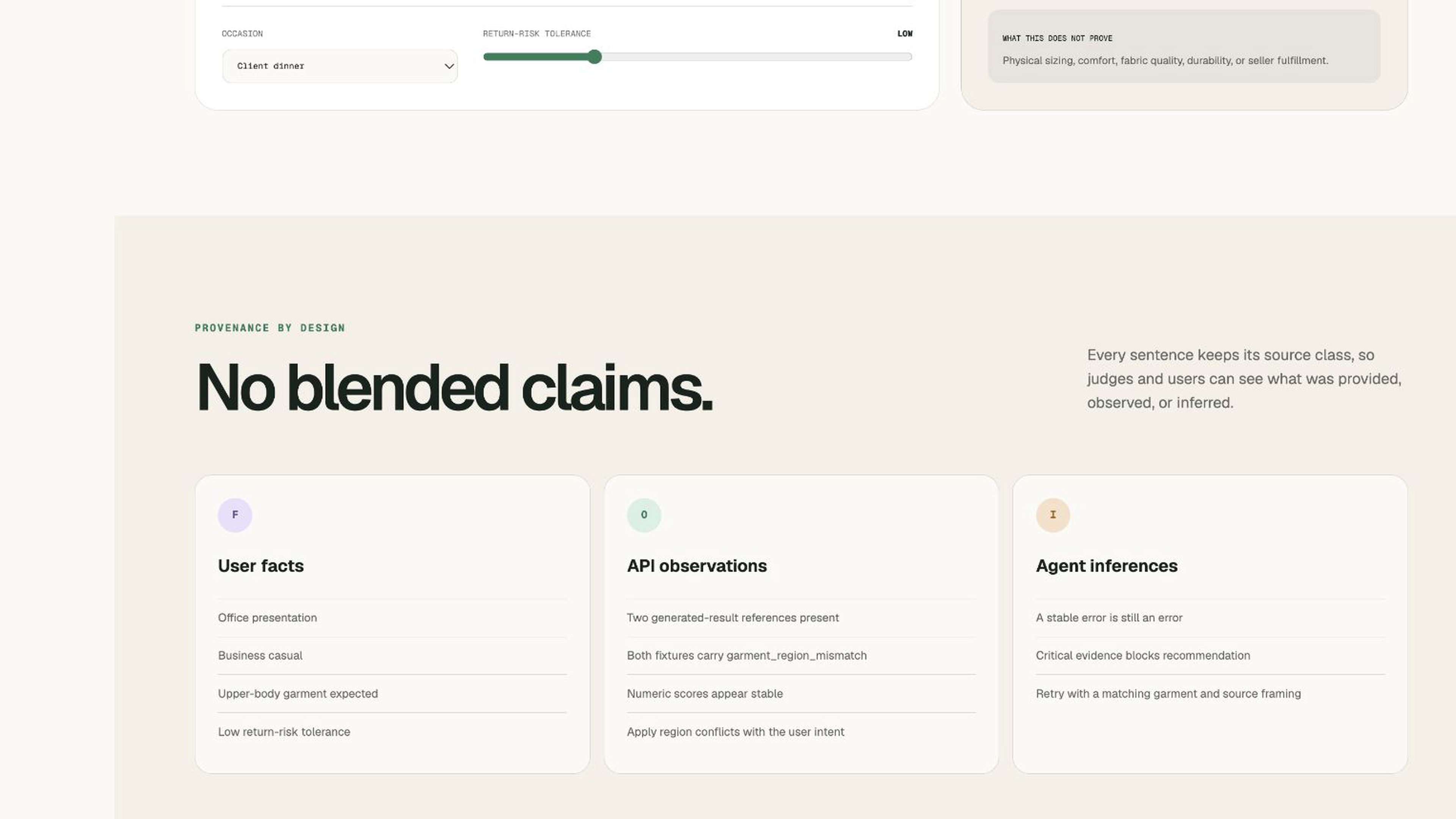
User facts, API observations, and agent inferences stay separate
-
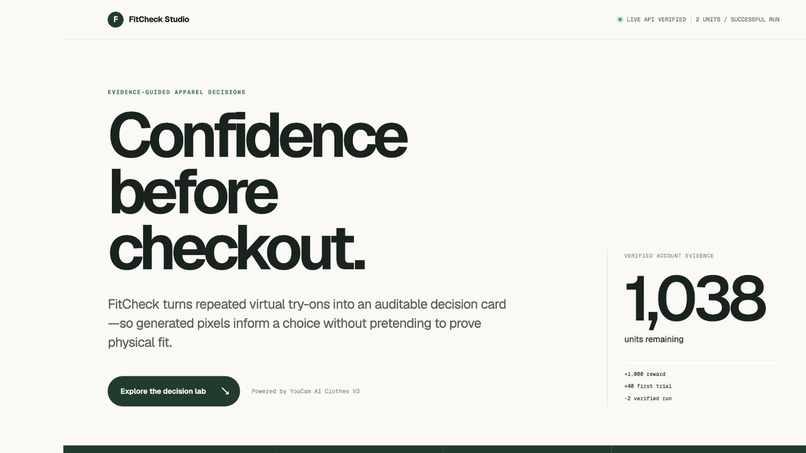
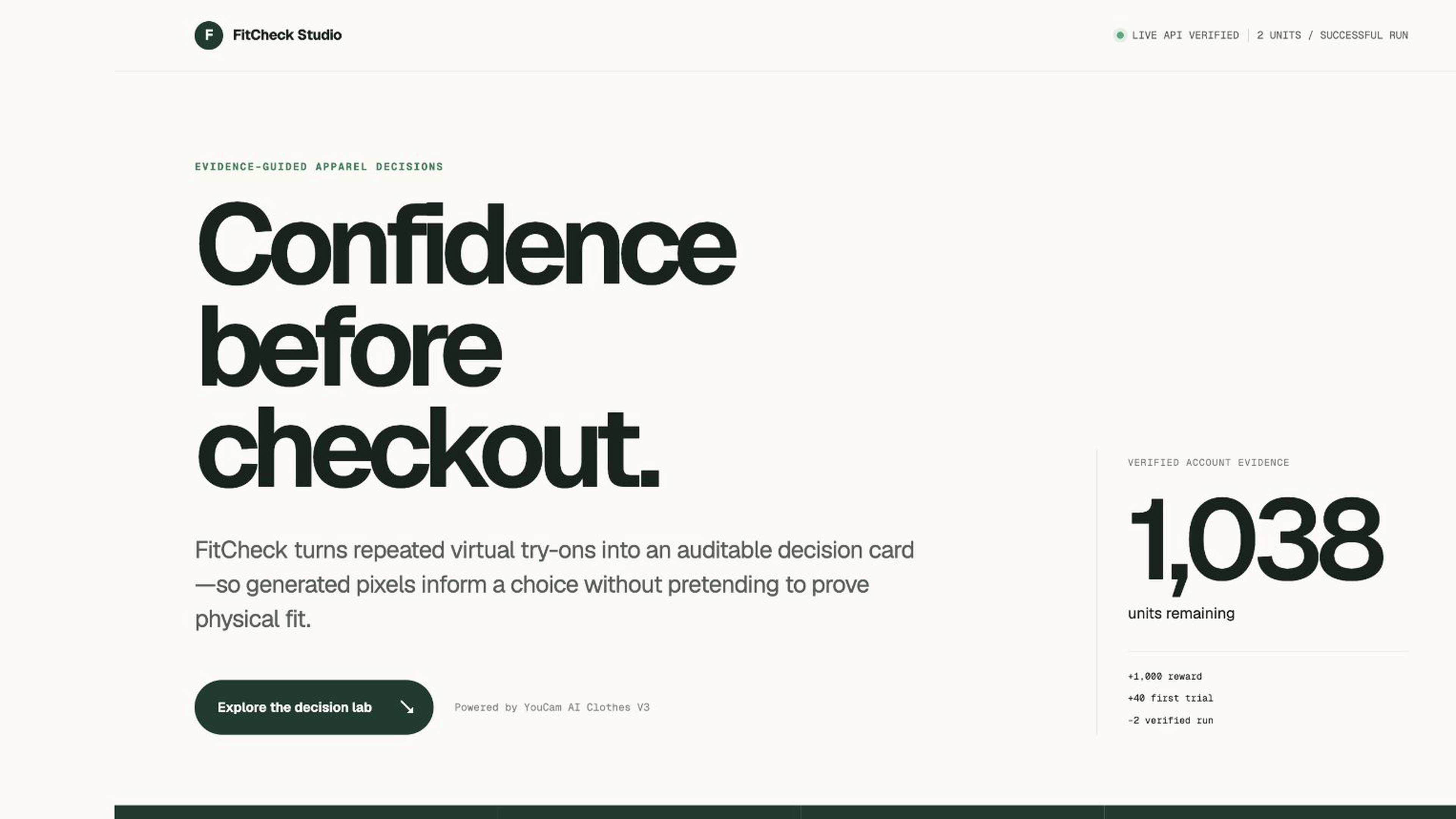
FitCheck Studio overview: confidence before checkout
-
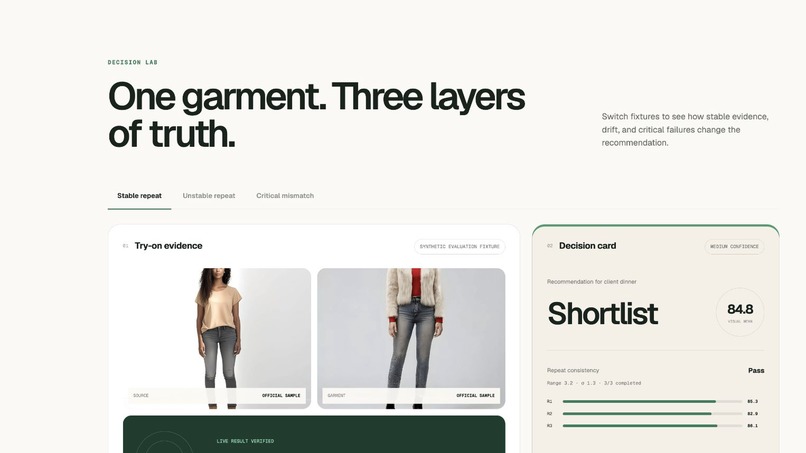
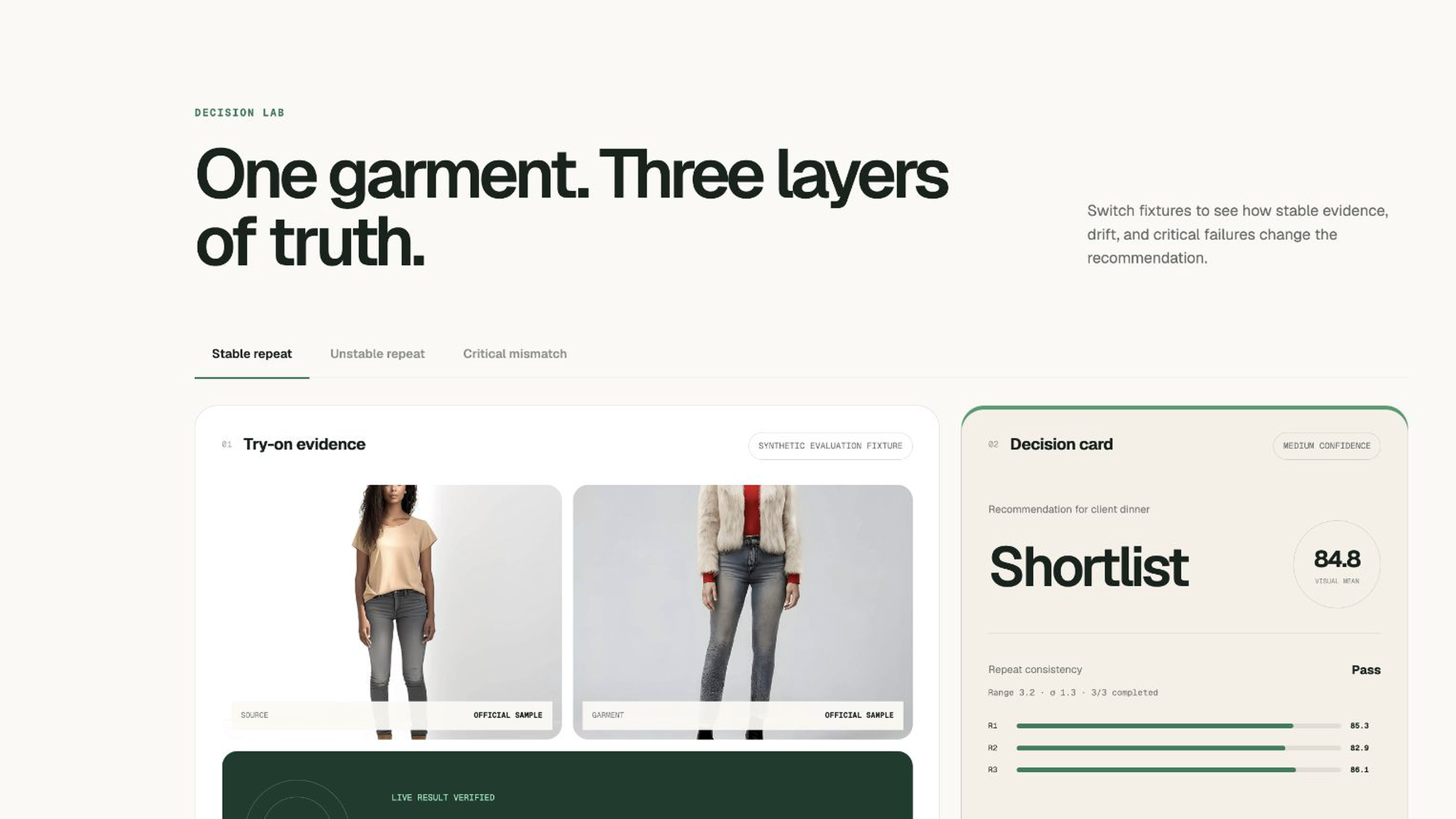
Stable repeated evidence produces a Shortlist decision
-
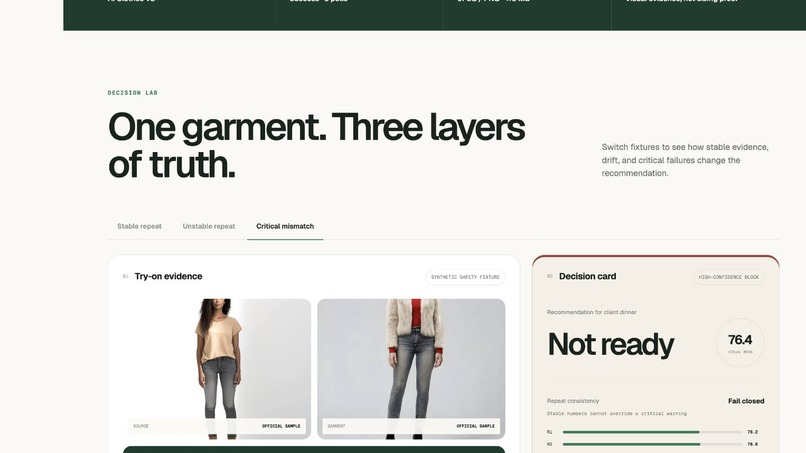
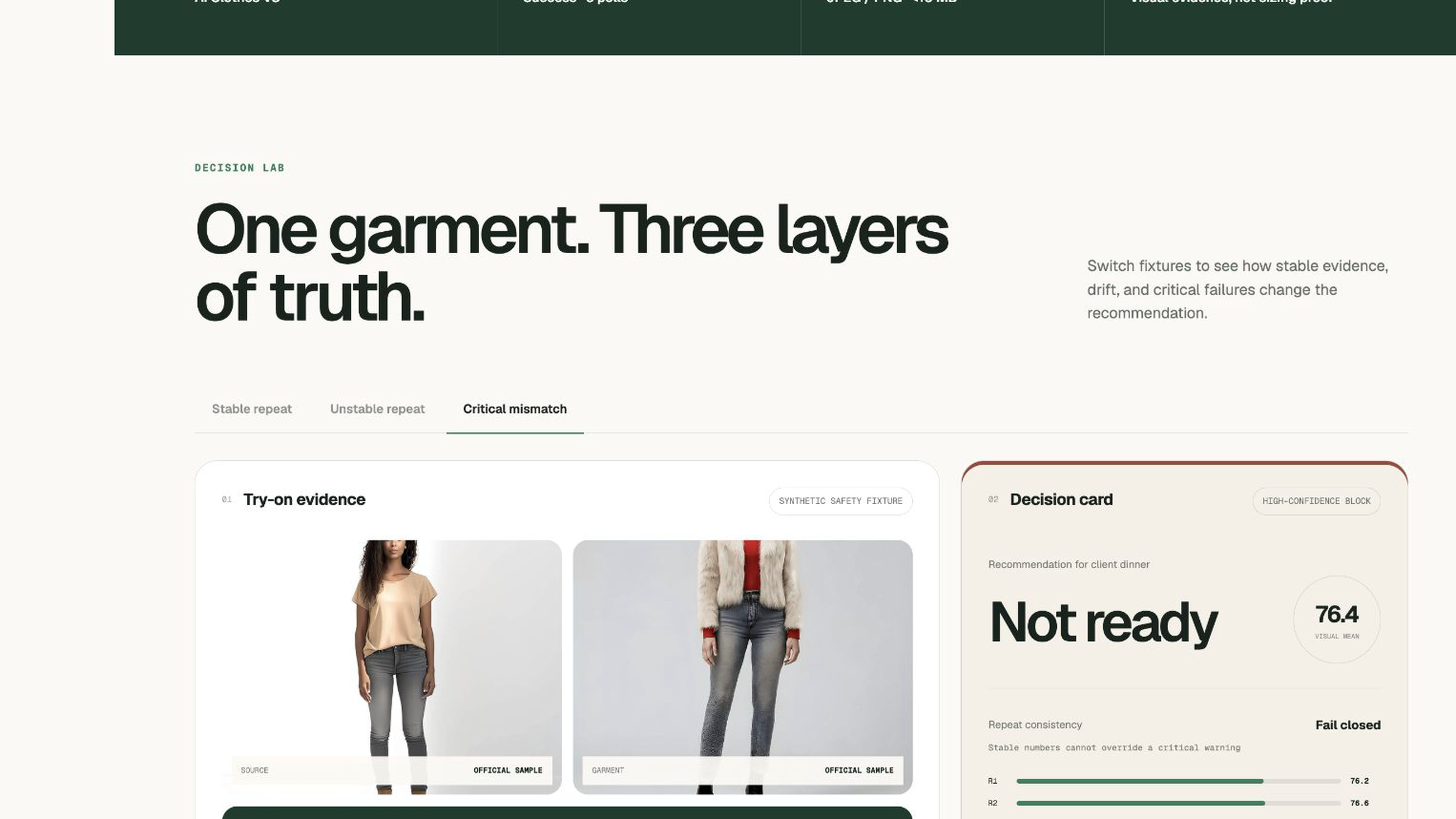
A critical mismatch fails closed as Not ready
-
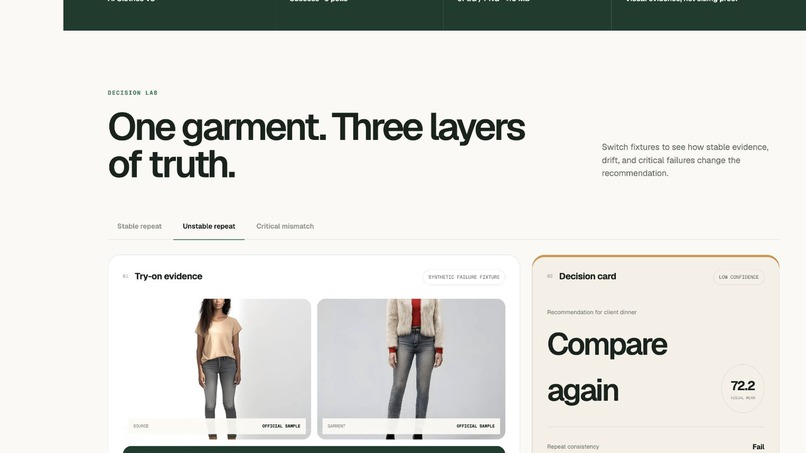
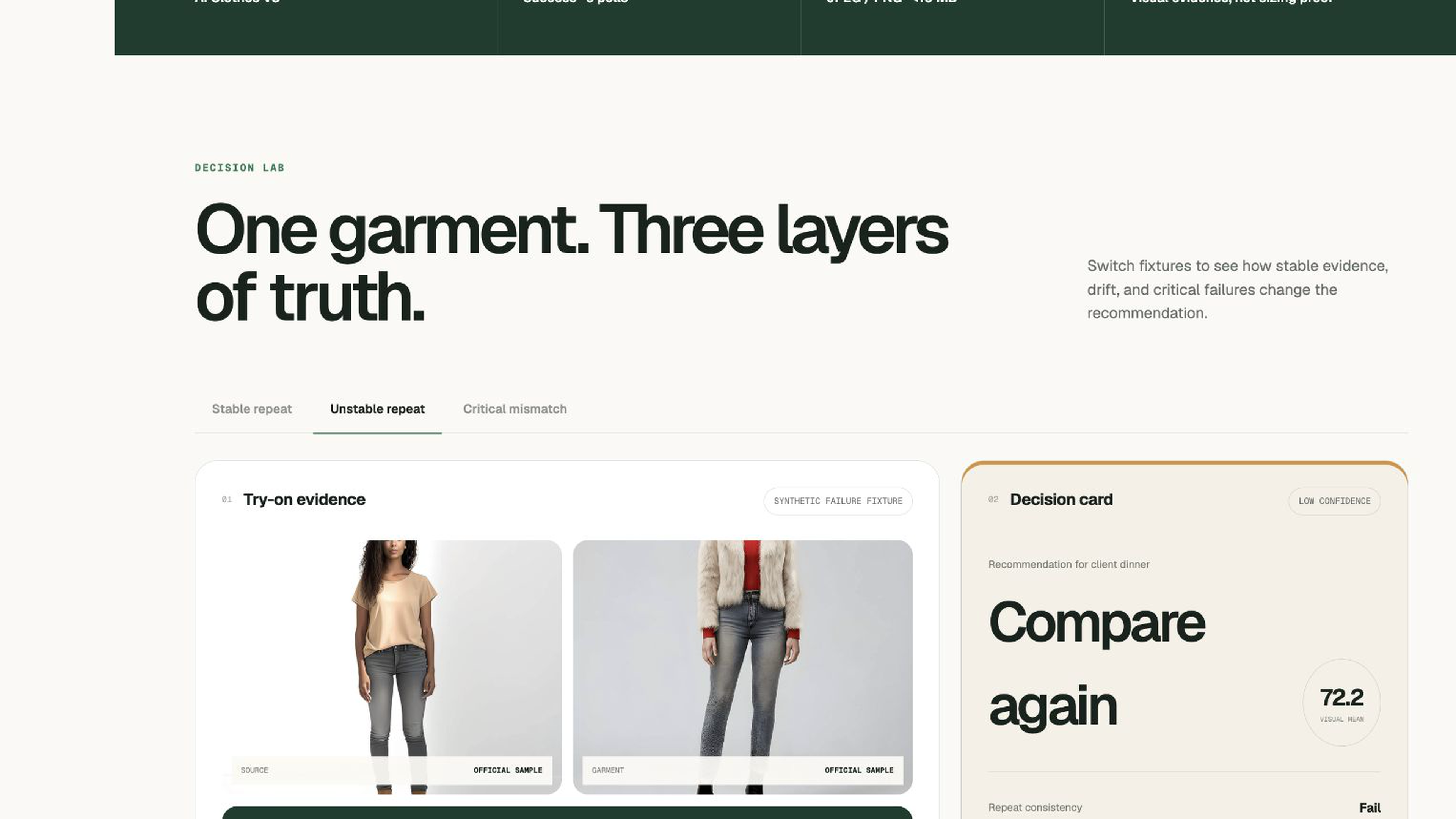
Unstable repeated evidence asks the shopper to Compare again
Links
Inspiration
Online fashion shoppers rarely struggle to generate one attractive image. They struggle to decide whether that image is reliable enough to inform a purchase. A single virtual try-on can look convincing while hiding run-to-run drift, generation failures, or a garment-region mismatch. That creates false confidence and avoidable returns.
FitCheck Studio treats a generated image as evidence, not proof. It asks a more useful question: does repeated visual evidence remain stable, and what exactly can the system infer from it?
What it does
FitCheck Studio combines YouCam AI Clothes V3 with a provenance-aware decision layer.
- A shopper supplies an occasion, preference, and return-risk tolerance.
- The system submits apparel virtual try-on requests and records terminal success, engine failure, result references, and visual warnings.
- A repeatability policy checks successful-run count, failures, score range, score standard deviation, warning rate, missing results, and critical warnings.
- The product returns a decision card: Shortlist, Compare again, or Not ready.
- Every statement remains visibly separated as a user fact, an API observation, or an agent inference.
The decision card always states what it does not prove: physical sizing, comfort, fabric quality, durability, or seller fulfillment.
How we built it
- YouCam AI Clothes V3 provides the apparel virtual try-on generation workflow through its asynchronous REST API.
- A Python verifier validates public HTTPS inputs, creates a task, polls to a documented terminal state, fails closed on unknown or malformed responses, and stores only redacted evidence.
- A deterministic Python decision engine evaluates repeated-run consistency and produces provenance-separated decision cards.
- A responsive Next-compatible vinext web experience makes stable, unstable, and critically invalid evidence understandable to a first-time user.
- The public demo uses clearly labeled synthetic evaluation fixtures; the real YouCam API success record is summarized separately so synthetic and live evidence cannot be confused.
Real API evidence
The official YouCam Apparel VTO sample completed successfully:
- create-task HTTP status: 200
- terminal state:
task_status=success - poll count: 6
- engine error: none
- measured account usage: 2 units
The API key and signed result query were never written to the repository.
Challenges
The hardest part was not the happy-path API call. It was defining an honest boundary between a visually plausible output and a purchase-oriented recommendation.
We had to handle activation timing, an initial authentication failure, bounded polling, redaction of signed result URLs, missing artifacts, duplicate run IDs, non-finite scores, critical warnings, and repeated outputs that disagree. We also found conflicting source-framing guidance in the API documentation, so the first real verification used YouCam's own official sample rather than silently choosing one interpretation.
Accomplishments
- Completed a real end-to-end YouCam AI Clothes V3 task.
- Measured a two-unit successful-call baseline from the authoritative usage ledger.
- Passed 16 product tests and all 4 deterministic decision fixtures.
- Built a coherent consumer-facing decision lab rather than a single-call API wrapper.
- Extracted the provenance and multimodal repeatability pattern into a provider-neutral shared agent library with 136 passing tests.
What we learned
Generated media should be evaluated as a sequence of evidence, not as one hero image. Reliability improves when the product preserves failure states, labels synthetic fixtures, separates observation from inference, and refuses to translate virtual appearance into unsupported physical-world claims.
What's next
- Build a consented live multi-image evaluation corpus.
- Calibrate visual-score thresholds against independent human judgments.
- Add a retailer adapter for return-policy and inventory context.
- Test whether provenance-visible decision cards reduce avoidable returns without reducing shopper confidence.
Testing instructions
The public demo is free and requires no account.
- Open the public demo.
- Review Stable repeat and confirm the card says Shortlist with a passing repeat-consistency result.
- Select Unstable repeat and confirm the recommendation changes to Compare again.
- Select Critical mismatch and confirm the product fails closed as Not ready, even though its numeric runs appear stable.
- Scroll to No blended claims and verify the three distinct columns: User facts, API observations, and Agent inferences.
For local verification:
python3 -m unittest discover -s tests -p "test_*.py"
python3 src/fitcheck.py evaluate --cases eval/cases.json
cd webapp
npm install
npm test
License
MIT. The project does not include an API key, private signed result URL, or third-party music.
Built With
- youcam-api-ai-clothes-v3

Log in or sign up for Devpost to join the conversation.