The Inspiration
Over 38% of medical equipment in developing nations sits out of service, and donated equipment frequently fails within its first year—not because it is broken, but because it doesn’t match local clinical realities. For instance, a donated 110V/60Hz oxygen concentrator sent to a 230V/50Hz hospital grid in The Gambia cannot run safely on a standard voltage step-down transformer; the 50Hz mains frequency causes the motor to overheat and seize.
Nonprofits like MedShare and Project C.U.R.E. spend between $10,500 and $28,000 per shipping container. When equipment arrives unusable, recipient clinics are burdened with clinical waste. We built Fit-Check as finalists in HackTN 2026 (Track 1: From Surplus to Social Good) to answer one critical question before shipping: Will this donated device actually work at that specific clinic?
What It Does
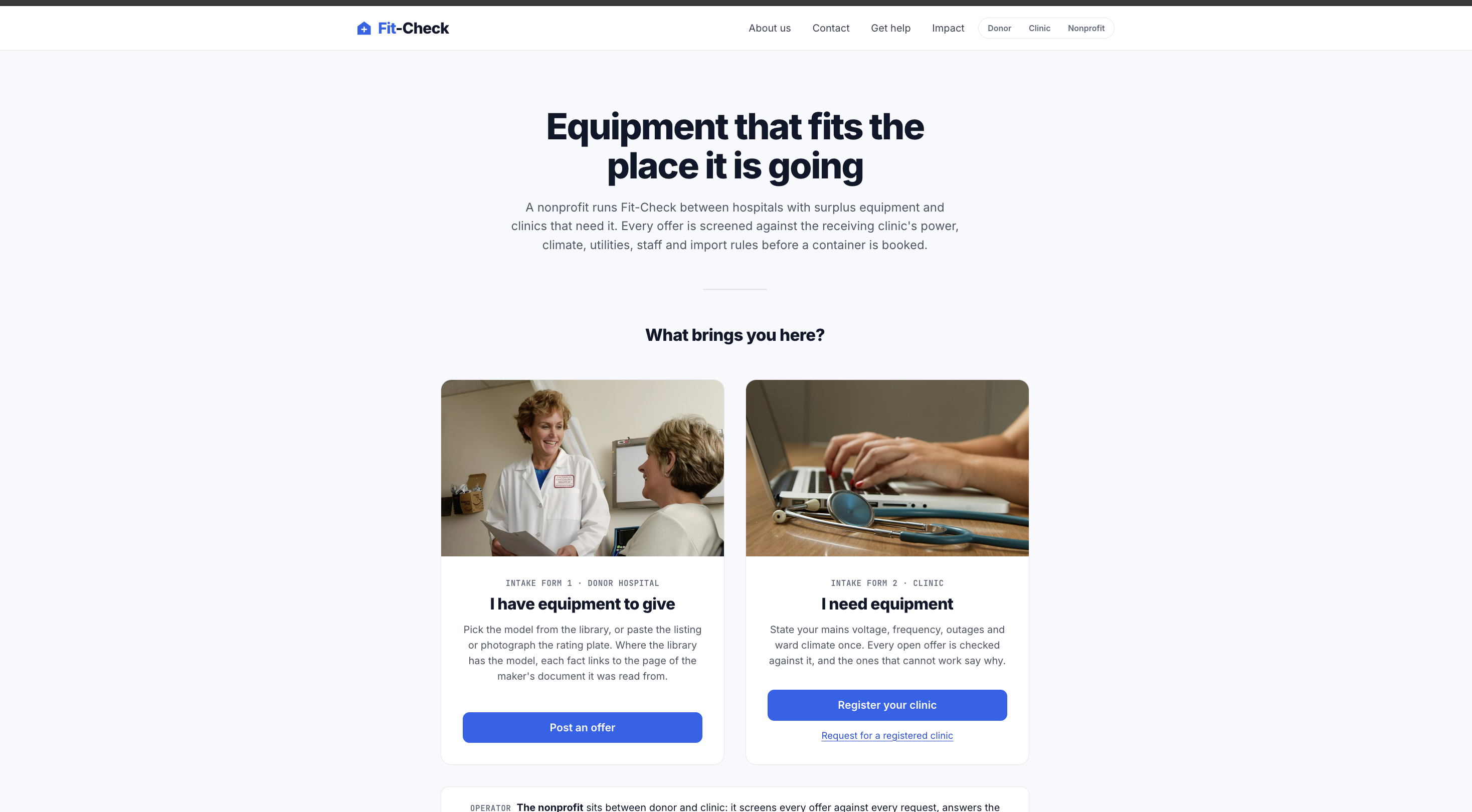
Fit-Check is a two-sided platform that pairs donor supplies with recipient hospital infrastructure:
- Two-Stage Allocation Pipeline: Compatibility and allocation are strictly decoupled. Compatibility is treated as a boolean predicate—a 60Hz motor either runs on a 50Hz grid or it doesn’t. Once non-viable equipment is eliminated, survivors are ranked by the minimal add-on kit required, then by great-circle distance.
- 15 Deterministic Checks: Based on WHO Annex 1 donation guidelines and IEC 60601-1 standards, evaluating voltage, frequency, operating temperature, humidity, grid reliability, utility dependencies (O2, distilled water, compressed air), consumables, and spare parts availability.
- Four Clear Verdicts: Every check yields
pass,fail,mitigable, orneeds info. A mitigable flag identifies the exact add-on required (e.g., a 230V voltage stabilizer or 2-year filter kit). If a fix requires altering the clinic’s building, utilities, or permanent staff, it is marked as a fail. - Automated Handover Packet: Extracts critical maintenance intervals and specs directly from the service manual, paired with in-country translations via OCI Language.
How We Built It
We architected a strict boundary separating AI extraction from deterministic engineering evaluation:
- AI Fact Extraction (Research Layer):
- Powered by OCI Generative AI using
meta.llama-4-maverickfor computer vision extraction from equipment nameplates/photos andopenai.gpt-oss-120bfor digesting service manuals and spec sheets. Every extracted fact carries strict provenance metadata (
nameplate,spec sheet,FDA GUDID registry, orIEC default) and returnsnullinstead of hallucinating.Deterministic Code Evaluation (Judge Layer):
Implemented entirely in Python without model intervention in the decision engine. Frequency mismatches, voltage deltas, and climate bounds are calculated mathematically.
Infrastructure & Cloud:
Hosted on an Oracle Cloud Infrastructure (OCI) Compute VM behind Caddy with automated HTTPS/Let's Encrypt termination.
Backed by MySQL HeatWave on a private subnet for persistent storage of clinic baseline profiles, equipment specs, and screening audits.
Authenticated via OCI Instance Principals for passwordless, secure cloud service calls.
Challenges We Ran Into
- Eliminating AI Hallucinations in Clinical Settings: In healthcare logistics, an AI hallucinating an operating tolerance can burn out an expensive motor or leave a clinic without supplemental oxygen. We solved this by enforcing a hard architectural boundary: AI models are restricted strictly to text and vision extraction with verifiable citations back to the source document. All verdict logic runs on deterministic Python rule engines.
- Missing Device Specifications: Many donor submissions lack climate and environmental operating limits. Rather than failing the device or guessing, our system falls back to default safety margins (IEC 60601-1: 5–40°C, 15–93% humidity) to detect if non-climate-controlled wards exceed rated tolerances.
Accomplishments That We're Proud Of
- Reached the Finals of Oracle HackTN 2026.
- Validated the engine against 20 real device screenings across three baseline clinics (Kayunga District Hospital, Uganda; Hôpital Communautaire de Pignon, Haiti; Bardiya Primary Health Centre, Nepal), successfully intercepting 11 non-viable shipments before containers left port.
- Engineered an end-to-end deterministic test suite (26 unit tests) running in under 0.1 seconds.
- Successfully deployed on OCI with live instances, MySQL HeatWave, and automated OCI Language translation pipelines.
What We Learned
- A functioning device is not the same as a usable donation. Power frequency and local supply-chain availability are the primary reasons equipment sits idle, not just broken hardware.
- Safe real-world AI deployment requires making the model an unopinionated data extractor, delegating high-stakes validation strictly to inspectable code.
What's Next for Fit-Check
- Live Registry Integrations: Expanding automated lookups beyond the FDA GUDID registry into European and international medical device databases.
- Carrier & Customs Verification: Building direct customs tariff validation and Ministry of Health import compliance tables beyond our pilot Uganda implementation.
- Post-Donation Lifecycle Auditing: Introducing structured 30-, 90-, and 365-day check-in protocols to track longitudinal device utilization and uptime.


Log in or sign up for Devpost to join the conversation.