-
-
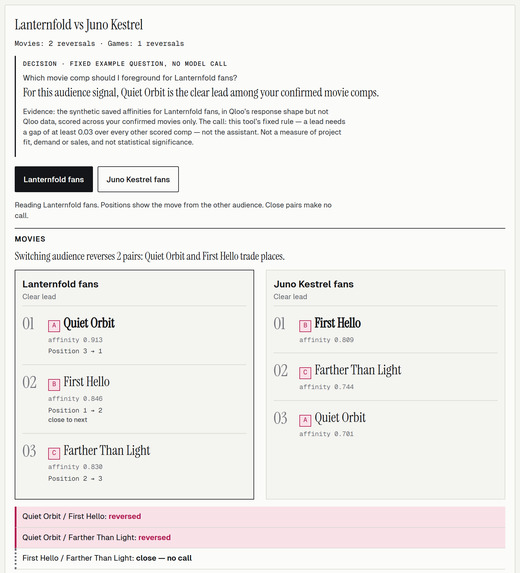
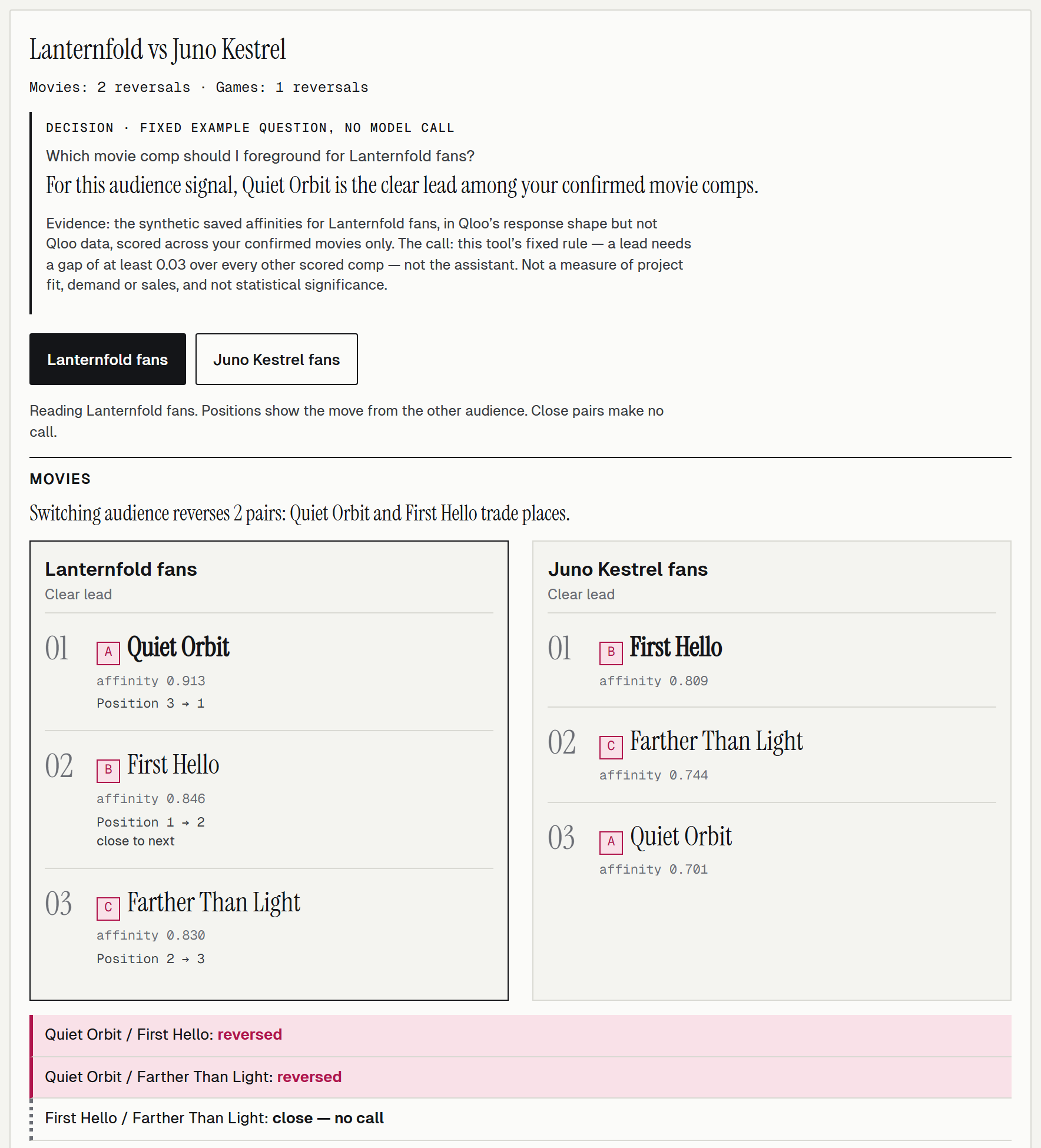
Interactive demo with synthetic data: compare audience rankings, reversals, and bounded decisions.
-
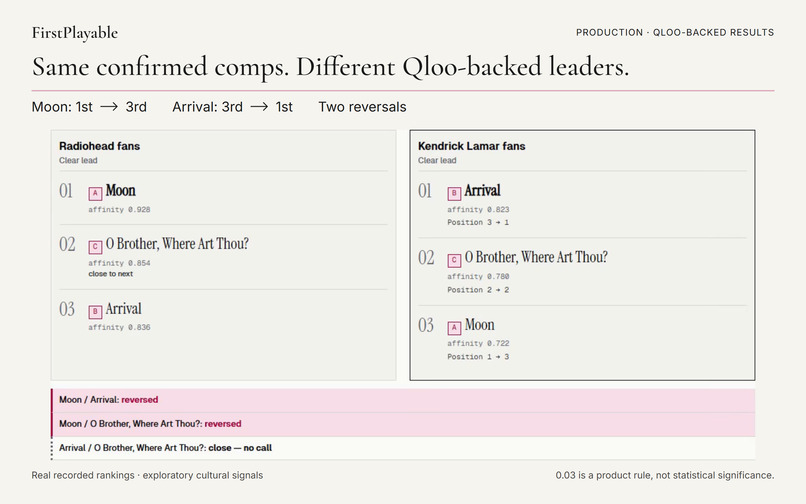
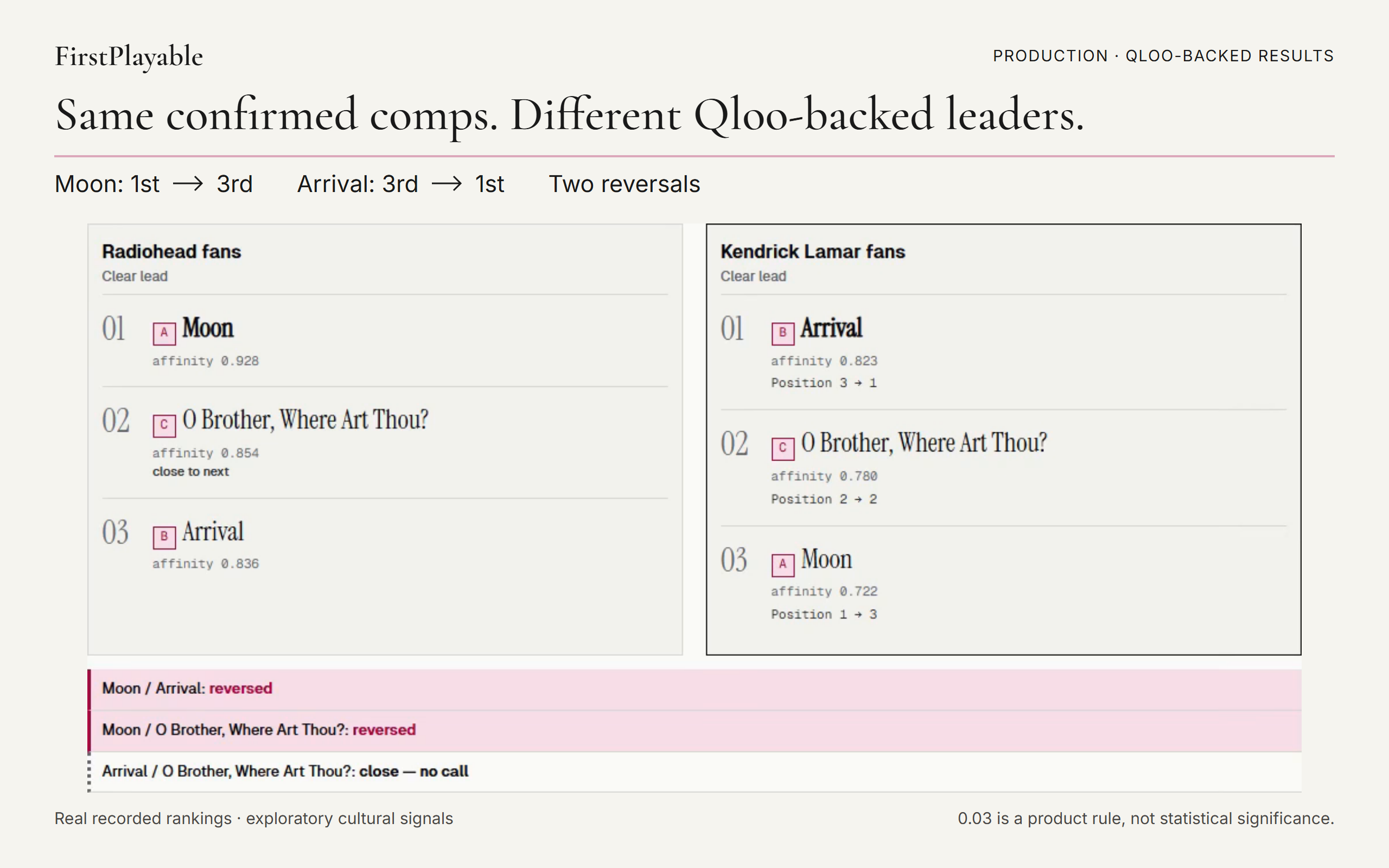
Real Qloo evidence: Moon leads for Radiohead, Arrival for Kendrick Lamar. Same comps, two reversals.
-
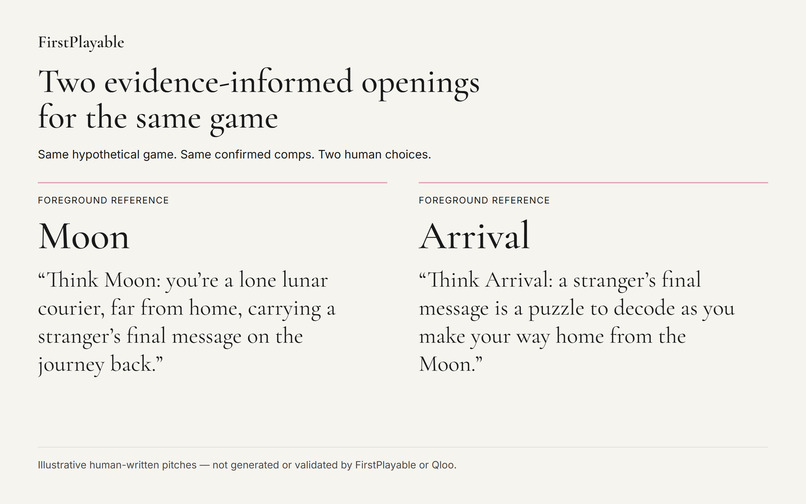
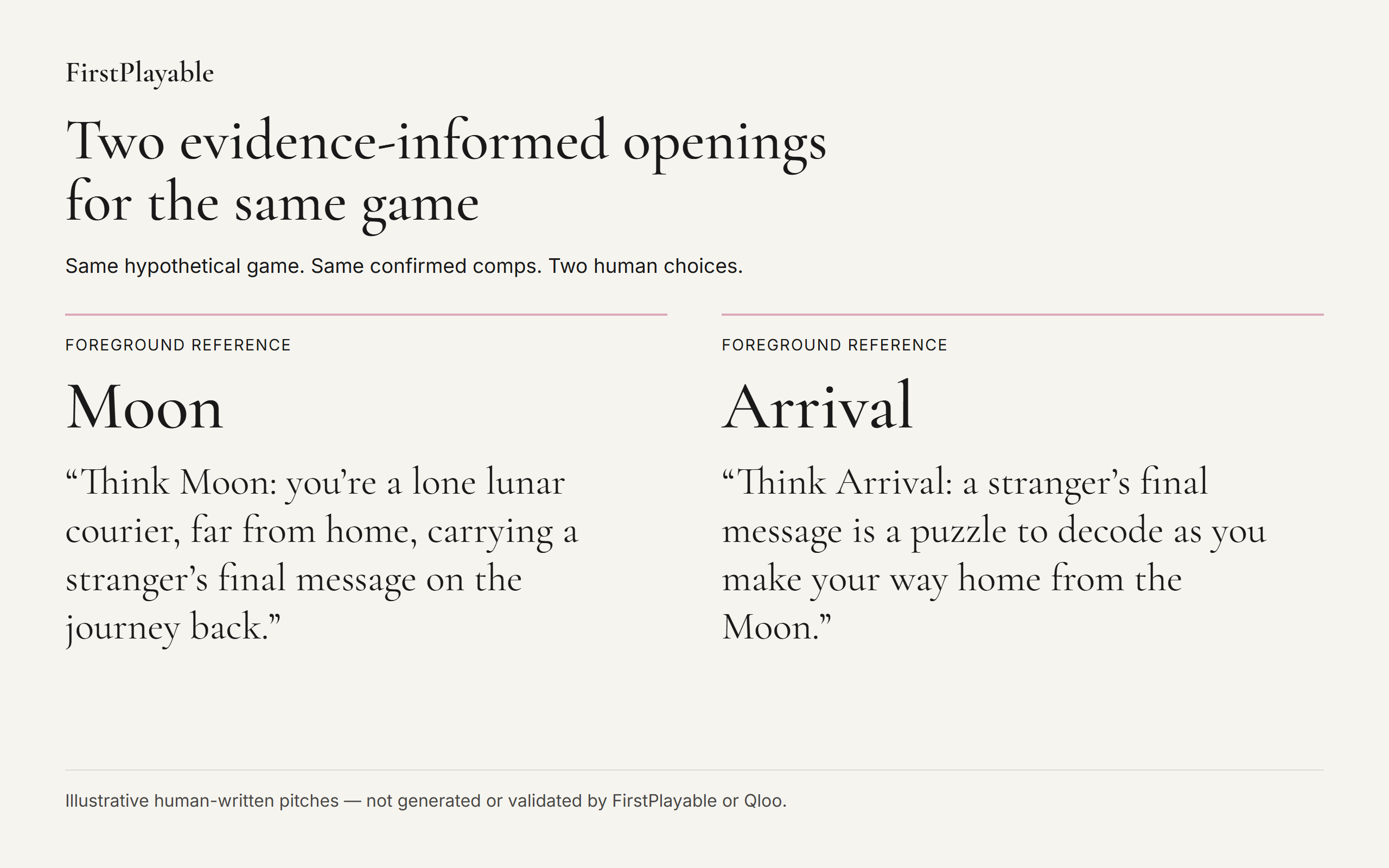
One hypothetical game, two evidence-informed pitch openings. Illustrative human-written choices.
Inspiration
“It's Outer Wilds meets Arrival.”
Indie game creators often explain their projects through familiar movies and games. But when several references genuinely represent the same project, which one should lead for a particular cultural audience?
The order isn't necessarily neutral. The same references can have different associations with different audiences.
We built FirstPlayable to make those differences visible through real Qloo data—and turn them into a bounded, inspectable decision.
Choose the comps. Switch the audience. See what changes.
What it does
FirstPlayable is an AI-assisted comp audition for indie game creators.
A creator names the movies and games that represent their project, selects two music-artist audiences, and explicitly confirms the exact references returned by Qloo.
FirstPlayable then ranks the same confirmed references for each audience, identifying meaningful ranking reversals, close calls, and whether one reference has a clear affinity lead.
Our real Qloo demonstration shows why this matters.
For a fictional exploration game called The Last Signal, we confirmed three real movie references: Moon, Arrival, and Interstellar.
Using actual Qloo responses captured on October 7, 2026:
- Radiohead fans: Moon leads at 0.928, followed by Arrival at 0.836 and Interstellar at 0.812.
- Kendrick Lamar fans: Arrival leads at 0.823, followed by Interstellar at 0.756 and Moon at 0.722.
Moon moves from first to third. Arrival becomes the leading reference.
The same creator-selected movies produce a different ordering under another audience signal.
But FirstPlayable doesn't force every comparison into a recommendation.
For Kendrick Lamar fans, Death Stranding (0.639) and Mass Effect (0.613) are too close under our explicit decision rule. The application returns “Close at the top — no single lead” instead of manufacturing certainty.
Switching audiences updates the question, decision, evidence and ranking focus together.
The default demonstration replays genuine recorded Qloo evidence instantly, with no provider calls. A separate live mode allows creators to submit and confirm their own references. Synthetic demonstration data remains clearly labeled and separate.
How we built it
FirstPlayable separates four responsibilities.
1. The creator chooses.
The creator supplies their references and confirms exact identities. Ambiguous search results are never automatically accepted as the intended title.
2. The AI agent interprets.
A constrained OpenAI agent handles natural-language requests, maintains reference selections, supports additions and replacements, and asks for clarification when necessary.
Its authority is deliberately limited. It cannot supply affinity scores, confirm identities or choose the winning reference.
3. Qloo provides cultural evidence.
Qloo Search resolves entity identities. Qloo Insights supplies audience-conditioned affinity measurements restricted to the creator-confirmed candidate set.
We validate the returned entities rather than assuming a successful API response honored every constraint.
4. Deterministic code makes the decision.
A separate comparison engine computes rankings, reversals and close calls. The foreground decision follows the selected audience and is derived from Qloo-backed results, never generated by the language model.
The application uses Next.js, React, TypeScript, Zod, Supabase PostgreSQL and Vercel, with automated unit, integration, security and Playwright browser checks.
Recorded evidence preserves its original retrieval timestamps and provenance. The comparison is recomputed using the same decision logic as the live workflow.
Challenges we faced
Entity ambiguity. Moon can refer to different films. We made explicit identity confirmation mandatory instead of trusting the first search result.
Conversational reliability. Short clarification replies could accidentally affect unrelated references. We introduced structured pending intent and deterministic clarification handling.
Evidence integrity. Cached and recorded Qloo data must remain traceable to its original retrieval. We implemented validated captures, request fingerprints, preserved timestamps and explicit separation between synthetic, recorded and live evidence.
Knowing when not to decide. Small affinity gaps should not become exaggerated conclusions. Our fixed 0.03 rule allows FirstPlayable to decline naming a leader. It is a transparent product convention, not statistical significance or a Qloo-provided confidence threshold.
Maintaining decision coherence. Switching audiences must change the actual question and answer—not merely highlight another column. We made the foreground decision follow the selected audience using the existing deterministic engine.
What we learned
An AI agent with taste should not merely sound culturally knowledgeable. It should make the evidence behind its decisions inspectable.
Qloo supplies external cultural association data. The agent understands the creator's instructions. Deterministic code translates the measurements into bounded decisions. The creator retains authority over which references genuinely describe their project.
We also learned that a useful system must be able to say “the evidence isn't enough.”
A transparent no-call can be more defensible than a confident but unsupported recommendation.
What's next
FirstPlayable is publicly deployed and working, with a recorded real-data demonstration and an interactive live workflow.
The next product question is whether indie creators find audience-conditioned reference comparisons useful when developing and testing how they explain their projects.
We don't claim that Qloo affinity measures sales potential, audience size, commercial demand, or persuasive effectiveness. Music-artist audiences are deliberately selected cultural proxies, not verified buyer segments.
FirstPlayable answers a narrower, testable question:
Given these creator-confirmed references and this cultural audience signal, which reference has a clear affinity lead—and when should the system decline to choose?
Try FirstPlayable: https://firstplayable.vercel.app/audition
Source code: https://github.com/Asembris/FirstPlayable
Built With
- next.j
- openai
- playwright
- postgresql
- qloo-api
- react
- supabase
- typescript
- vercel
- vitest
- zod

Log in or sign up for Devpost to join the conversation.