-
-
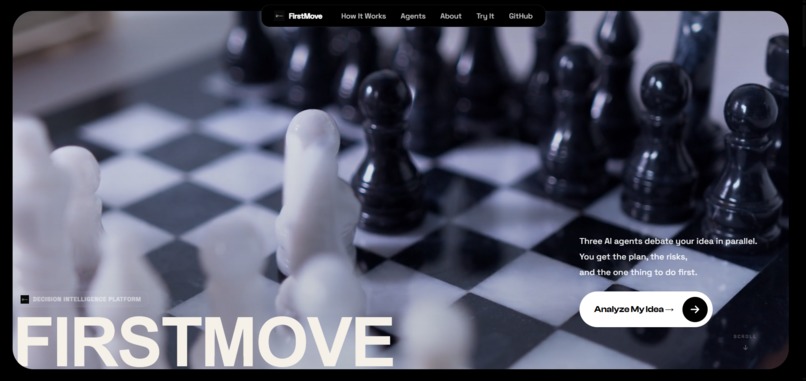
Landing Page
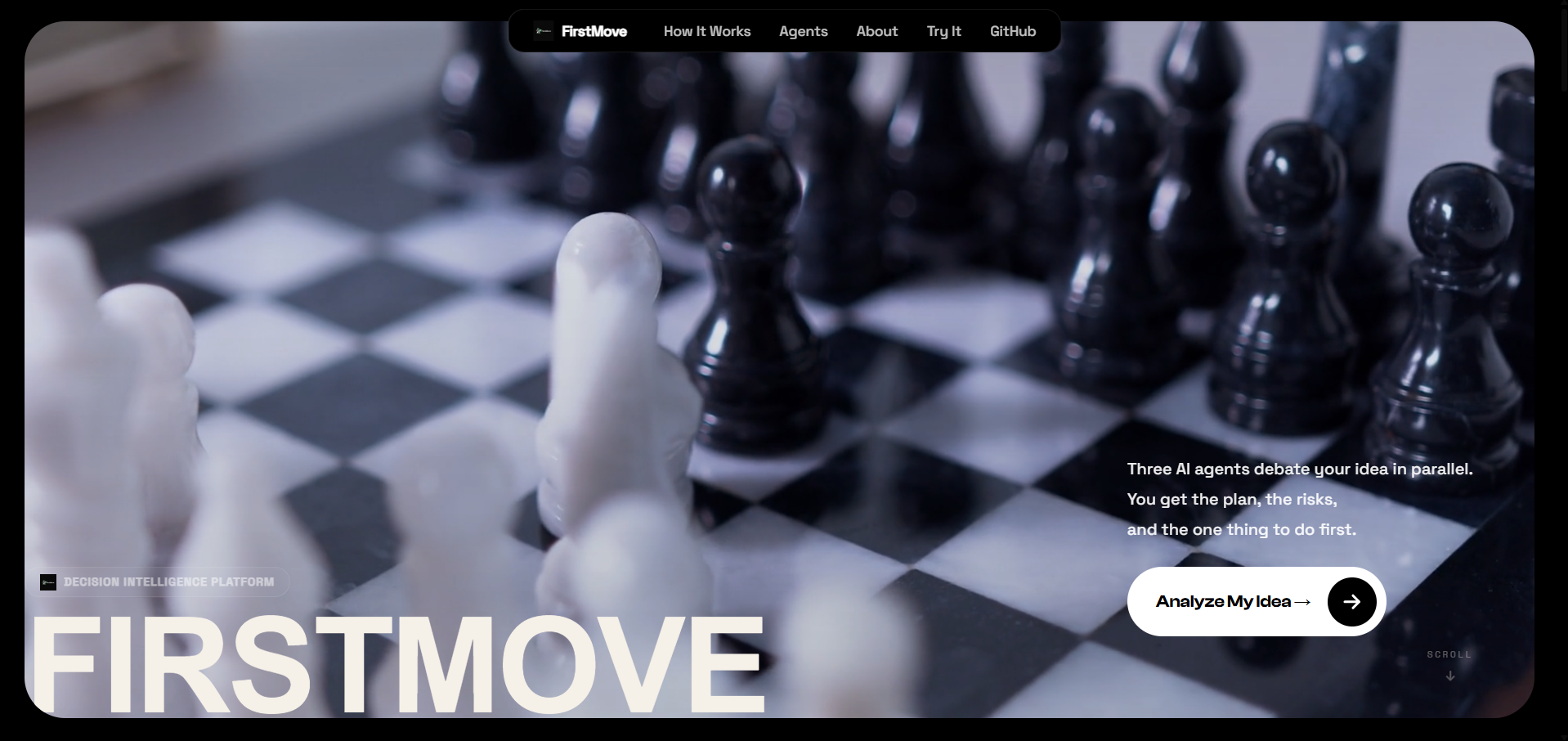
Inspiration
Every early-stage idea sounds great in your head and falls apart the moment someone asks "wait, who actually has this problem?" Most AI tools either flatter your idea or hand you a generic business plan template. Neither one tells you which of your assumptions will actually kill the project if it's wrong.
We wanted to build something that does what a sharp co-founder does: ask the uncomfortable questions first, find the one assumption your whole idea is balanced on, and give you exactly one thing to go test this week — nothing more.
What it does
You describe your idea in a sentence or two. FirstMove asks 3–4 sharp, Socratic follow-up questions to force clarity on who has the problem, what the real bottleneck is, and what success looks like in 30 days. From there, three AI agents — a Strategist, a Risk Analyst, and a Devil's Advocate — independently evaluate the idea and converge on:
- Your idea, sharpened into one crisp problem statement
- Load-bearing assumptions, each tagged Low/Medium/High confidence with a concrete way to test it
- A de-risked roadmap, sequenced so the riskiest assumption gets tested first
- Your FirstMove — one specific, doable-this-week action
FirstMove never tells you if your idea is good. It tells you what you don't know yet.
How we built it
- Frontend: React + Vite, Tailwind CSS, Framer Motion for the agent debate animations
- Backend: Vercel serverless functions — no database, no persistent server. State lives in memory for the session; this was a deliberate constraint to keep the prototype lean and judge-friendly
- AI: Google Gemini 1.5 Flash, called via native
responseSchemafor structured JSON output (questions array, then the full plan object), with three parallel agent personas debating the same idea before converging - Design system: A dark, editorial UI inspired by premium product sites — bento-grid workspace, confidence visualizations (numeric + qualitative + color), shimmer skeleton loading, and a chess-themed hero video to reflect the "test your position before you commit" framing
We front-loaded research before writing a single line of code: competitive analysis of existing idea-validation tools, the Mom Test and Lean Startup frameworks for the reasoning model, and UI/UX patterns specifically for tools that need to show AI reasoning chains without overwhelming the user. That research shaped the Desirability/Viability/Feasibility scoring underneath the assumption cards.
Challenges we ran into
The biggest challenge wasn't the AI logic — it was proving the idea wasn't "just a ChatGPT prompt." Early versions could be replicated by anyone pasting a clever prompt into any chatbot, and we had to be honest with ourselves about that. The fix was architectural, not cosmetic: structured multi-agent debate (three distinct reasoning personas, not one model wearing different hats), a state machine governing screen transitions, and a UI that visually surfaces disagreement between agents — something a single chat window can't show.
The second challenge was iteration speed on visual design. Several redesign passes kept regressing to the same dark-card-with-purple-accent pattern regardless of how the prompts were worded, because incremental prompts patch existing structure rather than replacing it. The fix was reusing a proven, fully-built landing page architecture from an earlier project and adapting it wholesale — same layout DNA, new content — rather than asking for "a redesign" in the abstract.
We also hit a late scramble compressing a 47MB 4K hero video down to web-friendly size without visible quality loss, solved by matching the exact codec/bitrate settings (H.264, CRF 22, 1080p, audio stripped) already proven to look clean in production elsewhere.
What we learned
The hardest part of building with AI agents isn't getting code — it's specification precision. Vague instructions like "make it look better" or "redesign this" get patched, not rebuilt. Specific, structural prompts (exact layout, exact component tree, exact CSS values) are what actually produce change. We also learned that defensibility against "AI could just do this" critiques comes from architecture and UX, not from the underlying model being clever.
Built With
- ffmpeg
- framer-motion
- gemini-1.5-flash
- google-gemini
- javascript
- react
- react-resizable-panels
- tailwindcss
- vercel
- vercel-serverless-functions
- vite


Log in or sign up for Devpost to join the conversation.