-
-
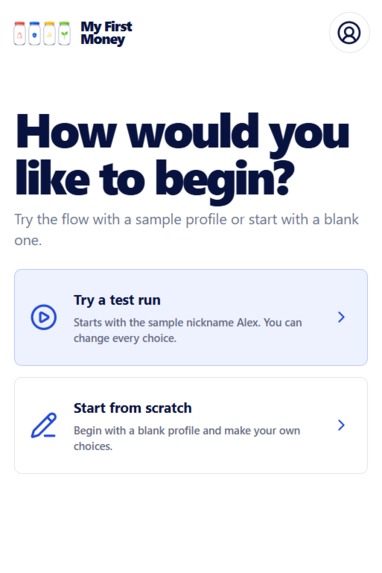
Start a money week.
-
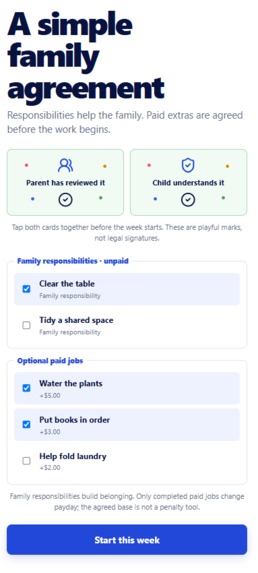
Family agreement.
-
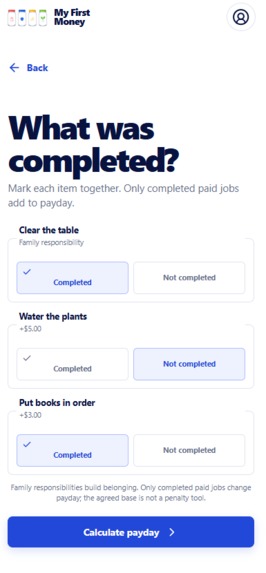
Week review.
-
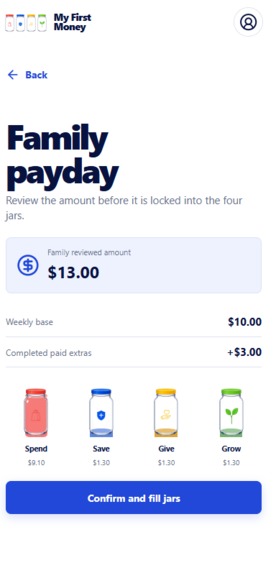
Payday.
-
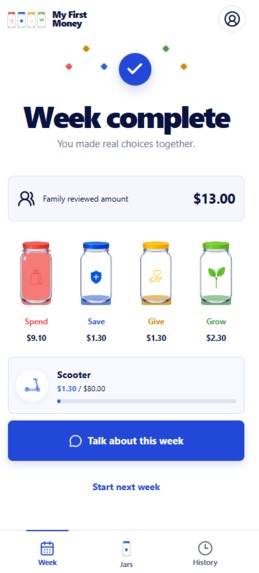
Week complete.
-
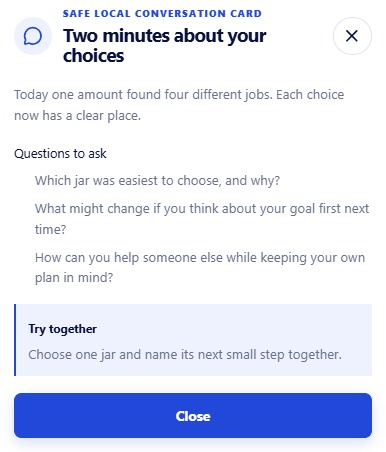
Money Moment.
-
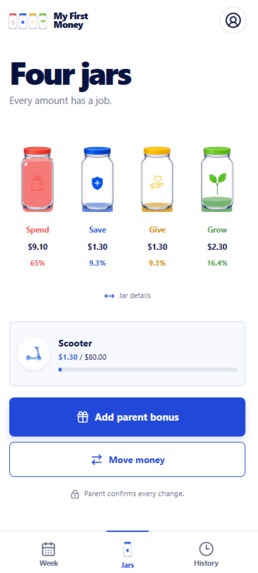
Jars.
Inspiration
Financial literacy is not one lesson. It becomes a habit through repeated choices.
The goal is not to teach financial theory in one sitting. It is to create many small, safe opportunities to practice trade-offs before adulthood.
A family that repeats the cycle over several years gives a child many chances to experience spending, patience, generosity, planning, and learning. It is not a guarantee of a particular outcome; it is a practical environment where better habits can be rehearsed together.
The parent can learn from this too. Explaining a choice clearly to a child can encourage an adult to examine their own habits.
What it does
My First Money is a supervised weekly money-practice routine for parents and children, designed first for families with children aged 7–13.
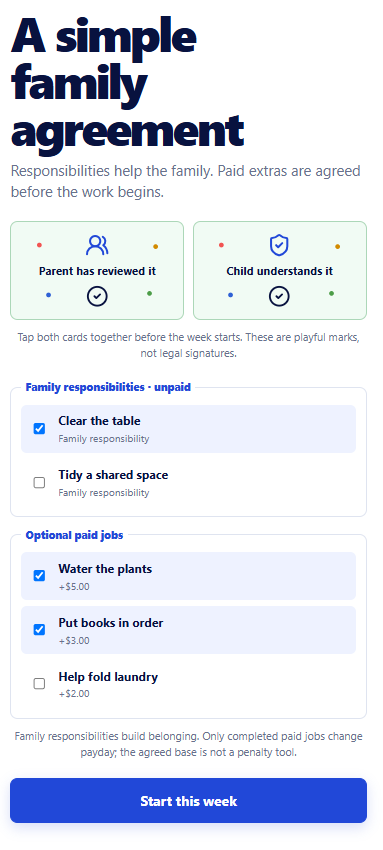
A parent creates a minimal nickname-only profile, chooses one focus for the week, and reviews a clear family agreement with the child.
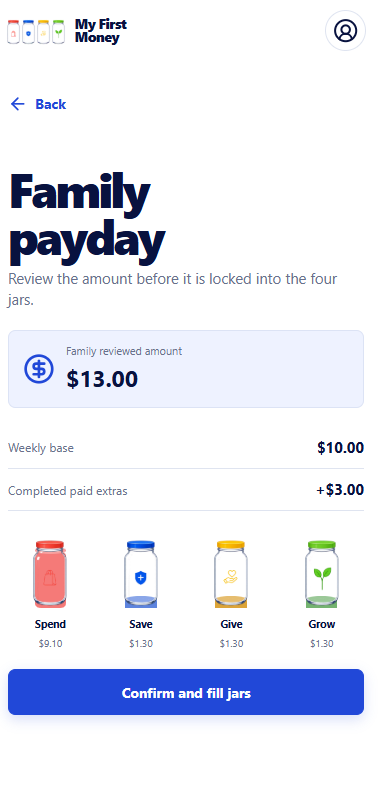
The parent may set a weekly base—the regular pocket-money amount agreed before the week begins. Once agreed, the base is included in payday and is never removed as a punishment. Everyday family responsibilities remain unpaid contributions to family life, while completed optional jobs add clearly agreed amounts on top of the base.
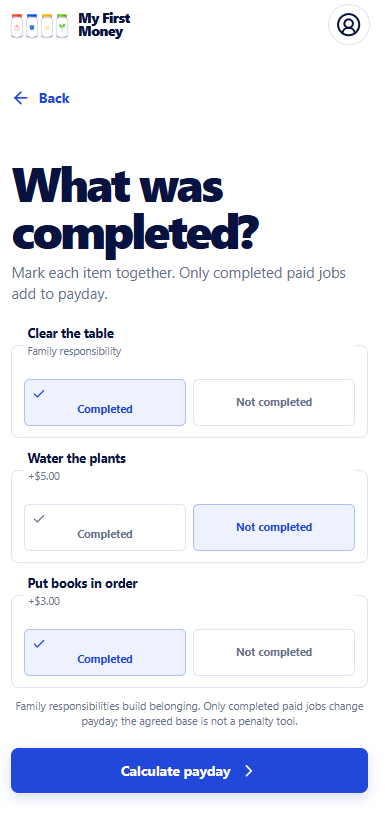
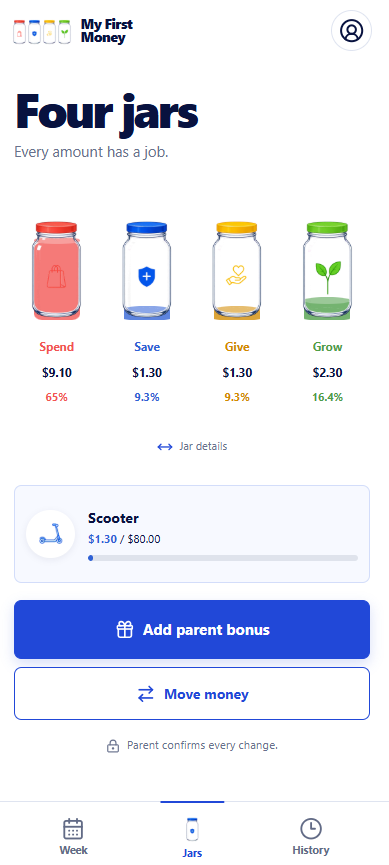
At the end of the week, the family reviews what was completed, confirms payday, and gives every amount a job across four jars:
- Spend — enjoy some money now through a considered choice.
- Save — make visible progress toward a chosen goal.
- Give — practice generosity and thinking beyond yourself.
- Grow — support learning, skills, or a parent-funded growth challenge.
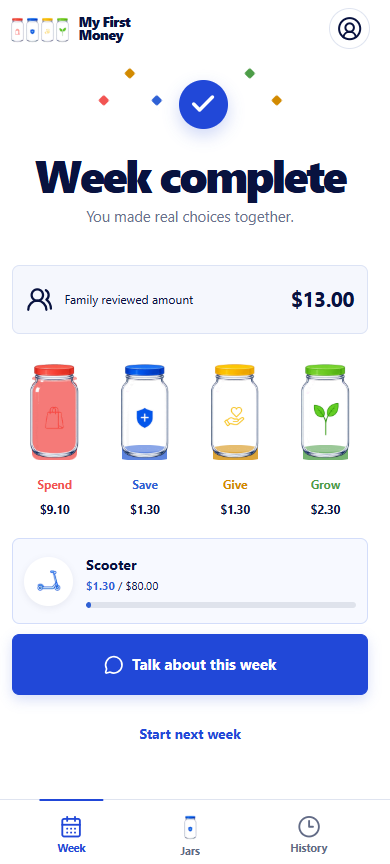
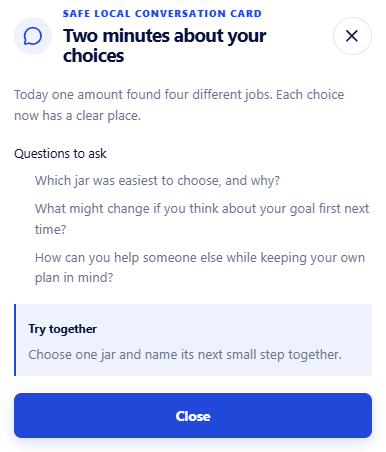
The family can then inspect each jar, move money with parent confirmation, use money for a clear purpose, review the append-only history, and voluntarily begin another week.
How I built it
The product research and safety pipeline existed before Build Week. During the submission period, I used Codex with GPT-5.6 Sol as my primary implementation partner to build the working application, domain rules, multilingual experience, Four Jars interface, tests, accessibility checks, security boundaries, container deployment, and submission evidence.
Codex was used for more than code generation. It helped translate product and privacy requirements into architecture, challenge unclear decisions, implement and debug the complete mobile flow, create automated tests, verify deployment behavior, and document the decisions made throughout the build.
The application is a TypeScript and Next.js modular monolith with Zod validation, integer minor-unit money calculations, same-origin server boundaries, append-only history.
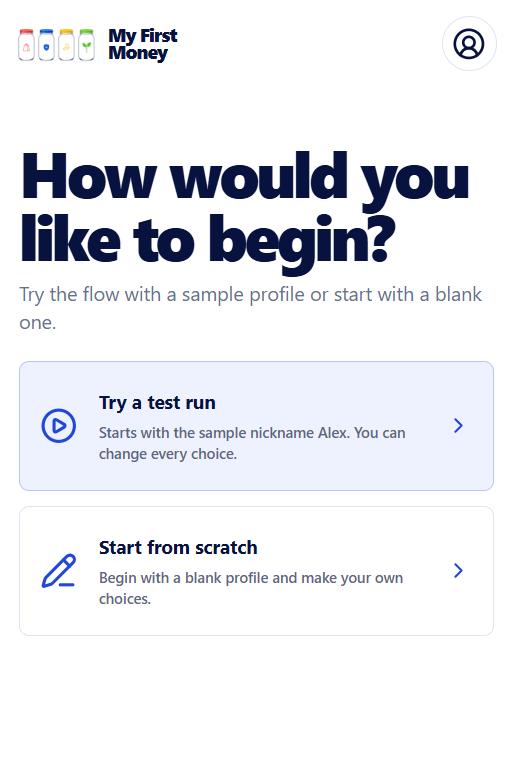
The deployed competition path uses synthetic data only and requires no credentials. The core flow has unit and component coverage plus live end-to-end verification across mobile and desktop viewports.
Challenges I ran into
The main challenge was balancing playfulness with trust. The interface needed to feel rewarding for a child without becoming a token economy, punishment system, or financial product.
Another challenge was separating regular pocket money from paid extra work in a way that a family could understand immediately. The agreed weekly base should not become a reward that can be removed as punishment. Everyday family responsibilities remain unpaid, while only completed optional jobs add money to payday.
The product also needed to remain visually engaging while keeping every calculation transparent and auditable. Before payday, the family can review its choices. After payday is confirmed, the allocation and history remain clear instead of silently changing.
Accomplishments that I'm proud of
- Built the complete weekly experience from an empty implementation workspace: child setup, weekly focus, family agreement, active week, completion review, payday, Four Jars allocation, history, and the next week.
- Turned an abstract financial-literacy idea into a clear product rather than a collection of prototype screens.
- Created an interactive Four Jars interface where every amount has a visible purpose across Spend, Save, Give, and Grow.
- Made the money rules transparent: an agreed weekly base, optional paid extras, calculations, exact allocation.
What I learned
The clearest product was not the one with the most features. It was the one with the most understandable repeated behavior: agree, practice, review, allocate, reflect, and begin again.
I also learned that financial education needs careful language. A weekly base should not become a punishment tool, family responsibilities should not be turned into transactions, and Grow should represent learning and development too.
Building the product with Codex also worked best as a continuous collaboration. Product decisions, implementation, browser testing, security review, and deployment improved through repeated verification rather than a single generation step.
What's next for My First Money
The next step is not adding as many features as possible. It is preparing the product responsibly for a real-family beta.
That includes parent authentication, persistent PostgreSQL storage, parental consent and deletion flows, backup and restore evidence, authorization testing, privacy review, and appropriate legal review before any real child or family data is accepted.
After those gates, the product can be tested with families to learn which goals, settings, and weekly prompts genuinely help them maintain the habit without making the experience complicated.
Built With
- codex
- coolify
- docker
- drizzle-orm
- gpt-5.6
- next.js
- openai-sdk
- playwright
- pwa
- react
- tailwind-css
- typescript
- vitest
- zod

Log in or sign up for Devpost to join the conversation.