
Inspiration
Every year, millions of people face medical emergencies where help exists but does not arrive in time. During those critical moments, most people panic, freeze, search random things online, or simply do not know what to do next.
- Average ambulance response times can range from 8 to 14 minutes in urban areas and even longer in rural regions
- 70% of cardiac arrests happen at home in front of family members
- Brain damage from choking can begin within minutes
- Stroke victims lose nearly 1.9 million neurons every minute treatment is delayed
We built First30.ai to bridge the gap between the emergency happening and professional help arriving.
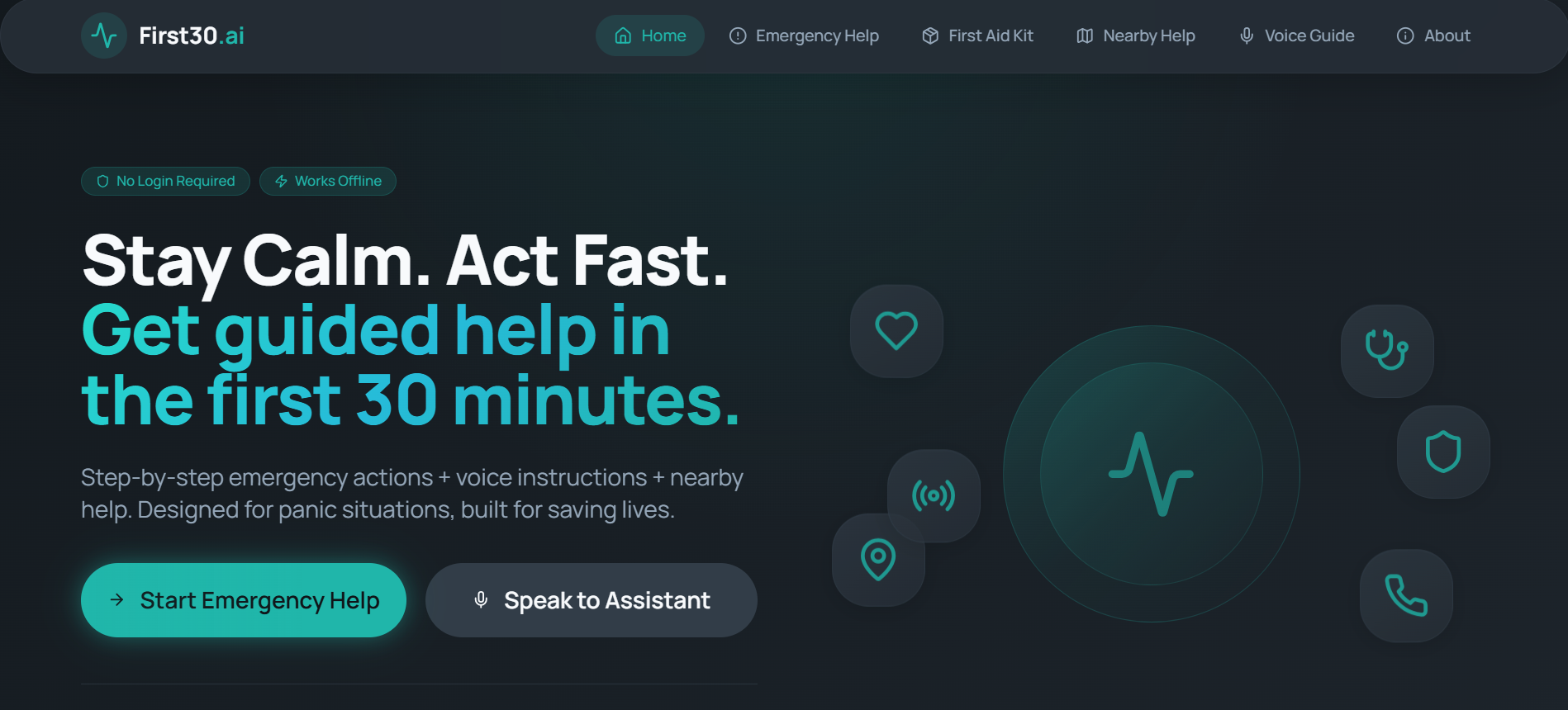
Instead of overwhelming users with long articles or complex instructions, First30.ai acts like a calm AI emergency companion that guides users step by step during the most critical 30 minutes.
Our goal is not to replace doctors or paramedics. Our goal is to help ordinary people take the next correct action confidently and quickly.
What it does
First30.ai is a graph-native, agentic AI emergency intelligence platform designed for real-world emergency response and preparedness.
The platform combines voice guidance, multi-agent AI reasoning, graph memory, location intelligence, and preparedness training into one system.
Core capabilities include:
- Voice-first emergency guidance with hands-free interaction
- Real-time AI emergency intake and structured triage
- Multi-agent reasoning powered by Jac and Jaseci
- Personalized first aid kit generation and training
- Nearby hospitals, pharmacies, AEDs, and emergency services
- Emergency simulations and preparedness scoring
- Persistent family safety graph with long-term memory
Unlike traditional first aid apps, First30.ai does not simply display static instructions. It adapts based on the situation, user profile, risks, preparedness history, and available resources.
Target Group
Primary Users
- Families and parents
- Elderly caregivers
- People without medical training
- Users in remote or underserved areas
Secondary Users
- Emergency dispatchers
- Community responders
- Schools and organizations
- First aid training programs
Tertiary Users
- Hospitals and healthcare organizations
- Insurance companies
- Public safety agencies
- NGOs and public health initiatives
Features & Functions
Emergency Guidance
- 15+ emergency scenarios including CPR, choking, burns, fractures, seizures, stroke, bleeding, drowning, and allergic reactions
- Step-by-step emergency instructions with one action per screen
- Calm UI designed to reduce panic
- Accessibility mode with larger text and simplified navigation
Voice Guide
- Real-time voice interaction using Web Speech API
- Live emergency transcription
- ElevenLabs-powered multilingual voice responses
- Hands-free guidance during emergencies
Agentic AI System
- Intake Agent for symptom extraction
- Triage Agent for severity classification
- Risk Prediction Agent for emergency escalation analysis
- Action Planning Agent for adaptive emergency response
- Resource Coordination Agent for nearby help discovery
- Preparedness Agent for long-term safety intelligence
Jac/Jaseci Graph Intelligence
- Graph-native family safety memory
- Dynamic node relationships between users, risks, incidents, kits, and training
- Walker-based reasoning flows
- Persistent preparedness tracking
- Explainable AI reasoning timeline
Emergency Intelligence Center
- Live graph visualization
- Agent orchestration dashboard
- Walker execution monitoring
- Emergency simulation mode
- Preparedness scoring system
Nearby Help
- Nearby hospitals, pharmacies, police stations, and fire stations
- OpenStreetMap + Overpass API integration
- Location-aware recommendations
- Quick navigation support
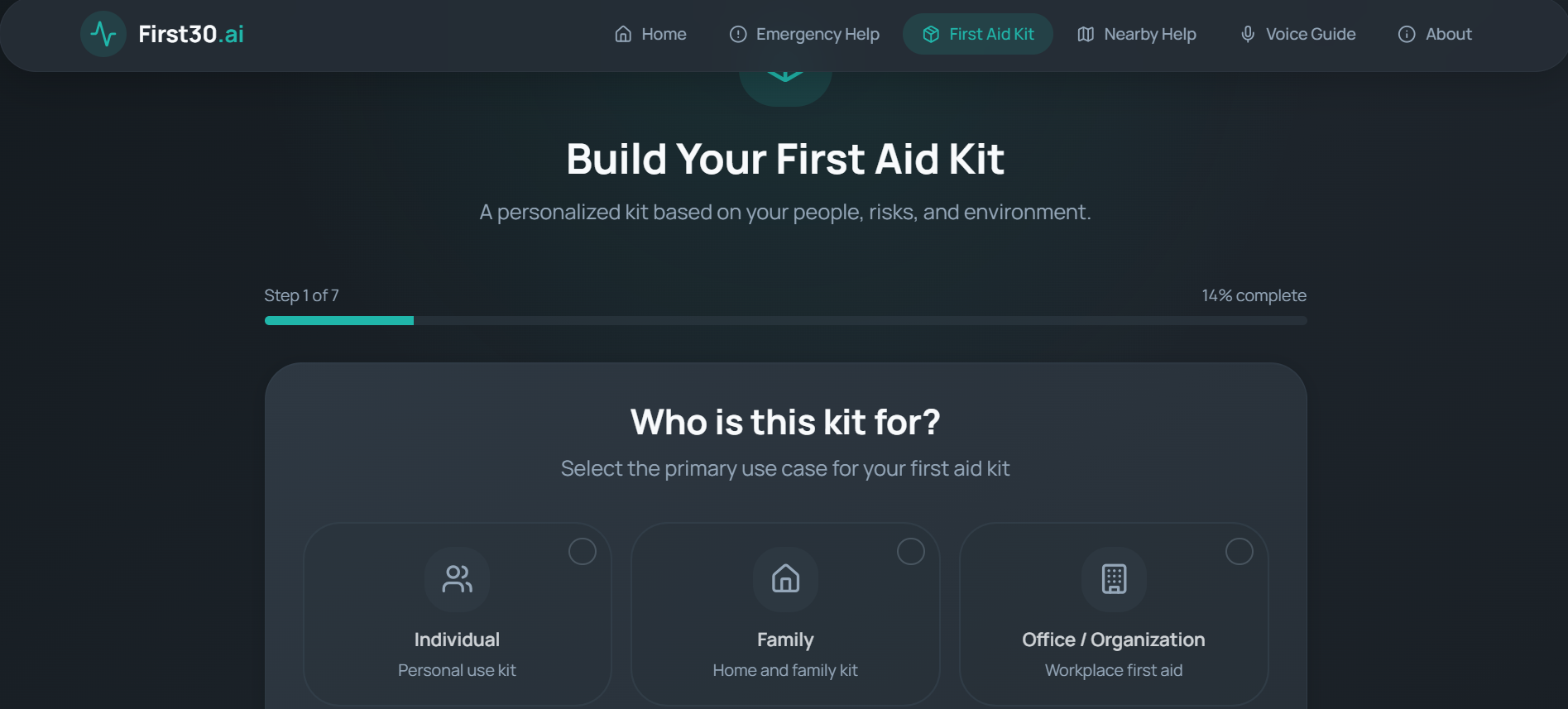
Smart First Aid Kit
- Personalized AI-generated first aid kits
- Household and risk-based recommendations
- Training lessons for every item
- Preparedness scoring and reminders
Training & Simulation
- Interactive emergency drills
- AI-evaluated responses
- Adaptive preparedness recommendations
- Long-term safety improvement tracking
Value Proposition & USP
| Traditional First Aid Apps | First30.ai |
|---|---|
| Static articles and instructions | Real-time adaptive AI guidance |
| Generic emergency flows | Personalized graph-based reasoning |
| Requires reading under stress | Voice-first hands-free interaction |
| No memory or context | Persistent preparedness intelligence |
| No training ecosystem | Simulations and readiness scoring |
| One-time usage | Long-term family safety platform |
| Limited accessibility | Multilingual and accessibility-focused |
| Single AI response | Multi-agent emergency coordination |
Innovation & Algorithmic Excellence
First30.ai focuses heavily on intelligent reasoning, graph relationships, and scalable AI orchestration rather than simple prompt-response workflows.
Why Jac & Jaseci Matter
Emergencies are relational problems:
- People have medical histories
- Risks evolve over time
- Families share environments
- Preparedness changes continuously
Jac and Jaseci allow us to model emergencies as living graph systems instead of isolated requests.
Graph-Native Intelligence
The platform stores and reasons through relationships such as:
- User → Family Member
- Family Member → Medical Condition
- User → First Aid Kit
- Incident → Risk Pattern
- Training → Preparedness Score
Walker-Based Reasoning
Specialized walkers traverse the graph to:
- Structure emergency input
- Predict risks
- Update preparedness memory
- Recommend adaptive actions
- Coordinate nearby resources
This allows explainable and scalable multi-agent reasoning rather than isolated AI responses.
User Feedback
"The calm interface made a huge difference. It feels like someone is guiding you instead of overwhelming you." — Beta Tester, Berlin
"The voice guidance is incredibly useful during CPR because you cannot keep staring at the screen." — Nurse, Hamburg
"Finally an emergency platform that works properly in Hindi for families like ours." — Software Engineer, Delhi
"The preparedness training and family graph are what make this feel futuristic." — Student Tester, Munich
Business Model
| Revenue Stream | Description |
|---|---|
| B2B Licensing | Hospitals, schools, corporate wellness, and emergency training programs |
| Freemium Model | Core emergency guidance free with premium preparedness tools |
| Enterprise Dashboard | Emergency intelligence dashboards for organizations |
| API Licensing | AI emergency reasoning APIs for third-party platforms |
| Public Health Partnerships | Government and NGO deployment programs |
| Training Integrations | Integration with certified first aid courses |
Implementation & Feasibility
Current Status
Functional prototype with:
- Emergency guidance flows
- Voice Guide
- Intelligence Center
- Graph-based AI architecture
- Simulation system
- Nearby help system
- Personalized first aid kits
Scalability
The platform is designed around modular agent architecture and graph-native memory, making it highly extensible.
Next Steps
- Clinical review with medical professionals
- Expanded multilingual support
- Offline emergency mode
- Wearable integrations
- Smartwatch emergency detection
- Hospital handoff integrations
- Community responder systems
Data Requirements & GDPR Compliance
Data Handling
| Data Type | Collection | Storage | Purpose |
|---|---|---|---|
| Location | User permission only | Temporary session | Nearby emergency services |
| Voice Input | Real-time only | Not permanently stored | Emergency guidance |
| Preparedness Graph | Optional local profile | Secure graph storage | Long-term safety intelligence |
| Language Preferences | Local storage | Browser only | Accessibility |
Privacy & Compliance
- No mandatory user accounts
- Minimal personal data collection
- User-controlled graph memory
- Transparent permissions
- GDPR-conscious architecture
- Secure API handling for voice services
How we built it
Frontend
- React
- TypeScript
- Tailwind CSS
- Framer Motion
- Leaflet Maps
AI & Agent Layer
- Jac
- Jaseci
- Graph-native memory architecture
- Multi-agent orchestration
- Walker-based reasoning system
- Gemini-2.5-Flash for structured emergency reasoning
Voice System
- ElevenLabs for multilingual TTS
- Web Speech API for transcription
Maps & Location
- OpenStreetMap
- Overpass API
- Browser Geolocation
Backend
- Edge Functions
- Secure API proxy architecture
- Structured emergency orchestration
Challenges we ran into
- Designing calm emergency UX without panic-inducing visuals
- Structuring safe emergency flows across many scenarios
- Making voice interaction reliable in noisy environments
- Designing graph-native reasoning that remains explainable
- Coordinating multiple AI agents efficiently
- Maintaining accessibility while keeping the interface visually modern
- Handling location failures and fallback systems gracefully
Accomplishments that we're proud of
- Built a working graph-native emergency intelligence system
- Successfully integrated multi-agent AI coordination
- Designed a calm emergency-first interface
- Created 15+ emergency guidance flows
- Built multilingual voice interaction with ElevenLabs
- Added preparedness simulations and scoring
- Developed a personalized first aid kit ecosystem
- Created explainable AI reasoning using Jac walkers and graph memory
What we learned
- In emergencies, clarity is more important than feature count
- Voice interaction becomes essential under stress
- Graph-native systems are extremely powerful for healthcare reasoning
- Preparedness and prevention matter just as much as emergency response
- Multi-agent AI systems outperform single-prompt approaches in complex scenarios
- Accessibility and calm UX directly affect user confidence
What's next for First30.ai
- Offline emergency mode
- Wearable integrations
- AI-powered health risk forecasting
- Expanded emergency simulations
- Clinical partnerships
- Real-world pilot programs
- Advanced preparedness analytics
Built With
- elevenlabs
- jac
- jaseci
- react
- supabase
- tailwind
- typescript

Log in or sign up for Devpost to join the conversation.