## Inspiration
I have friends who stare at an assignment for hours and just... can't start. Not because they're lazy. Because "Write a 5-page research paper, APA format, 5 sources, due Friday" feels like a wall. For students with ADHD, autism, and executive dysfunction, the hardest part isn't the work — it's starting.
I watched Yicheng, a student in my network, freeze in front of a "Graphic Production assignment" for an entire evening. They told me: "I feel as if the assignment may be worth many points of my grade." The pressure was paralyzing. Every productivity app they tried showed them a 20-step checklist, which only made the panic worse.
That's when I realized: neurodivergent students don't need more lists. They need smaller first steps.
What It Does
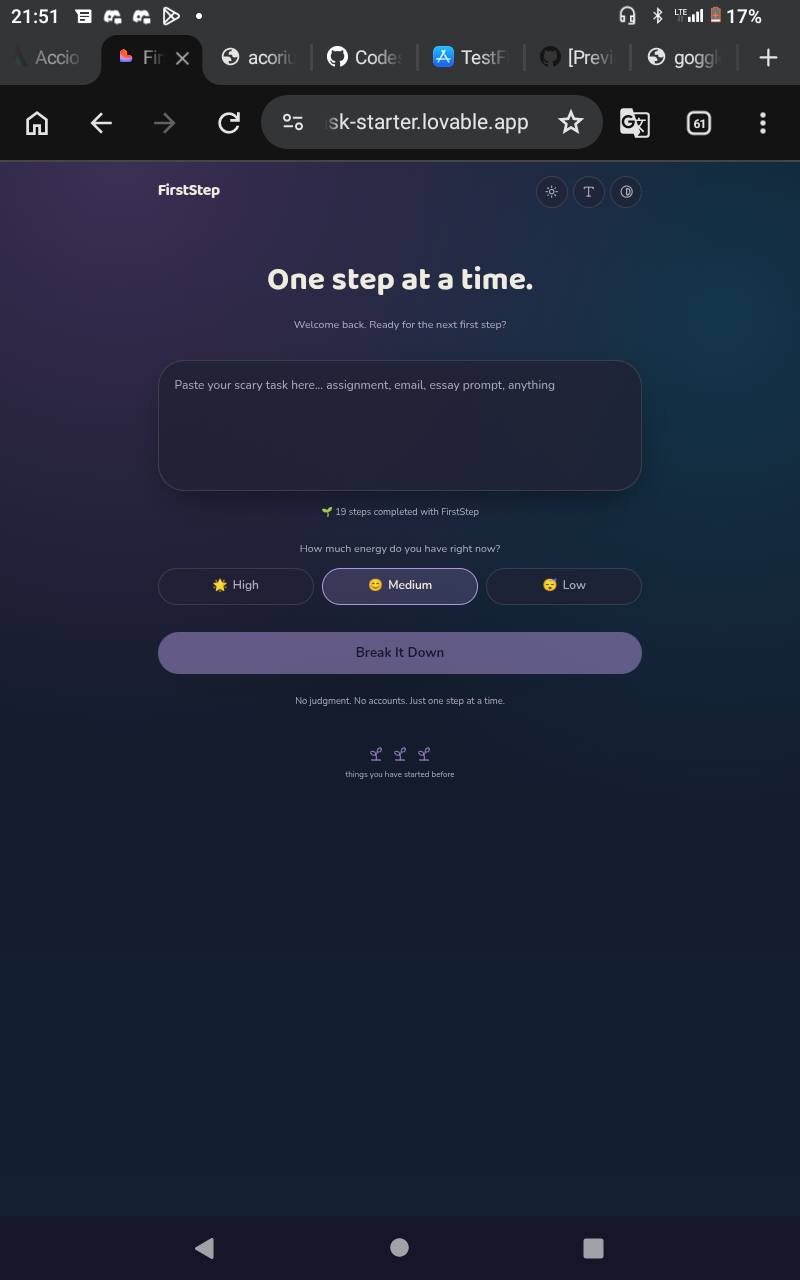
FirstStep is a one-page web app that turns any overwhelming task into one tiny, actionable step at a time.
- Paste your scary task — an essay prompt, email, syllabus, anything
- Pick your energy level — Low, Medium, or High
- Click "Break It Down" — AI decomposes the task into 2-10 minute micro-steps
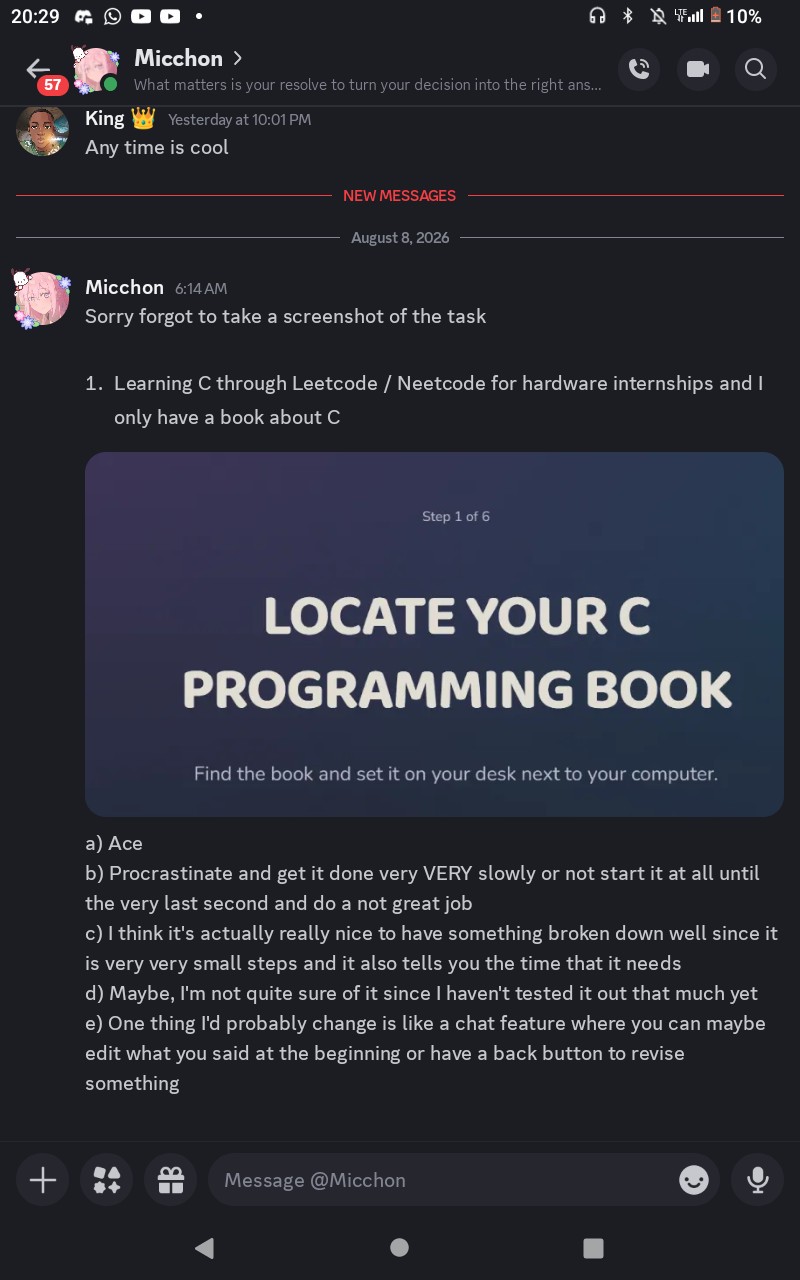
- See ONE step — full screen, massive text, one button: "Done →"
- Stuck? Hit "I'm Stuck" and the AI breaks the current step even smaller
No lists. No clutter. No popups. Just calm.
How We Built It
- Frontend: React + Tailwind CSS, built with Lovable
- AI: OpenRouter API (Claude 3.5 Haiku) with a custom system prompt engineered for neurodivergent task decomposition
- Design: Dark mode by default, dyslexia-friendly font toggle (OpenDyslexic), high contrast mode, zero animations except gentle 300ms fades
- Deploy: Vercel, zero-config
- No backend, no auth, no database — just a state machine and an API call
The core engineering is the state machine: future steps are locked until you complete the current one. This isn't a chatbot that dumps text. It's a cognitive prosthetic that engineers momentum.
Challenges We Ran Into
The "One Step" constraint was harder than expected. Our first design showed 3 steps at once. Yicheng told us it was still overwhelming. We had to redesign the entire UI to literally show only one step — and build a state machine to manage progression. What felt like a limitation became our strongest feature.
The AI sometimes gave steps that were still too big. We iterated the prompt 12 times to get the energy-adaptive logic right. Low energy needs "Open your laptop." High energy can handle bigger chunks. Getting that boundary right was critical.
Yicheng's honest feedback: they said they wouldn't use it for assignments that need teacher clarification first. Instead of hiding this, we leaned into it. It shaped our roadmap for an "Ask for Help" step type that prompts users to draft questions for their instructor.
What We Learned
Neurodivergent users don't need motivation. They need the task to stop being scary.
The smallest possible first action — "Open Google Docs" — is more powerful than any inspirational quote. We learned that accessibility isn't a feature you bolt on. It's the entire product philosophy. Every decision — dark mode default, no animations, one-step view, dyslexia font — came from listening to real users.
We also learned that honest user feedback is more valuable than fake enthusiasm. Yicheng told us what didn't work. That made FirstStep better.
What's Next
- "Ask for Help" step type for assignments that need teacher clarification before decomposition
- Cross-device sync so users can pick up where they left off
- LMS integration (Canvas, Google Classroom) to pull assignments directly
- A "Done Garden" — each completed task plants a visual sprout, building quiet momentum over time Inspiration
What it does
How we built it
Challenges we ran into
Accomplishments that we're proud of
What we learned
What's next for FIRST STEP
Built With
- accessibility
- adhd
- ai
- claude
- css
- css3
- executive
- function
- html5
- javascript
- lovable
- neurodiversity
- openrouter
- react
- tailwind
- vercel


Log in or sign up for Devpost to join the conversation.