Inspiration
In a real disaster, the life-or-death decisions made in the first hour fall to local mayors, hospital directors, school principals, and incident commanders who almost never get to practise them. In emergency management, real practice drills are called tabletop exercises: a facilitator gathers people from the fire service, utilities, the hospital, and public information around a map for half a day to argue through a crisis as it unfolds. Because those drills require a trained facilitator and a room full of specialists, most small towns, hospitals, schools, and companies run them rarely or never.
We asked a simple question: What if those role-players were autonomous AI agents with their own goals, private information, and opinions of you—standing around your own real-world table?
First Hour turns the high-stakes tabletop crisis drill into a ten-minute, seated, hands-only mixed-reality strategy game. And it belongs uniquely in spatial computing: five people arguing at once is unreadable on a flat screen, where everything collapses into a scrolling text log. Around a spatial tabletop:
- Every department head has a physical place and a spatial voice, so your ears and eyes naturally separate who is speaking;
- Where you turn your head is your leadership decision about who gets your scarce attention;
- Handing someone a physical gold chip is delegation;
- The town sits on your actual table, turning your living room or conference room into an emergency operations center.
What It Does
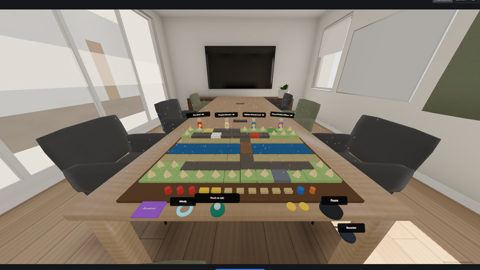
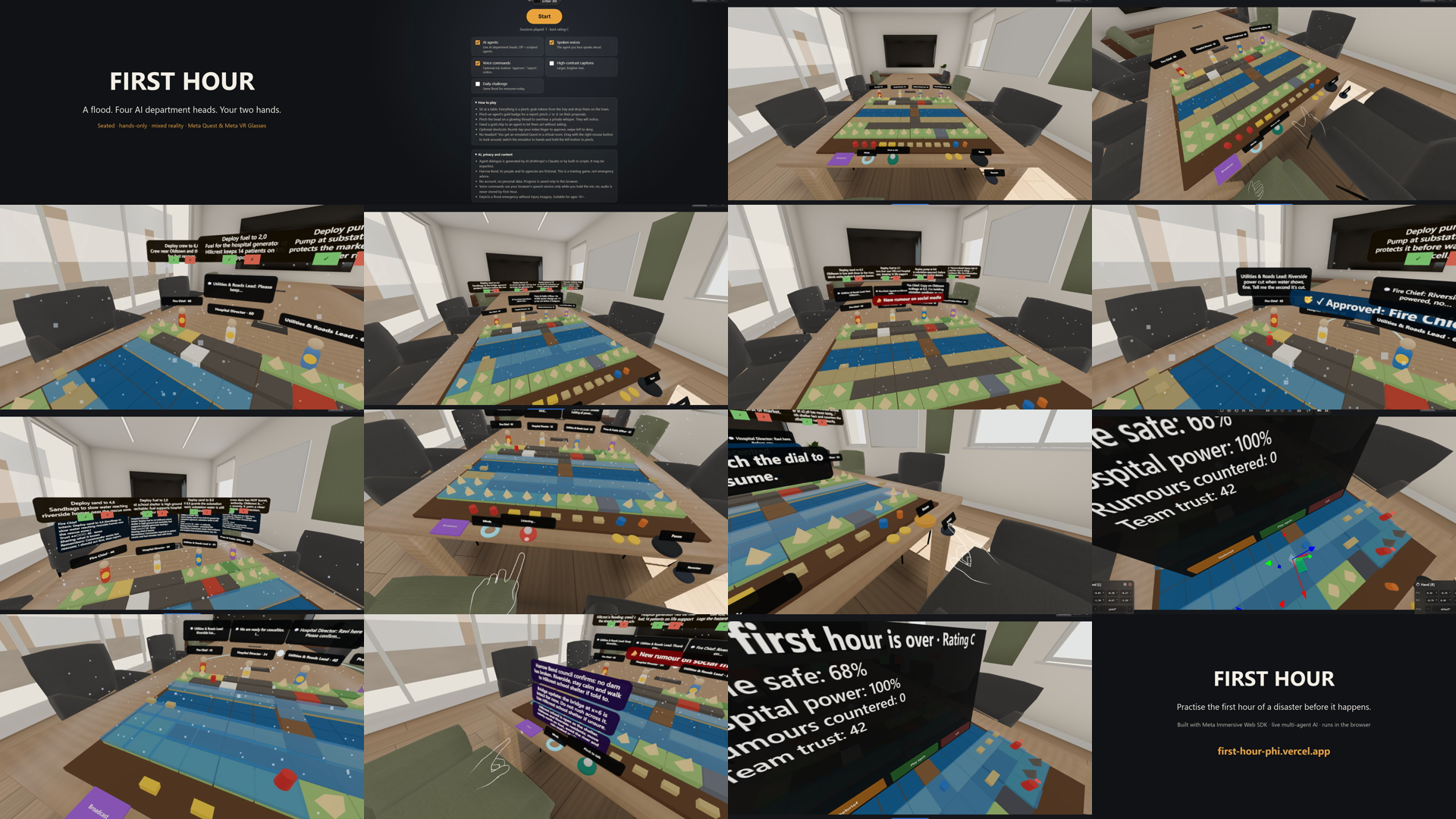
First Hour compresses one critical game hour into 10 real minutes (1 real second = 6 game seconds). When you press Start, the game scans your room for a horizontal table or desk using WebXR plane and mesh detection (or conjures a virtual tactical desk if no table is within reach). The riverside town of Harrow Bend (a 12×8 grid housing ~1,000 residents, a river with a central bridge, a power substation, a fire station, a 14-bed ICU hospital, and the Hillcrest School shelter on high ground) unfolds on your tabletop like an animated pop-up diorama. Rain begins to fall, floodwaters rise, and four embodied department heads rise along the far edge of the board:
- Chief Okafor (Fire Chief): Impulsive, brave, and blunt. Wants rescue crews in flooded neighborhoods and sandbags along residential riverbanks immediately. Only he sees district-by-district rescue call counts and crew status.
- Dr. Lindqvist (Hospital Director): Cautious, precise, and relentless about patient safety. Protects 14 ICU patients on life support. Only she sees the hospital's backup generator fuel reserves (60 game minutes) and medical grid status.
- Ravi Menon (Utilities & Roads Lead): Methodical and dry; thinks in cascading failure chains. Wants to pre-emptively cut power to flooding districts before water meets live electrical lines, and protect the substation before water hits
0.5mand triggers a town-wide blackout. Only he sees substation water sensors, bridge stress sensors, and road flood levels. - Mara Quist (Press & Public Officer): Quick, persuasive, and anxious about public trust. Fights viral social-media misinformation that erodes evacuation compliance. Only she sees the live rumour feed, public compliance rates, and emergency call volume.
The Core Loop: Attention, Trust, Whispers, and Trade-Offs
You have two hands, ten minutes, and more problems than resources:
- Attention is a physical mechanic: A 20° head-direction cone (designed to map directly to eye-tracking on Meta VR Glasses) determines which agent has your focus. The agent you face speaks at full volume and displays full captions; unfocused agents drop by
12 dBand show compact previews. - Ignore an agent and they act without you: Leave a department head unattended for >45 seconds without a delegation chip and they freelance—deploying tokens on their own judgment. Ignore them for >60 seconds and their trust erodes (
-2every 30s). Drop below 30 trust and they begin withholding their private sensor data from you. - Private Whispers & Backroom Deals: Agents don't just talk to you—they message each other. When two agents communicate privately, a glowing cyan-and-gold whisper thread arcs between them for 8 seconds. You can pinch the central bead to eavesdrop and read their message, but both agents notice you listening (
-5 trusteach). - Delegation via Gold Chips: You hold two physical Gold Authority Chips. Drop a chip at an agent's feet (
+10 trust) and their proposals execute automatically without waiting for your approval. Take the chip back (-8 trust) to revoke their autonomy. - "Agent Minds" X-Ray Lens: Pinch the glowing Minds torus lens on the near-left edge of the board to toggle a live cognitive X-ray over the table—revealing each agent's trust meter (
●●●○○), whether they are withholding intel, their current intention, their session memory of how you treated them, and color-coded network lines showing who has been messaging whom.
The After-Action Debrief & Timeline Scrubbing
When the clock hits 60 game minutes, the board freezes and scores your leadership from A to E based on Residents Safe %, Hospital Power Uptime %, Rumours Countered, and Team Trust. Entering the Debrief turns the game into an interactive leadership mirror:
- An AI Debrief Agent (backed by a deterministic rule analyzer) highlights three pivotal moments from your hour, each tied to a real emergency-management principle (Clear Objectives, Span of Control, Delegation, Checking Information, One Public Message).
- Pinching any moment—or pinching along the minute-by-minute timeline scrubber—replays the 3D town board to that exact 10-second snapshot.
- Finally, the debrief reveals every private whisper you missed while you were looking elsewhere.
How We Built It
1. Spatial Layer: Meta Immersive Web SDK (IWSDK 1.0) & Procedural Three.js
- Built in TypeScript on Meta IWSDK 1.0 (
@iwsdk/core) with WebXRimmersive-arpassthrough,handTracking,anchors,planeDetection, andmeshDetection. - Zero external 3D model or audio file downloads: Every mesh (the instanced 12×8 town board, rising water planes, houses, hospital, substation, bridges, agent figures, tokens, whisper arcs, rain particles, and UI cards) is built procedurally at startup, keeping the scene around ~30k triangles and ~48 visible meshes for smooth 60–72+ fps Quest performance.
- Procedural WebAudio Engine (
src/audio/): Rain ambience is real-time filtered noise scaled to simulation rainfall intensity; each agent speaks in spatialized procedural syllables with a distinct pitch and formant timbre (or optional Web Speech API synthesis); chimes mark proposals, placements, rejections, and crisis alarms. - Smart Table Placement (
src/xr/planes.ts,src/xr/table.ts): QueriesXRPlaneand boundedXRMeshsurfaces, prioritizingtable/desksemantic labels within0.35–1.1mabove the floor whose nearest edge is within1.2mof the seated player. Automatically scales the 12:8 board between0.5×0.35mand0.9×0.6mto fit the real surface, or spawns a fallback virtual desk at0.45mreach after 3 seconds. - Meta VR Glasses FOV-Ready: Designed and verified against the
metaVRGlassesemulator profile (74° × 68°field of view). All four agents sit within±27°along the far edge, and the token tray occupies the central 70% of the near edge so essential controls never clip outside the narrower optical window.
2. The Deterministic Simulation Engine (src/sim/)
The simulation is pure TypeScript with zero DOM or rendering dependencies, stepping in exact 0.5s real-time increments (3 game seconds) driven by a seeded Mulberry32 PRNG:
- Hydrology (
flood.ts): River cells accumulaterain × 0.0013per game second and equalize water + elevation across orthogonal neighbors. Sandbags raise effective elevation by+1.0per stack; the mobile pump drains its cell and neighbors at0.004/s. - Power & Critical Infrastructure (
power.ts): If water at the substation exceeds0.5, town-wide grid power drops. Flooded energized cells log live-water electrocution hazards unless Utilities cuts district power. The hospital seamlessly transitions to its 60-minute backup generator and tracks cumulative dark time if fuel runs dry. - Population & Evacuation Routing (
people.ts): Tracks ~1,000 residents across residential cells. Water>0.3places residents in danger; rescue crews stabilize a cell in120game seconds; buses pathfind over intact roads and bridges to the high-ground school shelter at0.2 × compliance / (1 + pathLength / 10)people per game second. - Strict Action Validation (
actions.ts): Every action—whether initiated by the player's hands or proposed by an AI agent—passes throughvalidateAction()andapplyAction(), checking coordinates, token availability, terrain rules, and role permissions before mutating state.
3. True 7-Agent Architecture (src/agents/ & api/turn.ts)
Unlike single-prompt "chat wrappers," First Hour runs seven isolated agents coordinated by Orchestrator (src/agents/orchestrator.ts) and a stateless Vercel serverless endpoint (api/turn.ts) calling Claude (claude-haiku-5-5 by default for low latency and ~$0.10/session cost, configurable via AGENT_MODEL to claude-opus-5-5):
- Asymmetric Observations (
observe.ts): Each department head receives only its own domain telemetry, its personal inbox of whispers and commander orders, its trust score, and its session memory. - Structured JSON Schema Enforcement (
prompts.ts,types.ts): Both the Anthropic API (output_config.format: json_schema) and dual client/server Zod validators enforce strict output bounds: speech≤25 words, rationale≤15 words, whispers≤20 words, memory notes≤15 words, and at most 2 validated action proposals per turn. - Behind-the-Scenes Pacing & Analysis:
- Director Agent (
director.ts): Monitors crisis tension and triggers up to one crisis event per 60s from a 7-card deck (bridge_collapse,generator_fault,bus_stranded,rumour_dam,rain_surge,substation_alarm,viral_livestream). - Rumor Agent (
rumor.ts): Generates contextual social-media misinformation every ≥45s that penalizes district evacuation compliance by0.1 × severityuntil countered by a broadcast. - Debrief Agent (
debrief.ts): Synthesizes the session log into three actionable leadership critiques.
- Director Agent (
- 100% Playable Offline / AI-Off ("Remove the Service" Compliance): Every single agent is backed by a deterministic heuristic policy (
fallback.ts) and a 288-line situational dialogue bank (lines.ts— 4 agents × 6 situations × 12 lines). If you toggle "AI agents on" off on the landing page, play offline, hit the 8-second timeout, or reach the 250-call session cap, the game plays seamlessly from start to debrief without a single hiccup.
4. Replayability, Persistence & Daily Challenge (src/game/)
- Campaign Progression (
persist.ts,progress.ts): Saves progress inlocalStoragewith zero sign-up friction. Earning an A or B rating unlocks persistent town upgrades across runs (1. Riverside Levee, 2. 90-Min Backup Hospital Generator, 3. Third Evacuation Bus), rotates weather conditions (Heavy Rain → Night Storm → Light Rain), and carries up to 3 cross-session agent memory notes into your next drill ("You left me hanging last time"). - Daily Challenge Mode (
daily.ts): Hashes the local calendar date (FNV-1a) into a shared daily seed so every player and judge on the same day faces the exact same storm curve and tracks their daily personal best.
Hand Interactions & Multimodal Accessibility
First Hour is built from the ground up to be 100% controller-free. Every interaction sits within a comfortable 0.3–0.7m (two-foot) seated reach:
| Interaction | Gesture / Modality | Spatial Feedback & Game Effect |
|---|---|---|
| Deploy / Recall Resources | Pinch-grab & release tokens from the near-edge tray (Sandbags ×4, Crews ×2, Buses ×2, Pump ×1, Fuel Truck ×1) |
Hovering highlights valid board cells in green/red; invalid drops (e.g., a bus in the river) chime and glide smoothly back to the tray. Releasing off-board recalls the token. |
| Request Sitrep | Pinch or fingertip-poke an agent's gold Badge | Immediately wakes that agent to deliver a domain report (or withhold it if trust <30). |
| Approve / Deny Proposal | Pinch or poke ✓ or ✗ on the floating card above an agent |
Executes the action (+5 trust) or rejects it (-3 trust). Unanswered cards expire after 15s. |
| Eavesdrop on Whispers | Pinch the glowing bead at the apex of a Whisper Thread | Reveals the private message between two agents; both notice (-5 trust each). |
| Delegate Authority | Pinch-grab a Gold Chip and drop it at an agent's feet | Grants autonomous execution (+10 trust); picking the chip back up revokes it (-8 trust). |
| Issue Public Broadcast | Pinch the purple Broadcast card, then pinch 1 of 3 drafts | Boosts town-wide compliance (+0.15) and counters active rumours (+0.20 in target district). 30s cooldown. |
| Inspect Agent Minds | Pinch or poke the cyan Minds torus lens | Toggles the X-ray cognitive overlay (trust bars, withheld intel flags, memories, and whisper network links). |
| Direct Attention | Natural head turn / gaze (20° cone) | Highlights the focused agent, expands their captions, raises their voice, and prevents neglect decay. |
| Hand Microgestures | Thumb-to-index tap / swipe (Quest hand microgestures) | Tap = approve focused proposal; Swipe left = deny; Swipe forward = request status report. |
| Optional Voice Commands | Pinch-to-Talk Mic on the table (SpeechRecognition) |
Speak natural orders ("Approve Fire Chief", "Ravi, status report", "Chief, send crews to Riverside", "Pause"). Every voice command has a 1:1 hand equivalent. |
| Pause & Comfort | Poke the Pause Dial (or remove headset / open menu) | Freezes simulation, audio, and agent timers; increments session.epoch so in-flight AI replies from before the pause are safely discarded. |
Challenges We Ran Into
- Keeping Asynchronous LLMs Honest Against a Real-Time Clock: An AI agent takes 1–5 seconds to reply, during which floodwaters move, bridges collapse, or the player might pause the game or move a token themselves. We solved this with two-stage validation and epoch tagging: every pause increments
session.epoch(dropping stale replies), and every agent proposal is validated against the simulation when it arrives and again at the moment the player pinches✓(returning stale proposals to the agent's inbox so it can adapt). - Preventing "Wall-of-Text" Fatigue in XR: Reading paragraphs in passthrough kills presence and overflows the narrower Meta VR Glasses field of view. We enforced hard word caps at both the schema and prompt levels (
≤25 wordsfor speech, rendered on single-line high-contrast canvas billboards), shifted relationship state into the visual Agent Minds X-ray lens, and made head direction automatically collapse unfocused captions. - Fitting Five Competing Voices Into One Seated Table: When four agents want your attention at once, flat audio becomes chaos. By synthesizing distinct procedural voice formants in 3D space and attenuating unfocused agents by
12 dB, simply turning your head toward Dr. Lindqvist or Chief Okafor naturally filters the room. - Developing and Verifying Without Physical Hardware Access: Because development relied on the IWSDK browser emulator (IWER +
@iwer/sem), we built 144 automated unit and integration tests across 21 test suites covering every simulation rule, orchestrator edge case, table-finding geometry calculation, and voice parser rule—plus a development×8fast-forward mode (KeyF) and automated CLI hand-sequence scripts (npx @iwsdk/cli xr run-sequence) to verify full 10-minute sessions end to end.
Accomplishments We're Proud Of
- Genuinely Agentic Gameplay—Not a Chatbot Wrapper: Agents have partial observability, private inboxes, trust thresholds, autonomous freelancing when ignored, and backchannel whispers—yet every action is strictly governed by a deterministic simulation.
- Passes the "Remove the AI" Test 100%: Toggle AI off on the landing page (or unplug the network) and First Hour remains a rich, replayable strategy game powered by heuristic policies and 288 pre-written situational lines.
- Zero-Asset-Download Instant Load: The entire 3D town, characters, particle effects, and spatial audio engine are procedurally generated in TypeScript—loading almost instantly in the Meta Quest Browser over HTTPS with ~30k triangles.
- 144 Passing Tests Across 21 Suites: Complete deterministic test coverage of flood physics, electrical cascading failures, evacuation pathfinding, table geometry selection, schema validation, and multi-agent orchestration.
What's Next for First Hour
- Multiplayer Human + AI Tabletop Drills: Allow 2–4 real colleagues in co-located or remote headsets to take seats around the same table, with AI agents filling the remaining departments.
- New Crisis Cartridges: Wildfire evacuation, urban heatwave & grid brownout, hospital mass-casualty surge, and municipal water-plant cyberattack.
- Hardware Eye-Tracking on Meta VR Glasses: Bind
src/game/attention.tsdirectly to WebXR eye-gaze rays so glancing at an agent or awhisper thread focuses them effortlessly. - Bring Your Own Town (GIS Import): Generate the board from OpenStreetMap elevation and building footprints so real city councils, schools, and hospitals can drill on their own streets.
- Enterprise "Drill Mode": Facilitator scenario injection,certified FEMA/ICS after-action report exports (PDF/JSON), and institutional training dashboards.
Built With
- anthropic-claude-api
- hand-tracking
- meta-immersive-web-sdk-(iwsdk)
- meta-quest
- meta-vr-glasses
- mixed-reality
- node.js
- three.js
- typescript
- vercel
- vite
- web-audio-api
- web-speech-api
- webxr
- zod

