Inspiration
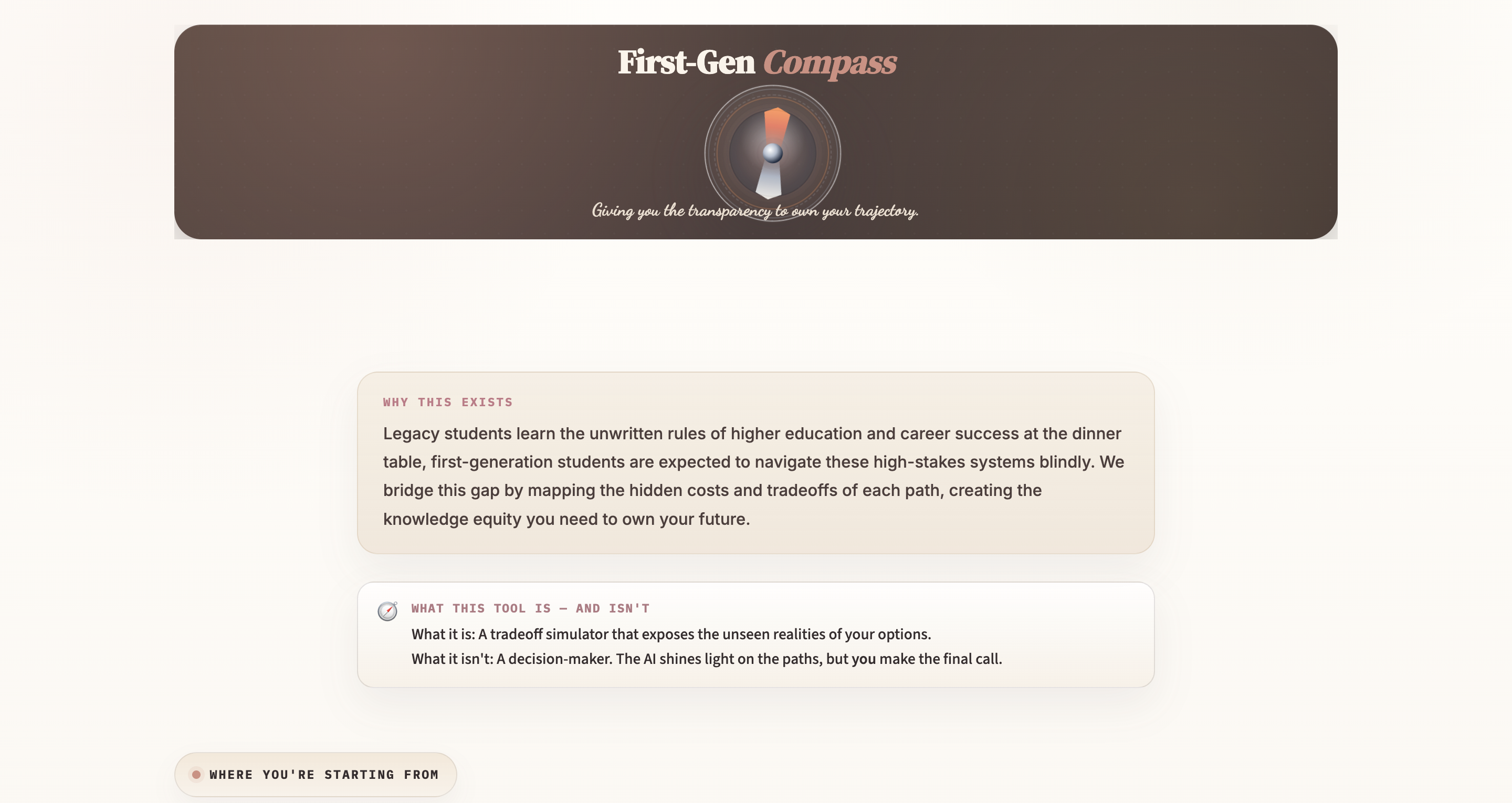
My mother was a first-generation college student raised by illiterate parents. When she faced major life choices, she didn't know the unwritten rules, the hidden costs, or the right questions to ask. There was no legacy network at the dinner table to guide her; she had to navigate a high-stakes, complex world completely alone. I built First-Gen Compass for people like her. First-generation students don't just lack resources; they lack structural clarity. When choices are high-stakes, the fear of things "going sideways" causes analysis paralysis. This tool acts as an equalizer, translating institutional opacity into transparent, empowering equity.
What it does
✽First-Gen Compass is a Life Decision Simulator built specifically to help users move from paralyzing uncertainty to structured action.
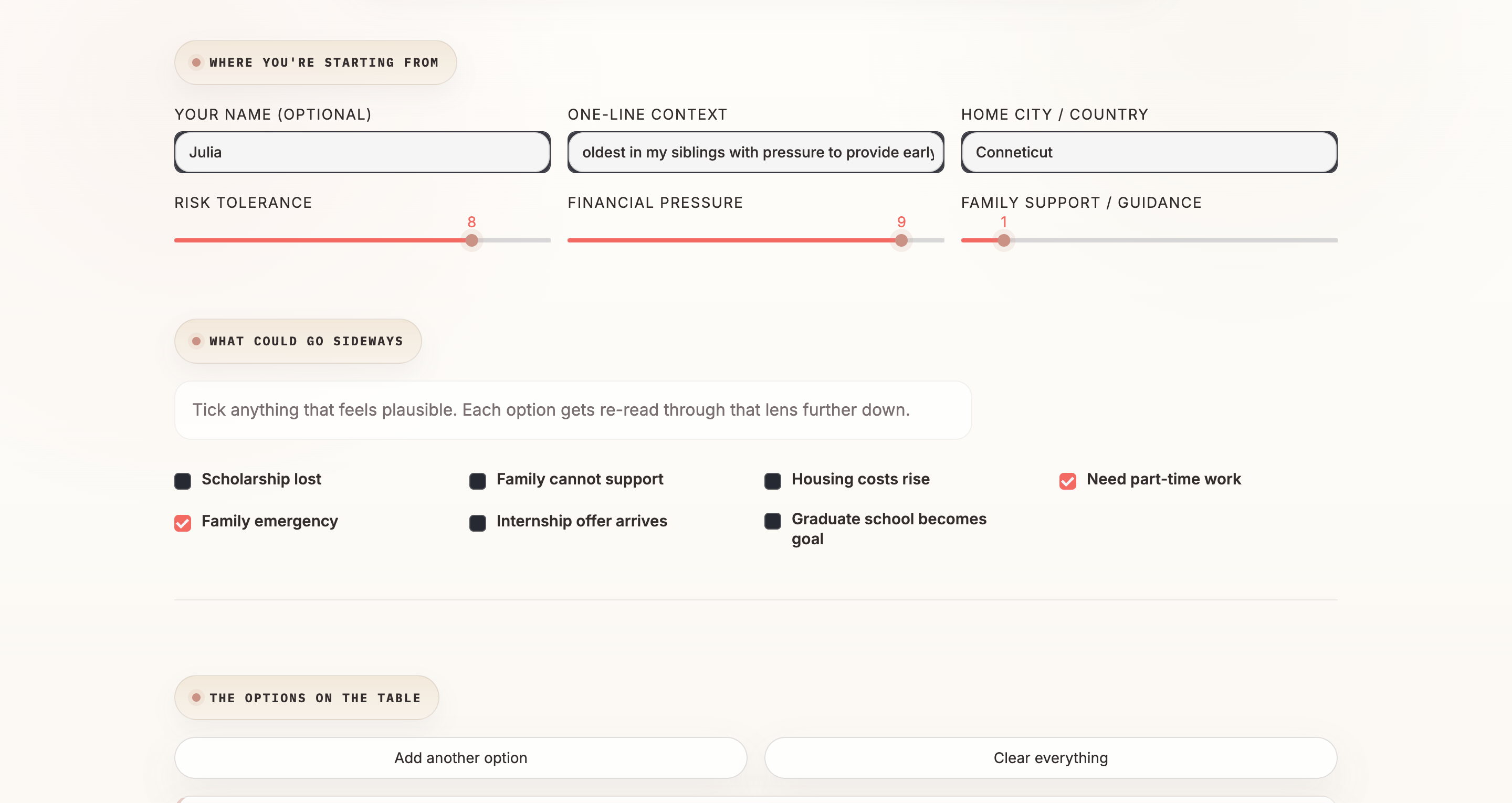
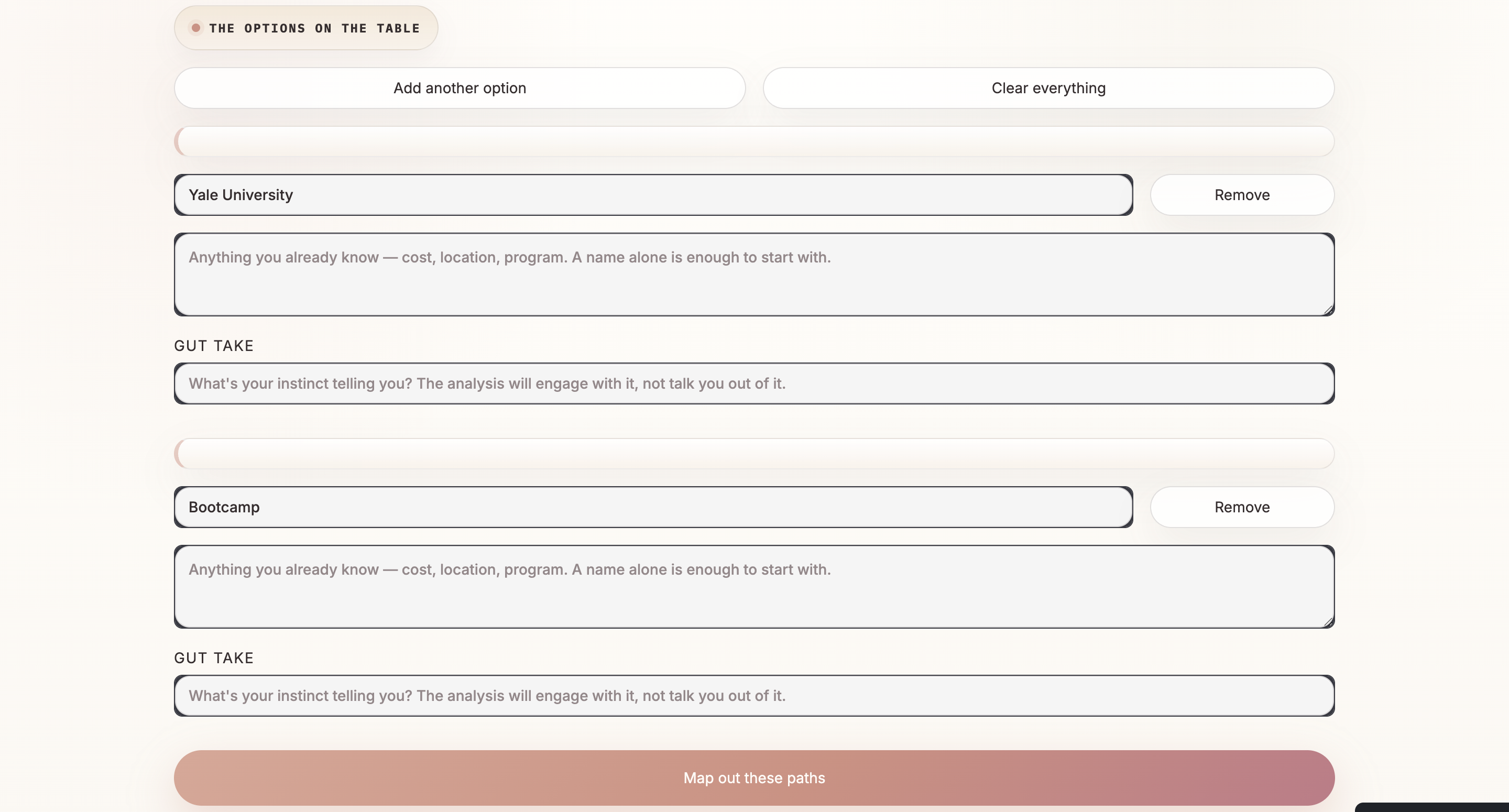
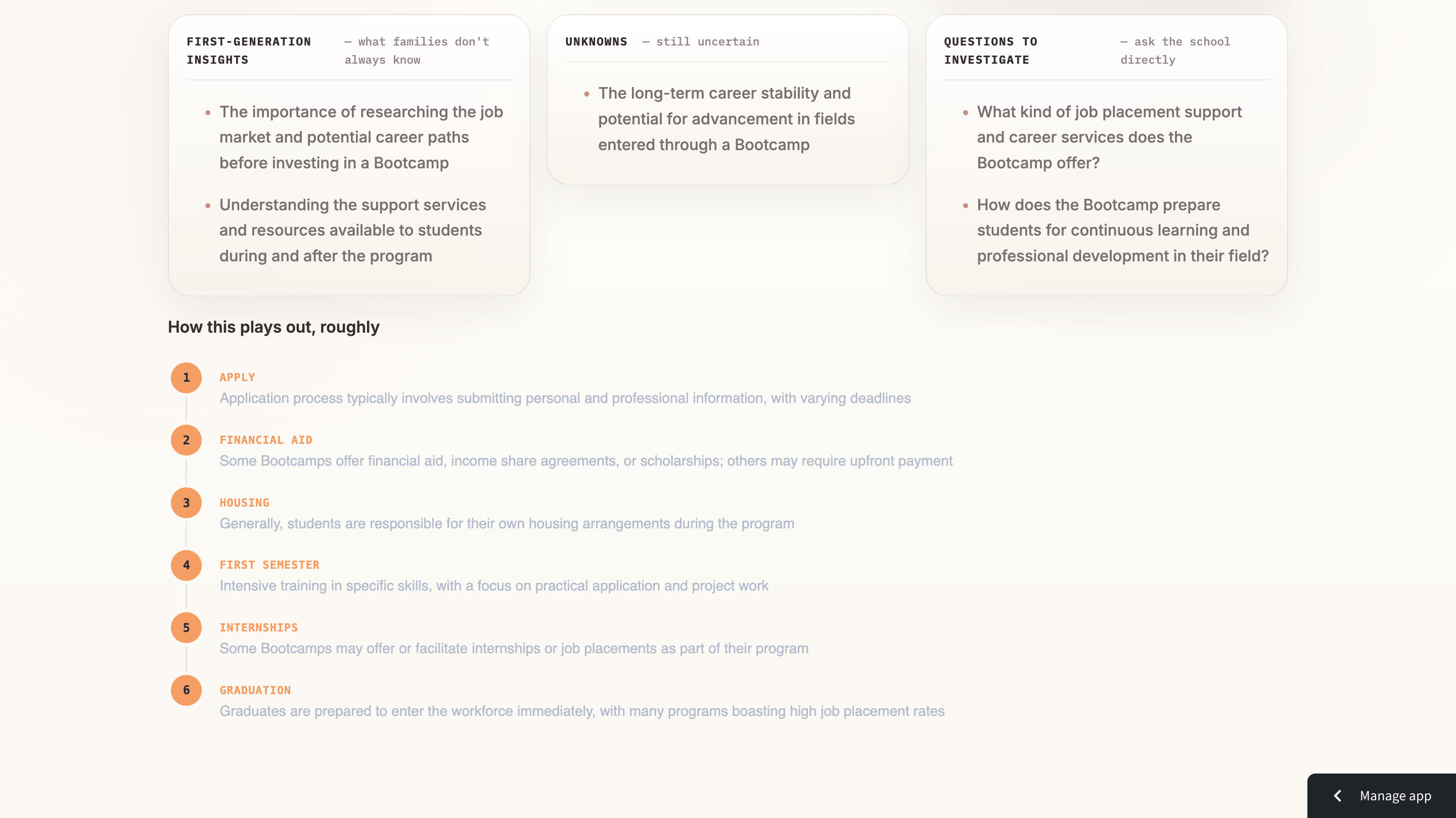
✽The Input Engine: Users input their starting point, their options, and critically, a personalized vulnerability checklist ("What could go sideways"—e.g., losing a scholarship, family emergencies, housing inflation).
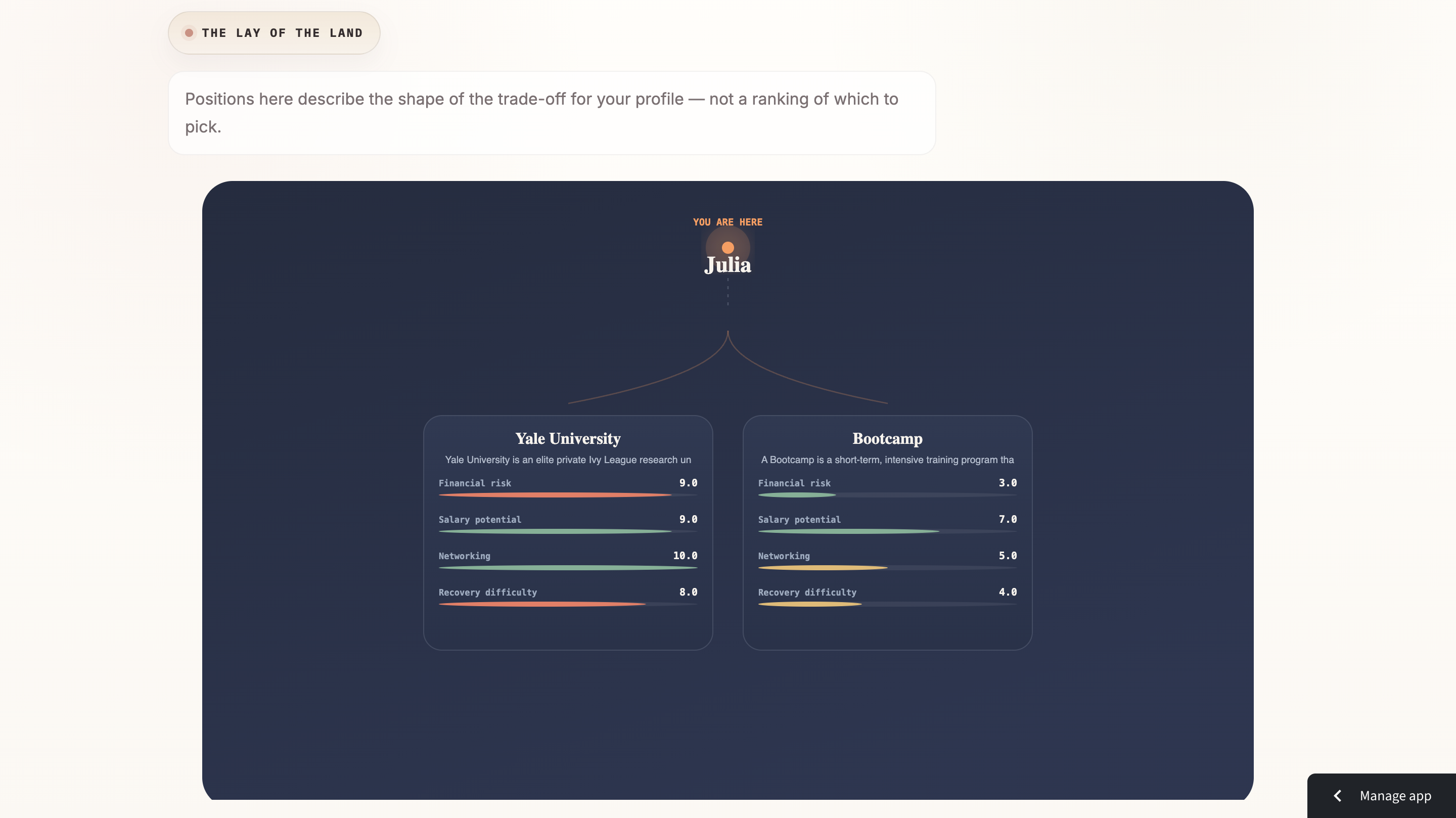
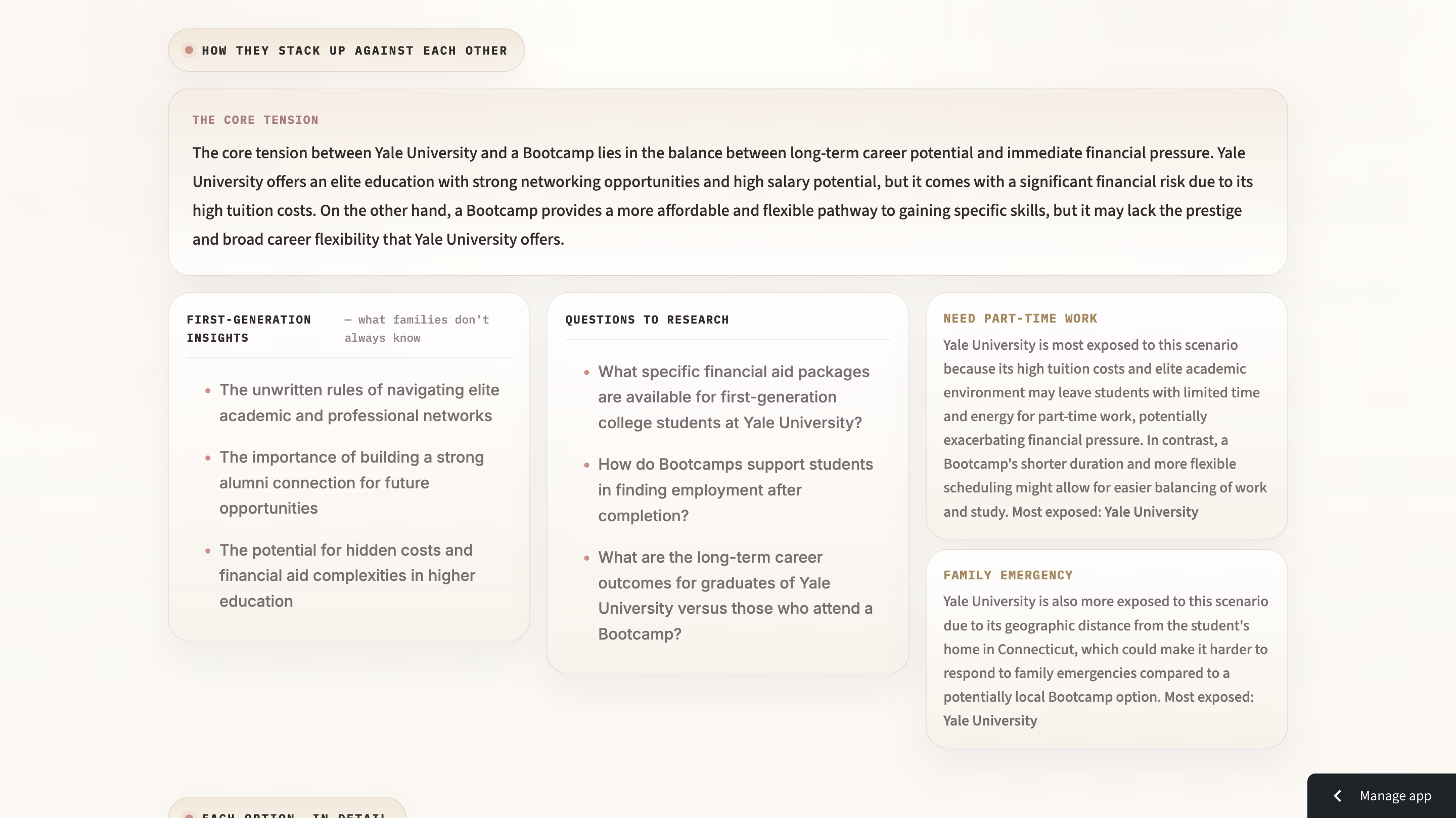
✽The Tradeoff Mapping System: Instead of a basic pros/cons list, the app outputs an interactive, relational map showing the core tension between choices.
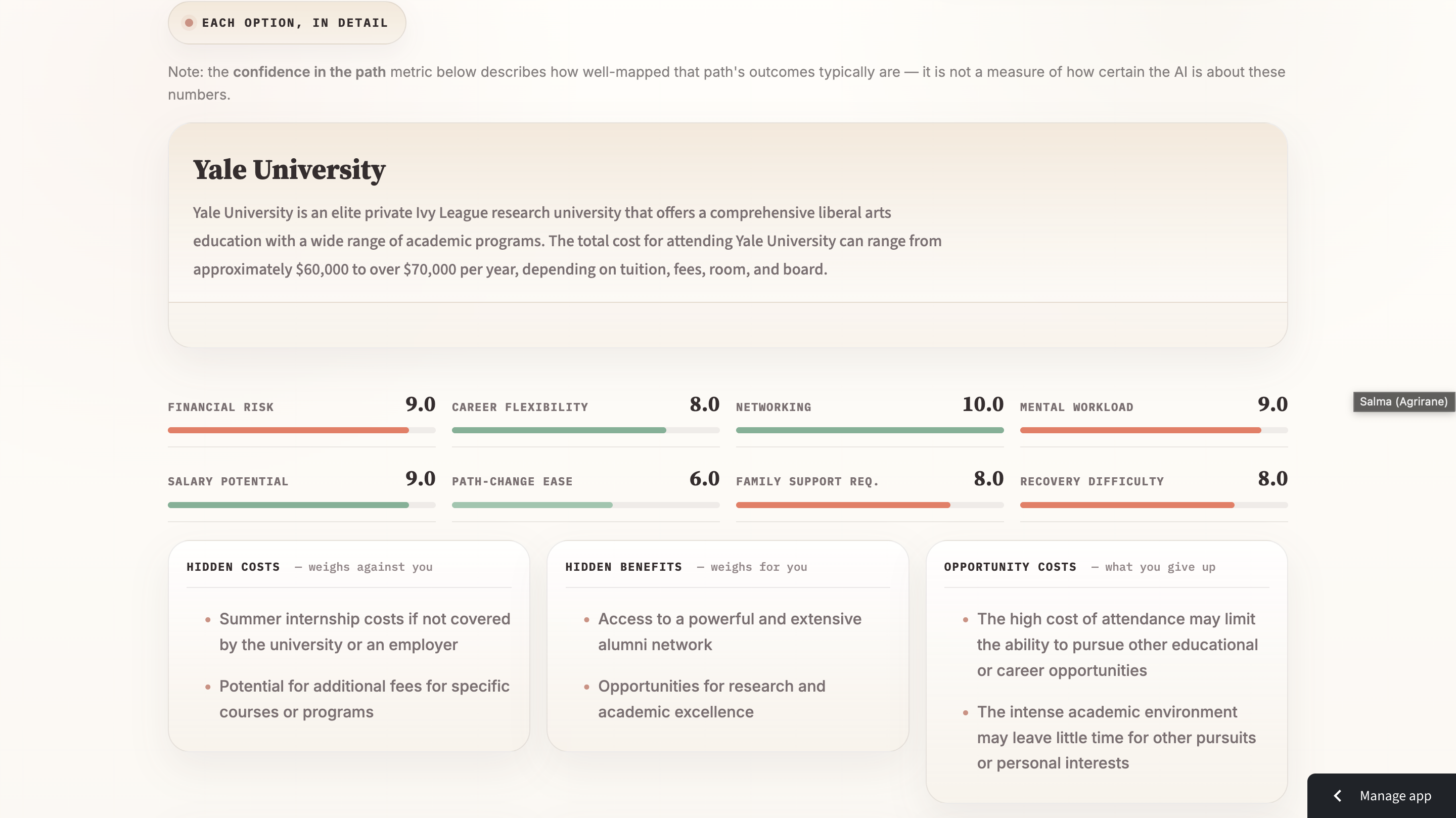
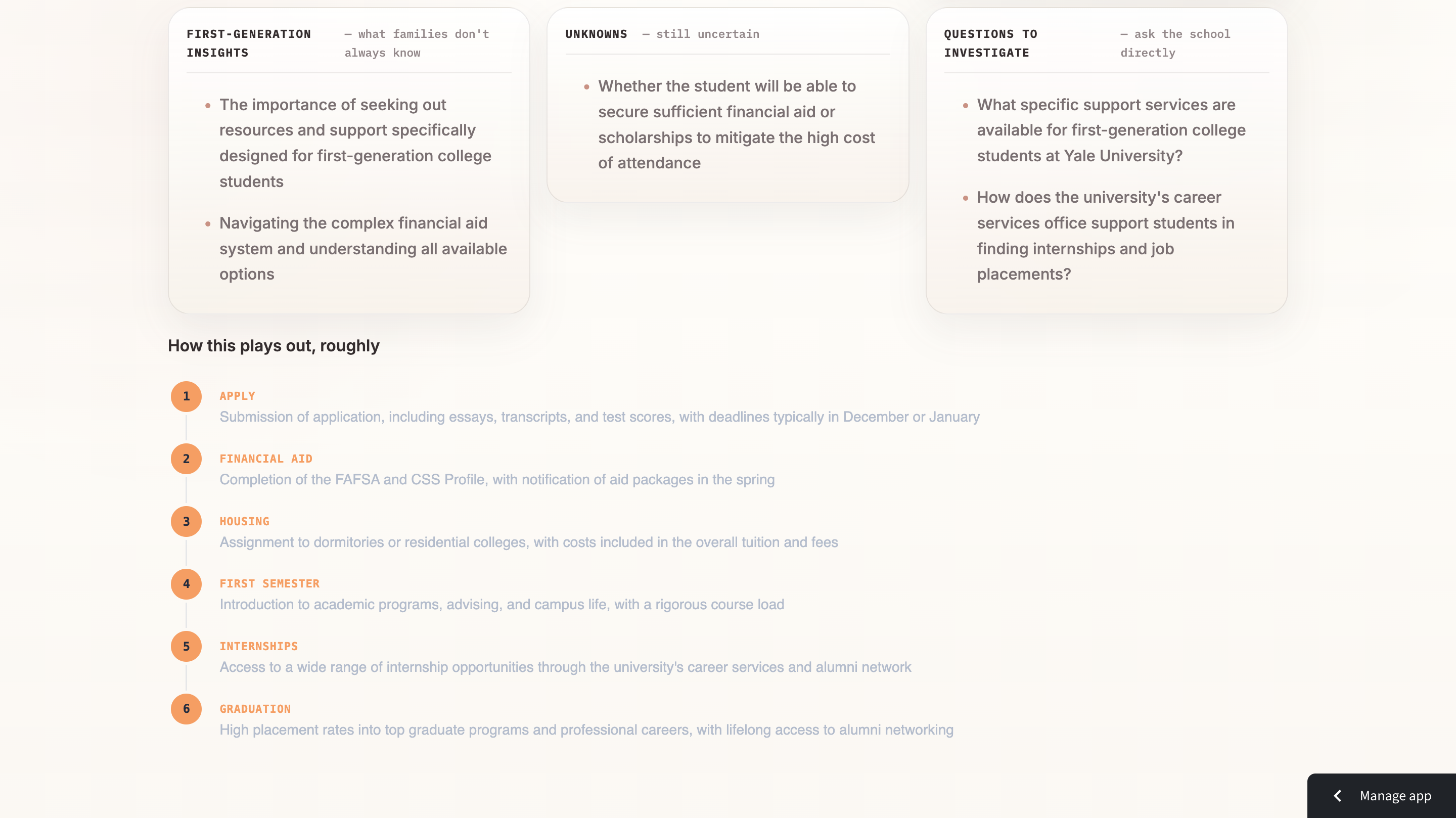
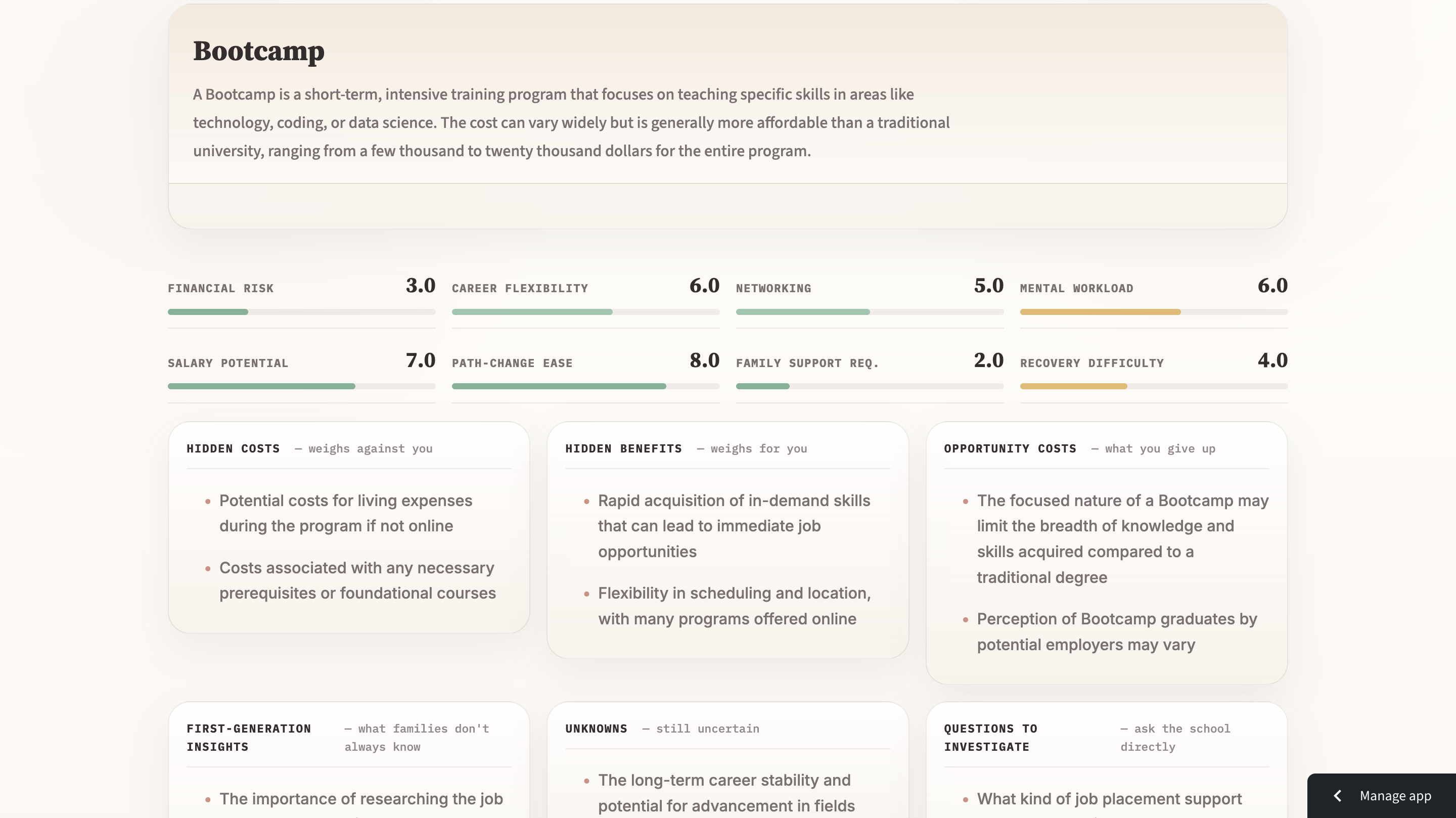
✽Deep-Dive Analytics: It breaks down every option across a 13-dimension calibrated scale (from Financial Risk and Salary Potential to Mental Workload and Recovery Difficulty) while dynamically surfacing hidden costs, unwritten institutional rules, and critical unknown factors.
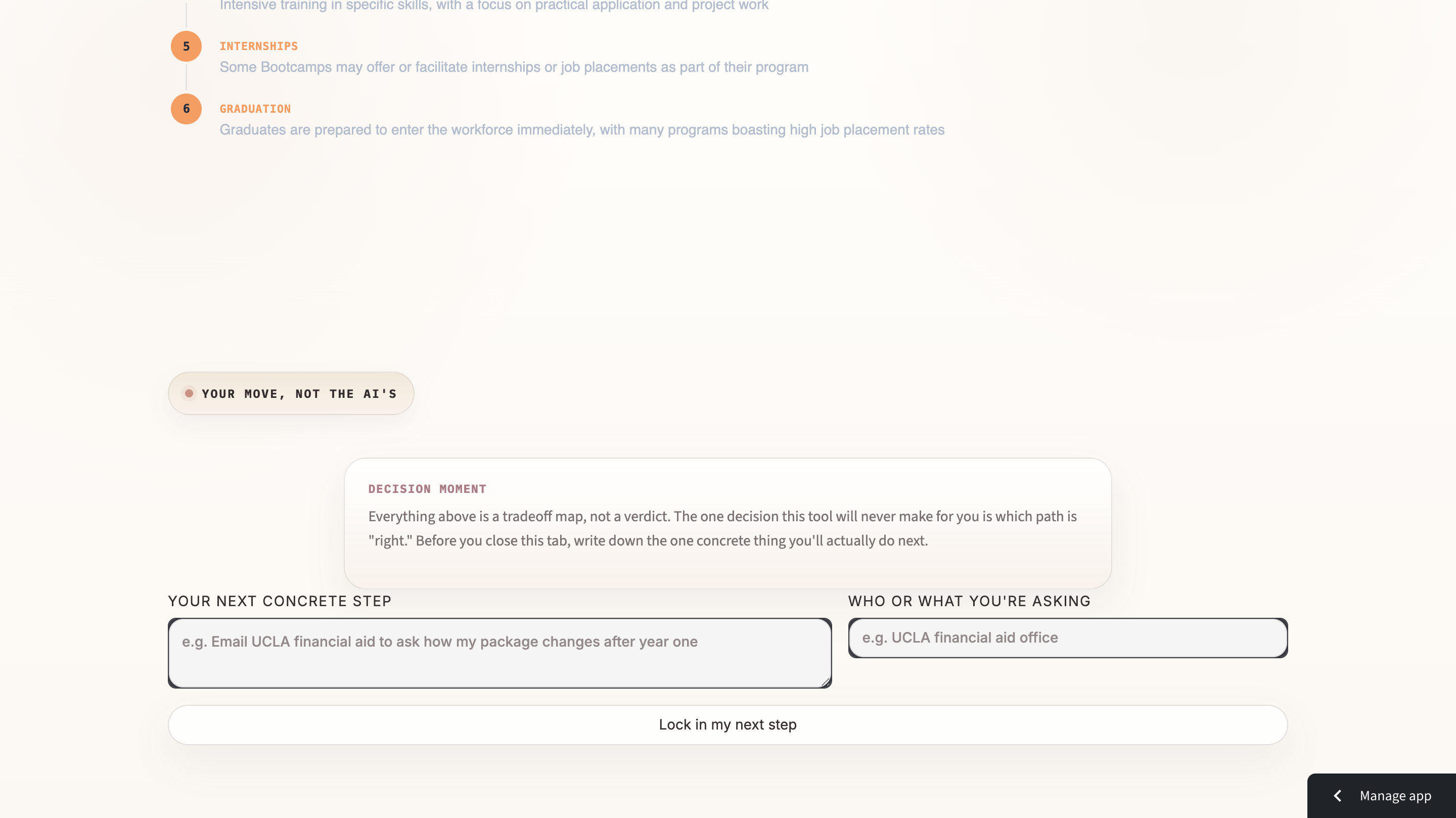
✽The Decision Moment: To prevent over-reliance on technology, the app never delivers an automated verdict. It concludes with a mandatory Human-in-the-Loop step, asking the user to commit to their next concrete real-world action.
How we built it
We built First-Gen Compass to feel like a premium, native application while maintaining the rapid prototyping speed of Python. We used Streamlit as our core framework but completely overhauled its default interface. We injected custom CSS, custom typography (Source Serif 4, IBM Plex Mono), and a bespoke floating SVG compass widget rendered directly through HTML/CSS injections.
The backend logic relies on structured LLM calls. We designed a rigorous prompt engineering pipeline that takes the user's profile, financial pressures, and chosen options, and sends them to the NVIDIA NIM API (Meta Llama 3.3 70B Instruct). Crucially, we force the LLM to return a strict JSON payload scoring 13 specific metrics (like "bureaucracy" and "recovery difficulty") and qualitative insights (hidden costs, first-gen unwritten rules).
To ensure the platform acts as a true catalyst for students—and not just a generic AI wrapper—we moved beyond standard API deployment. We focused heavily on fine-tuning and rigorous, iterative testing. Our team aggressively stress-tested the system against a massive variety of edge cases and nuanced first-generation scenarios. We continuously refined the model's constraints and scoring weights until the structured outputs consistently delivered highly accurate, realistic, and unvarnished assessments.
Challenges we ran into
Our biggest hurdle was calibrating the AI to prevent "false certainty." In early iterations, the LLM tended to act like an oracle, giving authoritative advice on what the user should do. This is incredibly dangerous for high-stakes decisions. We had to heavily restructure our prompt engineering and system guardrails, forcing the system to act purely as a data-mirror and tradeoff framework rather than an automated verdict machine.
Accomplishments that we're proud of
We successfully built a platform that handles uncertainty honestly. We are incredibly proud of our multi-dimensional evaluation grid, which explicitly scores abstract constraints like "Mental Workload" and "Path-Change Ease." Making the invisible, unwritten rules of higher education and career building visible to those who need it most is our proudest achievement.
What we learned
We learned that Responsible AI is not an afterthought; it is a fundamental architectural pillar. Designing the "Human-in-the-Loop" step made us realize that the true value of AI in decision-making isn't to think for humans, but to clear the mental clutter so humans can think clearly for themselves.
What's next for First-Gen Compass
✽Real-time data grounding: replace pure model-knowledge scoring with live retrieval — actual net-price calculators, current financial aid deadlines, and Bureau of Labor Statistics salary data — so figures are verifiable, not just plausible. ✽Outcome feedback loop: let students log what actually happened after they picked a path, so we can calibrate how accurate our "hidden costs" and "first-gen insights" really are over time. ✽Counselor/mentor mode: a shared view so a school counselor or mentor can review a student's tradeoff map with them, since the tool is meant to inform a conversation, not replace one. ✽Expanded scenario library: more "what could go sideways" branches (visa denial, mid-program major change, regional cost-of-living shocks). ✽Multi-language support: many first-gen students' families are more comfortable in a language other than English; we want the core insights translated so the whole household can engage with the decision.
Built With
- css
- html
- javascript
- json
- nvidia-nim-api
- python
- streamlit

Log in or sign up for Devpost to join the conversation.