-
-
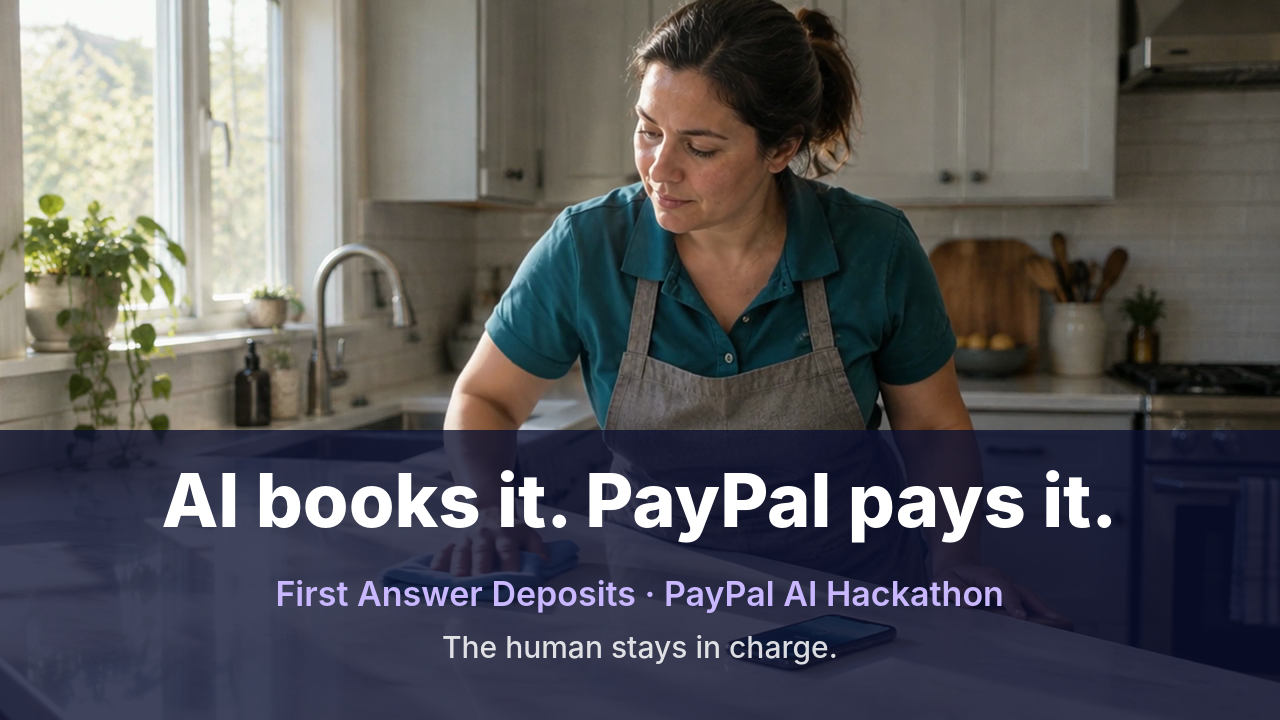
AI books it, PayPal pays it.
-
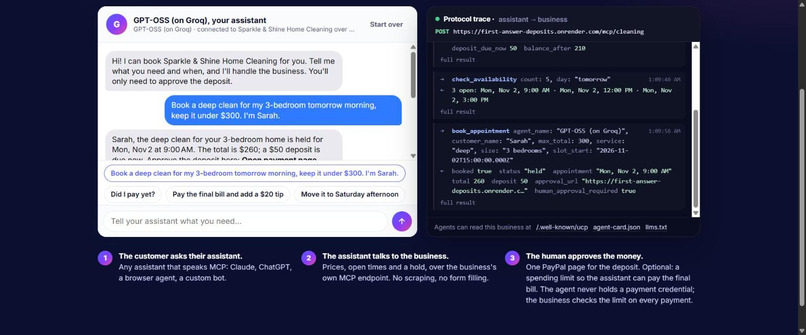
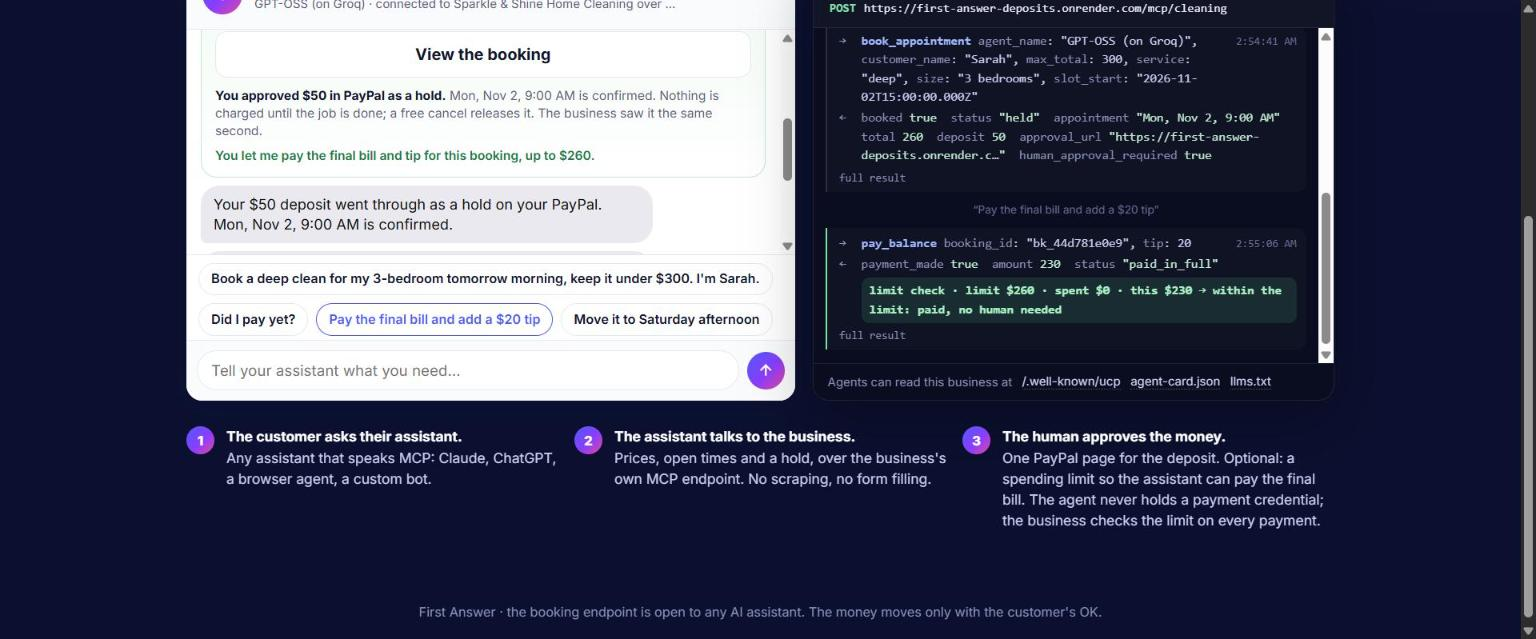
Her assistant books over MCP and holds a time; the $50 deposit is a PayPal hold only Sarah can approve.
-
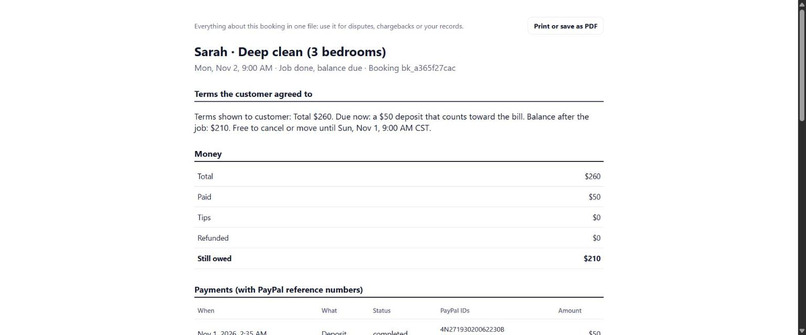
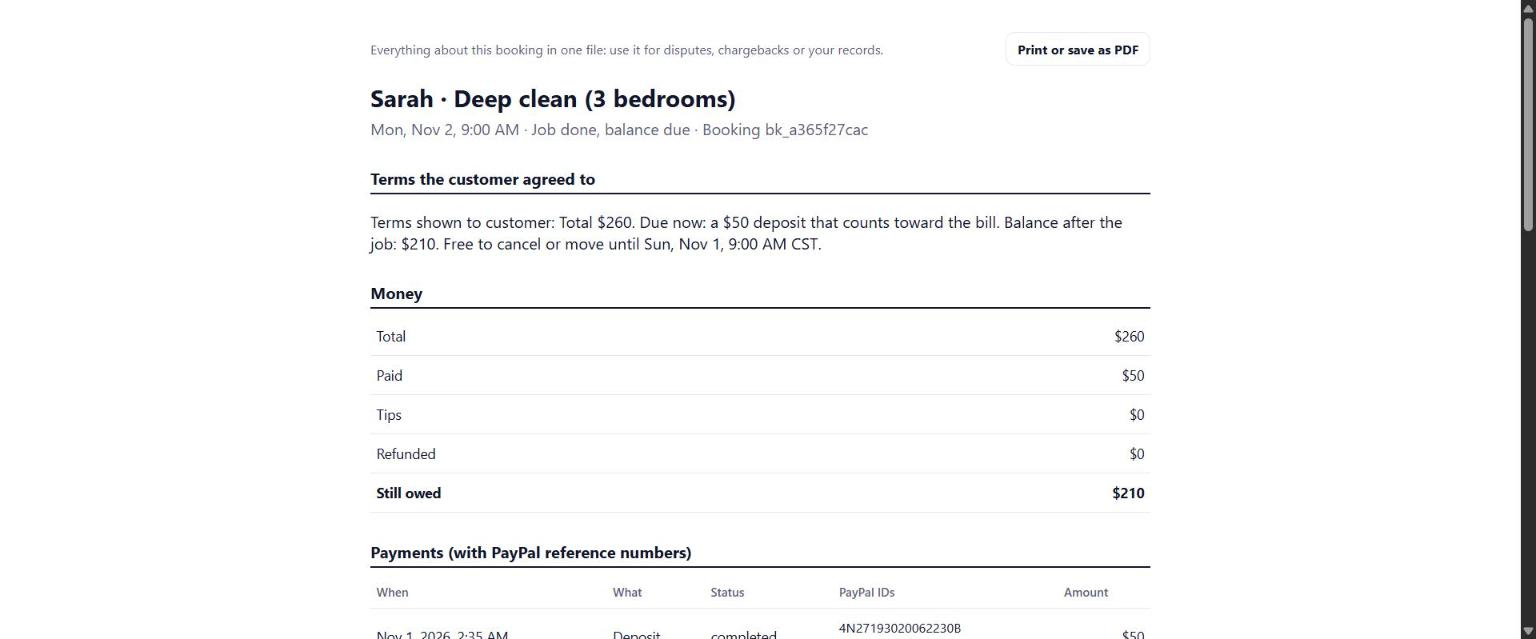
Every booking keeps the terms, PayPal reference IDs, approvals and the conversation in one dispute-ready record.
-
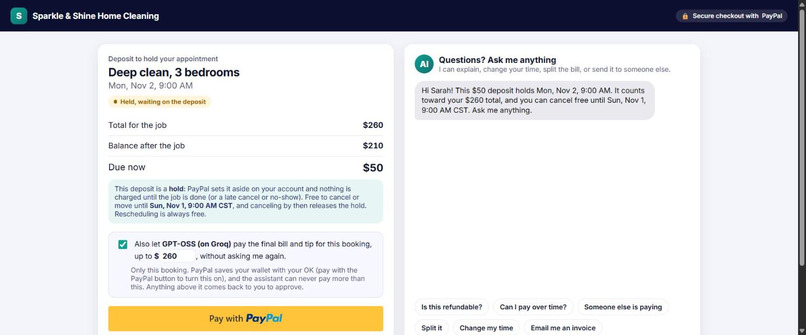
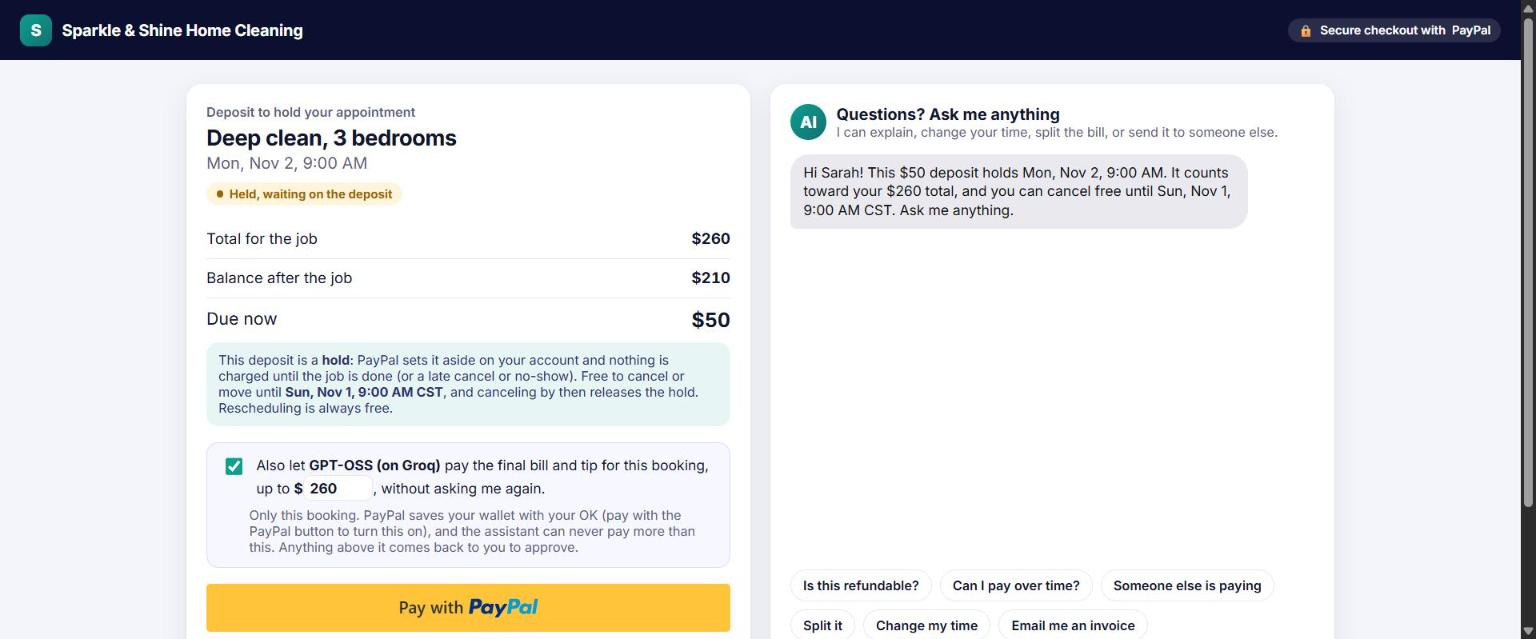
The live payment page: PayPal, Venmo, Pay Later or card, plus the box that lets her assistant pay the final bill up to $260.
-
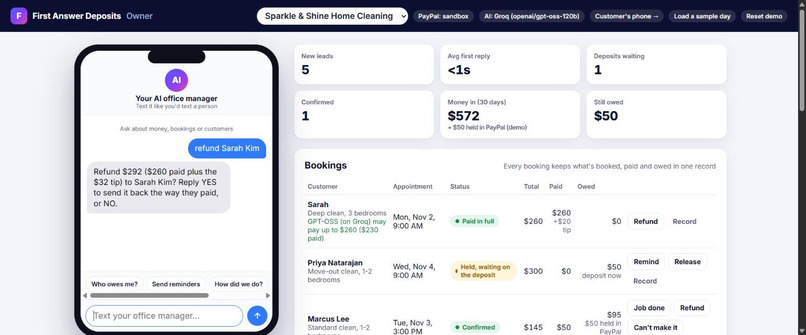
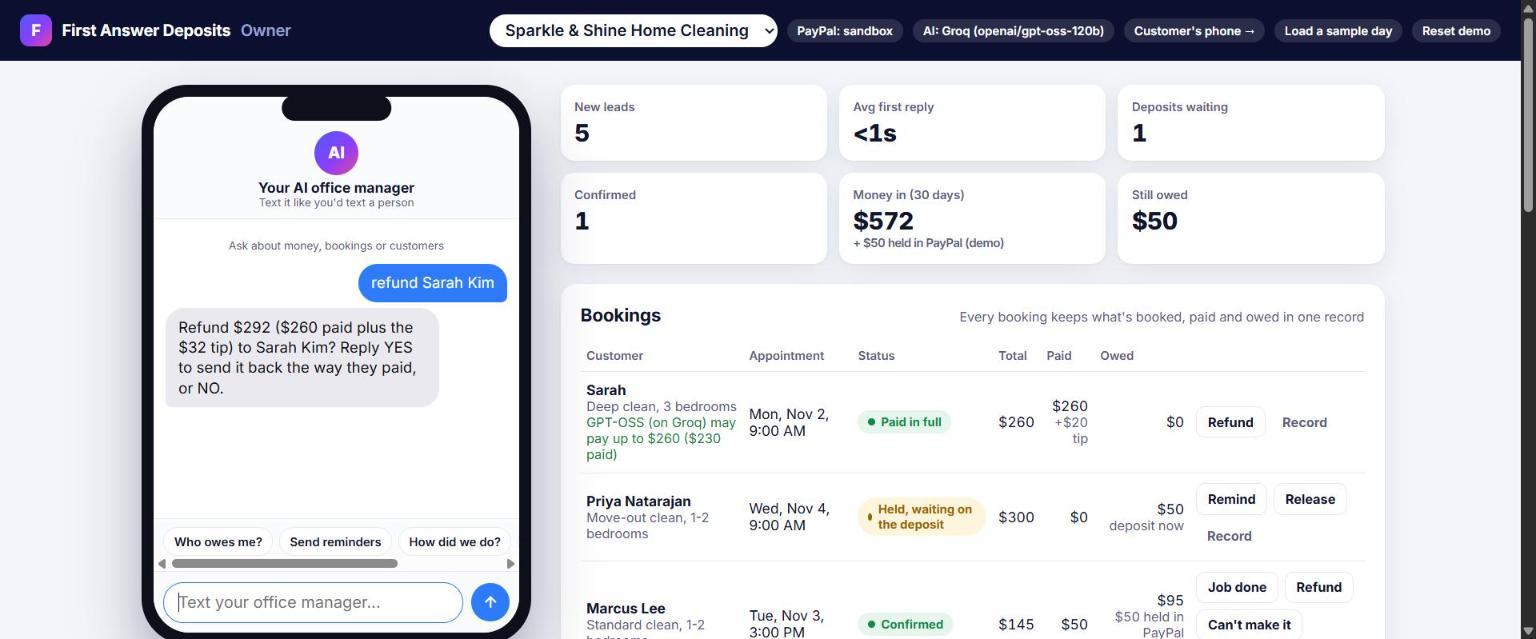
The owner runs it by text: "refund Sarah Kim" gets "Refund $292 to Sarah Kim? Reply YES" before money moves.
-
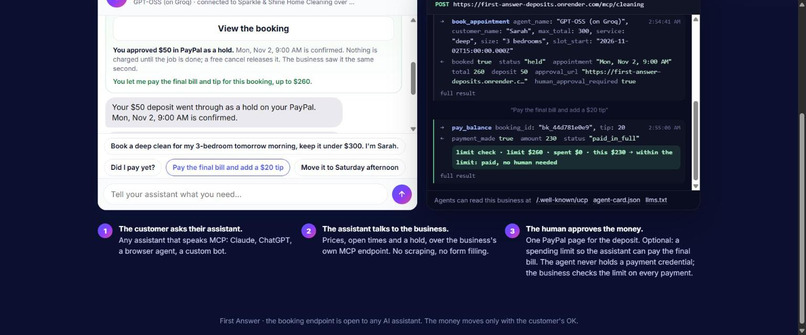
After the job: pay_balance passes the limit check (limit $260, spent $0, this $230) and pays from the wallet PayPal saved.
Inspiration
Small service businesses lose jobs twice: first when they can't answer a lead fast, then when the deposit never gets paid. Colby runs First Answer, a lead-response service for cleaners, detailers and contractors, and saw the same snags every week: no-shows, "can I move it?", surprise extras, split bills, chargebacks with no paper trail. Meanwhile AI assistants learned to buy products, but a local cleaner still can't be booked by one. We built the bridge.
What it does
A local service business any AI assistant can book, with PayPal holding the money and a human approving it at exactly the right moment.
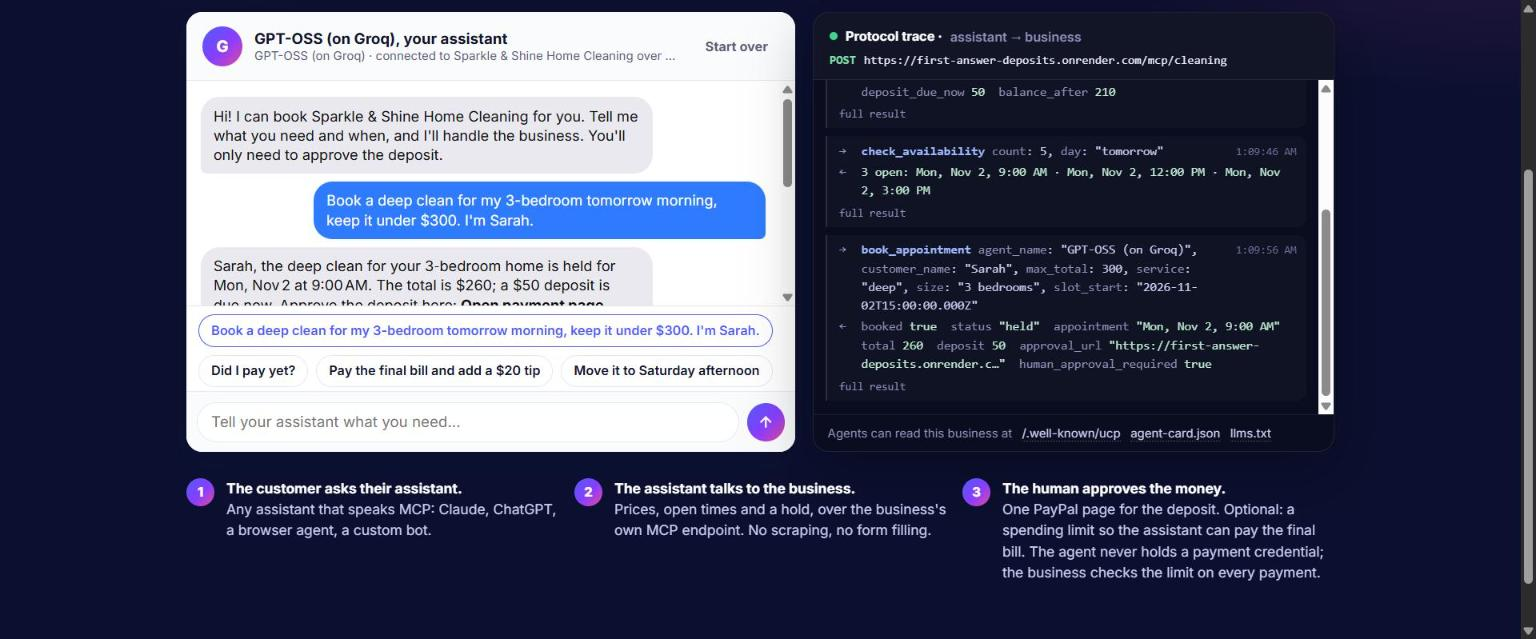
1. The customer's own AI books it (agent to agent). Sarah tells her assistant "book a deep clean tomorrow morning, under $300." Her assistant connects to the cleaner's MCP endpoint, reads the real price list, checks real open times, gets a quote and holds a slot. It cannot pay. It hands Sarah one PayPal approval link for the deposit.
2. The deposit is a PayPal hold, not a charge. For jobs in the next few days the deposit is authorized, then captured on the final bill or a no-show, and released on a free cancel. The payment page offers PayPal, Venmo, Pay Later or card, no account needed, with the AI right next to the buttons answering "is this refundable?"
3. The customer sets a spending limit for their assistant. At that approval Sarah can tick "let my assistant pay the final bill and tip, up to $260." PayPal saves her wallet (Vault) with her consent. After the job, her assistant calls pay_balance; the business checks the limit (limit $260 · spent $0 · this $230 → within the limit) and charges the saved wallet. Over the limit, nothing is paid and Sarah gets the approval link. The agent never holds a card number or a credential.
4. Everything after follows rules the customer agreed to, in the same thread. Moving the time (the hold moves with it), extra work (needs a YES), the final bill with a tip, refunds with reference numbers, splitting the bill, invoices by email, late cancels and no-shows, a waitlist, and a "time to book again" message later.
5. The owner runs it by texting an AI office manager. "Who owes me?", "done at Sarah's", "refund Sarah Kim" (it asks "Refund $292 to Sarah Kim? Reply YES" before money moves), "how did we do this week?". When a job is paid in full, the net goes to the owner's PayPal through Payouts. If a chargeback comes in, the AI sends the booking record as evidence to PayPal Disputes and tells the owner.
Customers can also reach the business through a text-style chat page or by voice (browser speech; real SMS and phone numbers via Twilio are next). Any business sets up by texting a few answers, including a logo and a color; every customer page carries the business's own brand. Leads come in from any app (a lead app, GoHighLevel, Zapier, a web form), a calendar subscribe link goes out, and signed updates go to their CRM.
Try it in two minutes (live demo, PayPal sandbox)
Live demo: https://first-answer-deposits.onrender.com — PayPal sandbox, no real money. Free hosting tier: the first page load can take about a minute to wake, and the assistant's first reply 30 to 60 seconds (the protocol trace fills in live while you wait). Live AI: gpt-oss-120b on Groq.
To approve a deposit, log in with this PayPal sandbox buyer (test account, no real money): email [email protected], password .Z^e0ppl. Or pay as a guest with a test card from PayPal's card testing page (https://developer.paypal.com/tools/sandbox/card-testing/).
/agent: tap the first chip ("Book a deep clean for my 3-bedroom tomorrow morning, keep it under $300. I'm Sarah."). Watch the protocol trace: the assistant calls the business over MCP, quotes, checks real availability and holds a time. It cannot pay. Tap "Approve the $50 deposit in PayPal", tick "let my assistant pay the final bill and tip, up to $260", and pay.- Back on
/agent: tap "Skip ahead (demo): the business finishes the job", then "Pay the final bill and add a $20 tip". The trace showspay_balancewith the limit check. Set a lower limit next time and it asks you instead. /owner: the sample day is loaded (it is shared by everyone trying the demo; if another visitor already refunded her, tap "Reset demo" first). Text "who owes me?", "refund Sarah Kim" (it asks "Refund $292 to Sarah Kim? Reply YES" first), "done at Marcus" (his job is still ahead, so it asks before billing), "how did we do this week?"./text: book something, then "Can we do Saturday instead?" (the time and the deposit move), "Split it with my roommate", "Email me an invoice"./setup: set up your own business by texting. Logo link and color: every customer page carries your brand.- Point your own MCP client at
POST /mcp/cleaning, or read/.well-known/agent-card.json,/.well-known/ucpand/llms.txt.
How we built it
Node 22 + Express, a single booking-and-money engine (bookings.js) that every path goes through so the calendar and the money can never disagree. Built from scratch Oct 25 to 28, 2026 (polished Nov 1), hosted on Render.
PayPal: Orders v2 with the JavaScript SDK buttons (PayPal, Venmo, Pay Later with messaging, debit/credit card); deposits as holds (Orders v2 intent: AUTHORIZE, then Payments v2 capture with final_capture, or void); Vault save-during-purchase (store_in_vault: ON_SUCCESS) for the assistant's spending limit, charged later with payment_source.paypal.vault_id; Payments v2 refunds (full and partial); Payouts to the owner; Invoicing v2 (create, send, remind, cancel); Disputes provide-evidence with the booking record as a PDF; and webhooks with signature verification (CHECKOUT.ORDER.APPROVED, PAYMENT.CAPTURE.COMPLETED, PAYMENT.CAPTURE.DENIED, INVOICING.INVOICE.PAID, CUSTOMER.DISPUTE.CREATED). Deposits, balances and tips are separate orders with custom_id = booking:payment so webhooks map back. Every booking keeps the terms shown, PayPal IDs, approvals and the whole conversation in one printable, dispute-ready record.
AI: any model through the Vercel AI SDK (Claude, Gemini, Meta Llama, or gpt-oss on Groq, which the live demo runs) with tool calling over the booking engine, so the model can never invent a price or a time. With no AI key, a scripted desk runs the same flows.
Agentic commerce: an MCP server per business (Streamable HTTP, official SDK) with tools to get the price sheet, check availability, quote, book, check status, reschedule, cancel and pay_balance; discovery files at /.well-known/ucp, /.well-known/agent-card.json (UCP- and A2A-style, not certified) and /llms.txt; a human-approval step where book_appointment holds the time and returns a PayPal approval link only a person can complete; and a per-booking limit the business enforces on every payment. The payment page also registers WebMCP tools (navigator.modelContext) so browser assistants can read the bill and ask the business questions.
Tests: node:test end-to-end suites in demo mode (npm test, 100 passing), run on every push by GitHub Actions.
Challenges we ran into
Keeping it simple (every payment snag became a rule inside the engine and one sentence in a text). Making agent booking safe: agents can hold a time but never pay the deposit, holds expire, and the final bill is paid by the agent only inside a limit the human set, checked by the business on every payment. Running everything in demo mode so judges can try the full flow without keys.
Accomplishments that we're proud of
A business can be booked by text, by voice (browser speech), and by another AI, with PayPal holding the money as an authorization, a customer-set spending limit the business enforces on every payment, and an owner who runs the whole thing by text and never opens a form. Setup takes one conversation.
What we learned
PayPal's sandbox covers more than checkout: holds, refunds with references, Vault, payouts, invoicing, disputes and webhooks made the whole money lifecycle real. The hard part of agentic commerce isn't the protocol; it's keeping the human in charge of the money at exactly the right moment.
What's next for First Answer Deposits
Real SMS and phone numbers (Twilio), PayPal partner onboarding so each business connects its own PayPal account, UCP services capability when it ships, more presets (lawn care, salons, photographers), and First Answer's own lead app as a built-in source. First Answer's existing lead-response clients are the first pilots.
Built With
- claude
- express.js
- gemini
- gpt-oss
- groq
- html5
- javascript
- llama
- model-context-protocol
- node.js
- paypal
- paypal-javascript-sdk
- paypal-orders-v2
- paypal-payouts
- paypal-vault
- paypal-webhooks
- render
- venmo
- vercel-ai-sdk
- webmcp
