-
-
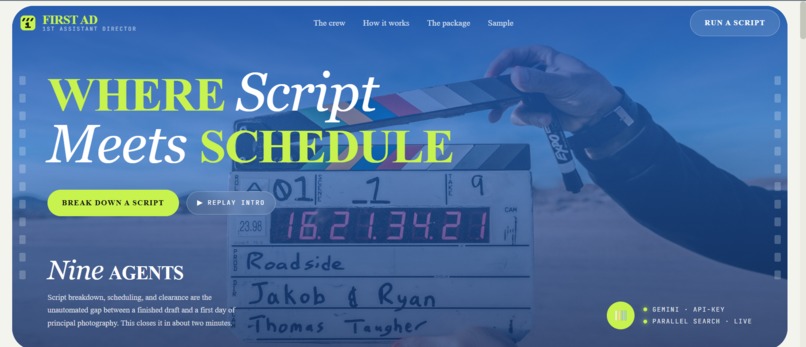
Landing
-
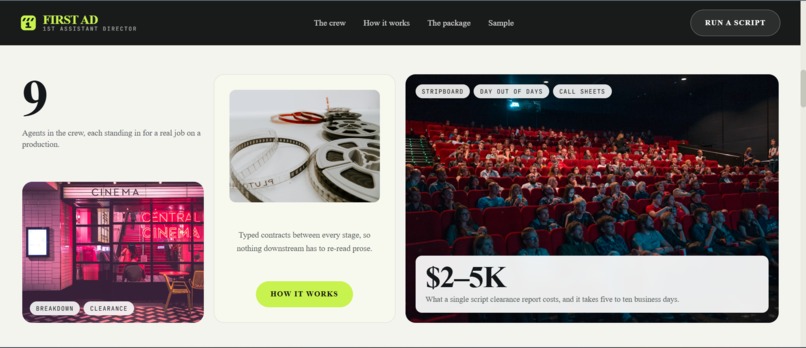
Landing (How it works)
-
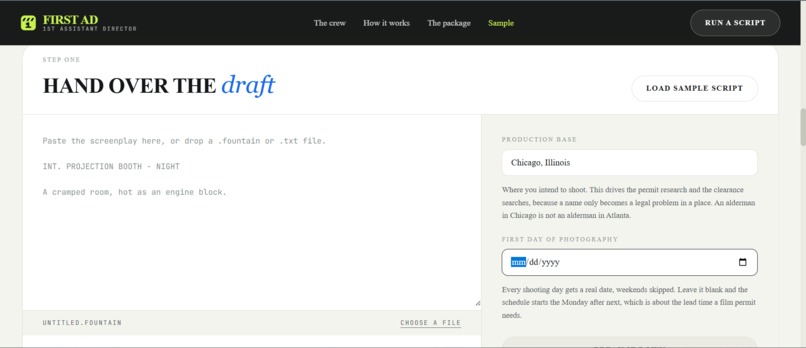
File-Drop
-
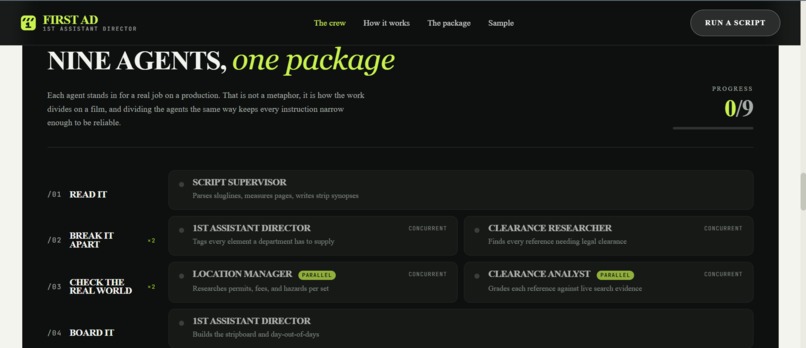
Agent Orchestrator
-
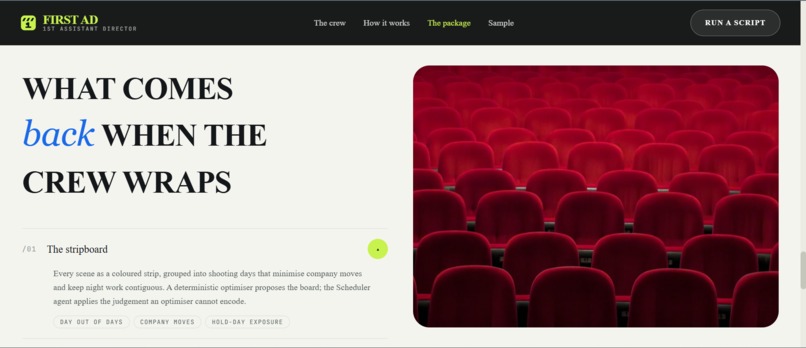
Stripboard
-
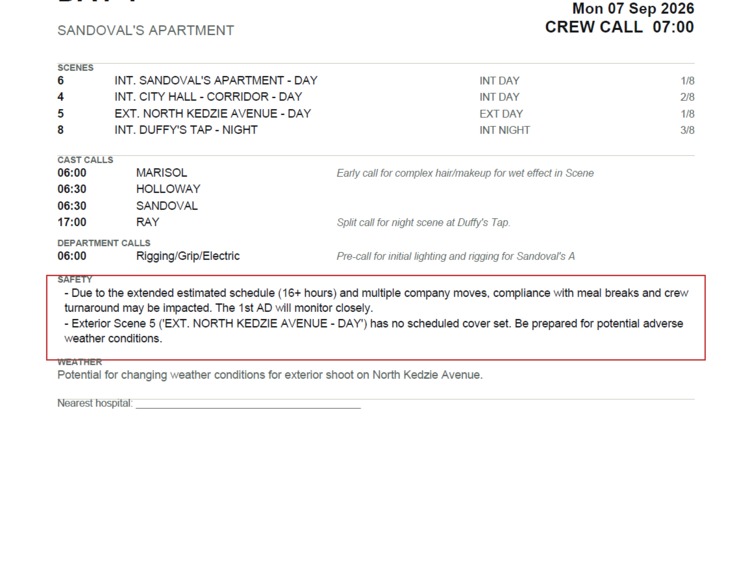
Call Sheet
-
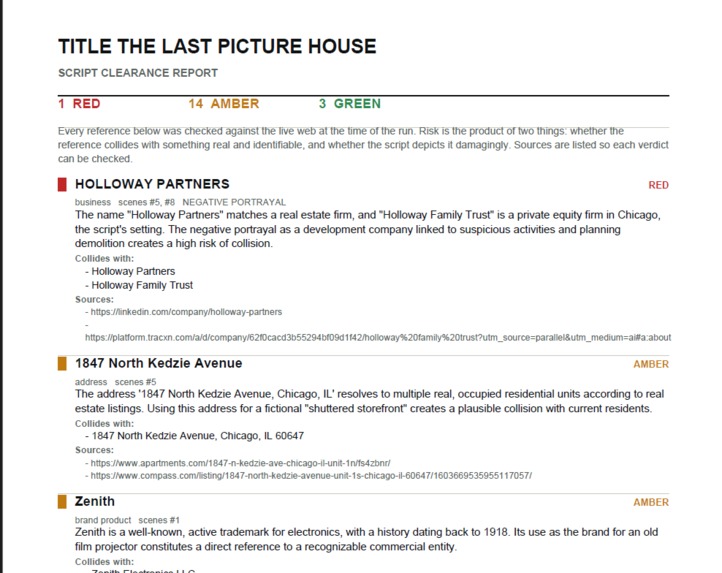
Clearance Report
Inspiration
Making a film starts long before the cameras roll. Between "we have a script" and "we're ready to shoot" are weeks of manual work: breaking down every scene, researching real-world references, checking locations and permits, building a shooting schedule, creating budgets, and preparing call sheets.
We wanted to explore whether a coordinated system of agents could handle this entire production-planning layer — not as a chatbot, but as a digital production crew that produces the structured documents a real production team needs.
What it does
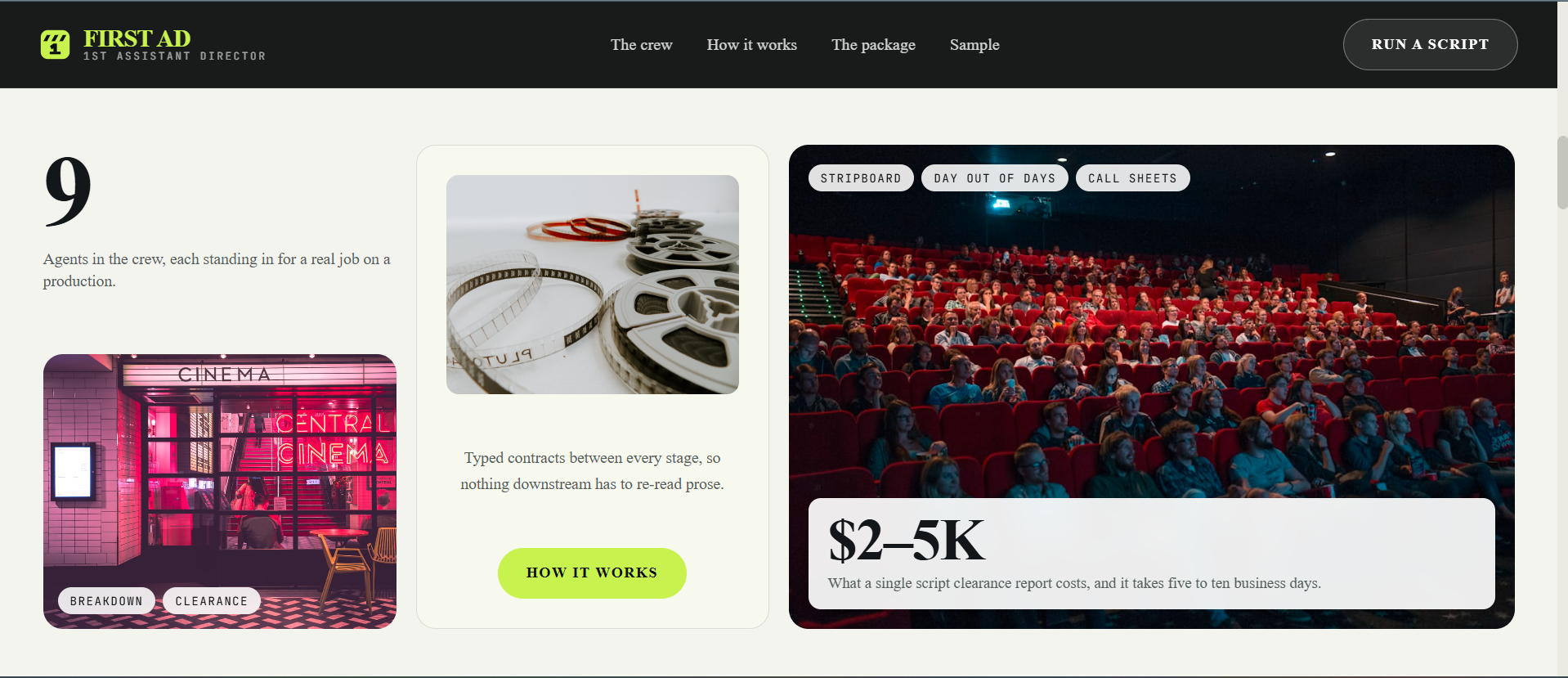
First AD turns a screenplay into a production-ready package in minutes.
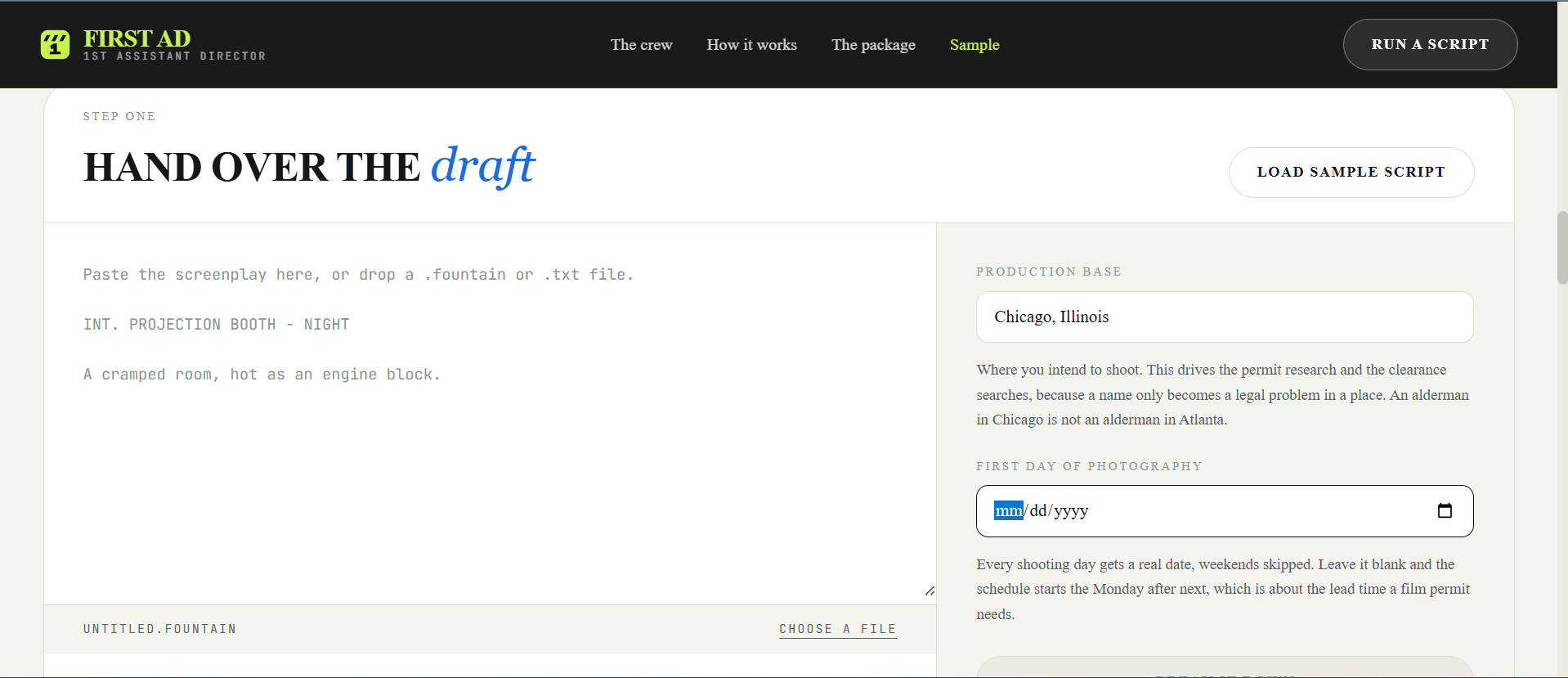
It reads the script, identifies production requirements, researches real-world entities, and produces:
- Script breakdown
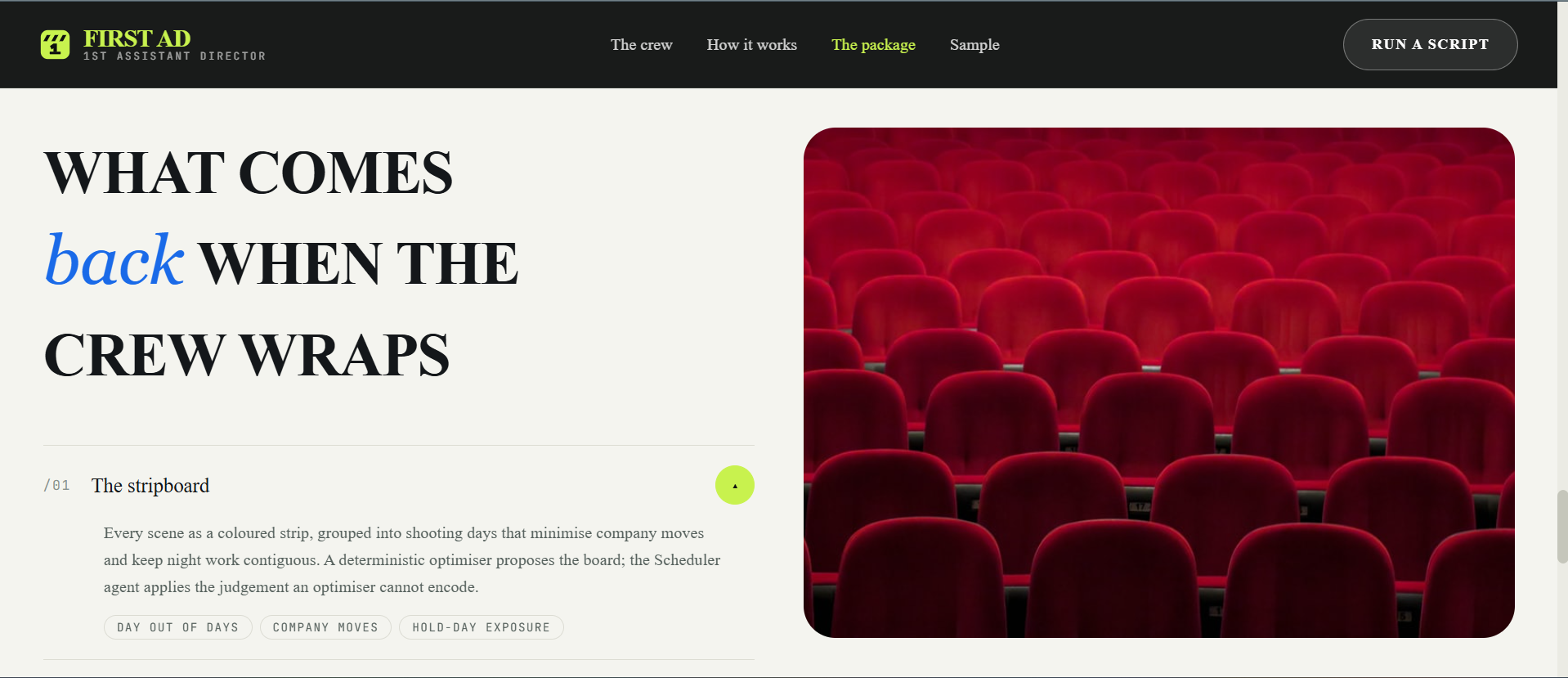
- Stripboard and shooting schedule
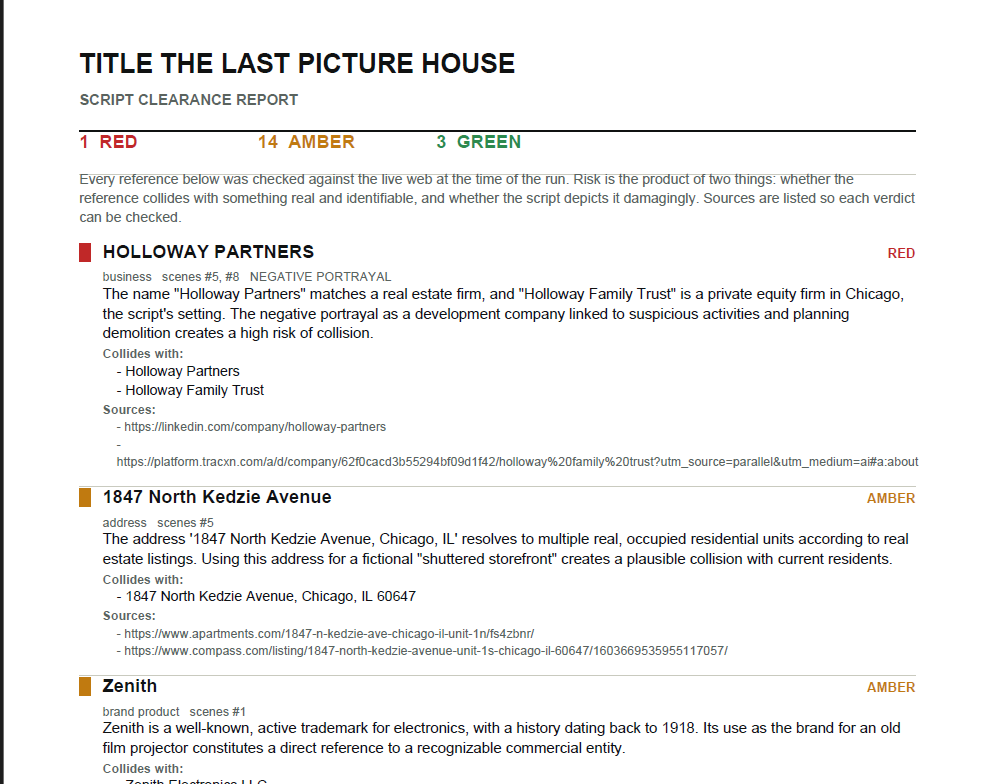
- Clearance research with source citations
- Location permits, fees, lead times, and hazards
- Production compliance checks
- Budget top sheet
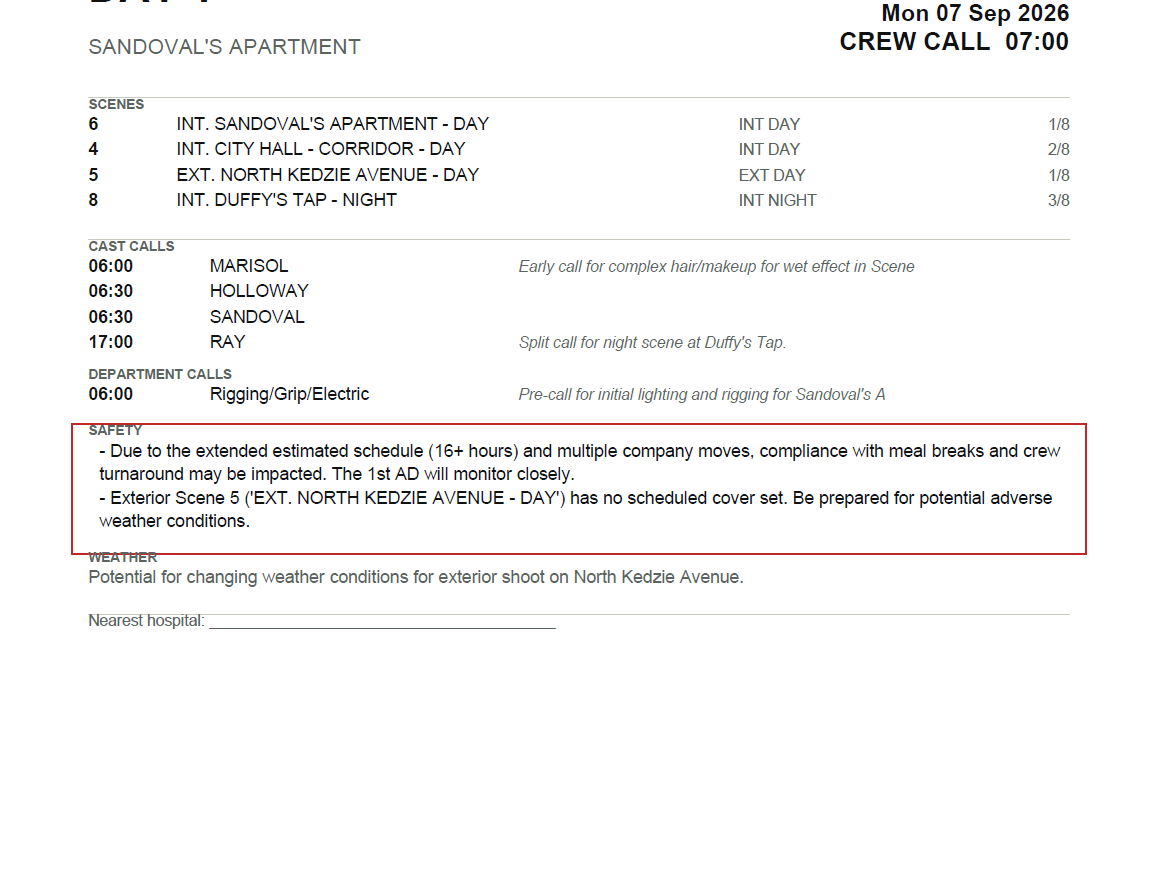
- Call sheets
- Annotated screenplay
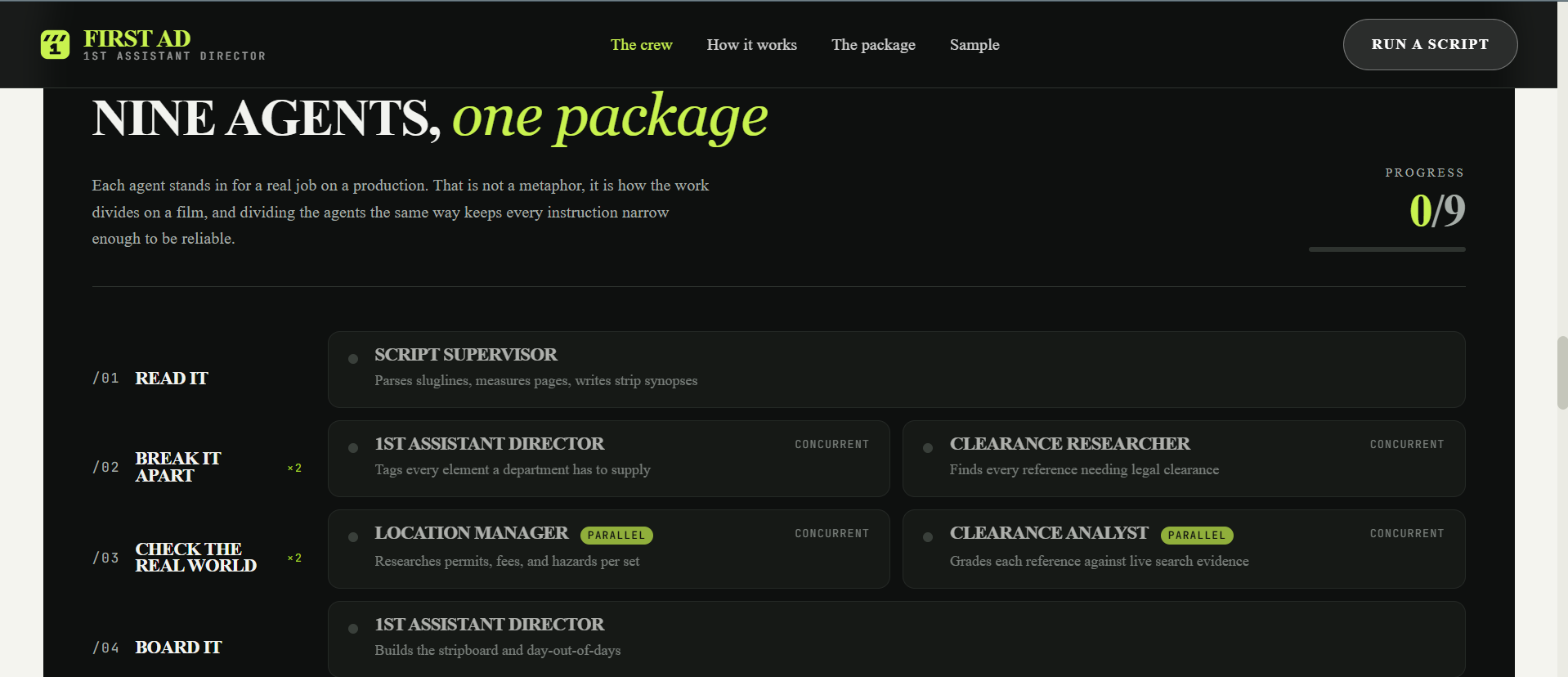
The system uses 9 agents across a deterministic 7-stage pipeline. A 14-scene sample screenplay completed end-to-end in 323 seconds on the Gemini free tier.
How we built it
We built First AD using Google's Agent Development Kit (ADK) with Gemini 2.5 Flash and Pro.
Each production role is represented by an LlmAgent with a typed Pydantic output_schema. This means every stage produces structured data that the next stage can consume instead of passing around unstructured text.
The pipeline is:
Script Supervisor → 1st AD / Clearance Researcher → Location Manager / Clearance Analyst → Stripboard → Compliance → Budget → Call Sheets
For real-world research, we integrated the Parallel Search API. Every clearance decision is grounded in searchable sources and citations rather than relying solely on the model's internal knowledge.
The backend uses FastAPI, while the frontend is built with Next.js, React, and Tailwind CSS. The system can run Gemini through either an API key or Google Cloud Vertex AI.
Challenges we ran into
The biggest challenge was making a multi-agent system reliable and deterministic.
Agents need to make complex production decisions, but allowing them to freely call other agents or tools can make a pipeline unpredictable. We solved this by enforcing a fixed seven-stage workflow and using typed contracts between every stage.
Another challenge was real-world clearance research. A language model cannot reliably determine whether a person, business, address, or other entity actually exists today simply from its internal knowledge. We therefore separated reasoning from research and used Parallel Search to ground clearance decisions in external sources.
We also had to work within Gemini rate limits, so concurrency is deliberately bounded and high-volume stages are separated between Flash and Pro models.
Accomplishments that we're proud of
We're proud that First AD isn't just a demo interface — the entire nine-agent pipeline actually runs end-to-end on live Gemini.
A 14-scene screenplay can go from raw script to a complete production package in 323 seconds.
We're especially proud of the clearance system. Every risk verdict is backed by sources that can be opened and reviewed, making the output much more useful for an actual production workflow.
We also built the system so that outputs are structured, persisted, exportable, and usable beyond the interface, including CSV and JSON exports.
What we learned
We learned that building useful agentic systems is less about making agents autonomous and more about giving them clear boundaries and reliable interfaces.
Typed outputs, deterministic orchestration, controlled concurrency, model tiering, and grounded search made the system significantly more reliable than simply asking one large model to perform the entire task.
We also learned that these systems become particularly powerful when they coordinate different kinds of work — reasoning, research, optimisation, compliance, and document generation — rather than treating everything as a single prompt.
What's next for First AD (First Assistant Director)
The next step is taking First AD from a prototype into a production-grade tool for longer scripts and real production workflows.
We want to support:
- Feature-length screenplays
- More detailed scheduling and optimisation
- Richer location and permit databases
- More comprehensive clearance workflows
- Production-company collaboration
- Integration with existing production-management tools
- More sophisticated budgeting and scheduling constraints
- Continuous updates as real-world production information changes
Ultimately, we want First AD to become the production coordinator that takes a screenplay from script breakdown to shooting day.
Built With
- fastapi
- gemini2.5flash
- googleadk
- next.js
- parallelsearchapi
- react
- ssr
- vertex

Log in or sign up for Devpost to join the conversation.