

Inspiration
FirmTalks was created to bridge the gap between automated firmware security analysis and collaborative human expertise. With IoT vulnerabilities rising, we envisioned a unified platform that combines deep firmware inspection, AI-powered threat detection, and community-driven discussions to secure embedded systems.
What it does
- Firmware Analysis: Unpacks firmware binaries into hierarchical directories using Binwalk (Python/Flask backend).
- Malware Detection:
- Scans files with VirusTotal API for known threats.
- Uses a custom AI model to detect suspicious patterns (e.g., anomalous code behavior).
- Scans files with VirusTotal API for known threats.
- Discussion Platform: A MERN stack (MongoDB, Express, React, Node.js) forum with WebSocket-based real-time communication for instant collaboration and updates.
How we built it
- Backend:
- Python/Flask server for firmware upload, Binwalk unpacking, and directory structure generation.
- Integrated VirusTotal API for signature-based malware detection.
- Trained an AI model using Scikit-learn on firmware malware datasets for anomaly detection.
- Python/Flask server for firmware upload, Binwalk unpacking, and directory structure generation.
- Frontend:
- MERN stack for the discussion platform: React for dynamic UI, Node.js/Express for REST APIs, MongoDB for storing threads/comments.
- Socket.io for real-time messaging, notifications, and live updates in discussions.
- Unified dashboard to view analysis reports and participate in discussions.
- MERN stack for the discussion platform: React for dynamic UI, Node.js/Express for REST APIs, MongoDB for storing threads/comments.
Challenges we ran into
- Syncing Python/Flask (firmware analysis) with MERN (discussions) into a seamless user experience.
- Optimizing Binwalk for large firmware files without overwhelming the Flask server.
- VirusTotal API rate limits delaying scan results during peak usage.
- Implementing low-latency WebSocket communication for real-time discussions while handling high concurrent user loads.
- Balancing the AI model’s accuracy (low false positives) with performance in real-time analysis.
Accomplishments that we're proud of
- Successfully merged static analysis (Binwalk), cloud APIs (VirusTotal), and AI detection into a single pipeline.
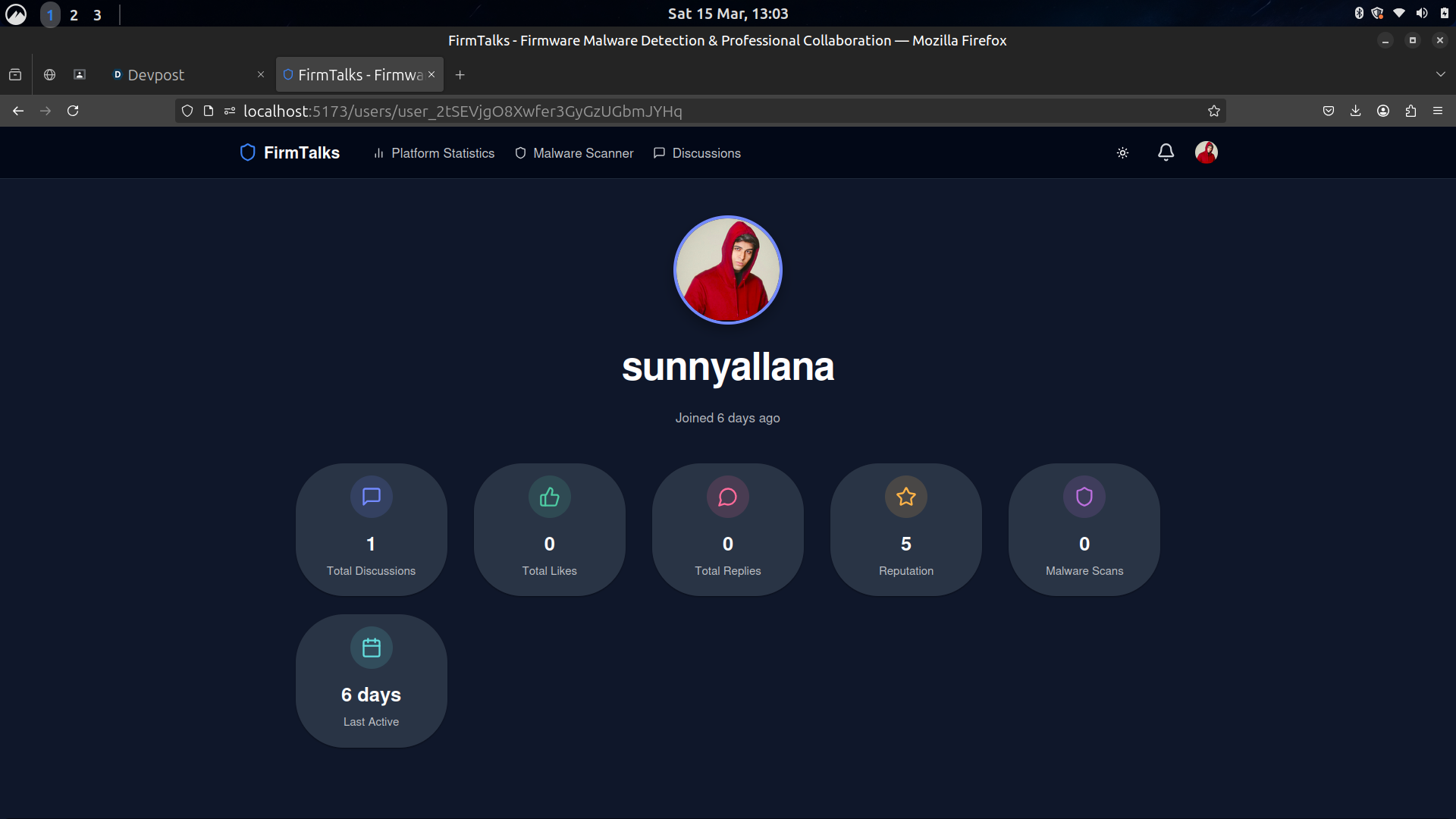
- Built a responsive MERN discussion platform with real-time WebSocket updates, Markdown Support, User Profile & Statistics, and secure authentication.
What we learned
- Hybrid analysis (static + AI + crowdsourced insights) outperforms single-method approaches.
- WebSocket integration requires careful state management to avoid UI/data sync issues.
- Community engagement thrives when technical workflows (e.g., sharing analysis reports) are integrated into real-time discussions.
What's next for FirmTalks
- Enhance the AI model with graph-based anomaly detection for firmware dependency graphs.
- Add automated CVE matching for unpacked libraries/components.
- Scale WebSocket infrastructure to support large-scale user interactions.
- Implement live firmware emulation for dynamic analysis.
- Expand the MERN platform with code snippet sharing and GitHub integration.

Log in or sign up for Devpost to join the conversation.