Inspiration
On January 8, 2026, the Eaton Fire tore through Altadena, California. Within hours, 17 people were dead, thousands of homes were gone, and families were stranded waiting for evacuation orders that came too late. The failure wasn't firefighters. It wasn't equipment. It was coordination. When a wildfire crosses a county line, someone has to pick up a phone. When evacuation zones need to be drawn, someone has to drive the perimeter. When six agencies need to be briefed simultaneously, someone has to write six separate emails. In the middle of a firestorm, with 40mph winds and lives on the line, that someone is the Incident Commander — alone, overwhelmed, and working from a whiteboard. We watched the aftermath of the Eaton Fire and kept asking the same question: why is the most critical coordination infrastructure in wildfire response still running on phone calls? We built FireSync because the gap between detection and coordinated response is measured in lives. GOES-18 geostationary satellites detect fires in 5 minutes. Our agent processes that data in under 60 seconds. The IC reviews and approves. Total time from ignition to coordinated multi-agency response: under 8 minutes. The Eaton Fire coordination took 4 hours. We are not trying to replace the Incident Commander. We are trying to give them the situational awareness in 4 minutes that currently takes 4 hours to assemble — so they can make better decisions, faster, with lives on the line.
What it does
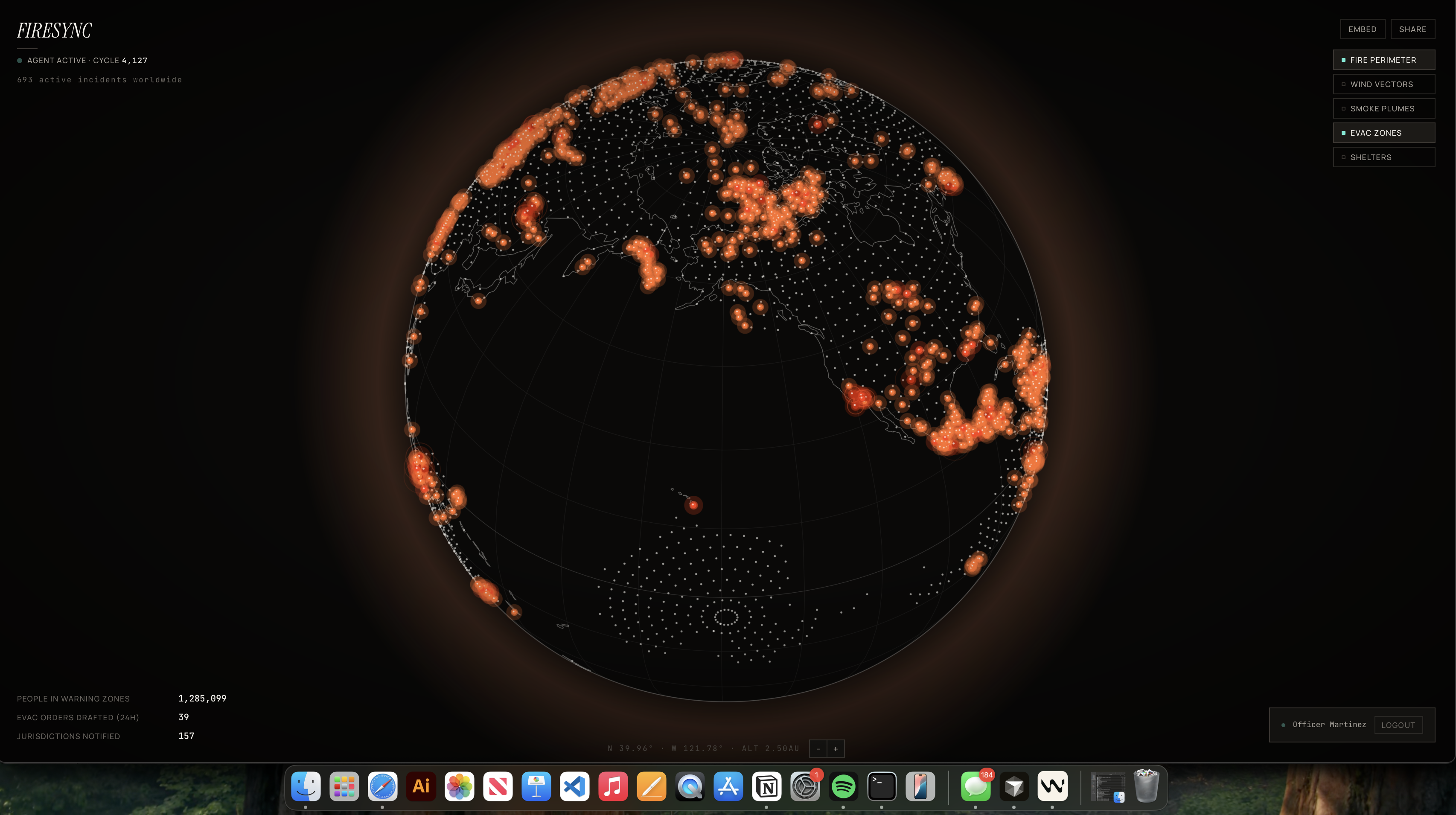
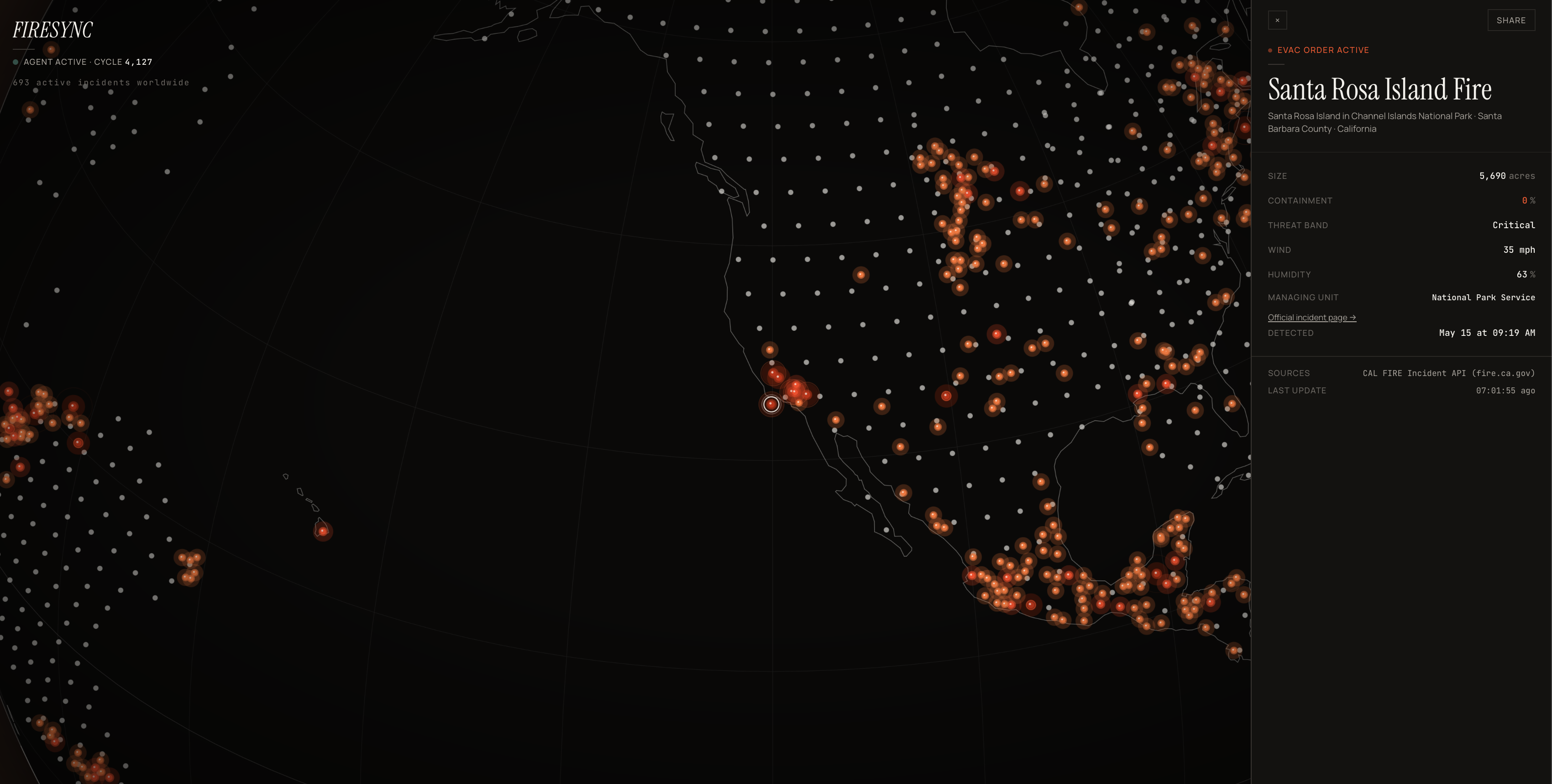
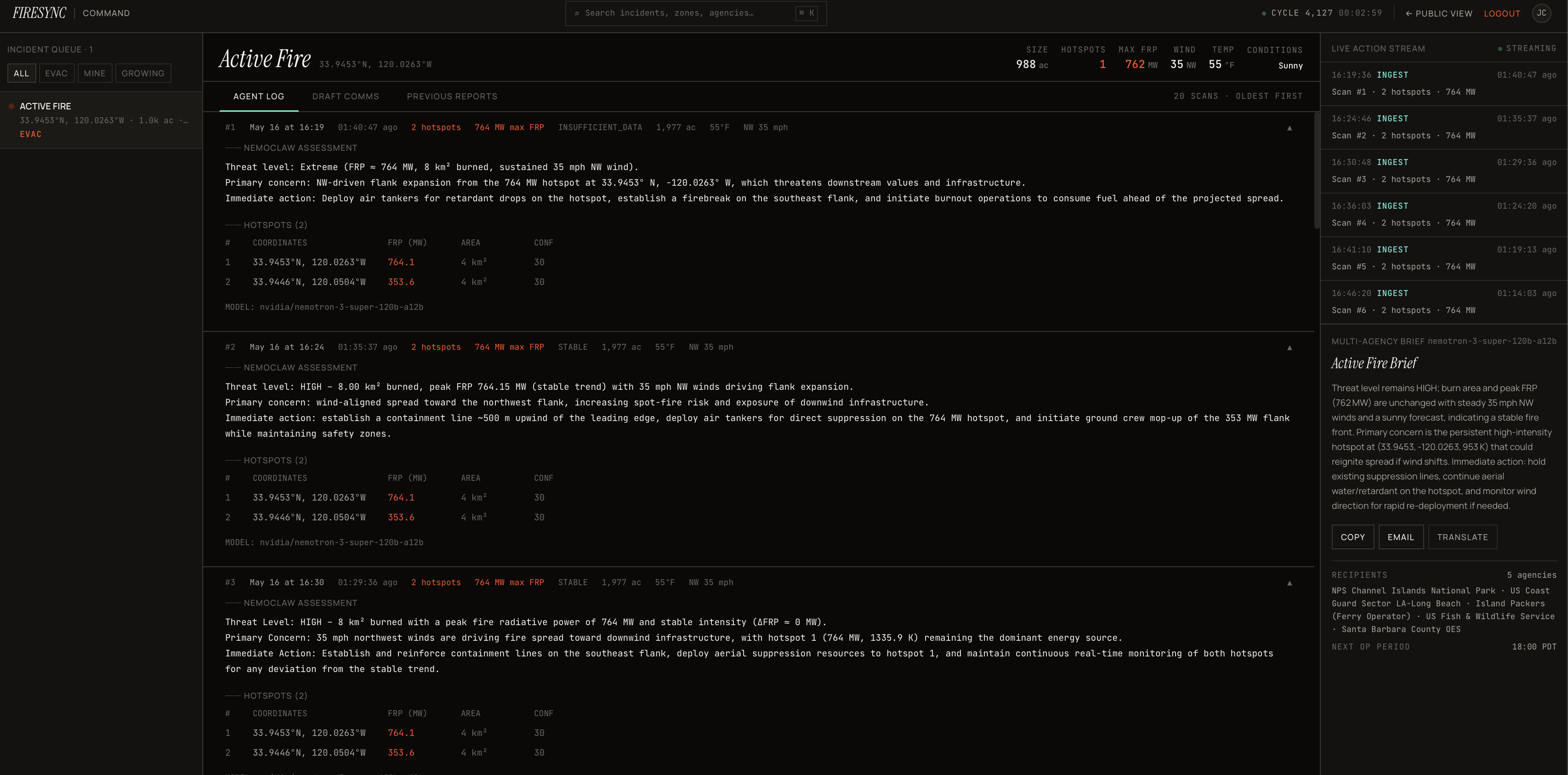
FireSync is an autonomous wildfire coordination agent that continuously monitors GOES-18 satellite feeds, detects active fire hotspots in real time, triages severity, generates evacuation zones, and dispatches prioritized instructions to every relevant agency simultaneously, in under 5 minutes, across jurisdictions, without human initiation.
How we built it
We built FireSync on NVIDIA's NemoClaw autonomous agent framework, powered by Nemotron Nano for fast triage classification and Nemotron Super for deep tactical reasoning on major incidents. The backend runs on FastAPI with GOES-18 satellite ingestion, NWS weather data, and OSM infrastructure mapping. Every agent decision is logged to Supabase and streamed live to a React frontend featuring a real-time global fire globe and an operational command center, both fed by live satellite data.
Challenges we ran into
Deduplicating satellite hotspots across consecutive passes was harder than expected. The same fire gets re-detected every scan cycle, and without clustering logic, agencies would receive duplicate alerts continuously. Getting NemoClaw to produce consistently structured dispatch output under varying fire conditions also required significant prompt engineering. OSM's Overpass API returned 406 errors under load, forcing us to build fallback infrastructure to handle mid-demo.
Accomplishments that we're proud of
We detected a real active fire off the California coast tonight during the hackathon. Two hotspots at 297 megawatts intensity with 40 mph NW winds. FireSync autonomously generated evacuation zones, a tactical Commander Brief, and prioritized agency dispatches within minutes. The entire pipeline ran without a single human initiating anything. That's the thing we set out to build, and it worked on a real incident on the night of the demo.
What we learned
Autonomous agents in safety-critical domains need human override built into the architecture from the start, not bolted on afterward. We also learned that the hardest part of wildfire coordination isn't the AI reasoning, it's the data plumbing: satellite ingestion formats, jurisdiction boundary mapping, and agency registry management are where real production systems live or die. NemoClaw's reasoning capability exceeded our expectations for generating actionable, context-aware dispatch instructions.
What's next for FireSync
Production FireSync needs three things: a real agency registry with verified contacts and CAD system integrations, a human-in-the-loop confirmation gate for evacuation-level decisions, and multi-region deployment so a wildfire can't take out the coordination system it's supposed to coordinate. Longer term, FireSync's architecture applies to any cross-jurisdictional emergency. Floods, earthquakes, hazmat incidents. The autonomous coordination layer is domain-agnostic.
Built With
- asyncio
- d3-geo
- httpx
- javascript
- languages-python
- nasa-firms
- national-weather-service-(nws)
- nemotron-3-nano-omni
- nemotron-3-super-120b-databases-supabase
- openstreetmap-overpass-libraries-&-other-sqlalchemy
- postgresql
- python-dotenv
- react
- redis-cloud-&-platforms-nvidia-nim
- sql-frameworks-fastapi
- supabase-apis-&-data-sources-goes-18-satellite-(noaa)
- vite-nvidia-tools-nemoclaw

Log in or sign up for Devpost to join the conversation.