-
-
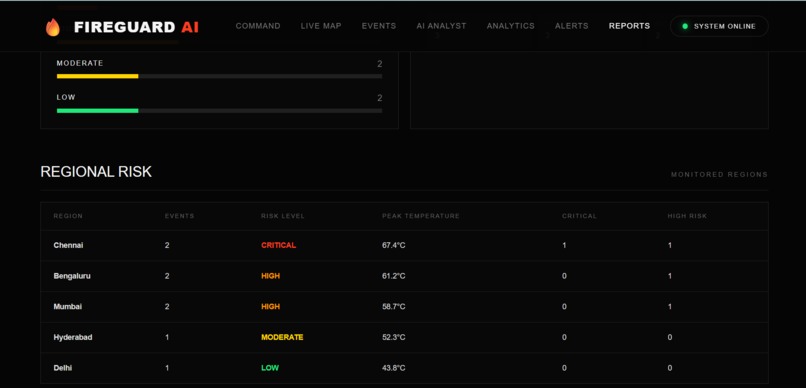
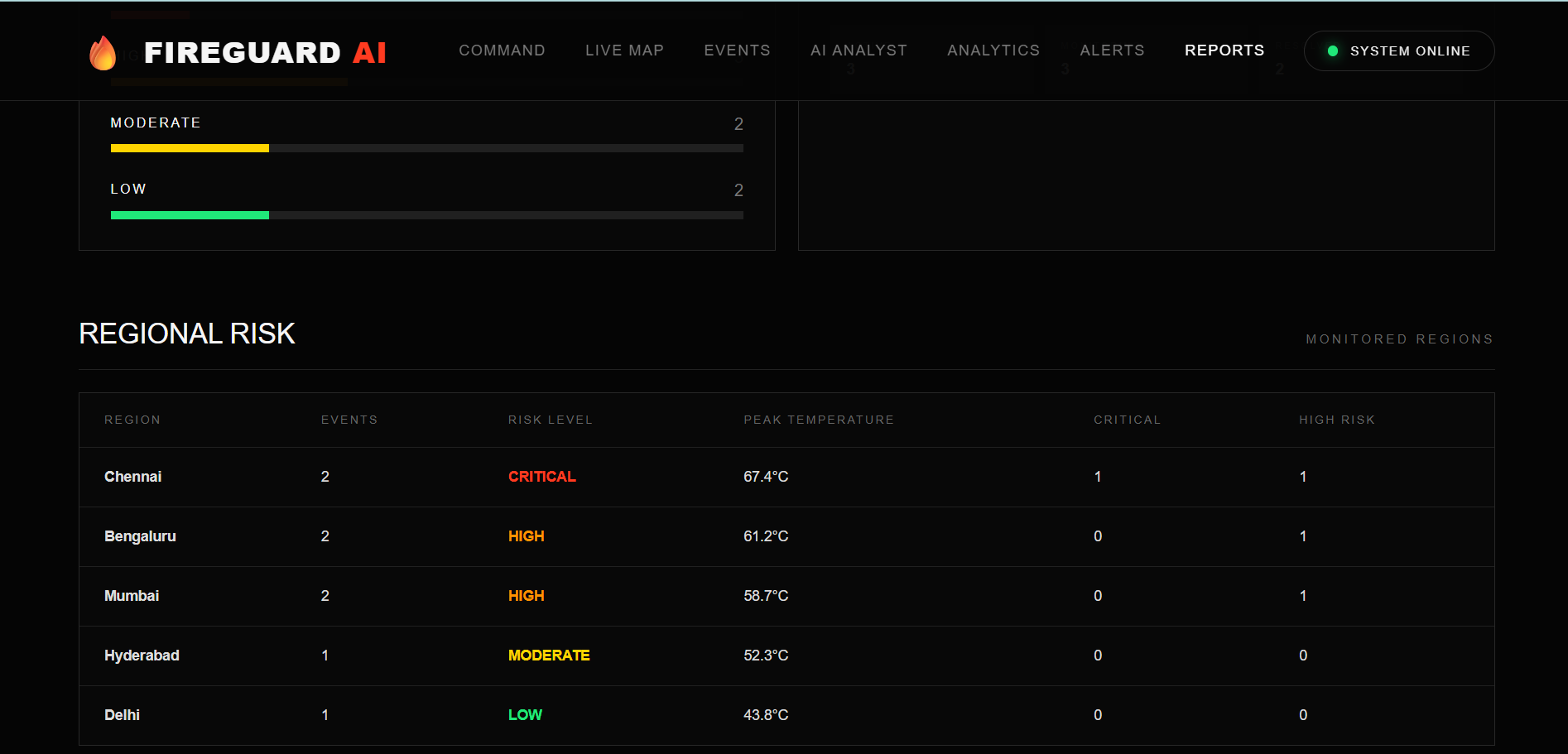
Report Page
-
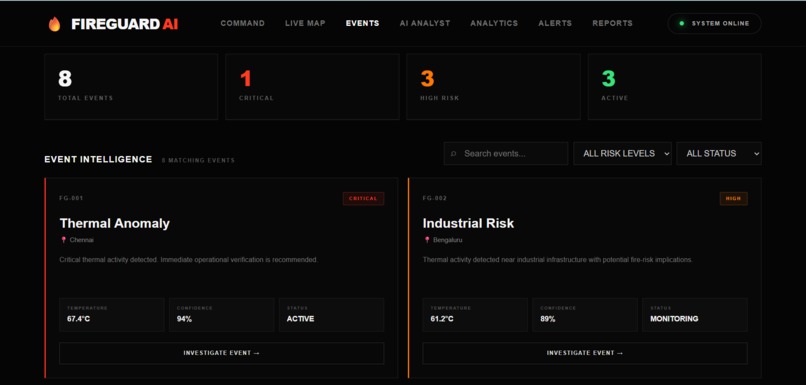
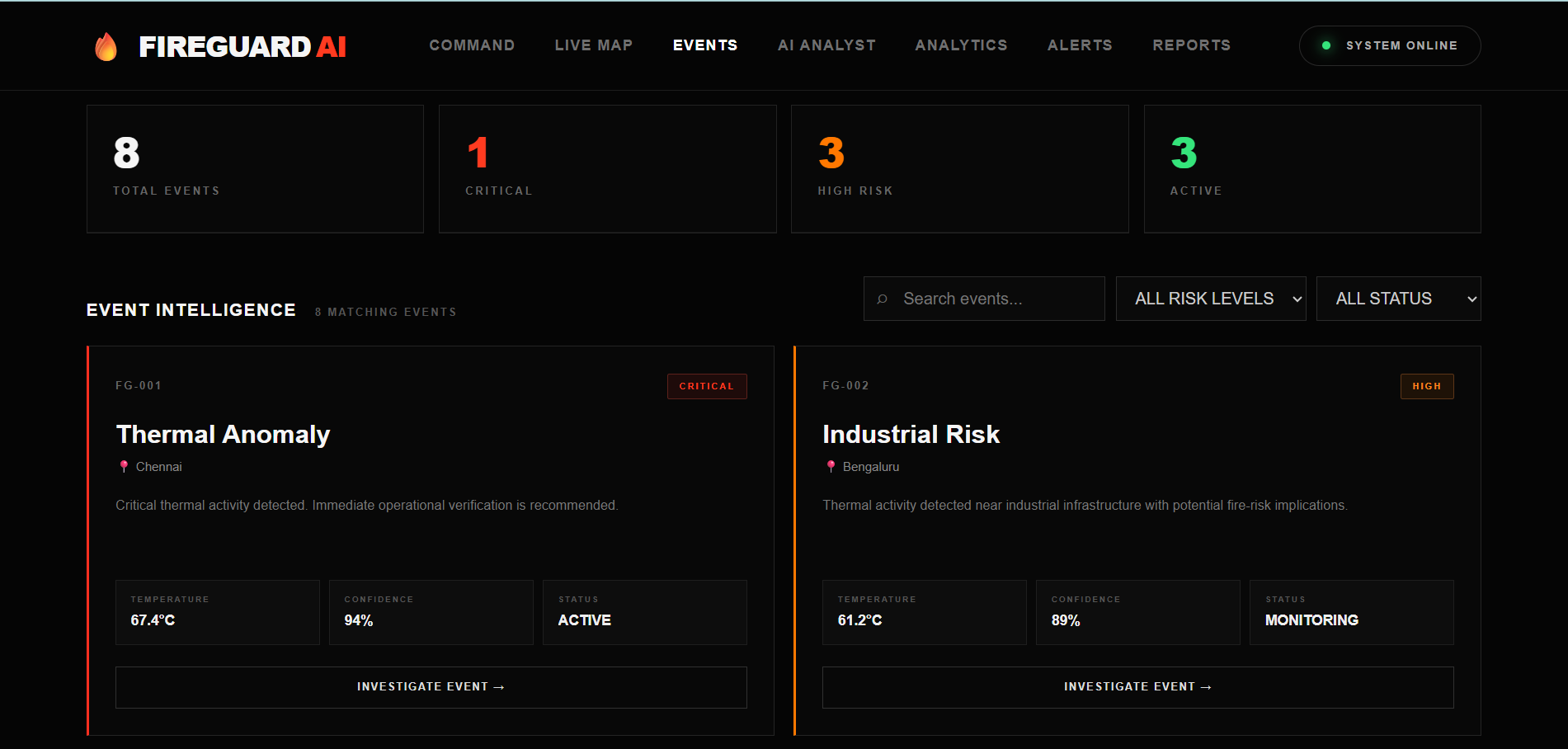
Events page
-
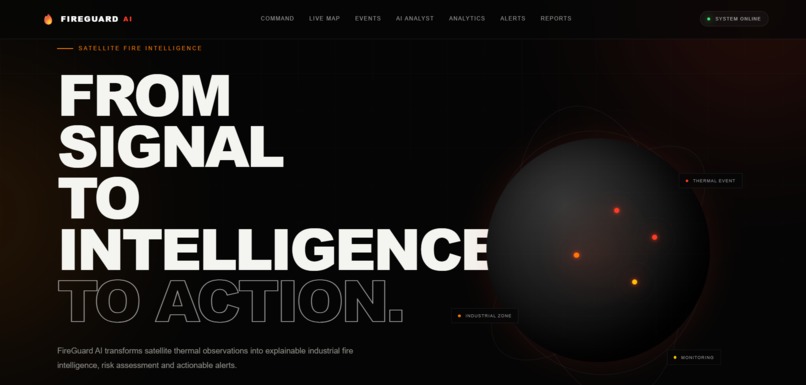
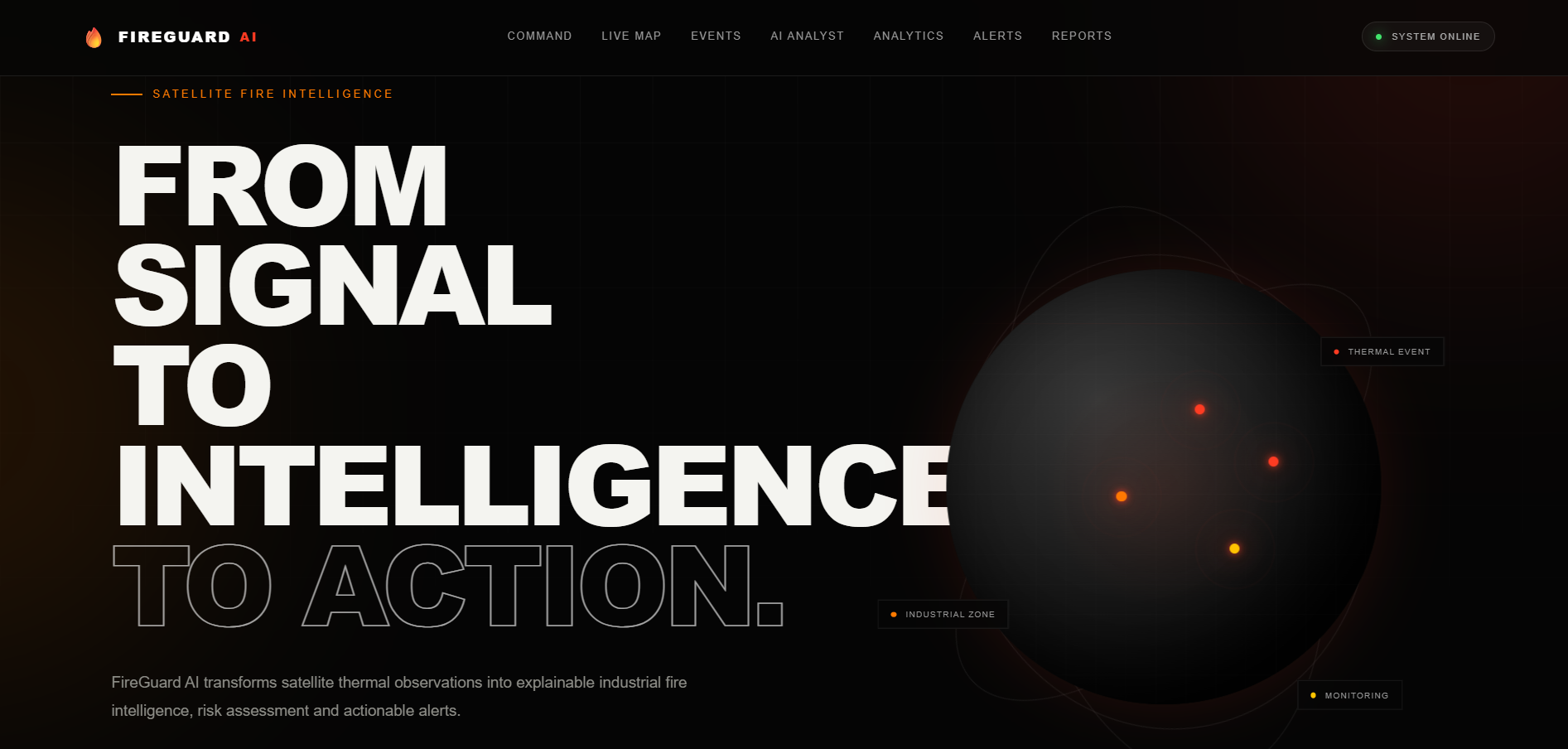
Mainpage
-
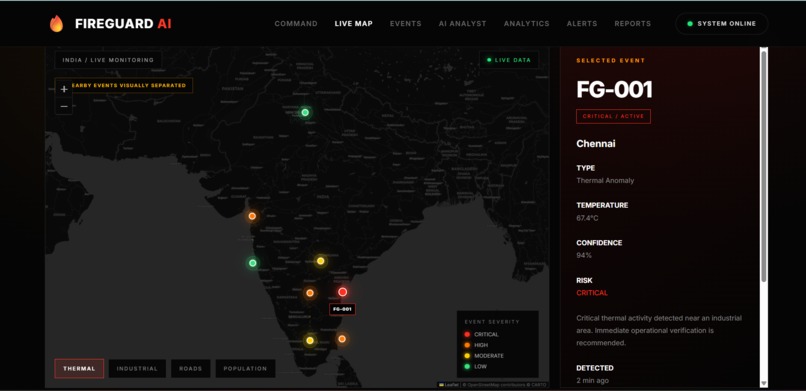
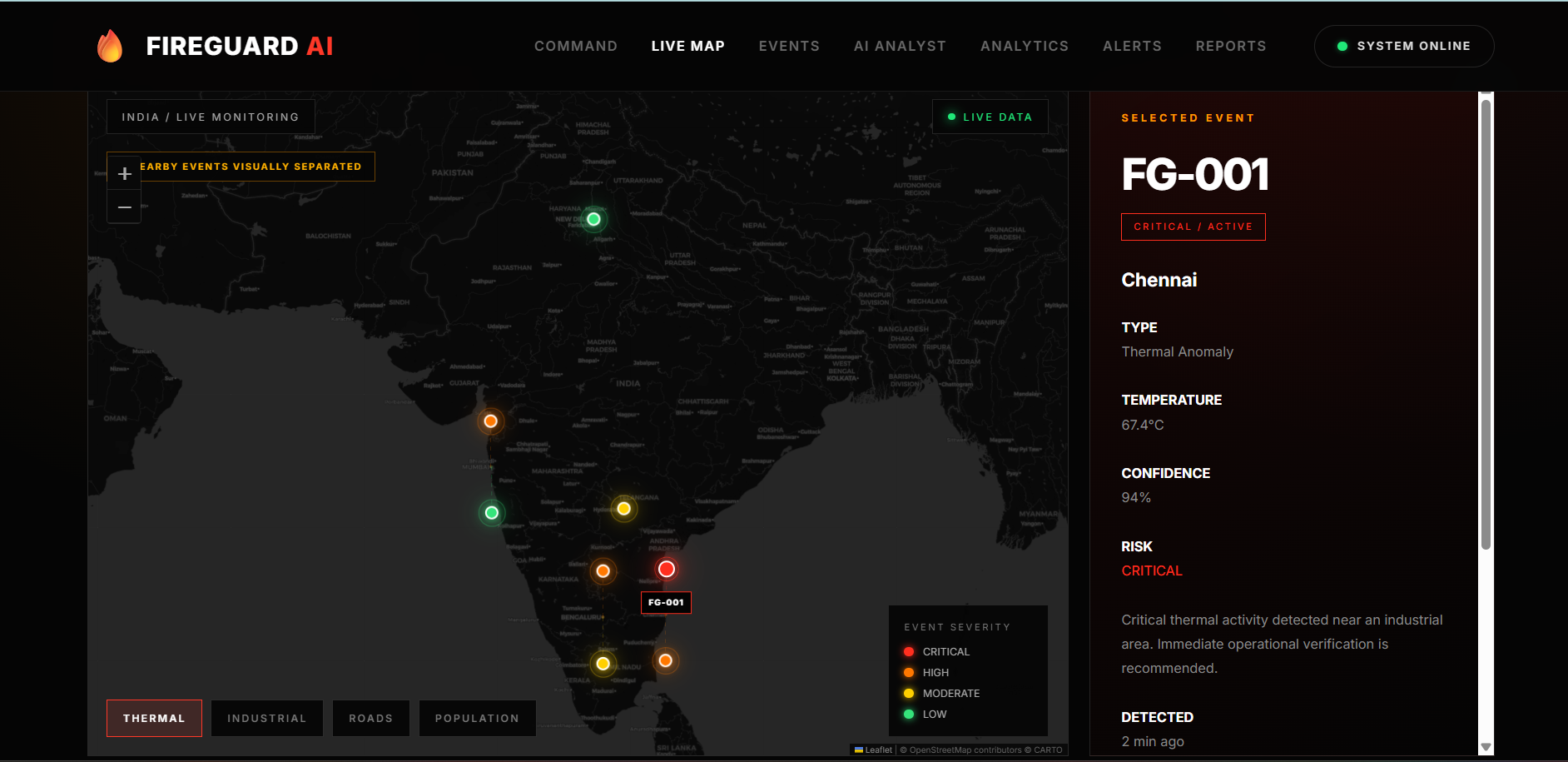
Live Map page
Inspiration
FireGuardAI was created to address the challenge of identifying and understanding potential fire and thermal hazards before they become more severe.
Traditional monitoring systems can provide individual sensor readings or alerts, but operators also need context: where the event is occurring, how severe it may be, what the surrounding risk looks like, and what action should be considered.
The idea behind FireGuardAI is to combine thermal-event monitoring, geographic visualization, alerts, analytics, and AI-assisted risk assessment into a single operational platform.
The project focuses on turning raw observations into an understandable risk assessment that can help an operator make faster and more informed decisions.
What FireGuardAI Does
FireGuardAI is an AI-powered thermal fire-risk intelligence platform.
The platform provides several connected modules:
- Command dashboard
- Live geographic map
- Event monitoring
- Alert management
- AI Analyst
- Analytics
- Reports
- REST API backend
The AI Analyst is the main interactive component. An operator can describe a situation using natural language, select a region and analysis mode, and submit the observation for assessment.
The system evaluates the reported situation and produces structured information such as:
- Threat level
- Risk score
- Thermal signal
- Industrial proximity
- Population exposure
- AI confidence
- Explanation
- Recommended response
AI Risk Assessment
One of the main goals of the project was to make the AI analysis respond differently to different situations rather than returning the same result for every input.
For example, the system can distinguish between:
Normal conditions
A normal clear day with no unusual thermal activity, no smoke, and no fire detected in the monitored region.
This produces a low-risk assessment.
Thermal anomaly
There is a localized increase in heat near an industrial area. No visible flames or smoke have been reported, but the thermal signal is higher than normal and should be monitored.
This produces a moderate-risk assessment.
Active fire emergency
A rapidly spreading fire with heavy smoke has been detected inside a densely populated industrial facility. Multiple structures are threatened.
This produces a critical-risk assessment.
This demonstrates the intended progression of the system:
Normal → Low Risk → Thermal Anomaly → Moderate Risk → Active Fire → Critical Risk
How We Built It
FireGuardAI was developed as a full-stack web application.
The frontend provides the operator-facing interface and contains separate modules for the dashboard, map, events, alerts, analytics, reports, and AI analysis.
The backend provides a REST API that handles health checks, events, alerts, and AI analysis requests.
The AI analysis engine uses structured rules and contextual processing to interpret free-text observations and produce a consistent risk assessment.
The application was designed so that the frontend communicates with the deployed backend through HTTP API requests.
The backend and frontend are deployed online, allowing the complete project to be demonstrated through a web browser.
Technology Stack
Frontend
- HTML5
- CSS3
- JavaScript
- Responsive web interface
- REST API integration
Backend
- Python
- Flask
- REST API
- JSON-based data handling
- Rule-based AI analysis engine
Deployment
- GitHub
- Render
- Cloud-hosted frontend
- Cloud-hosted backend API
System Architecture
The overall architecture follows this workflow:
User / Operator
↓
FireGuardAI Web Interface
↓
AI Analyst / Dashboard / Map / Events / Alerts / Analytics / Reports
↓
REST API
↓
FireGuardAI Backend
↓
Analysis Engine
↓
Structured Risk Assessment
The modular architecture makes it possible to extend the system with additional data sources and intelligence capabilities in the future.
Challenges We Faced
One of the main challenges was ensuring that the AI Analyst did not simply return the same result for every free-text input.
The system needed to distinguish between normal conditions, moderate thermal anomalies, and serious fire situations.
Another challenge was connecting the frontend to the deployed backend correctly. During development, the application initially used local development addresses such as 127.0.0.1:5000. These had to be replaced with the deployed backend API so that the online application could communicate correctly.
We also tested the API independently using direct HTTP requests to verify that the backend produced different assessments for different situations.
The final system was tested using normal, moderate-risk, and critical fire scenarios.
Testing
The AI Analyst was tested with multiple levels of fire-risk scenarios.
Test 1 — Normal
Input:
A normal clear day with no unusual thermal activity, no smoke, and no fire detected in the monitored region.
Result:
LOW — 15/100
The system identified the situation as low risk and reported a normal thermal signal.
Test 2 — Moderate
Input:
There is a localized increase in heat near an industrial area. No visible flames or smoke have been reported, but the thermal signal is higher than normal and should be monitored.
Result:
MODERATE — 54/100
The system identified an elevated thermal condition requiring monitoring.
Test 3 — Critical
Input:
A rapidly spreading fire with heavy smoke has been detected inside a densely populated industrial facility. Multiple structures are threatened.
Result:
CRITICAL — 95/100
The system identified a high-risk fire situation and produced a critical assessment with high industrial and population exposure.
These tests demonstrate that the analysis responds to the severity and context of the submitted situation.
What We Learned
Developing FireGuardAI provided experience across several areas of software development.
We learned how to:
- Design a multi-module web application
- Build and connect REST APIs
- Process structured and unstructured user input
- Develop rule-based AI analysis logic
- Create risk scoring systems
- Connect frontend interfaces to deployed backend services
- Test APIs independently
- Deploy a full-stack application
- Debug frontend/backend integration issues
- Design an operational interface for risk monitoring
The project also highlighted the importance of testing AI-assisted systems with different types of input rather than validating them with only one successful example.
Future Improvements
FireGuardAI is designed as a prototype platform that can be extended significantly.
Future versions could integrate:
- Real-time satellite thermal data
- IoT temperature and smoke sensors
- Computer vision for smoke and flame detection
- Advanced machine-learning models
- Historical fire datasets
- Real-time weather information
- Automated emergency notifications
- SMS and email alerts
- Predictive fire-risk forecasting
- More advanced geographic risk modelling
- Real-time data streaming
- Integration with emergency response systems
These improvements could allow FireGuardAI to move from a prototype intelligence platform toward a more comprehensive real-time fire-risk monitoring system.
Project Status
FireGuardAI is currently a deployed working prototype.
The major platform modules are operational, including:
- Dashboard
- Live Map
- Events
- Alerts
- AI Analyst
- Analytics
- Reports
- Backend REST API
The project can be accessed through a web browser and the backend API can be independently tested.
Developer
Jeffisha A John Stewartsson J R Joshua Miracle J Mahalakshmi P Narmathakavi C S
Designed, developed, tested, and deployed as the FireGuardAI project.
🔥 Detect → Analyze → Assess → Alert → Visualize → Respond
Conclusion
FireGuardAI demonstrates how thermal monitoring, geographic information, structured event data, alerts, and AI-assisted analysis can be combined into a single fire-risk intelligence platform.
The goal is not simply to detect a thermal signal, but to provide meaningful context around that signal and help an operator understand its potential severity.
FireGuardAI — turning observations into actionable fire-risk intelligence.


Log in or sign up for Devpost to join the conversation.