-
Project Overview
The Journey: Wildfire Detection Using Deep Learning
Building this project was a journey from understanding the theoretical power of neural networks to applying them toward a tangible, real-world environmental challenge.
Inspiration
The motivation behind this project was the increasing frequency and severity of wildfires globally. I wanted to explore how computer vision, specifically Convolutional Neural Networks (CNNs), could be leveraged to build an automated early-warning system. The idea was to create a tool capable of processing imagery faster than traditional methods, potentially saving lives and ecosystems by detecting outbreaks at their inception.
How I Built It
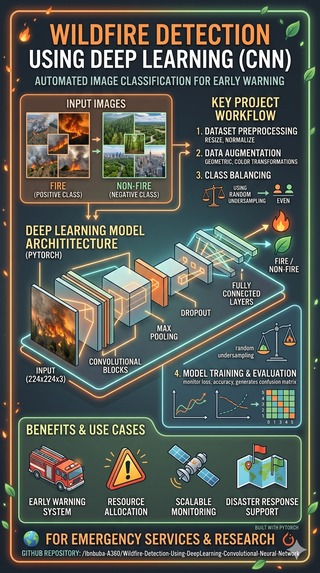
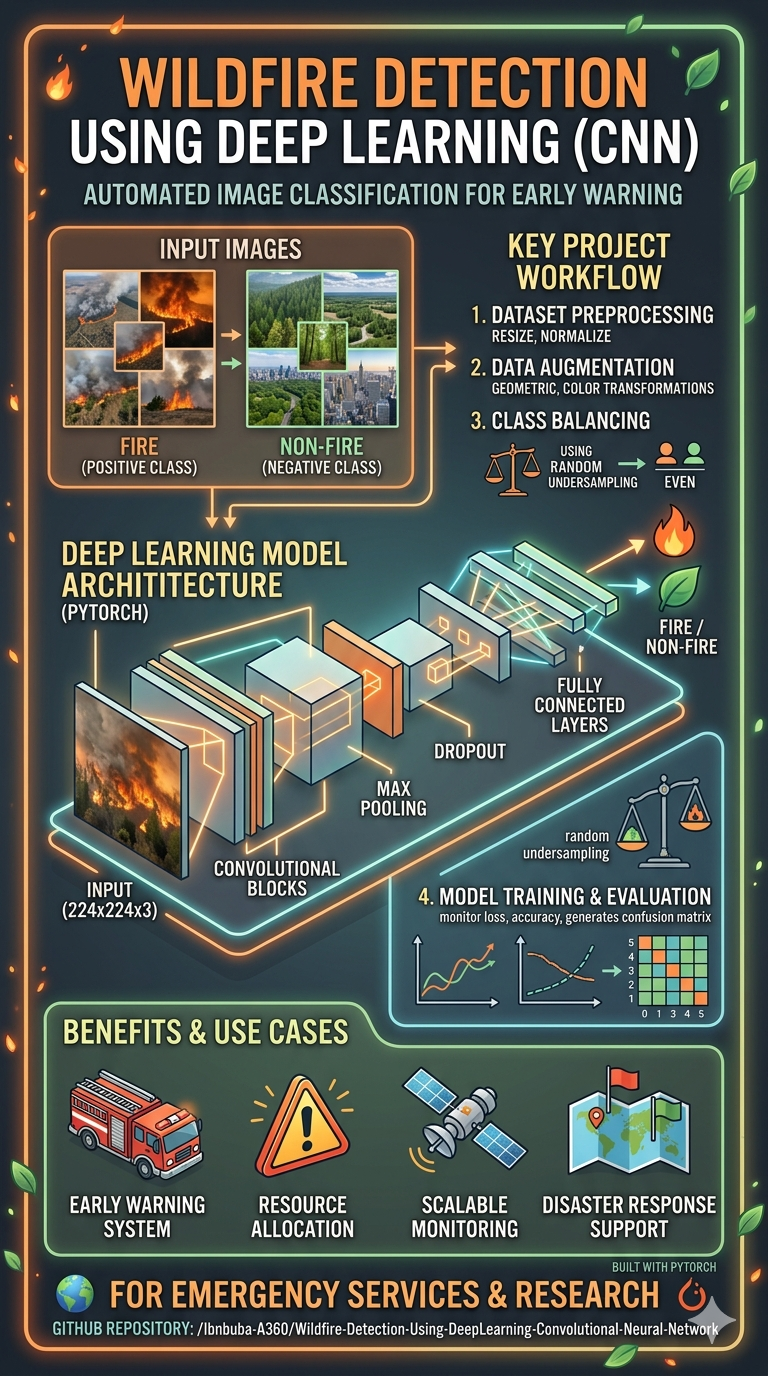
The project was constructed as an end-to-end pipeline using PyTorch. The architecture relies on the principle that local spatial patterns in images can be captured through convolution operations:
- Data Processing: I started with a raw dataset and applied standard preprocessing, including resizing images to 224 x 224 pixels.
- Addressing Imbalance: To ensure the model learned effectively, I implemented random undersampling to balance the classes (fire_images, non-fire_images).
- CNN Architecture: I designed a custom model featuring:
- Three Convolutional Blocks: To extract hierarchical features.
- Max Pooling: To reduce the dimensionality of the feature maps.
- Dropout Layers: To mitigate overfitting.
- Fully Connected Layers: To finalize the classification probability.
Challenges Faced
- Data Imbalance: The most significant challenge was the disparity in the original dataset. If left unchecked, the model would become biased toward the majority class. Using random undersampling was a key learning moment in maintaining model integrity.
- Overfitting: Early iterations showed the model performing well on training data but struggling with new images. Introducing dropout layers helped improve the model's generalization capabilities.
What I Learned
Through this project, I gained a deep appreciation for the data-centric side of machine learning. I learned that:
- A sophisticated model cannot compensate for poor or biased data.
- The importance of monitoring both training and validation loss curves is paramount to understanding when a model is "learning" versus "memorizing".
- Practical PyTorch implementation—from building custom data loaders to managing model checkpoints—is a skill that bridges the gap between theory and application.
This experience has been invaluable in understanding the complexities of deploying deep learning models in real-world scenarios.


Log in or sign up for Devpost to join the conversation.