-
-
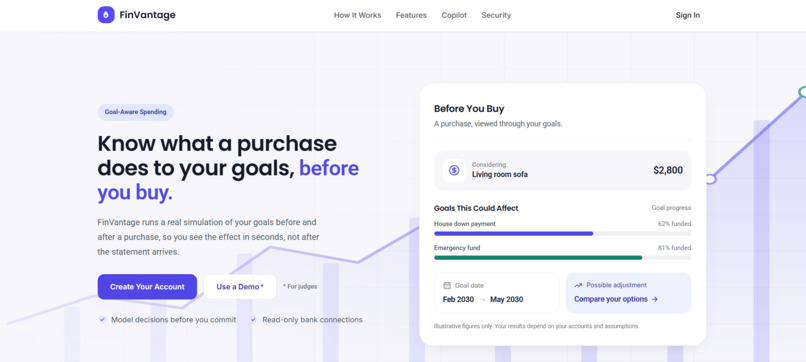
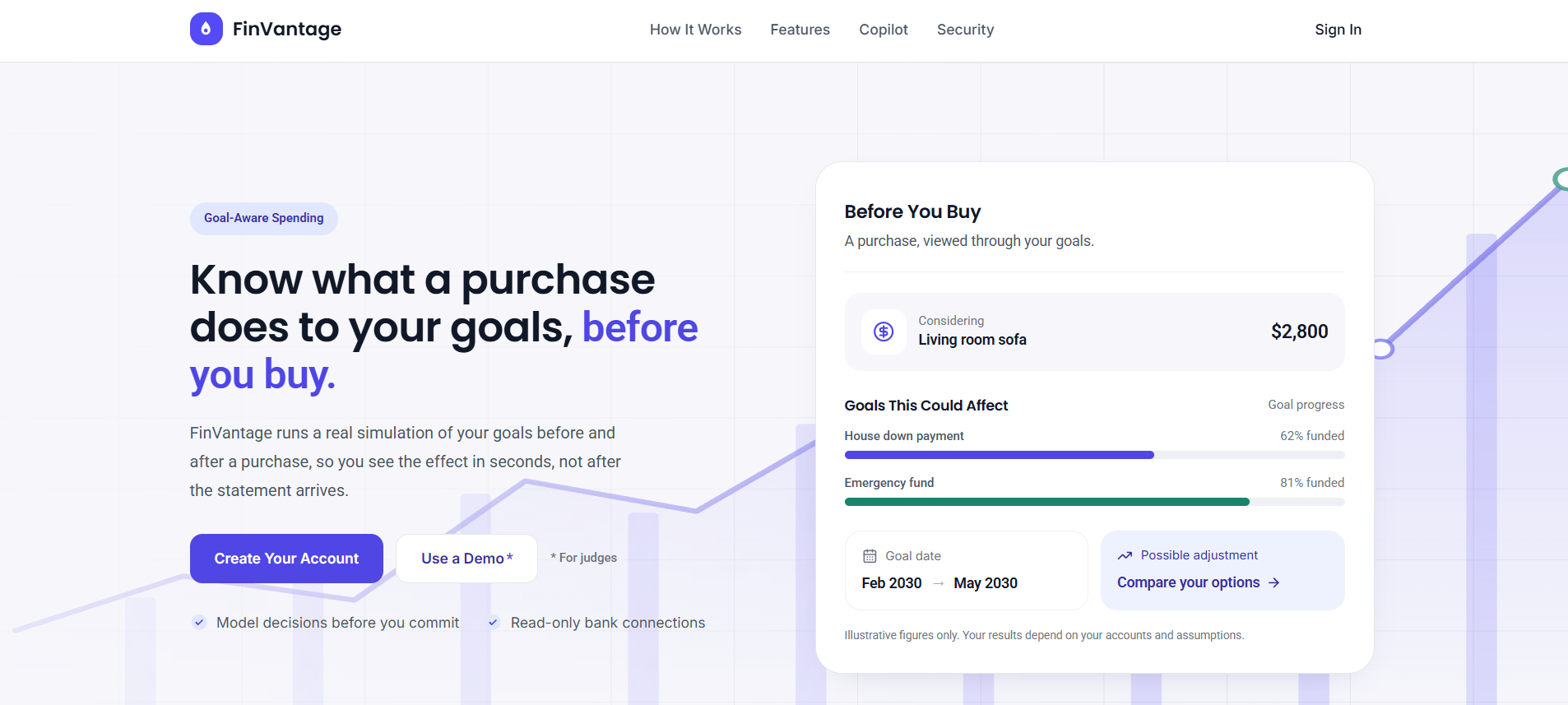
Landing Page
-
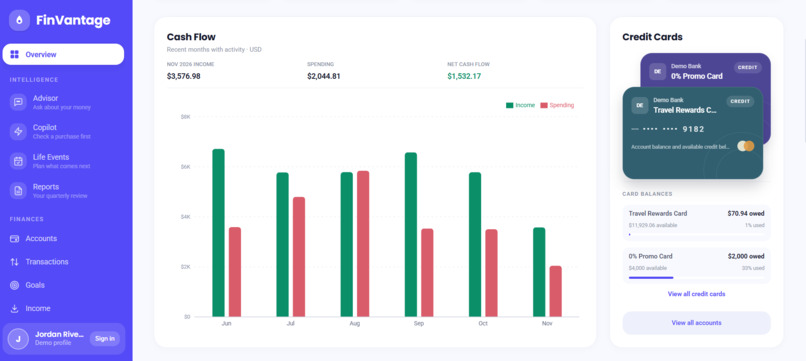
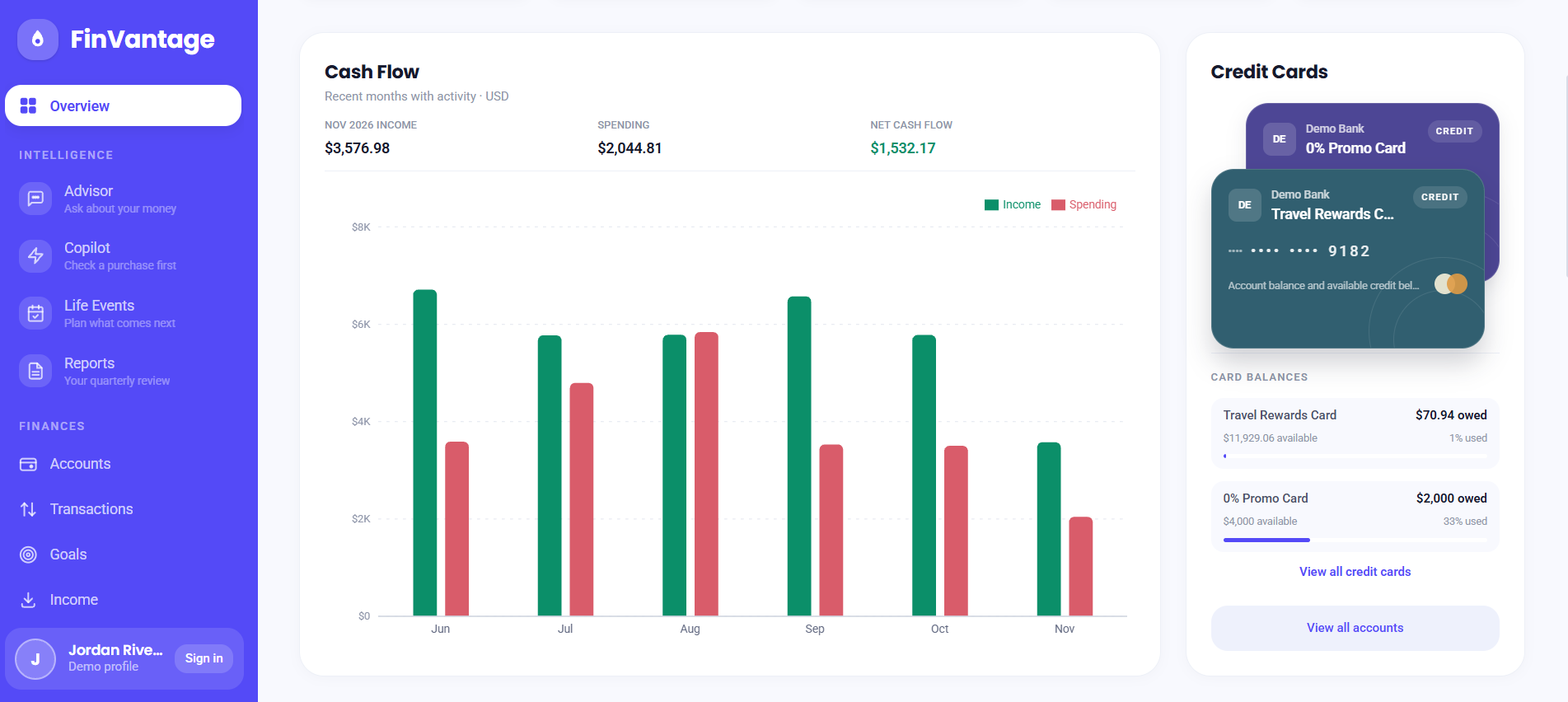
Overview Page
-
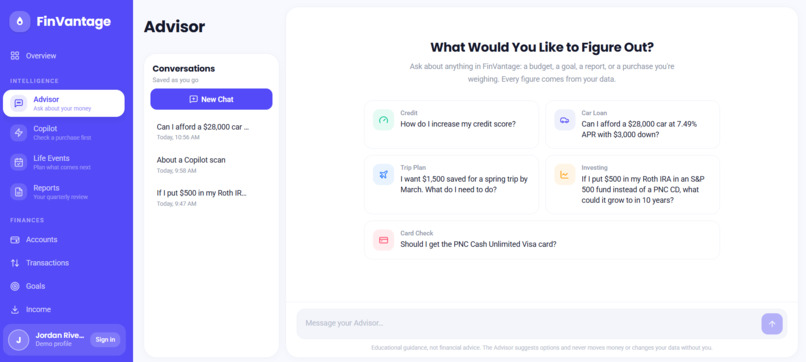
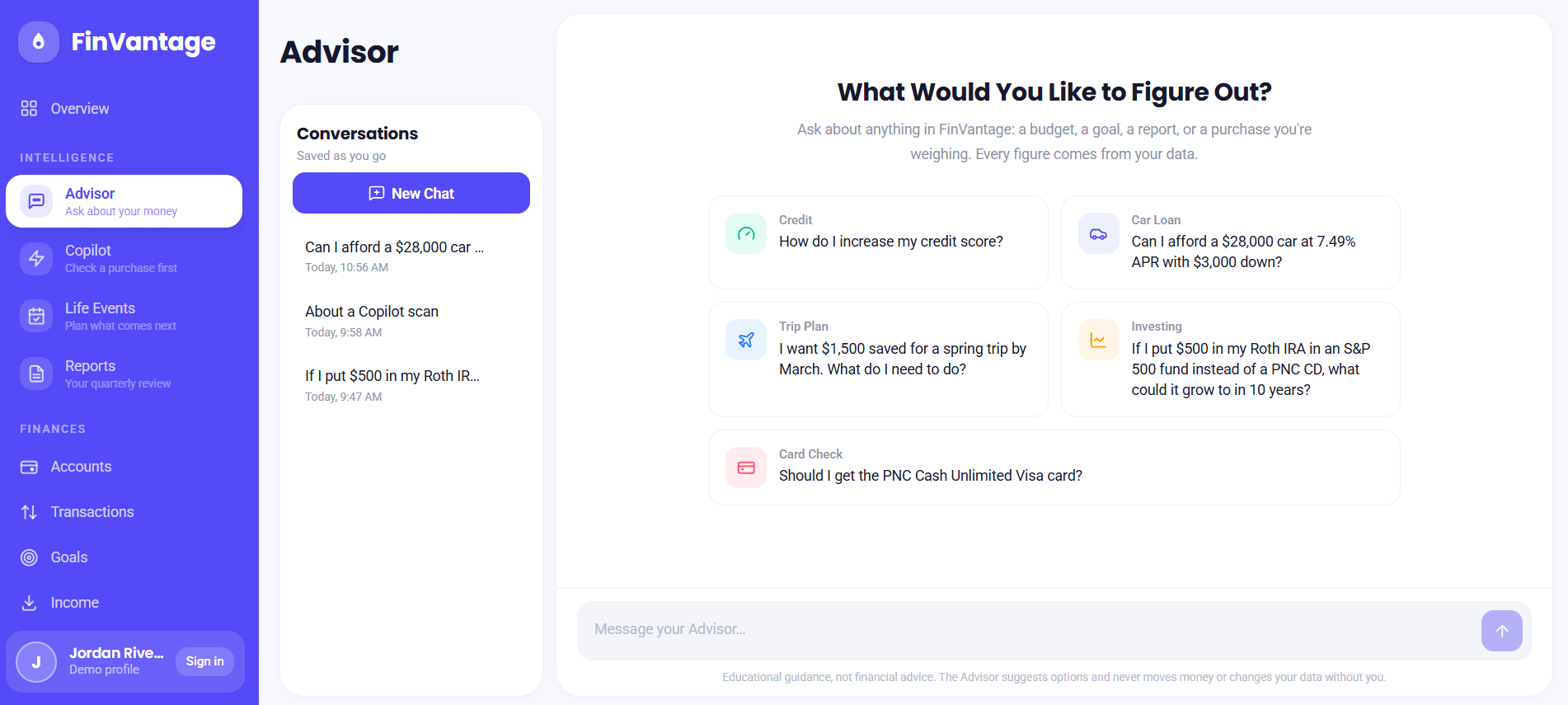
Advisor Tab - Ask a question, get an answer, sometimes as a widget: loan explorer, goal planner, growth comparison, or card evaluator
-

Copilot on Amazon - A $1,099 MacBook triggers a heads-up before you buy: your cushion, the 10-year cost, and a smarter move
-
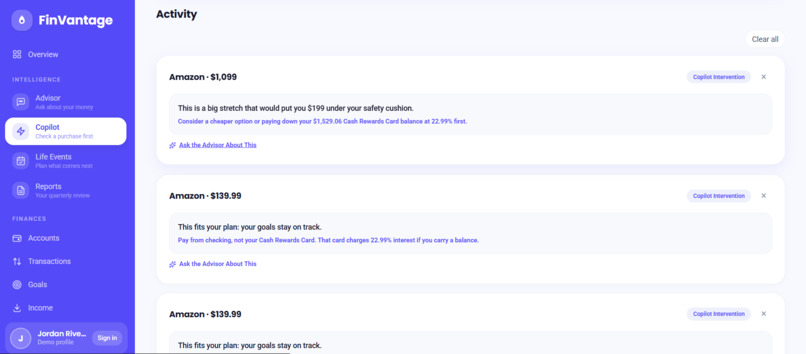
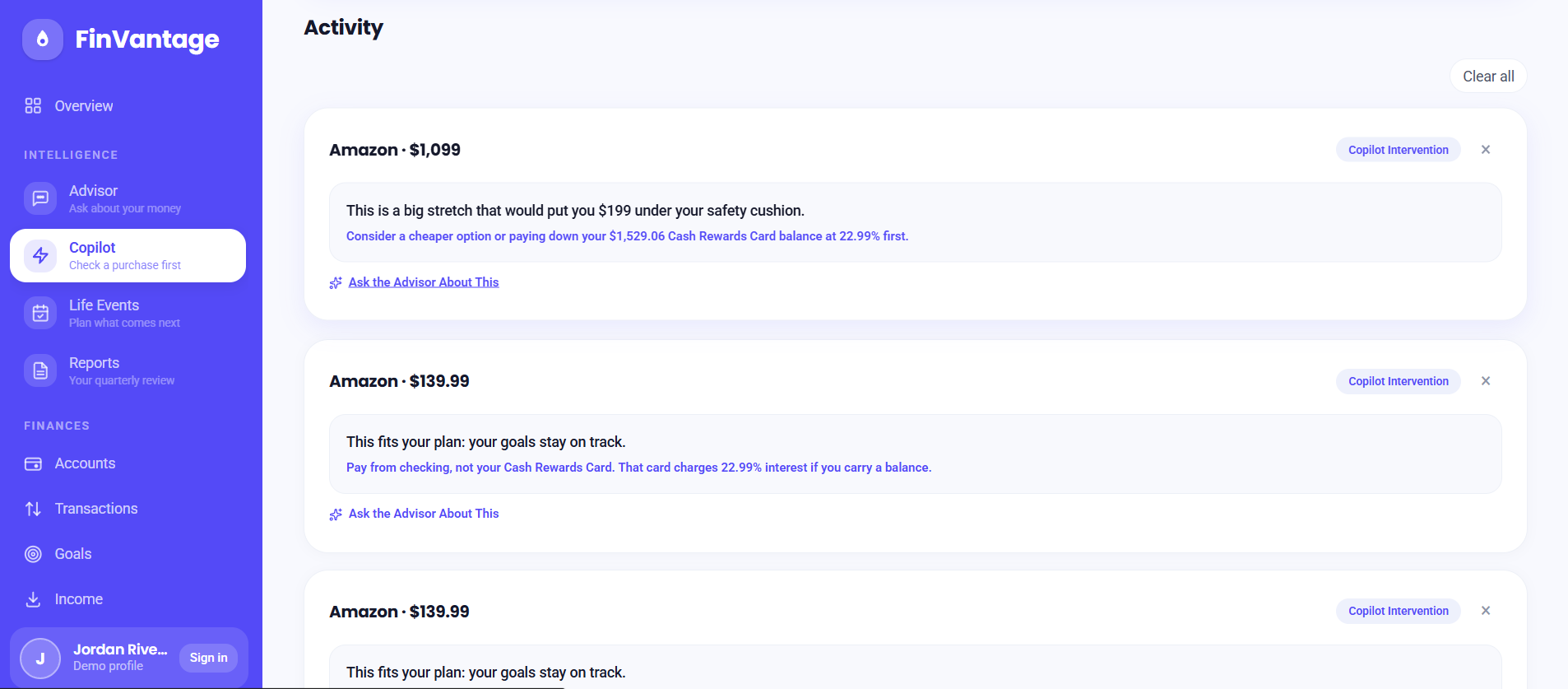
Copilot Tab - Every intervention is saved to a live feed, with a one-click shortcut to ask the Advisor about it
-
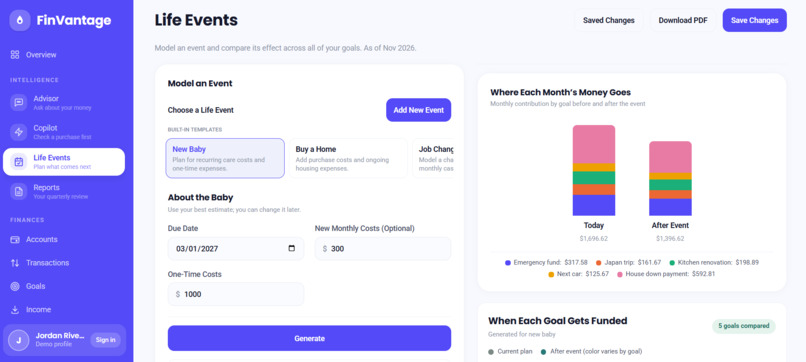
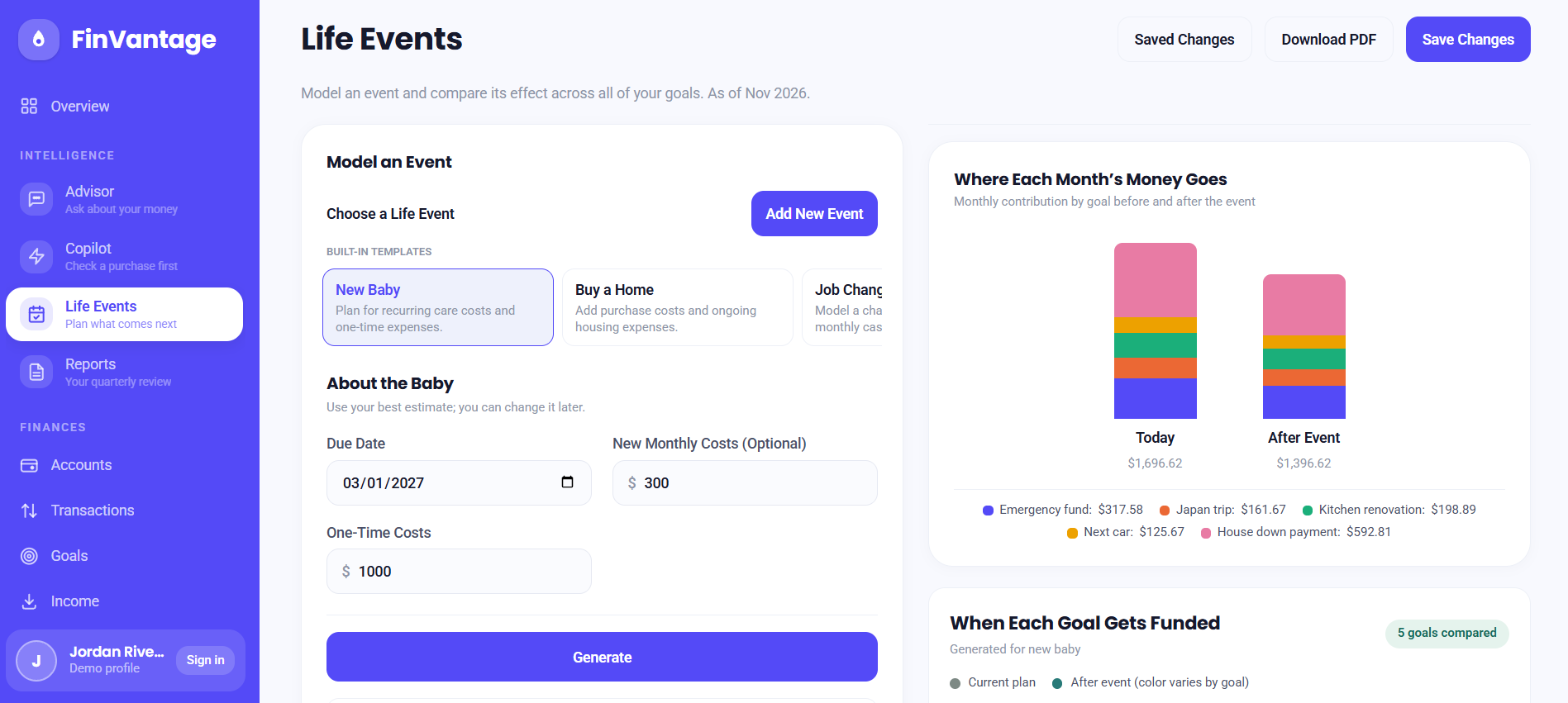
Life Events Tab - Model a new baby or a move and watch every goal’s monthly funding shift, before anything is saved
-
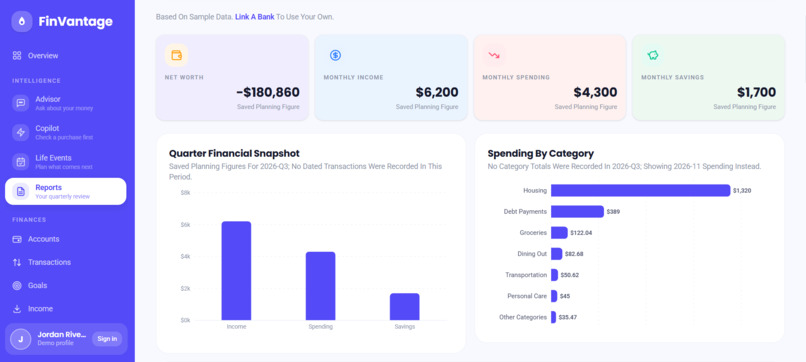
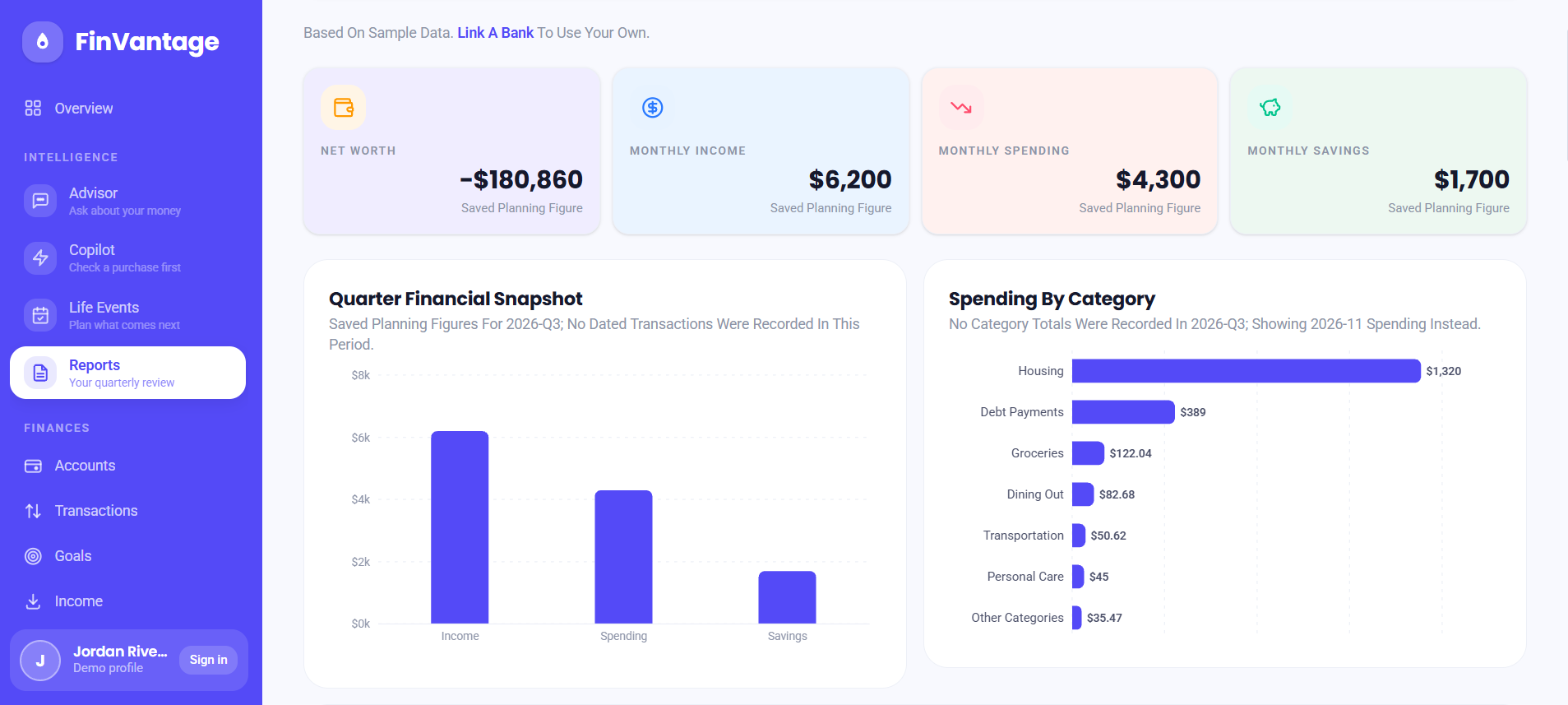
Reports Tab - Your quarterly snapshot: income, spending, savings, and where the money went
-
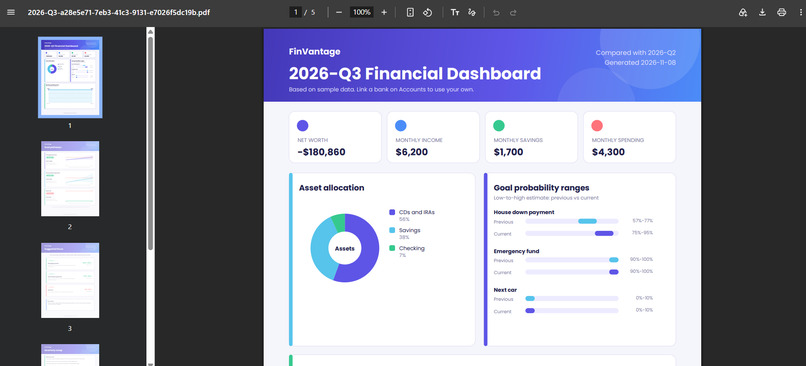
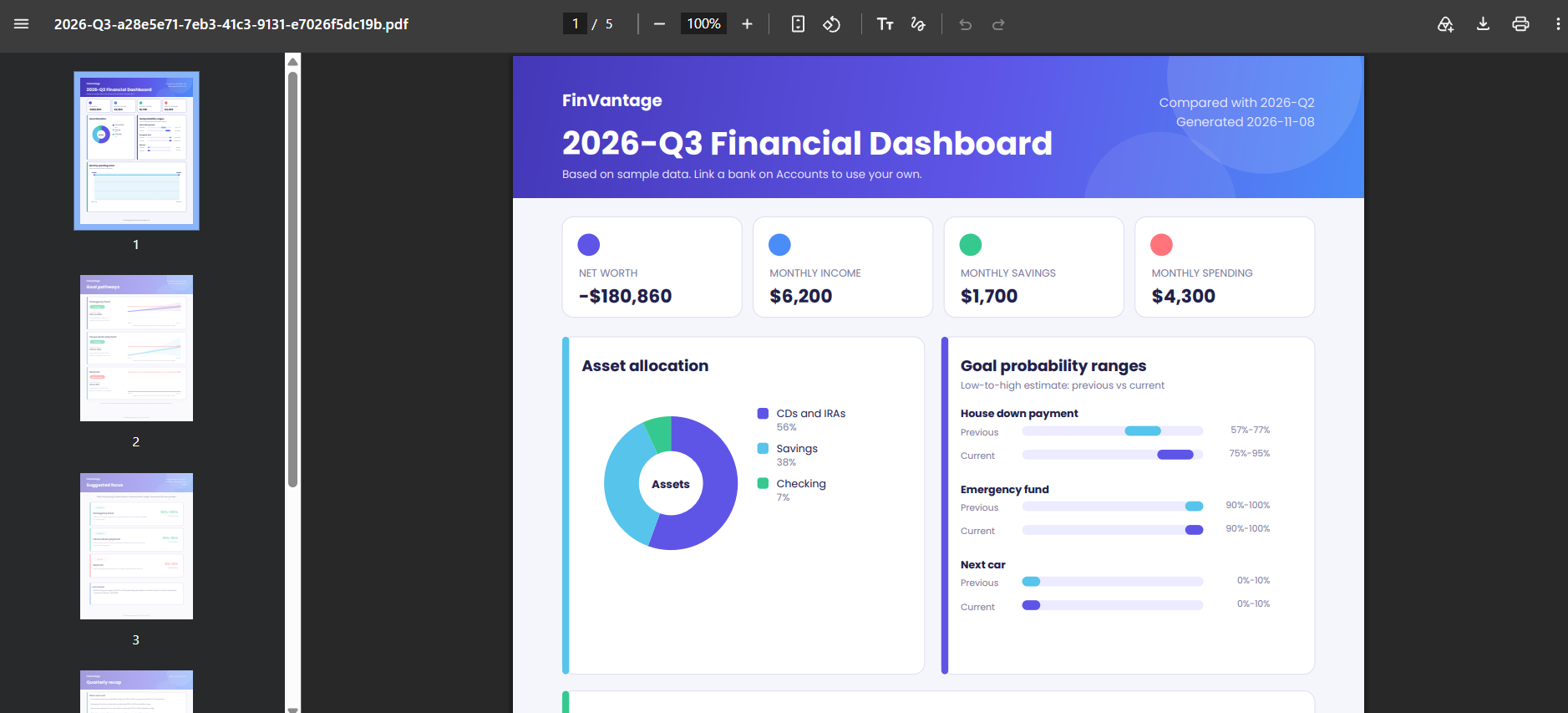
Reports PDF - A downloadable quarterly review with goal ranges (previous vs. current), asset allocation, and suggested focus areas
-
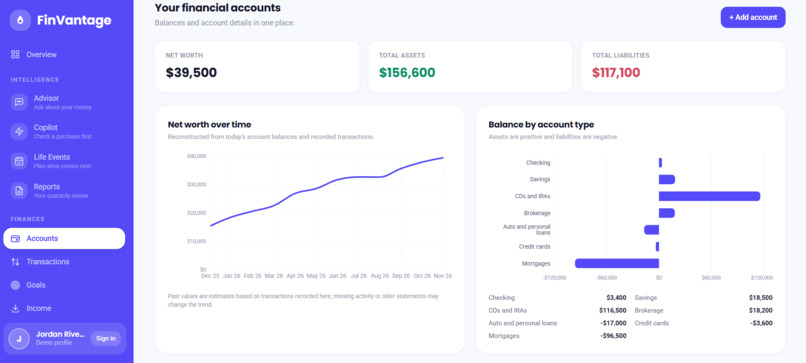
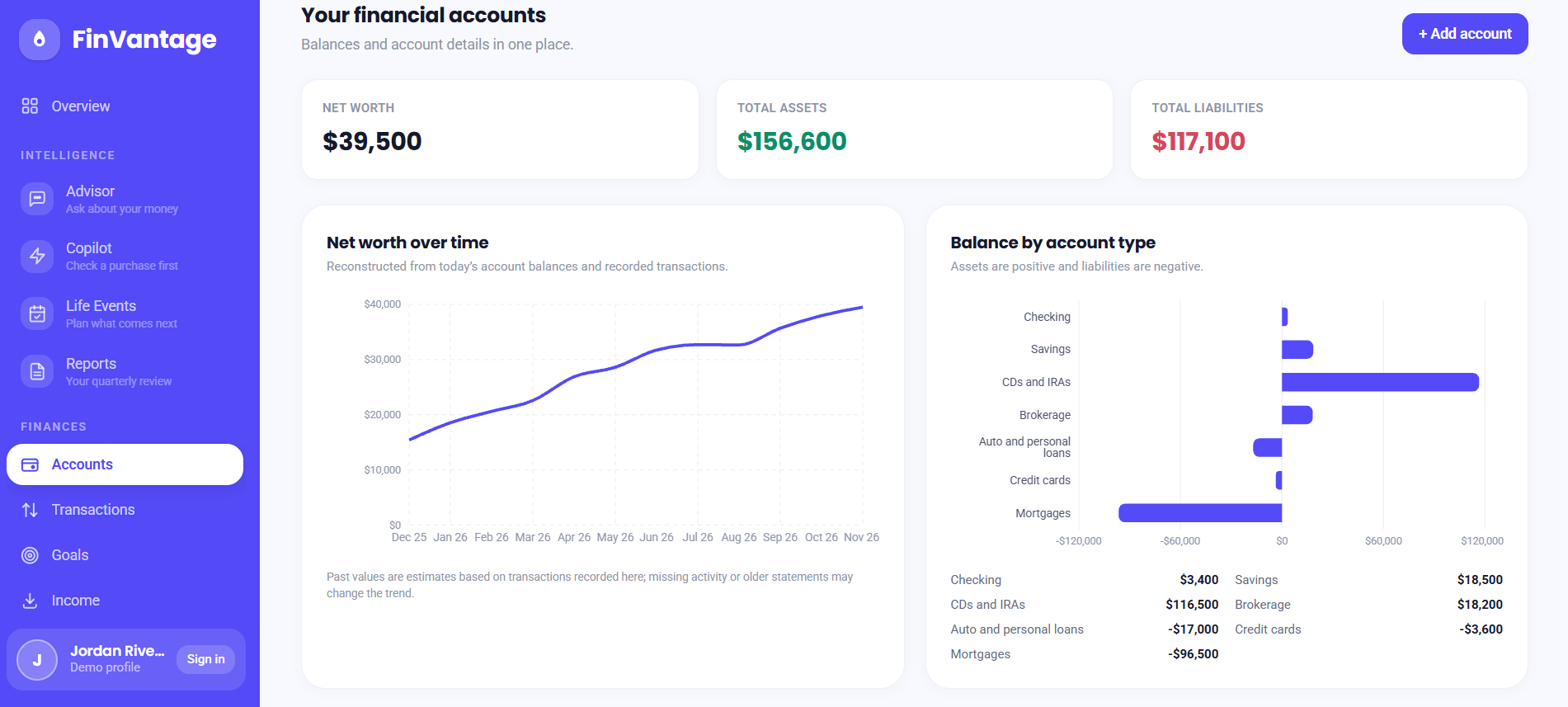
Accounts Dashboard
-
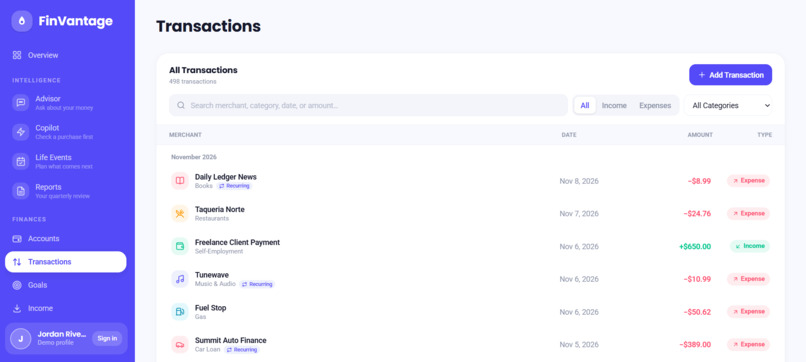
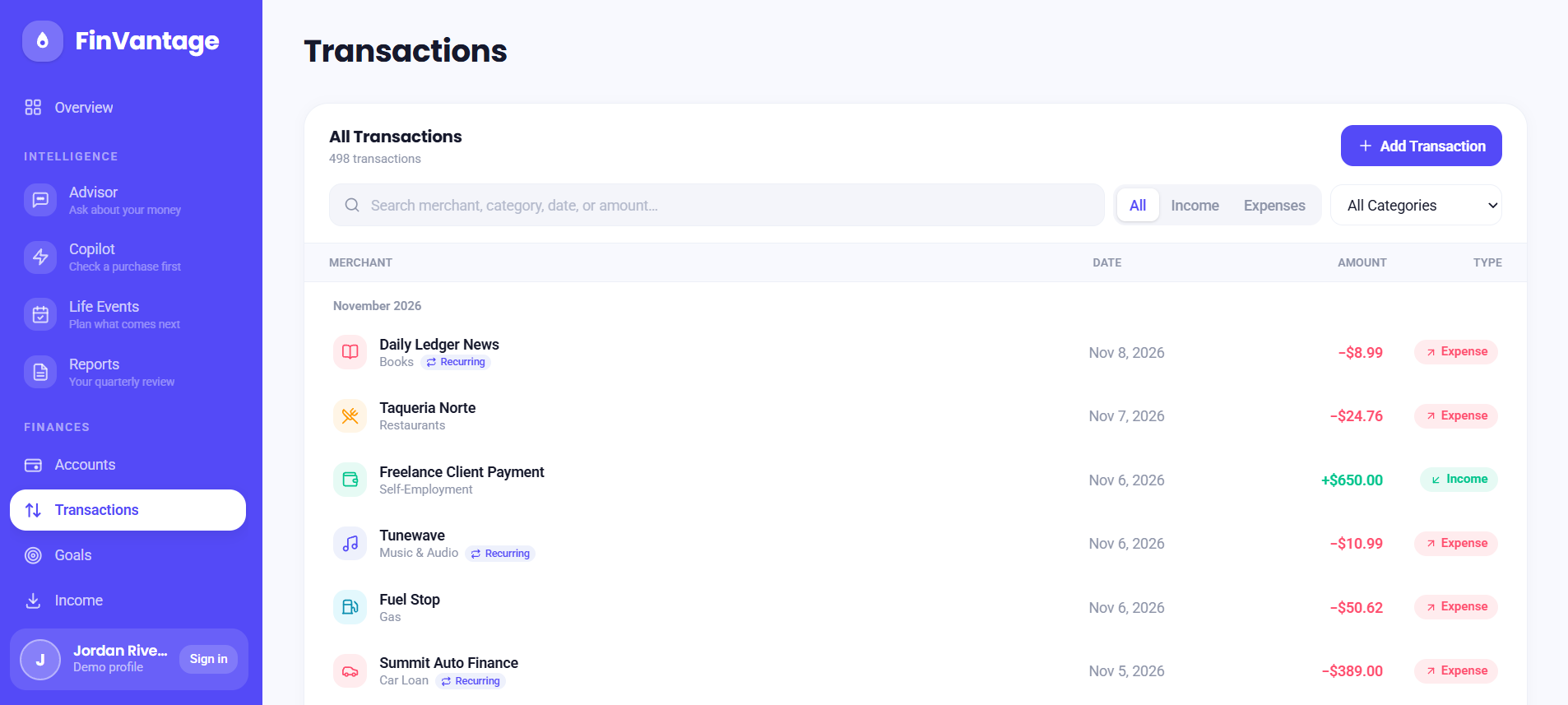
Transactions Dashboard
-
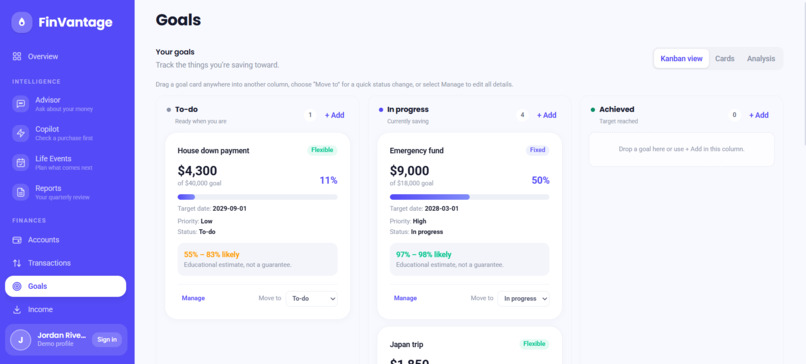
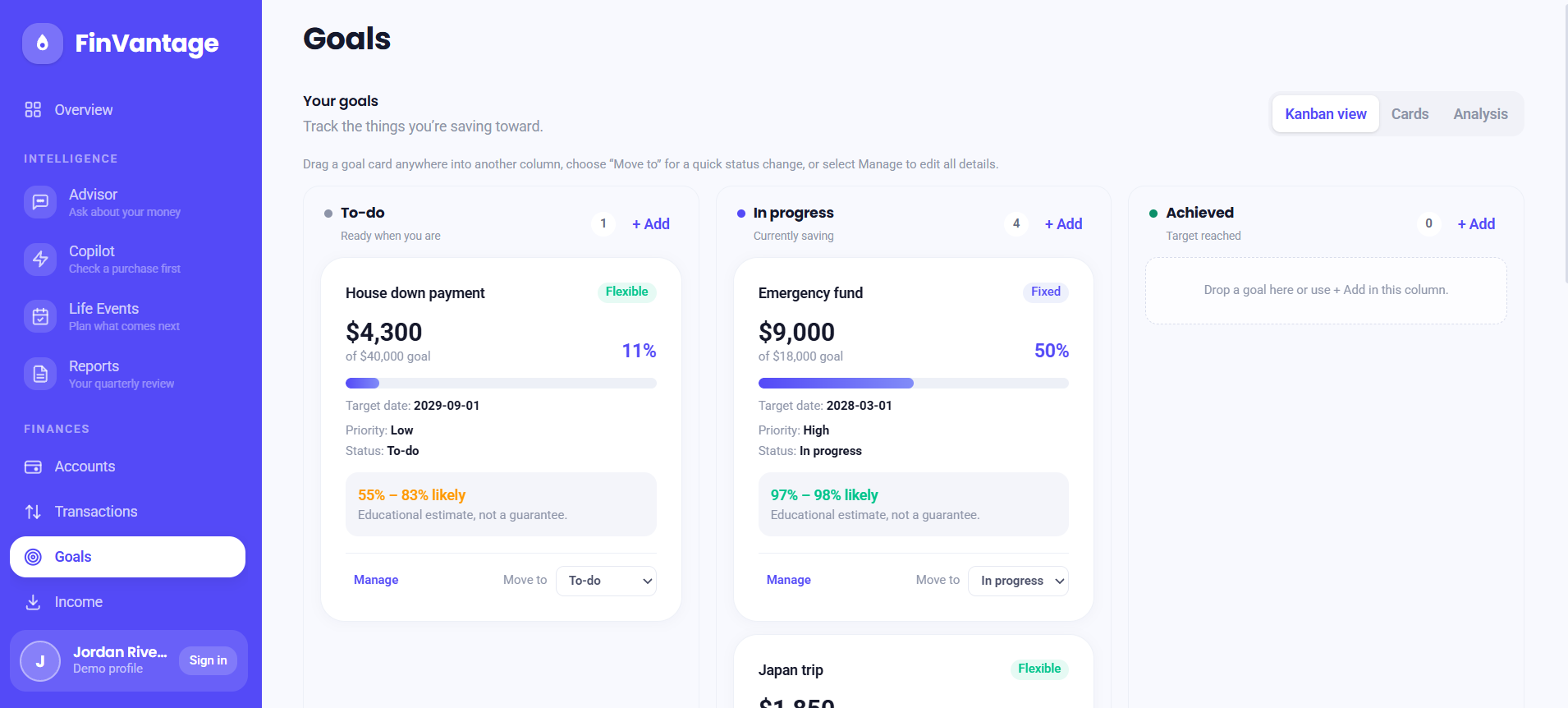
Goals Dashboard
-
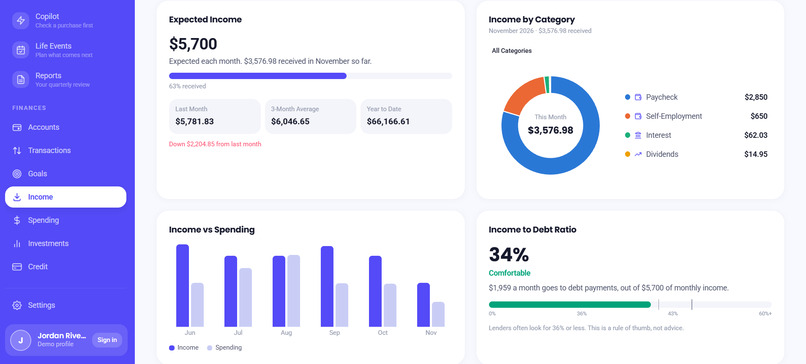
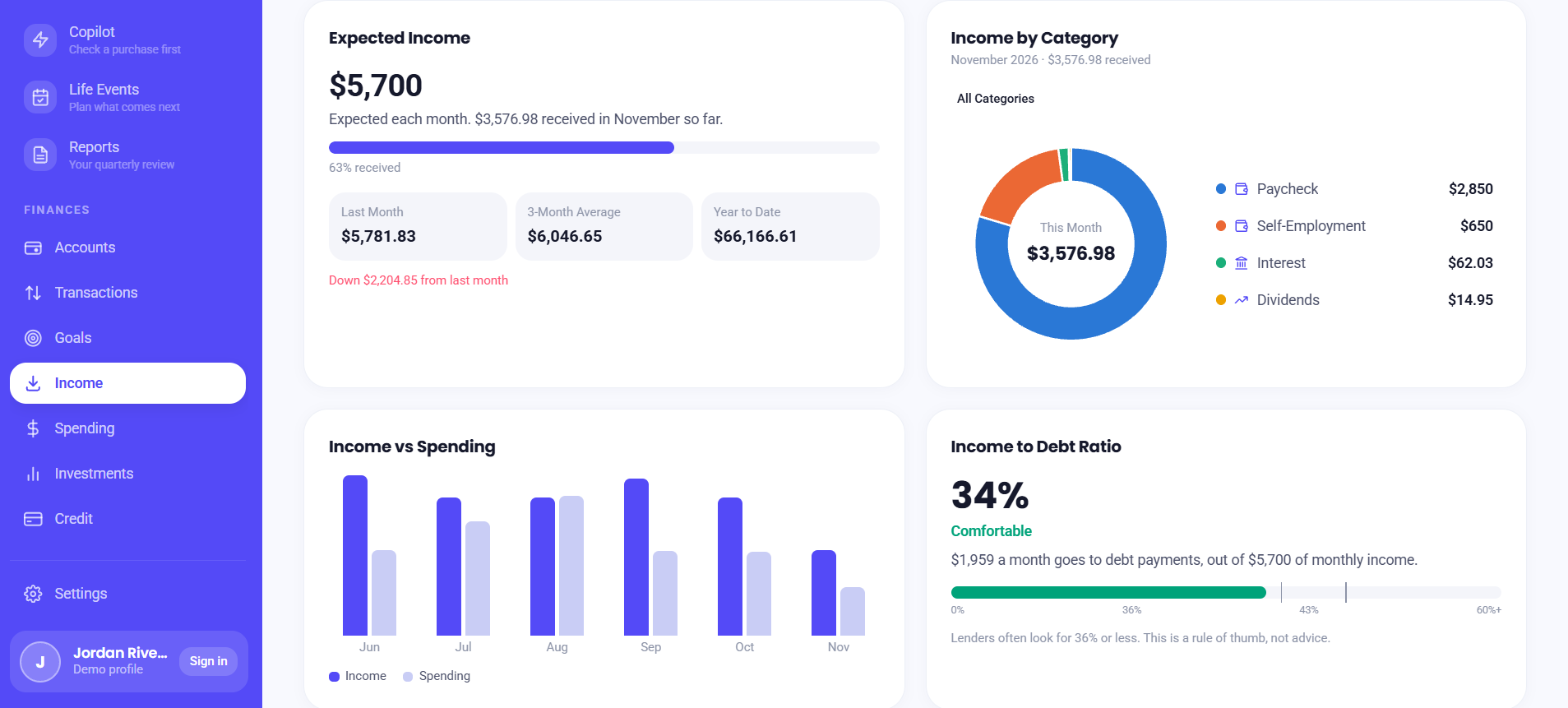
Income Dashboard
-
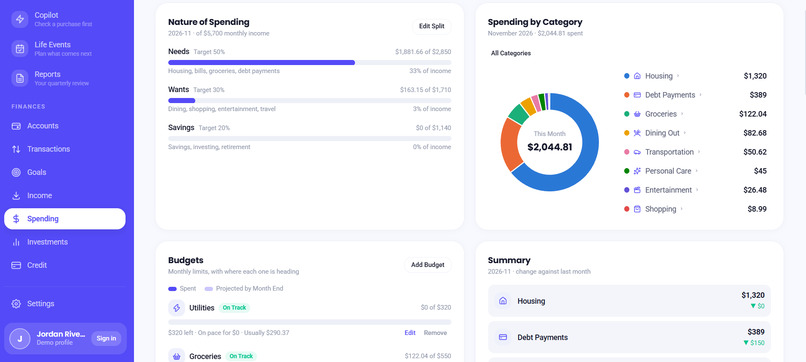
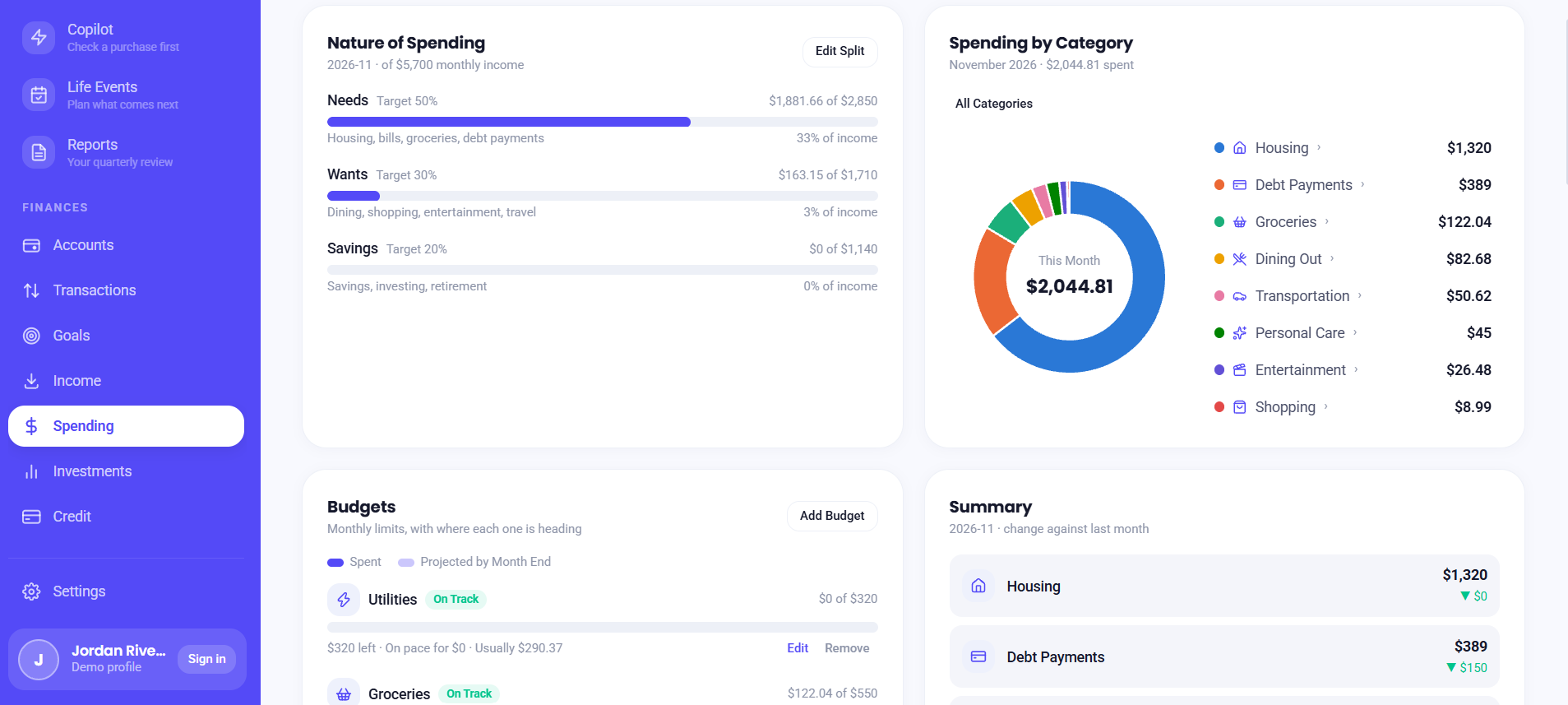
Expenses Dashboard
-
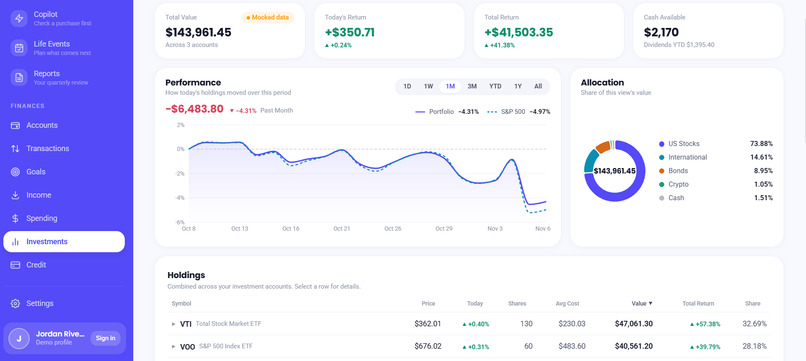
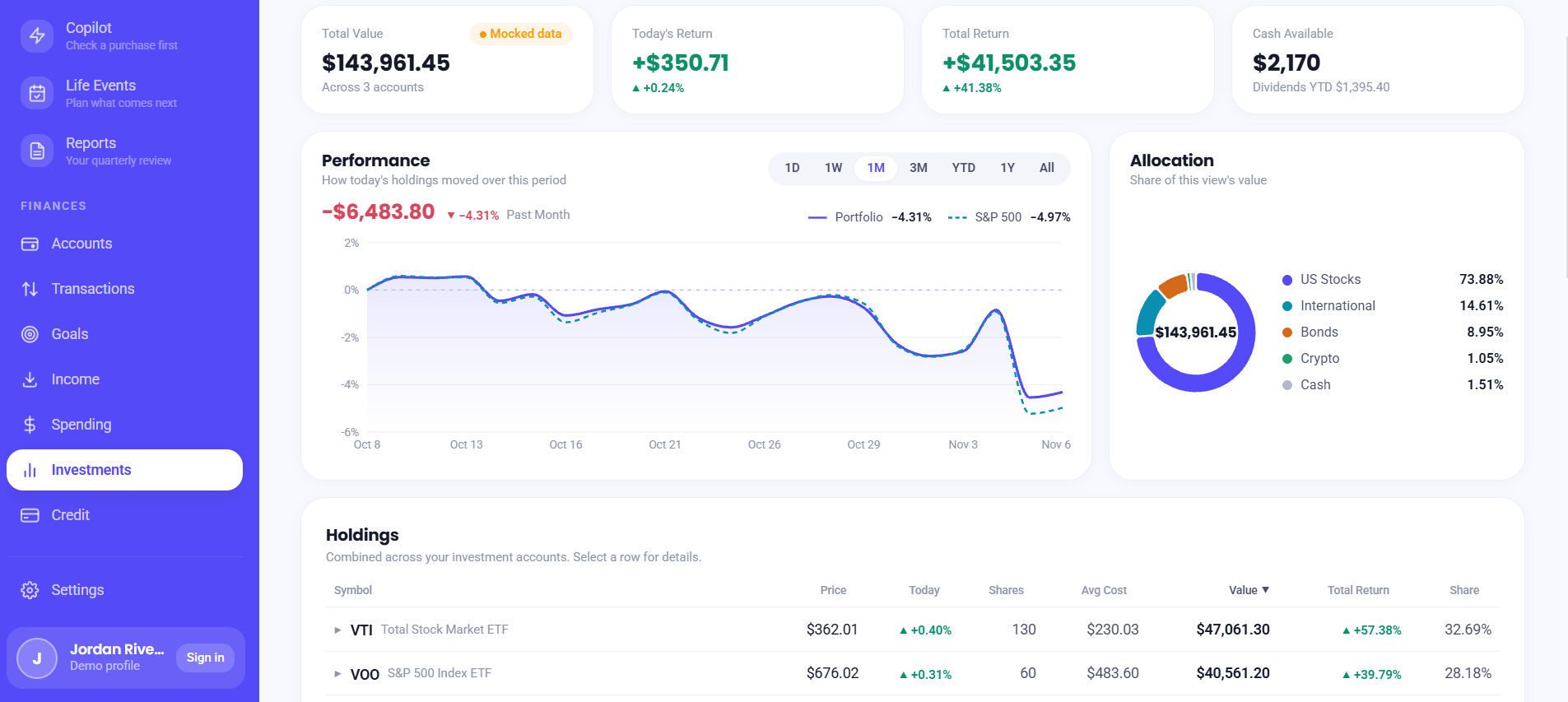
Investments Dashboard
-
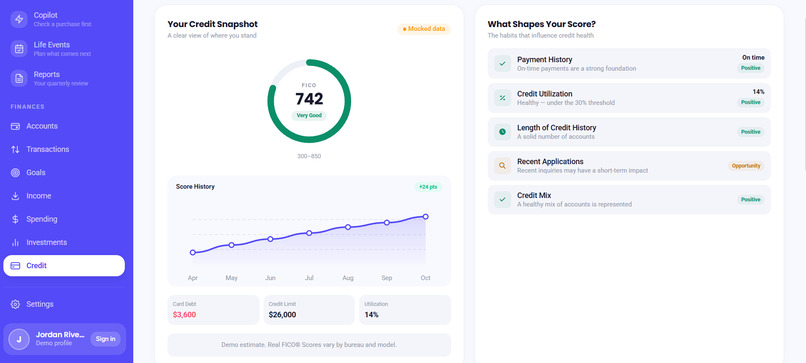
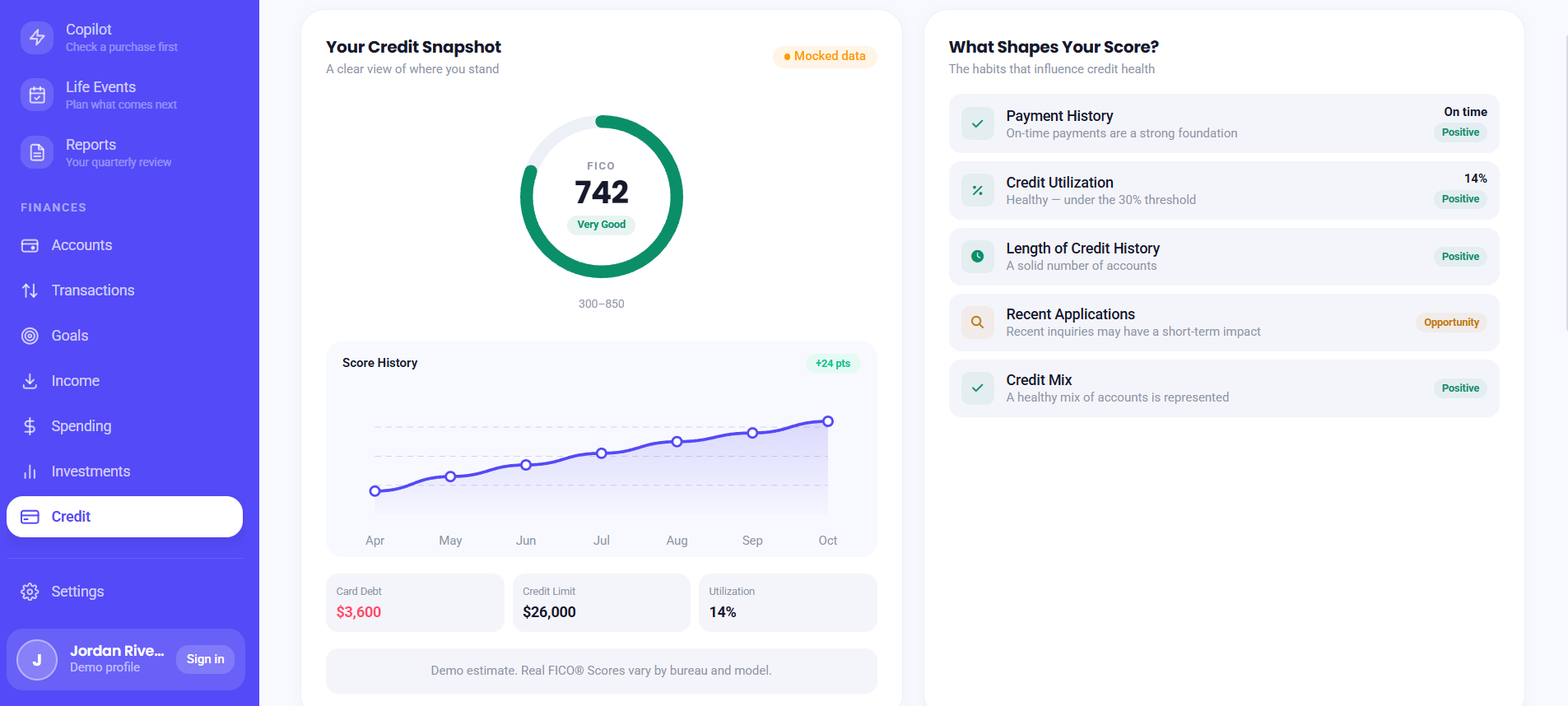
Credit Report Dashboard

FinVantage 🧠
"All Your Money. One Brain."
🚀 Inspiration
Your money is everywhere. Checking here, savings there, a CD, a Roth IRA, a 401(k), a car loan, three credit cards, a mortgage - and almost no one has one clear view of how they're doing or what to do next.
The apps that exist (Mint, YNAB, Credit Karma) all landed on the same formula: link your accounts, categorize, budget, show a net worth number. They share two gaps. They look backward, and they're passive. You only see the consequence after the money is gone.
And the moments that matter most - the Amazon checkout, the lease application, the car loan - happen somewhere else entirely, with no advice in sight.
We thought: Why does your financial life live in a dozen places, with nothing watching over the decisions that actually shape it?
What if all of your money lived in one place, thought with one brain, and spoke up at the exact moment you were about to decide? And what if that brain was never allowed to make up a number?
That's how FinVantage was born: a complete finance ecosystem that looks forward - every account, every goal, every decision - before the money is gone.
🌐 It's Live. Go Try It.
👉 Open the Live Demo 👈
No sign-up, no real bank info, no setup. Click in and explore as Jordan Rivera, our demo profile with 12 accounts and 498 transactions already loaded.
Try it in 2 minutes:
- 💬 Ask the Advisor: "Can I afford a $28,000 car at 7.49% APR with $3,000 down?" Then drag the sliders.
- ⚡ Meet the Copilot: on the Copilot tab, download the extension, load it in Chrome, and open any Amazon product.
- 👶 Plan a life event: open Life Events, pick New Baby, and watch every goal's funding shift.
- 📊 Go chart-hunting: flip through the Finances tabs and see your whole financial life come together in charts.
💡 What it does
FinVantage is a web dashboard and a Chrome extension, powered by one brain: a single backend where a deterministic math core and a Monte Carlo simulator compute every number, and an AI only puts those numbers into plain words.
🧠 The Intelligence Suite
Four tools that do the thinking before you do the spending.
💬 Advisor - "Ask about your money"
Ask anything and get an answer grounded in your own data:
- "Can I afford a $28,000 car at 7.49% APR with $3,000 down?"
- "If I put $500 in my Roth IRA in an S&P 500 fund instead of a PNC CD, what could it grow to in 10 years?"
- "Should I get the PNC Cash Unlimited Visa card?"
It uses about 15 typed tools to look things up and run real calculations, then shows its work under "How These Numbers Were Worked Out." Interactive visuals (a loan explorer, goal planner, growth comparison, and card evaluator) recompute on the server as you drag a slider. Conversations save as you go, and it never moves money or changes your data without you.
⚡ Copilot - "Check a purchase first"
A Chrome extension that notices a big money decision on the page you're viewing and slides in a card showing what it does to your goals, in about a second.
On a real $1,099 MacBook Air on Amazon, a card appears:
Heads up from FinVantage This is a big stretch that would put you $199 under your safety cushion. Why: Spending $1,099 now means missing out on $1,062.90 in growth over 10 years. What you could do: Consider a cheaper option, or pay down your $1,529.06 Cash Rewards Card balance at 22.99% first.
A $139.99 purchase? "This fits your plan: your goals stay on track." Every card gets a verdict chosen by code, never by the AI: Looks good, Worth a look, Heads up, or Warning. It also reads rental listings (a $1,950 apartment turns your emergency fund goal red and names the rent you can afford), car-financing quotes, and credit card payment pages (pay the balance in full and see the interest you save per year).
It updates live as the price changes, links to "Compare With All Goals," and saves every intervention to a feed with an "Ask the Advisor About This" shortcut. It reads only four things: page type, item type, price, and merchant. No page text. No browsing history. No screenshots.
🔮 Life Events - "Plan what comes next"
Stress-test your life before you live it. A custom Monte Carlo engine runs 5,000 possible futures with income, spending, and market returns all varying, and funds your goals together, in priority order, from one pool of savings, the way real money works.
Pick New Baby, add $300 a month in new costs and $1,000 up front, and watch the money going to your goals drop from $1,696.62 to $1,396.62 a month, goal by goal. Or just type "We're having a baby in March." Every result is an honest range, never a fake-precise number, a before-and-after preview comes first, and nothing saves until you say yes. Export the comparison as a PDF.
📄 Reports - "Your quarterly review"
A quarterly recap of what went well, what didn't, and why, as a downloadable PDF with goal probability ranges (previous vs. current quarter), asset allocation, and suggested focus areas. Schedule it to land in your inbox. Every figure is aggregated in code, and Gemini writes only the prose.
📊 The Dashboard
Every account, every dollar, one place. Seven tabs, one line each:
- 🏦 Accounts: Checking, savings, CDs, Roth IRA, 401(k), brokerage, auto and personal loans, credit cards, and a mortgage - covering all six PNC account types, plus Plaid bank linking that replaces the demo data everywhere with real data in a click
- 🔁 Transactions: searchable transactions with income and expense filters, category colors, and recurring charges tagged automatically
- 🎯 Goals: a Kanban board (To-do, In progress, Achieved) where each goal carries its own simulated range, like "97 to 98% likely"
- 💵 Income: what you expect vs. what's landed this month, income vs. spending, and a plain-English income-to-debt ratio
- 🧾 Spending: budgets that show where each category will land by month end, plus a Needs, Wants, and Savings split against an editable 50/30/20 target
- 📈 Investments: your portfolio vs. the S&P 500 across any time range, with allocation and holdings (share counts mocked), along with a watchlist, top movers, market news
- 💳 Credit: a score gauge, history and "What Shapes Your Score?" in plain language, along with all your credit cards and their stats
And one rule above all: FinVantage suggests. It never moves money, applies for credit, or clicks anything for you.
🧠 We've got the math: an AI that can't invent a number
Everything above runs on one rule:
Math first. Words last.
Language models are great with words and bad with arithmetic. So we split the job. Every figure is computed in code before the AI writes a single word. Google Gemini only turns those figures into a plain-language sentence, and a guardrail rejects any card or answer containing a number it wasn't given. If Gemini is slow, down, or wrong, you get a template card built from the exact same math. The demo never shows an empty state.
More rules the code enforces, backed by tests:
- Probabilities are always ranges, with a disclaimer beside them
- Mocked values (credit score, share counts) carry a visible "Mocked data" badge
- Nothing the user didn't confirm ever gets saved
- Advisor web searches containing your name, email, or dollar figures are blocked before they leave the server
- Secrets stay on the server, and the extension never sees a password
- The simulator is deterministic: same inputs, same output, so any difference between a baseline and a what-if is caused by the change alone
The result: an advisor in every tab that does the math before it says a word.
🛠️ Tech Stack & Architecture
A TypeScript monorepo with two clients - a Next.js dashboard and a Manifest V3 Chrome extension - calling one Hono API. Zod contracts define every route once, so server and clients are typed from the same table, and a response that drifts from its contract fails loudly instead of quietly shipping bad data.
Frontend: Next.js (App Router), React, Tailwind CSS, and Recharts, with a purple design system, Poppins headings, one-hue fan charts, a colorblind-checked palette, and green, amber, and red reserved strictly for verdicts (always with an icon and a label). The Copilot card renders in a Shadow DOM, so no host page's CSS can touch it.
The Brain (Backend & Math): A Hono API on Node, a deterministic math core, and a custom seeded Monte Carlo engine. A full Copilot evaluation takes about 0.6 seconds.
AI Layer: Google Gemini handles card wording (structured JSON output), Advisor function calling across about 15 typed tools, Google Search grounding, life-event parsing, and quarterly report prose, always behind the number-checking guardrail.
Data Layer:
- SpacetimeDB holds the relational ledger, credentials, and live push. Signed-in browsers subscribe to a per-user view with their own sign-in token, so each user only ever receives their own events.
- MongoDB Atlas holds simulation runs, Copilot events, life events, reports, report PDFs, email schedules (with atomic leasing so nothing sends twice), and Advisor conversation memory.
- Plaid Sandbox supplies the bank link, transactions, liabilities, and holdings, with access tokens encrypted using AES-256-GCM.
- Alpaca and Financial Modeling Prep supply market data for the Investments page.
Platform: Our own email and password auth with RS256 tokens and a JWKS endpoint, PDFs via pdfkit, email via Gmail SMTP, and deploys to Vercel through GitHub Actions.
⚙️ Challenges We Ran Into
Making an LLM trustworthy with money: Our first Gemini cards said things the math never said. The fix was stronger than a better prompt: we withhold any figure the math didn't justify, so the number check rejects any claim about it.
Latency: With default thinking, Gemini took over 15 seconds per card and everything fell back to templates. Minimal thinking brought it to about 1.1 seconds while still passing the guardrail.
Advice that sounds like a real advisor: Early on, our app told someone $77,000 in debt that a $4,799 laptop "Looks good." We added rules for purchase size against income, spare cash, and heavy debt, plus real-world guidelines like 30% rent and 36% debt-to-income.
Judging only what a decision changes: A $12.99 extension cord once told a user to "move $2,413" because they were already below their cushion. Now a purchase is judged only on what it changes.
Serverless meets live updates: Serverless functions can't hold a WebSocket, so the API talks to SpacetimeDB over HTTP and the browser holds the subscription itself.
Platform pivots mid-build: SpacetimeAuth didn't fit our email and password flow, so we built our own auth with a JWKS endpoint SpacetimeDB could trust, and we swapped hosting and database plans along the way.
Amazon's ever-changing markup: Prices appear in different places depending on the product, so each site rule tries several selectors in order. We tested on 8 real products, including decoy prices and option switching.
🏆 Accomplishments We're Proud Of
- An AI financial assistant that cannot invent a dollar figure, enforced by code and tests, not by prompting
- Advice at the point of commitment, on a real Amazon page, in about a second
- An honest simulator: ranges instead of false precision, deterministic seeds, and goals that compete for the same dollars
- An Advisor that answers almost any money question, shows its working, and never saves without a yes
- Real infrastructure in 24 hours: Plaid Sandbox, per-user live subscriptions, MongoDB, Gemini, scheduled email, PDF reports, and deploys on push
- A contracts-first monorepo that let four people build in parallel without breaking each other
- 315 automated tests, all passing
📚 What We Learned
- Let code decide and let the model explain. Giving the model fixed figures and checking its output is safer and faster than trusting it with arithmetic.
- Withholding a number is a stronger guardrail than asking the model not to use it.
- Structured data wants structured retrieval. Typed tools beat embeddings for "what did I spend at Amazon in October?"
- Honest uncertainty beats false precision. Plain words like "on track" and "at risk" land faster than percentages.
- Small, visible fallbacks make live AI demos reliable.
📈 By the Numbers
- 5,000 simulated futures per run, about 0.6 s per Copilot evaluation
- 4 fields leave the browser, ever
- 12 accounts across all 6 PNC account types, 498 transactions in the demo profile
- 127 Plaid categories mapped to about 20 everyday categories
- 86 typed API routes, 13 dashboard pages
🔮 What's Next for FinVantage
- 🌐 Live-site support for Zillow, Apartments.com, Best Buy, Apple and CarMax checkout
- 🏦 Copilot and simulator powered by linked-bank transactions
- 🧾 LLM categorization for merchants we can't place yet
- 📈 Real investment positions and a real credit score provider
- 🔍 Attribution: separating "worse because of spending" from "worse because you reprioritized"
- 🔐 Production Plaid, password reset, rate limiting, and the compliance review real accounts require
- 🛒 A Chrome Web Store listing for one-click install
🏡 FinVantage - From First Paycheck to First House, We've Got the Math.
Because your whole financial life deserves something smarter than a rear-view mirror.
🔗 Try It Out
- Live dashboard: https://finvantage-web-ten.vercel.app (dashboard at
/app) - Live API: https://finvantage-api.vercel.app/health
- GitHub: https://github.com/ashzaeen/FinVantage
- Plaid Sandbox login:
user_good/pass_good
👥 Team
- Ashzaeen Fatmi Khan - product lead, dashboard and design system, landing page, AI Advisor, spending and budgets, income and transactions
- Aram Salman - Monte Carlo simulator, math core, Copilot cards and Gemini guardrails, Chrome extension, demo sites
- Zheng Yao Wong - platform, CI and deploys, SpacetimeDB, auth, live subscriptions, Plaid, MongoDB, investments and credit pages
- Samyog Maharjan - quarterly report agent, life event simulator, landing page trust section, Advisor history
FinVantage provides educational projections, not financial advice. Simulator outputs are ranges and estimates, not guarantees. All data is synthetic or Plaid Sandbox.


