
Inspiration
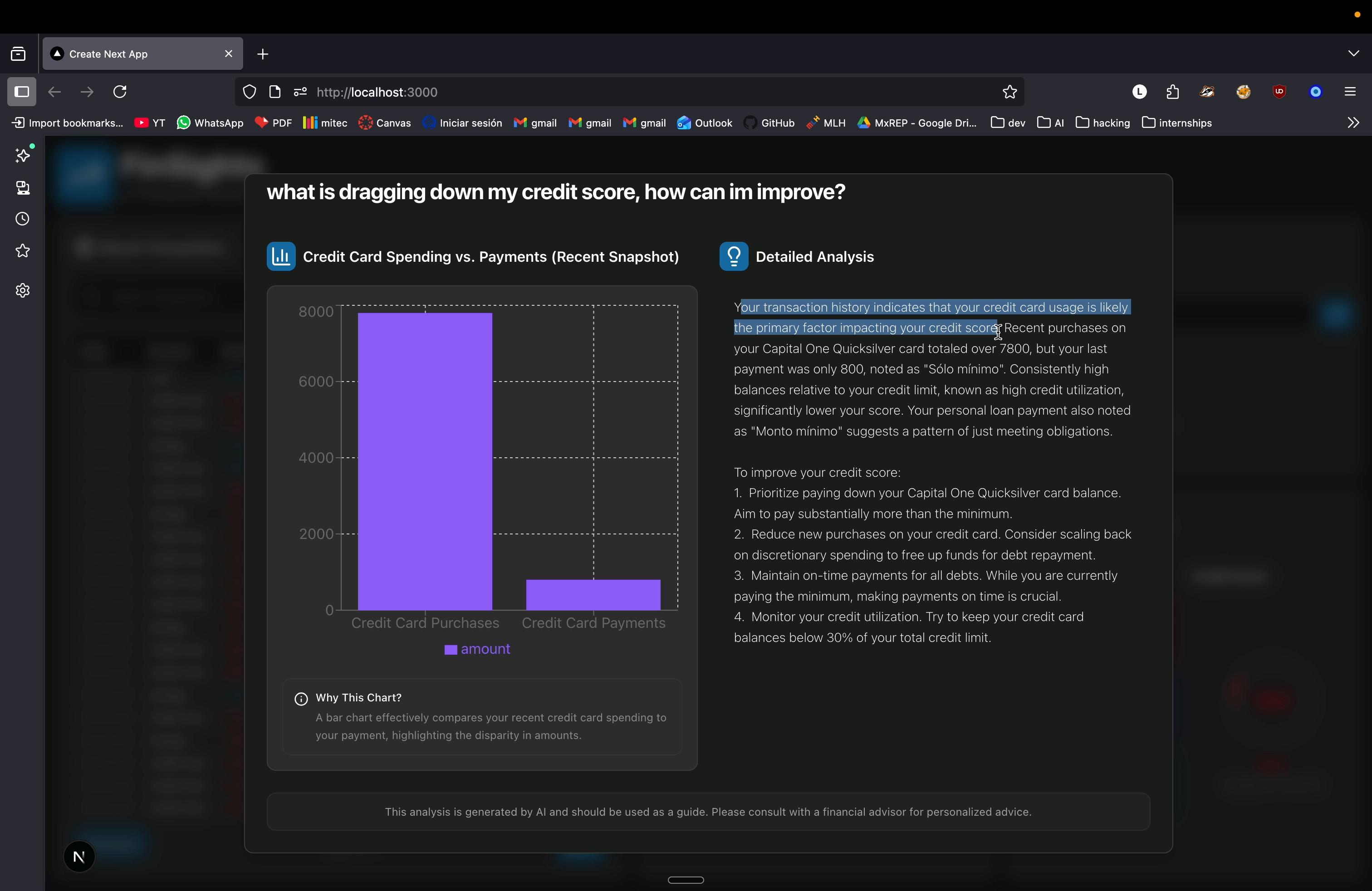
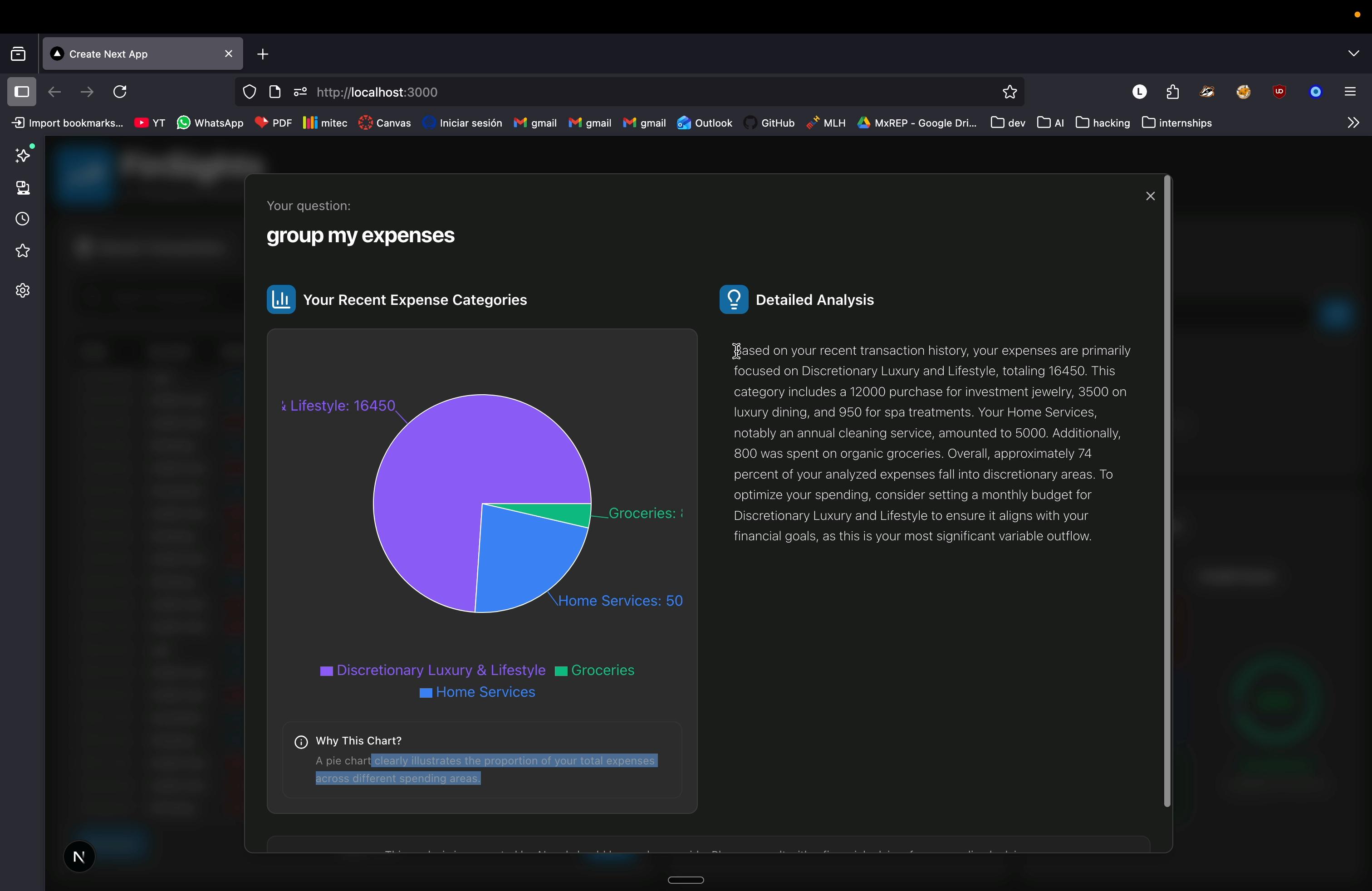
Today, we have thousands of AI tools, yet there’s still no easy way to truly understand our finances through AI. That’s why we created FinSight, a tool that lets you talk directly to your finances, visualize your data, and understand it better. With our AI agent, you can ask questions in everyday language and receive answers tailored to your personal financial information.
FinSight was born to be a helpful resource for anyone who wants to learn how their finances work, making it easier for people to gain clarity and take control of their financial life.
What it does
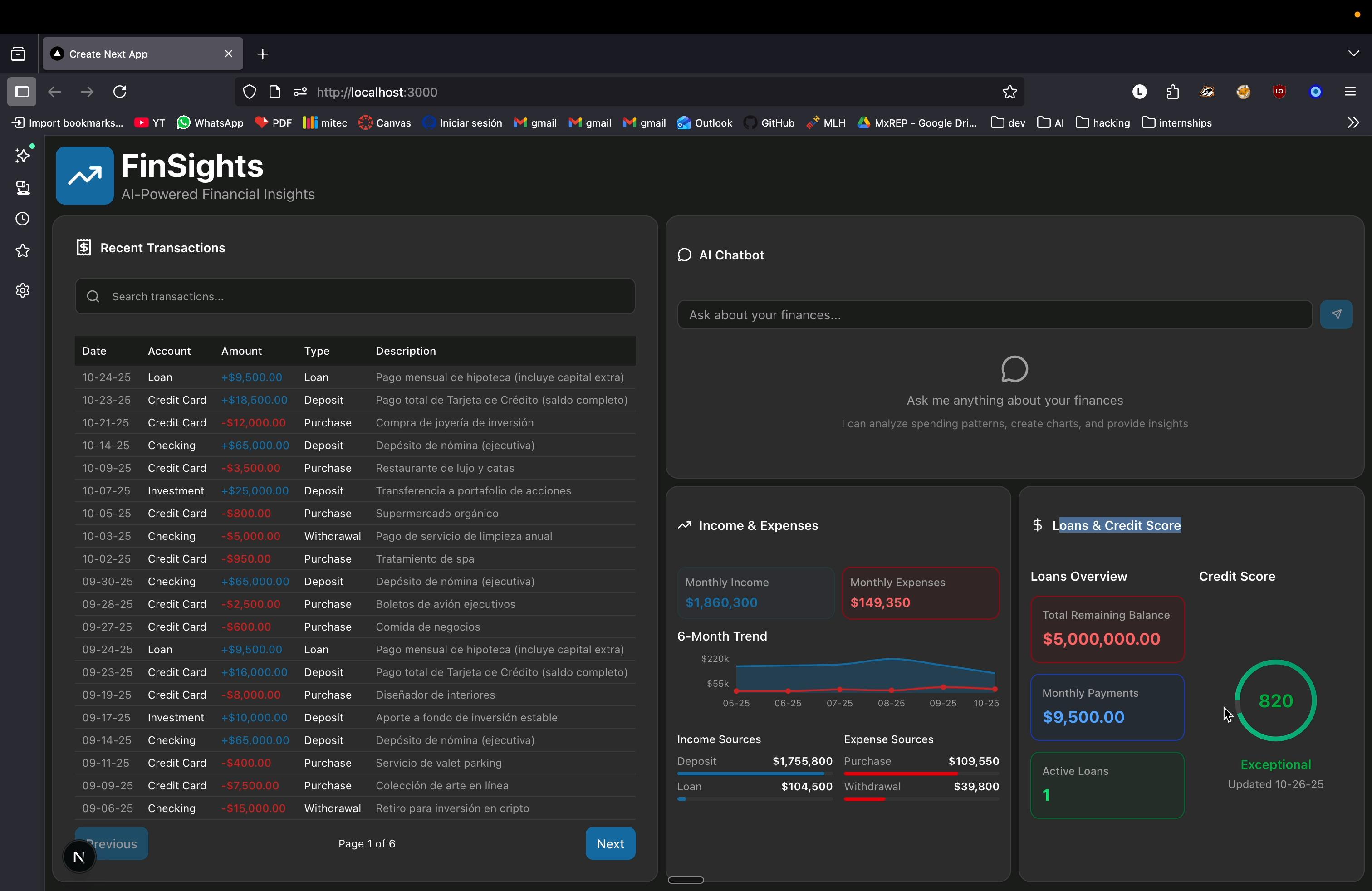
FinSight lets users ask an AI chatbot questions about their financial data to better understand it. It also provides a clear and efficient way to view transactions, income & expenses, and loans & credit score through charts.
How we built it
With the idea in mind, we began by analyzing the project requirements, defining all the modules it would include, and establishing the overall scope. We mapped out the key functionalities, user interactions, and the main goals we wanted to achieve with the platform.
Next, we evaluated which tools and technologies would be most suitable for our needs. After careful consideration, we decided on:
- Frontend: Next.js, React, TypeScript, Tailwind CSS — to build a responsive and interactive user interface
- Backend: FastAPI, Uvicorn, Capital One API — to handle data processing and serve API endpoints efficiently
- Agent: Gemini — to implement the AI-driven chatbot for financial insights
Once the tools were chosen, we moved on to the development phase. We created the project structure, set up the repository, and designed the UI layout and color palette to ensure a consistent and appealing visual experience. Afterwards, we focused on programming the core functionality to solve the problems we identified, including transaction tracking, AI integration, and data visualization.
After development, we began rigorous testing. We used Capital One’s Nessie API to fetch live data and simultaneously created mock datasets to simulate real-world scenarios. This allowed us to validate our features even when external API data was unavailable, ensuring reliability and smooth user experience.
Throughout the process, we also iterated based on feedback from team members, refining the UI, improving chatbot responses, and optimizing the backend endpoints.
The final steps of the project included creating comprehensive documentation, preparing tutorials for setup and usage, and ensuring the project was ready for deployment. This included visual aids to demonstrate the AI chatbot, charts, and data insights.
In the end, the project not only delivered a working solution but also served as a valuable learning experience in full-stack development, API integration, and designing AI-powered tools for real-world financial education.
Challenges we ran into
The main challenge was connecting all three services , frontend, backend and the AI agent, and making them work smoothly together. We also had to handle CORS issues and unify the mock data structure so it matched the live API format. Another challenge was managing environment variables and process isolation so that switching between live mode and mock mode didn’t break the app.
Accomplishments that we're proud of
We’re proud that the whole system works end-to-end, and that the AI agent runs as a standalone microservice that can be replaced or upgraded easily. And even without API keys, anyone can clone the repo and run the full dashboard locally with mock data, which makes the project extremely easy to test and demo
What we learned
Throughout the development of FinSights, we gained valuable insights across technical, product, and user experience dimensions. On the technical side, working with banking APIs like Nessie taught us the critical importance of robust error handling and building flexible architectures that seamlessly work with both mock and real data. We discovered that presenting complex financial data effectively requires a delicate balance between detail and simplicity - our visualizations needed to tell compelling stories rather than simply display numbers. The FastAPI and Next.js stack proved invaluable, providing clear separation of concerns that made our system both scalable and maintainable.
From a product perspective, we learned that trust is paramount when dealing with financial data. Users are extremely sensitive about their banking information, making transparency in data handling absolutely crucial. We also discovered that users don't just want information - they want actionable insights. Simply showing someone their spending patterns isn't enough; they need clear guidance on what to do next. Finally, we found that AI works best as a copilot rather than an autopilot. The chatbot should complement visual exploration of data, not replace it, and personalized recommendations based on individual spending patterns are far more valuable than generic financial advice.
What's next for FinSights
Our next step is bringing FinSights to mobile platforms through native iOS and Android applications. This will enable users to access their financial insights on-the-go, receive real-time notifications about spending patterns, and interact with their financial data anywhere, anytime. Making financial awareness accessible through mobile devices is crucial for transforming it from an occasional check-in into a daily habit. Simultaneously, we're committed to significantly enhancing our AI chatbot capabilities by training it with more comprehensive financial datasets and implementing advanced natural language processing. The improved AI will provide more accurate, contextual responses, better understand nuanced financial questions, and offer truly personalized recommendations based on individual spending patterns and financial goals.
Gemini AI studio
For the AI component, we used Gemini AI Studio to design, test, and fine-tune our chatbot prompts before integrating them into the backend. Gemini allowed us to quickly iterate on conversation flows, improve response consistency, and define how the model interprets financial data. Once satisfied with the results, we connected our trained prompt configuration directly to the FastAPI backend, enabling real-time interaction between users and the AI agent.
Built With
- fastapi
- geminiapi
- nessieisreal
- next.js
- react
- tailwind
- typescript


Log in or sign up for Devpost to join the conversation.