FinSight AI: Make Smarter Financial Decisions with Confidence
Inspiration
Financial decisions can be overwhelming, especially for college students and young adults navigating loans, credit cards, major purchases, and budgeting for the first time. Financial offers often contain complicated terms, additional fees, and promotional interest rates that make it difficult to understand the true cost of a decision.
We wanted to answer one simple question: What if you could see the financial consequences of a decision before making it?
Inspired by the FNB Financial Confidence Challenge at HackPSU, we created FinSight AI, an interactive platform designed to make financial information more transparent, understandable, and actionable.
Our goal wasn't just to build another budgeting tool. We wanted to help people investigate financial offers, simulate potential outcomes, identify their financial breaking points, and make decisions that align with their personal priorities.
We believe financial confidence comes not only from understanding what you can afford today, but also from recognizing how your decisions could affect your future financial stability.
What It Does
FinSight AI combines financial offer analysis, personalized simulations, financial stress testing, and behavioral insights into one interactive platform.
Our application includes five interconnected features that guide users through the financial decision-making process.
1. TrustGraph: Understand the Fine Print
Financial offers can sound appealing at first glance, but the details often tell a more complicated story.
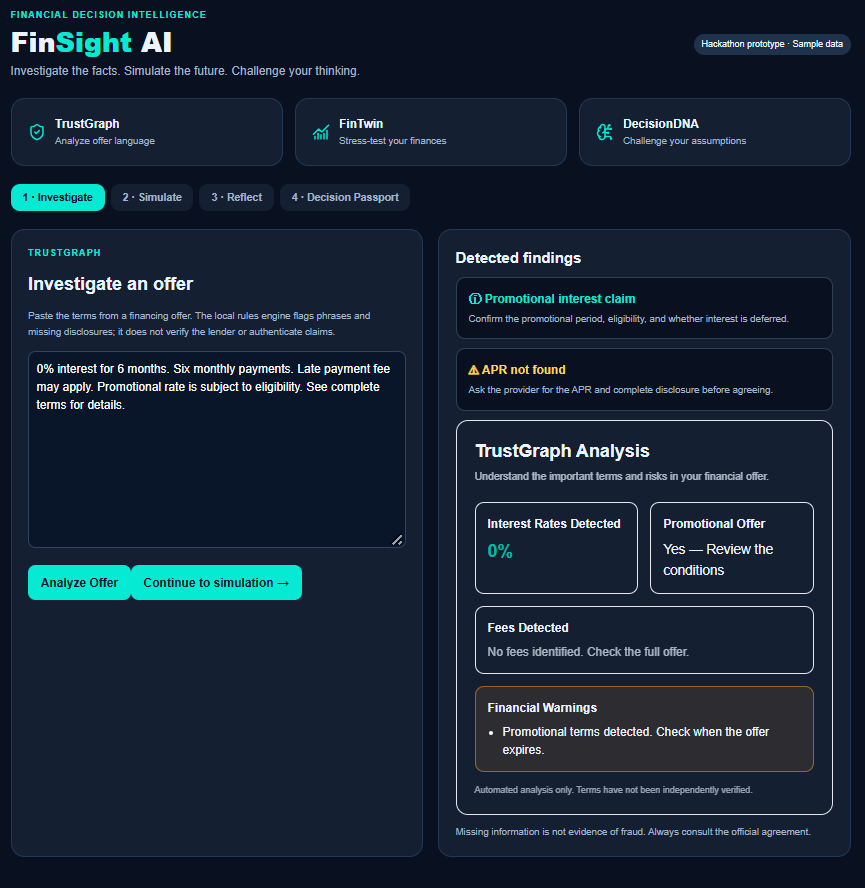
TrustGraph allows users to paste financial offers, such as loan agreements, financing promotions, or credit card advertisements, into the platform.
Our rule-based analyzer examines the text to identify:
- Promotional interest claims and APR information
- Potential late-payment consequences
- Additional fees and charges
- Financial terms that deserve closer examination
- Potential warning signs associated with an offer
Instead of expecting users to interpret complicated financial language on their own, TrustGraph highlights important information and encourages them to verify the terms before accepting an offer.
For example, an advertisement promoting 0% APR for 12 months might also include a significantly higher interest rate after the promotional period, origination fees, or late-payment penalties.
TrustGraph helps users recognize these details and understand why they matter.
The platform also distinguishes between detected information and independently verified terms, emphasizing that its findings are educational rather than guarantees about an offer.
2. FinTwin: Visualize Your Financial Future
FinTwin creates a personalized financial simulation based on the user's financial circumstances.
Users enter information such as:
- Monthly income and expenses
- Current savings
- Purchase or loan amount
- Repayment period and annual interest rate
- Potential emergency expenses
- Expected income reductions
Using these inputs, FinTwin calculates the monthly loan payment, total repayment amount, and remaining monthly cash flow.
It also generates an interactive 12-month projected savings graph, allowing users to visualize how a financial commitment could affect their savings over time.
To provide additional perspective, FinTwin compares three possible financial paths:
- No Purchase: How savings might grow without taking on the financial commitment.
- Financed: How savings might change after accounting for loan payments.
- Stress Test: How unexpected expenses and reduced income could affect financial stability.
These visualizations help users move beyond simply looking at a monthly payment and begin understanding the longer-term consequences of their choices.
3. Financial Breaking Point: Discover Your Financial Limits
One of FinSight AI's most distinctive features is Financial Breaking Point, which helps users understand how much financial pressure their budget can withstand.
Traditional affordability calculations often focus on whether someone can make a payment under their current circumstances.
We wanted to go further by asking:
What happens if those circumstances change?
Financial Breaking Point calculates:
- Break-even monthly income: The minimum monthly income needed to cover expenses and loan payments.
- Maximum income reduction: The percentage of income a user could lose before their monthly cash flow becomes negative.
- Additional monthly expense limit: How much extra recurring spending the budget could accommodate.
- Current monthly cash flow: The amount remaining after expenses and loan payments.
We also implemented an interactive income-reduction slider that lets users simulate different levels of income loss, from 0% to 100%.
As users adjust the slider, the platform calculates their updated monthly cash flow and displays warnings when their expenses exceed their income.
FinSight AI also provides a Financial Risk Assessment, categorizing financial vulnerability based on the user's baseline financial situation and available financial flexibility.
For example, a student might have $150 remaining each month after financing a laptop. Although the purchase appears affordable, Financial Breaking Point could reveal that losing just 7.5% of their income would eliminate that surplus.
This helps users understand the difference between being able to afford something today and being financially prepared for unexpected changes.
4. DecisionDNA: Understand Your Financial Priorities
Financial decisions aren't based on numbers alone. Personal priorities, motivations, and financial habits also influence the choices people make.
DecisionDNA introduces a reflective component to FinSight AI.
Users answer two questions:
- What matters most to you?
- Why does this financial offer appeal to you?
Their answers help establish the context behind the decision.
DecisionDNA then generates personalized financial insights using the user's selected priority and financial simulation results.
For example, if someone prioritizes protecting emergency savings but their stress-test simulation projects a significant savings shortfall, DecisionDNA highlights that conflict.
It may encourage the user to consider whether delaying the purchase could better protect their emergency fund.
Rather than simply telling users what to do, DecisionDNA presents a personalized observation and a question for reflection.
We also designed the feature so insights are generated when users click Generate My Insights, giving them control over when their updated financial circumstances and priorities are evaluated.
Our goal is to help users recognize when an attractive financial offer might conflict with what matters most to them.
5. Decision Passport: Bring Everything Together
After investigating an offer, simulating its impact, and reflecting on their priorities, users can generate a Decision Passport.
The Decision Passport consolidates important information from their financial analysis into a structured, downloadable JSON report.
It includes:
- Financial inputs and loan details
- Monthly payments and cash-flow calculations
- Stress-test results and projected savings
- Financial breaking-point indicators
- Risk classification
- Detected offer terms and warnings
- Selected financial priorities and motivations
Instead of leaving users with disconnected calculations, Decision Passport preserves the key information behind their decision in one place.
Users can download the report to review their financial assumptions and findings later.
This creates a record of not just the potential financial outcome, but also the factors and priorities considered during the decision-making process.
How We Built It
We developed FinSight AI as a full-stack web application using:
- Next.js: Application framework and backend API routes
- React: Interactive frontend components
- TypeScript: Type-safe frontend and backend development
- Tailwind CSS: Responsive interface styling
- Recharts: Interactive financial graphs and visualizations
- Lucide React: Interface icons and visual indicators
- Git and GitHub: Version control, collaboration, and feature integration
- Vercel: Application deployment and hosting
Backend Development
We developed financial calculation functions that estimate loan payments, total repayment costs, monthly cash flow, savings projections, and financial stress thresholds.
We also implemented a rule-based financial offer analyzer that identifies common patterns associated with promotional rates, interest charges, fees, and potentially concerning terms.
Our Next.js API endpoint, /api/analyze, processes financial inputs and offer information, returning structured results for the Financial Twin, Financial Breaking Point, and TrustGraph.
The backend also evaluates financial risk based on the user's financial circumstances.
Frontend Development
We designed the frontend around four main sections: Investigate, Simulate, Reflect, and Decision Passport.
Each section guides users through a different stage of financial decision-making.
We built interactive financial input forms, dynamically generated results, responsive dashboards, savings projection charts, an income-reduction slider, and personalized reflection components.
We also added input validation to prevent incomplete financial information from being submitted for analysis.
Integration and Deployment
We divided development into frontend and backend responsibilities to work efficiently during the hackathon.
Using separate GitHub branches, we developed features independently before integrating them into a shared application.
We connected our financial calculation logic to the user interface, tested the complete decision-making workflow, and deployed FinSight AI through Vercel.
Our architecture separates financial calculations from presentation components, making the platform easier to maintain, test, and expand.
Challenges We Faced
Translating Financial Concepts into Understandable Results
One of our biggest challenges was transforming financial calculations into information that users could easily interpret.
Calculating a monthly payment is relatively straightforward, but explaining what that payment means for someone's financial stability requires more context.
We addressed this by combining numerical results with visual savings projections, stress-test scenarios, and explanations of financial vulnerability.
Building Meaningful Financial Stress Tests
We wanted FinSight AI to do more than calculate whether a purchase fits into someone's current budget.
Developing Financial Breaking Point required us to consider how income reductions, recurring expenses, emergency costs, and savings interact.
We also needed to make the stress-test results interactive without making the interface overwhelming.
The income-reduction slider became an important part of our solution because it allows users to explore financial vulnerability themselves rather than relying on a single static result.
Interpreting Financial Offers Responsibly
Financial offers can be written in many different ways, making consistent term detection challenging.
We implemented a rule-based analyzer to recognize common financial language and identify potential concerns.
An important part of this process was ensuring the platform didn't present detected information as independently verified facts.
We wanted to encourage informed decisions without creating a false sense of certainty.
Connecting Financial Data with Personal Priorities
Another challenge was making DecisionDNA more meaningful than a simple questionnaire.
Initially, personal preferences and financial calculations were relatively separate.
We improved DecisionDNA by connecting the user's selected financial priority with their actual simulation results.
This allowed us to generate insights that respond to the user's financial circumstances rather than relying entirely on generic advice.
Collaborating and Integrating Under Time Constraints
With a small team and a limited hackathon development window, coordinating frontend and backend development required careful communication.
We used separate GitHub branches, shared data structures, and a common API endpoint to integrate our work.
We also encountered challenges involving component layouts, input handling, state management, and synchronizing dynamically generated results.
Testing the complete application helped us identify and resolve inconsistencies before deployment.
What We Learned
Building FinSight AI strengthened our understanding of software engineering, financial technology, and user-centered product design.
We gained hands-on experience with:
- Building full-stack applications with Next.js and TypeScript
- Designing and testing API endpoints
- Implementing financial calculations and stress-test models
- Creating interactive dashboards with React and Recharts
- Managing application state and user-triggered analysis
- Integrating frontend and backend development through GitHub
- Building responsive interfaces and validating user inputs
- Designing transparent financial risk indicators
- Translating technical financial concepts into understandable insights
- Deploying and testing a complete application through Vercel
One of our biggest takeaways was that a financial decision can appear affordable under normal circumstances while still exposing someone to significant financial risk.
We also learned that personalization becomes more meaningful when it connects what users care about with what their financial data actually shows.
Most importantly, we realized that financial confidence isn't just about having more information. It's about understanding what that information means for your own situation.
What's Next for FinSight AI?
Although we developed FinSight AI during HackPSU, we see opportunities to expand its capabilities.
Our future plans include:
- Advanced AI-powered offer interpretation: Using language models to better understand complex financial agreements and explain unfamiliar terminology.
- Side-by-side offer comparisons: Helping users compare financing options based on total cost, fees, and financial risk.
- Expanded what-if simulations: Allowing users to adjust loan terms, emergency expenses, and financial assumptions more extensively.
- Smarter DecisionDNA insights: Incorporating both financial priorities and decision motivations into more personalized recommendations.
- Enhanced Decision Passport reports: Creating more detailed, human-readable summaries that explain financial tradeoffs and potential risks.
- Improved financial education: Providing accessible explanations of interest rates, debt, savings, and financial resilience.
- More advanced risk modeling: Exploring additional financial scenarios and more flexible projections.
Our long-term vision is to develop FinSight AI into a financial decision companion that helps users evaluate important financial choices with greater clarity, confidence, and awareness.
Final Thoughts
Financial confidence starts with financial clarity.
FinSight AI was built around the belief that people should be able to understand the potential consequences of financial decisions before committing to them.
By combining offer analysis, personalized financial simulations, interactive stress testing, and behavioral reflection, we help users explore not only what a financial decision costs, but also how it could affect their future financial stability.
Instead of simply asking:
"Can I afford this?"
We want users to ask:
"Can I still afford this if life doesn't go according to plan?"
That's the question FinSight AI was built to help answer.
Built With
- css3
- git
- github
- html5
- javascript
- next.js
- node.js
- react
- recharts
- tailwindcss
- typescript
- vercel

Log in or sign up for Devpost to join the conversation.